
Which Has More Caffeine: Is Espresso Stronger Than Coffee?
This post contains affiliate links. As an Amazon Associate, we earn from qualifying purchases.
Espresso is stronger than drip coffee in terms of caffeine concentration per ounce, but a standard serving of drip coffee contains more total caffeine. A 1-ounce shot of espresso has about 63 mg of caffeine. An 8-ounce cup of drip coffee has roughly 95 mg. The confusion starts when people equate intense flavor with caffeine content and forget that serving size is the real deciding factor.
Most people taste that bold, syrupy espresso and assume it’s packing a bigger caffeine punch. They’re wrong. They’re conflating flavor intensity with stimulant power. A typical mug of black coffee will wire you harder than a single shot, and a large coffee shop drink can contain the caffeine of four espressos.
This guide breaks down the numbers, explains why roast level and bean type matter more than you think, and shows you how to calculate your actual intake from any drink.
Key Takeaways
- Ounce for ounce, espresso contains roughly 4-5 times more caffeine than drip coffee. But since a serving of drip coffee is 8-12 ounces, it almost always delivers more total caffeine.
- Bean type is a major hidden variable. Robusta beans have about 182 mg of caffeine per 100g, while Arabica has about 154 mg. Many inexpensive espressos use Robusta blends, which can skew comparisons.
- Dark roast coffee beans have slightly less caffeine by weight than light roast beans. The longer roasting process breaks down more caffeine molecules. When measured by volume (scoops), the difference is minimal.
- Brewing method and contact time dictate extraction. Espresso’s 25-30 second extraction under high pressure is efficient but brief. Immersion methods like French press or cold brew, with minutes or hours of contact, pull more total caffeine into the water.
- The FDA’s safe daily caffeine limit for most adults is 400 mg. One 16-ounce Starbucks Blonde Roast coffee (360 mg) puts you close to that limit before you’ve had anything else.
The Caffeine Numbers Don’t Lie
Start with the baseline data from the U.S. Department of Agriculture. Their nutrition database is the gold standard for this kind of comparison, and it shows a clear picture.
A single 1-ounce shot of espresso contains about 63 milligrams of caffeine. An 8-ounce cup of brewed drip coffee contains between 95 and 165 milligrams, with an average around 95 mg. Do the math. The espresso shot is more concentrated, about 63 mg per ounce versus coffee’s 12-16 mg per ounce. But the coffee cup is eight times larger. The total caffeine in the mug wins.
According to USDA nutrition data, espresso has 63 mg of caffeine in a 1-ounce shot. Regular coffee averages 12 to 16 mg per ounce, totaling about 95 mg in an 8-ounce cup.
This is the core fact that flips the common assumption. Your brain associates espresso’s intense, non-watery mouthfeel with “strength,” but your body responds to the total milligrams ingested. That grande cup of drip is a bigger stimulant delivery vehicle.
TL;DR: Per ounce, espresso wins. Per serving, drip coffee wins. The USDA puts a 1-ounce espresso shot at 63 mg and an 8-ounce coffee at about 95 mg.
Why Everyone Gets “Stronger” Wrong
We use one word, “strong,” for two completely different experiences. One is pharmacological strength, the dose of caffeine hitting your bloodstream. The other is sensory strength, the density of flavor compounds dissolved in the cup.
Espresso excels at sensory strength. The 9 bars of pressure force water through finely-ground coffee in 25 to 30 seconds. This process extracts a high concentration of oils, solids, and dissolved gases, creating that signature viscous body and crema. The caffeine in espresso vs coffee comparison is about concentration versus total volume.
Drip coffee is a slower, gentler extraction over 4 to 6 minutes. More water passes through more grounds, yielding a larger volume with a lower concentration of those intense flavor compounds. It tastes “weaker” but often contains more total caffeine simply because there’s more liquid.
The mix-up is understandable. But it leads to bad decisions, like slamming two espresso shots for an afternoon pick-me-up when a small coffee would give you a steadier, longer-lasting lift with less acidity.
The Four Factors That Actually Change Caffeine Content
Forget the simple espresso-versus-coffee binary. The real caffeine in your cup is decided by four variables working together. Miss one, and your guess is just a guess.
1. Serving Size Is Everything
This is the biggest lever. Coffee shops have normalized massive serving sizes, which makes direct comparisons with a 1-ounce shot silly.
| Drink | Serving Size | Approx. Caffeine |
|---|---|---|
| Single Espresso Shot | 1 oz (30 ml) | 63 mg |
| Starbucks Doppio (2 shots) | 2 oz (60 ml) | 150 mg |
| Standard Drip Coffee | 8 oz (237 ml) | 95 mg |
| Starbucks Grande Pike Place | 16 oz (473 ml) | 310 mg |
| Starbucks Grande Blonde Roast | 16 oz (473 ml) | 360 mg |
| Starbucks Grande Cold Brew | 16 oz (473 ml) | 205 mg |
Look at that Blonde Roast number. A single 16-ounce coffee has nearly six times the caffeine of a single espresso shot. The serving size caffeine variable completely overpowers the brewing method.
2. Bean Type: Robusta vs. Arabica
The species of coffee bean is a huge, hidden factor. Coffea canephora, commonly called Robusta, naturally contains more caffeine than Coffea arabica. It’s a pest-resistant trait.
A caffeine isolation study cited by Breville found Robusta green coffee beans contain about 182 mg of caffeine per 100 grams. Arabica green beans contain about 154 mg per 100 grams. That’s an 18% difference before roasting even begins.
Common mistake: Assuming all “espresso” beans are high-caffeine, many specialty espressos are 100% Arabica for flavor, while cheaper blends or pre-ground cans often mix in Robusta to boost caffeine and crema.
Many traditional Italian espresso blends include a portion of Robusta for that very reason, it adds caffeine, body, and that distinctive bitter punch. If you’re comparing a 100% Arabica pour-over to an espresso made with a Robusta blend, you’re not just comparing methods. You’re comparing different raw materials.
3. Roast Level: Dark vs. Light
Here’s a counterintuitive one. Dark roast beans are often described as “stronger” or “bold.” In terms of caffeine content, they’re actually slightly weaker.
The roasting process breaks down caffeine molecules. The longer and hotter the roast (i.e., the darker it gets), the more caffeine degrades. When you measure by weight, using a scale, a dose of dark roast coffee will have marginally less caffeine than the same weight of light roast.
But we usually measure coffee by volume, with a scoop. Dark roast beans are less dense, having lost more mass and moisture. A scoop of dark roast weighs less than a scoop of light roast. This can sometimes offset the degradation, making the caffeine content by volume roughly equal. The difference is small, but it’s real. Light roasts generally have a slight edge.
4. Brewing Method and Contact Time
Extraction is a function of time, temperature, and turbulence. Espresso is a sprint. Drip coffee is a brisk walk. Cold brew is a marathon.
- Espresso: ~30 seconds at 9 bars of pressure. Highly efficient extraction for its brief time, but limited by the small water volume.
- Drip/Pour-Over: 4-6 minutes of water flowing through grounds. More time and more water equals more total caffeine extracted, just at a lower concentration.
- French Press/Cold Brew: 4-24 hours of full immersion. This maximizes caffeine extraction. A cold brew coffee can have significantly more caffeine per ounce than drip, and you’re often drinking a larger serving.
The method dictates the rules of the game. You can’t win a marathon by being the fastest sprinter.
Espresso-Based Drinks: The Dilution Principle
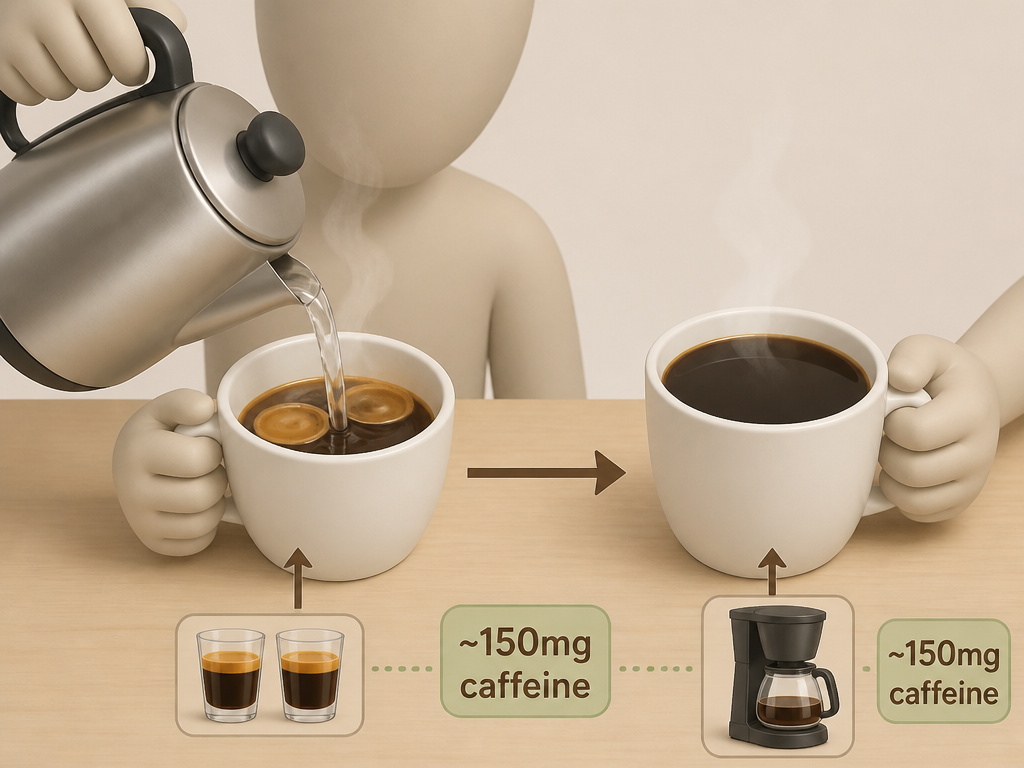
This is where the math gets practical. When you add espresso to milk or water, you’re diluting its concentration but not necessarily reducing the total caffeine.
An Americano is just espresso shots topped with hot water. A double-shot Americano has the same 150 mg of caffeine as two neat shots, just in a 12-ounce cup. A latte has the same two shots diluted with 10 ounces of milk. The total caffeine is identical to the espresso; the concentration is not.
Compare that to a brewed coffee vs americano. A 12-ounce Americano (2 shots) has about 150 mg of caffeine. A 12-ounce drip coffee has roughly 140-180 mg. They’re in the same ballpark. The difference is flavor profile, not stimulant power.
I used to order a large latte thinking the bigger drink meant more caffeine. The barista was pulling two shots for a 16-ounce cup, the same two shots that go into a 6-ounce cappuccino. I was just paying for more milk. Now I ask for an extra shot if I need the kick.
Milk-based drinks camouflage the caffeine content. A giant mocha feels like a dessert, but it might only have one shot of espresso. A small black drip coffee is a more reliable caffeine delivery system.
How Much Caffeine Is Too Much?
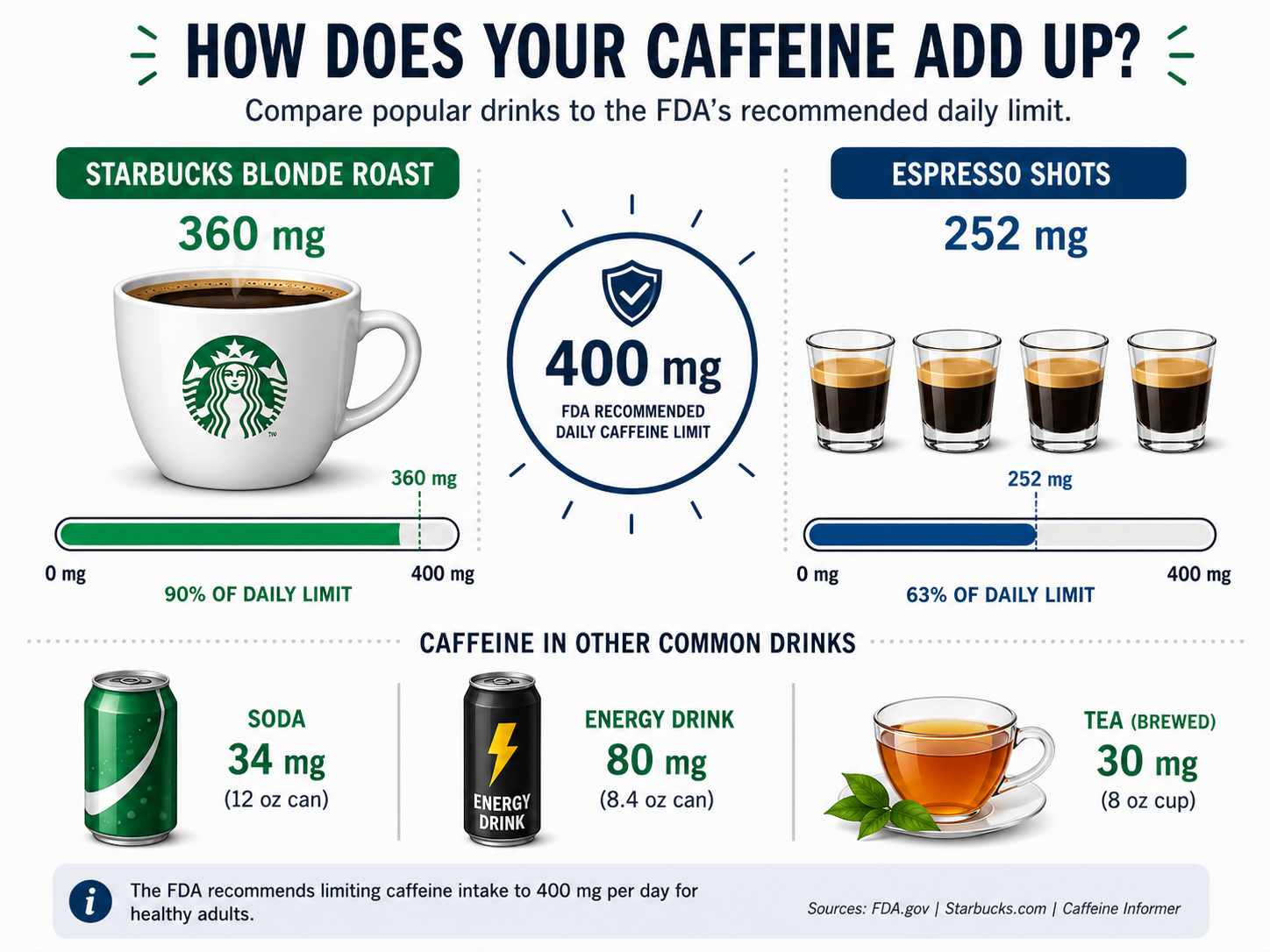
The U.S. Food and Drug Administration sets a guideline of 400 milligrams of caffeine per day as a safe amount for most healthy adults. This is a useful benchmark for contextualizing your choices.
One 16-ounce Starbucks Blonde Roast coffee (360 mg) brings you to the brink of that limit in one cup. Four shots of espresso spread throughout the day (252 mg) leaves you more room. This Consumer Reports caffeine comparison is a solid resource for understanding these daily limits.
It’s not just coffee. Be aware of other sources. A can of Coca-Cola caffeine has about 34 mg. A can of Red Bull caffeine has about 80 mg. Even black tea caffeine can contribute 40-70 mg per cup. It all adds up.
TL;DR: The FDA’s 400 mg daily limit is easy to hit with large coffee shop drinks. A Starbucks Grande Blonde Roast has 360 mg. Track all your sources, not just coffee.
Frequently Asked Questions
Does a double espresso have more caffeine than a regular coffee?
Usually, no. A double espresso (doppio) is about 2 ounces with roughly 125-150 mg of caffeine. An 8-ounce “regular” coffee has about 95 mg, but a typical mug or coffee shop small is 12 ounces (140-180 mg). The coffee often still wins. A 16-ounce coffee absolutely wins.
Is caffeine content the same as “strength” in coffee?
No. “Strength” in coffee tasting refers to the concentration of dissolved solids, which creates body and mouthfeel. Caffeine content is a separate chemical measure. A strong-tasting, intense espresso can have less total caffeine than a mild-tasting, large drip coffee.
Does dark roast have more caffeine than light roast?
No. Dark roast has slightly less caffeine by weight because the longer roasting process breaks down caffeine molecules. When measured by volume (scoops), the difference is minimal because dark roast beans are less dense. The variation is small enough that bean type (Robusta vs. Arabica) is a far bigger factor.
Which brewing method extracts the most caffeine?
Cold brew typically wins for total caffeine extraction per serving due to its very long immersion time (12-24 hours). However, it’s often served diluted or over ice, which lowers the concentration. For maximum caffeine per ounce, a finely-ground, long-steeped French press is hard to beat.
The Bottom Line
Stop equating the thick, syrupy punch of an espresso with a higher caffeine dose. It’s a sensory trick. The numbers from the USDA and major chains are clear: a standard serving of drip coffee almost always delivers more total caffeine than a single shot of espresso.
If you’re chasing a buzz, look at serving size first, then bean type. A large light-roast coffee made with a Robusta blend is the heavyweight champion. If you prefer the ritual and flavor of espresso, just know that you’ll need two or three shots to match the caffeine in a medium drip coffee. Choose your drink for the experience you want, not the myth you’ve heard.
