
Caffeine in Espresso vs Coffee | The Milligram Truth
A standard 12-ounce mug of drip coffee delivers more caffeine (about 95mg) than a single shot of espresso (about 65mg). While espresso is more concentrated per ounce, you consume less liquid. The total caffeine depends on your serving size, not just the brew method’s potency.
A single shot of espresso contains roughly 65 milligrams of caffeine. A standard 12-ounce mug of drip coffee delivers about 95 milligrams. The espresso is more concentrated, packing its caffeine into 1.5 fluid ounces, but the mug of coffee uses more ground beans, giving you a higher total dose. The confusion starts when people compare “per ounce” without considering the actual serving size they drink.
Most comparisons stop at “espresso has more caffeine per ounce.” That’s true, but it’s also useless. You don’t drink coffee by the ounce. You drink a shot or a mug. The real question isn’t about concentration; it’s about what actually lands in your cup after you pull the lever or press the brew button.
This guide breaks down the numbers, the bean science, and the brewing variables that shift those numbers. You’ll see why your morning latte might not be the jolt you think, and why that seemingly weak office drip could be the real heavyweight.
Key Takeaways
- Total caffeine wins: A 12oz mug of drip coffee almost always delivers more total caffeine (90-120mg) than a single espresso shot (65mg).
- Concentration is a red herring: Espresso’s high caffeine-per-ounce figure (around 40mg/oz) misleads because the serving size is so small.
- Bean type matters more than brew method: Robusta beans can have nearly double the caffeine of Arabica, regardless of how you brew them.
- Dose is king: The 25g of coffee in your drip pot beats the 18g in your espresso basket for sheer caffeine potential.
- “Strong” taste doesn’t mean “high caffeine”: The intense, bitter notes in espresso come from concentrated solids and roasting, not necessarily extra caffeine.
The Milligram Math: Espresso vs Drip Coffee
Forget the myths. The numbers tell the story.
A standard single espresso shot uses about 18g of coffee to yield 30ml (1oz) of liquid, extracting roughly 65mg of caffeine. A standard 12oz (355ml) mug of drip coffee uses about 25g of coffee, extracting about 95mg of caffeine. The coffee wins on total milligrams.
The YouTube transcript from Crema Coffee gets it right: a shot has about 126mg? That’s for a double shot. Their 12oz drip coffee figure of 144mg is also on the high end, but it illustrates the point. The mug wins. Another video claiming 30-50mg per shot is referencing a smaller, older standard single shot. Modern specialty coffee shops pull doubles as the default, which blurs the line further.
The core misunderstanding is comparing concentration to total volume. Yes, espresso concentrate packs 30-50mg of caffeine into a single ounce. Drip coffee might only have 8-10mg per ounce. But you drink 12 of those ounces. The math is simple: 10mg/oz x 12 oz = 120mg. That’s nearly double a single shot.
TL;DR: Compare whole drinks, not concentrations. Your mug of coffee almost always contains more total caffeine than your single shot of espresso.
Why Dose Weight Beats Brew Method
The brewing process, pressure versus percolation, does change how efficiently caffeine is pulled from the grounds. But the starting amount of caffeine in the grounds matters more.
Espresso’s 9 bars of pressure and 25-second contact time are ruthlessly efficient at extraction. It can pull over 90% of the available caffeine from its 18g dose. Drip coffee, with its longer brew time and larger water volume, might only extract 80-85% from its 25g dose. Yet, because the drip starts with more coffee, even a slightly lower extraction percentage yields a higher total.
Think of it like squeezing oranges. Espresso is a powerful, short press on one orange, getting almost all the juice. Drip is a gentler, longer press on one and a half oranges. You still get more total juice from the one and a half oranges, even if the press isn’t as aggressive.
Common mistake: Assuming “stronger” taste means more caffeine, the bitter, intense flavor of espresso comes from a high concentration of total dissolved solids (including oils and bitter compounds), not a proportional increase in caffeine.
A Practical Comparison Table
This table shows how the numbers stack up in real-world servings. The “Single Origin” column assumes a medium-roast Arabica bean.
| Drink | Coffee Dose | Water Volume | Est. Caffeine | Best For |
|---|---|---|---|---|
| Single Espresso Shot | 18g | 30ml (1oz) | 65mg | A quick, concentrated flavor hit |
| Double Espresso Shot | 36g | 60ml (2oz) | 130mg | Matching a full mug of coffee’s caffeine |
| Drip Coffee (12oz mug) | 25g | 355ml (12oz) | 95mg | Sustained alertness, larger volume |
| French Press (12oz cup) | 30g | 355ml (12oz) | 115mg | Full-bodied flavor with a higher caffeine load |
| Pour-Over (12oz) | 22g | 355ml (12oz) | 85mg | Clean, nuanced flavor with moderate caffeine |
Notice the double shot. It uses twice the coffee of a single, so its caffeine content jumps to rival the mug of drip. This is why asking for a “double” changes the game. Most cafe drinks like lattes and cappuccinos are built on a double shot base. Your 16oz latte might have 130mg of caffeine from the espresso, diluted by a lot of milk.
The Bean’s Built-In Caffeine
The brewing method is only half the equation. The coffee bean itself is a variable storage tank for caffeine. The two main species, Arabica and Robusta, are not created equal.
Arabica (Coffea arabica) is the quality favorite, known for its complex, sweet, and acidic flavor profile. It also happens to contain less caffeine, typically 1.2% to 1.5% of its dry weight. Robusta (Coffea canephora), often used in blends and instant coffee, is harsher and more bitter but packs nearly double the caffeine, ranging from 2.2% to 2.7%. A study in Food and Chemical Toxicology on caffeine intake patterns confirmed this significant species-level difference.
If you brew a shot from a 100% Robusta bean, you could be getting 120mg of caffeine from a single shot, eclipsing many mugs of Arabica drip. This is a primary reason why some espresso-based drink caffeine levels can be deceptive; the bean choice is a hidden variable.
Roast Level’s Minor Role
Here’s a counterintuitive fact: darker roasts have slightly less caffeine by weight than lighter roasts. The roasting process burns off mass, including some caffeine. A bean loses up to 20% of its weight during a dark roast. So, if you measure by scoop, a scoop of dark roast (less dense, larger beans) will contain fewer beans and thus less total caffeine than a scoop of light roast. If you measure by weight, which you should, the difference becomes almost negligible. The flavor intensity of dark roast is not a caffeine indicator.
The Machine and The Method
Your equipment and technique directly influence how much of the bean’s potential caffeine ends up in your cup. It’s not just about having an espresso machine or a drip pot.
Espresso Extraction Variables
Three variables dictate espresso extraction: grind size, dose, and time. A finer grind increases surface area, allowing more caffeine to be extracted quickly under pressure. But go too fine and you channel, water finds a path of least resistance, leaving other grounds under-extracted. A PMC espresso extraction kinetics study details how flow rate, particle size, and temperature interact. The sweet spot for a double shot is 18-20g of coffee yielding 36-40g of liquid in 25-30 seconds.
I dialed in a new bag of beans on my Breville Barista Express last week. The first shot, ground too coarse, gushed out in 18 seconds and tasted sour. The yield was 45g. It was weak, and the caffeine extraction was poor. The second shot, ground two clicks finer, took 28 seconds for a 38g yield. The flavor was balanced, and the caffeine kick was noticeably sharper. That seven-second difference changed everything.
Home automatic machines like Jura or Philips models often use pre-ground or capsule systems, which standardize the dose and tamp pressure. This consistency means the caffeine output is predictable but often lower than what a skilled barista can achieve with a prosumer machine. A Nespresso Vertuo capsule, for example, is engineered for a specific output and contains about 5-6g of coffee, resulting in a lower total caffeine per serving compared to a traditional 18g portafilter dose.
Drip Coffee Brewing Factors
Drip coffee’s caffeine extraction is governed by grind size, water temperature, and contact time. A too-coarse grind and a brew time under four minutes will leave caffeine in the grounds. A PMC study on caffeine in coffee brews confirms that these variables create a wide range of possible caffeine concentrations in the final cup.
A standard home drip machine often suffers from sub-optimal water temperature (below 195°F) and uneven saturation. A manual pour-over with a gooseneck kettle, where you control the pour pattern and water heat precisely, will typically extract more caffeine from the same dose of coffee. The brewed coffee caffeine in a well-executed pour-over can surpass that of a mediocre drip machine batch.
Espresso Drinks vs. Coffee Drinks
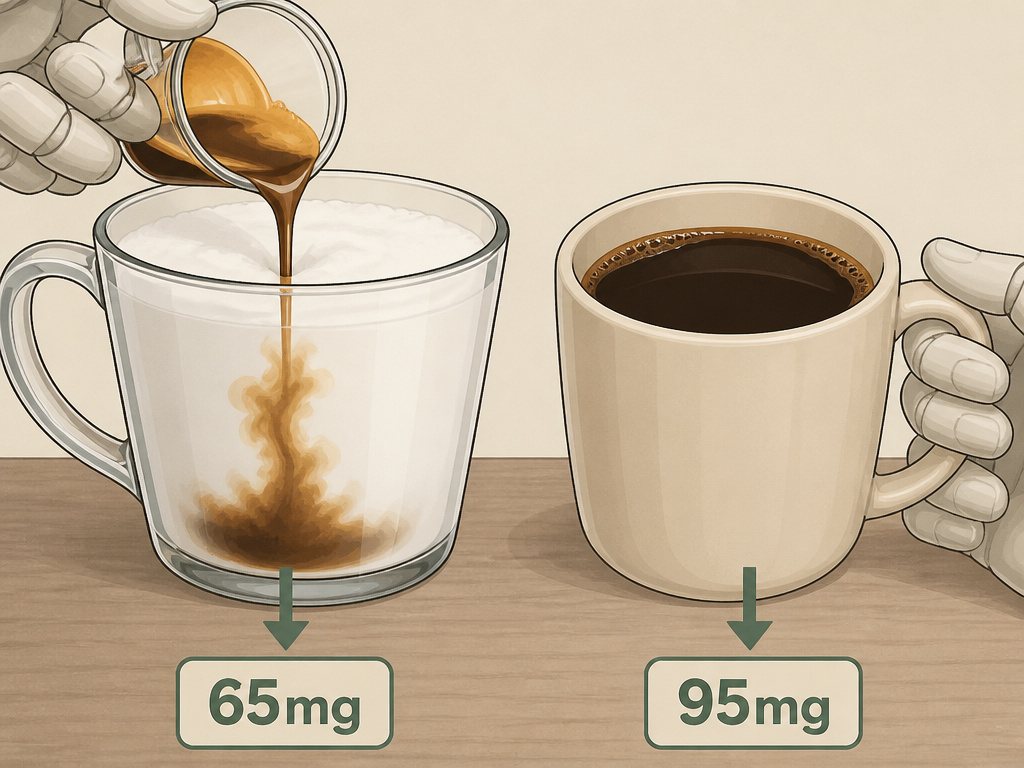
Ordering a “coffee” is simple. Ordering from an espresso menu is a minefield of volume and milk.
A straight shot is one thing. But when you add water or milk, you’re diluting the concentration without adding more caffeine. An Americano, a shot of espresso with hot water added, creates a coffee-like drink that still only contains the caffeine of the original shot(s). So a 12oz Americano made with one shot has less caffeine than a 12oz brewed coffee. It just tastes similar.
Milk-based drinks are the real wild card. A 12oz latte and a 12oz cappuccino both typically contain one or two shots of espresso. The rest is steamed milk and foam. That means your giant latte has the caffeine of one or two tiny shots, spread throughout a huge volume. You’re getting a caffeine micro-dose in a filling beverage.
| Drink (12oz) | Espresso Shots | Est. Caffeine | Notes |
|---|---|---|---|
| Black Drip Coffee | N/A | 95mg | The baseline for comparison. |
| Americano | 2 | 130mg | Two shots diluted with hot water; matches drip coffee caffeine. |
| Latte | 1 | 65mg | Mostly milk; one shot’s worth of caffeine. |
| Cappuccino | 1 | 65mg | Less milk than a latte, but still only one shot’s caffeine. |
| Red Eye / Shot in the Dark | 1 added to drip | ~160mg | A drip coffee with an extra shot poured in; the true power move. |
This is why comparing caffeine in a cappuccino to a mug of coffee is misleading. The cappuccino is an espresso beverage first, defined by its milk texture, not its stimulant power.
Other Beverages in the Caffeine Arena
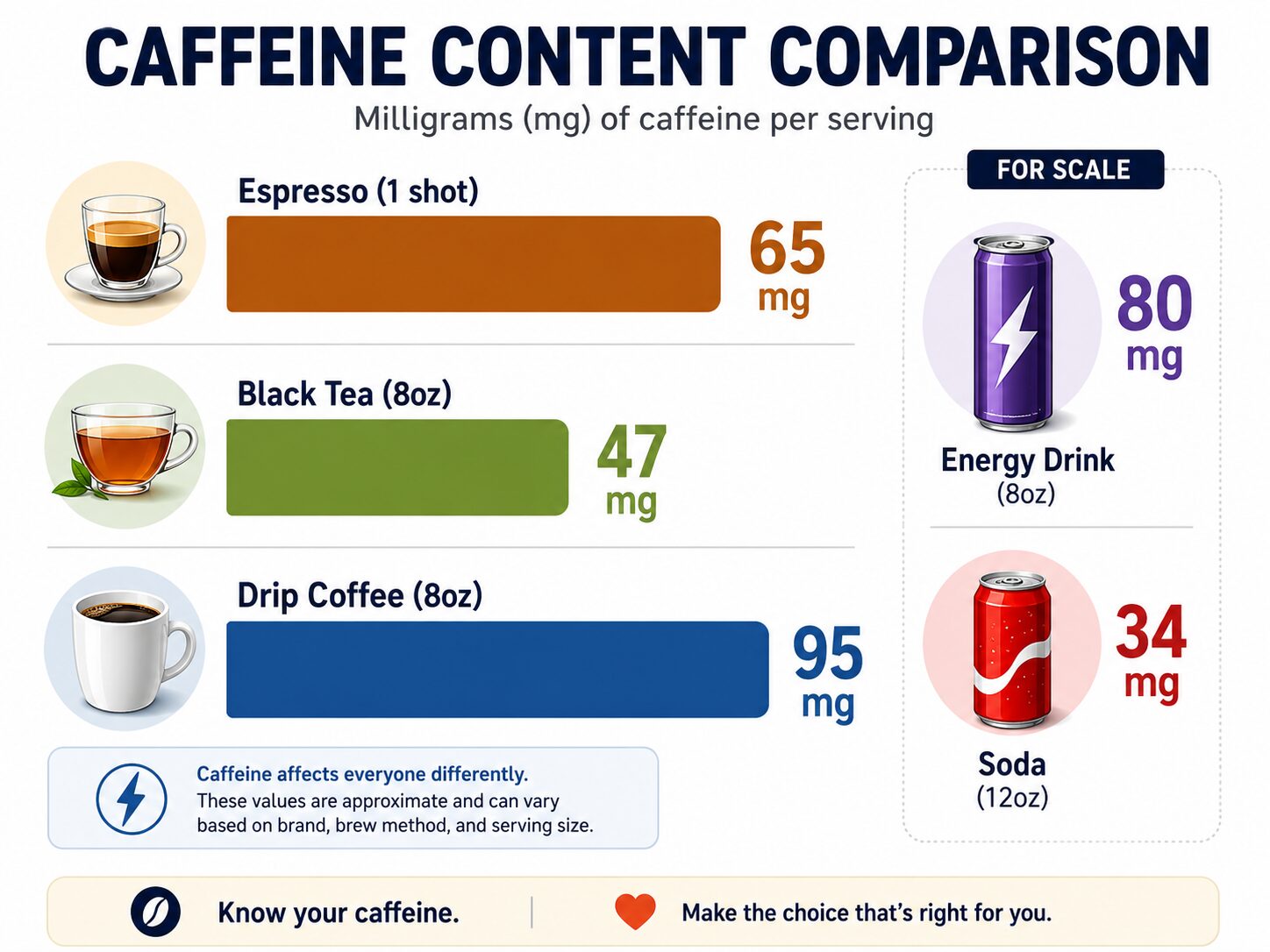
Where do tea, energy drinks, and soda fit in? They provide useful context for the espresso vs. coffee debate.
A standard 8oz cup of black tea contains about 47mg of caffeine, putting it between a single espresso shot and a mug of coffee. Green tea is lower, around 28mg. This makes caffeine in tea a middle-ground option. Even a strongly brewed black tea caffeine serving rarely challenges a standard coffee mug.
Energy drinks are a different beast. A can of Red Bull (8.4oz) has 80mg of caffeine, slightly more than a single espresso shot but less than a coffee. A 16oz Monster has about 160mg, which is in the territory of a double shot or a strong cup of drip. The Monster Energy caffeine and Red Bull caffeine content is standardized and printed on the can, unlike coffee, which is variable.
Soda is the lightweight. A 12oz can of Coca-Cola has a mere 34mg of caffeine. You would need to drink almost three cans to match a single shot of espresso. The Coca-Cola caffeine content is so low it’s often not considered a significant source for regular caffeine consumers.
How to Actually Control Your Caffeine Intake
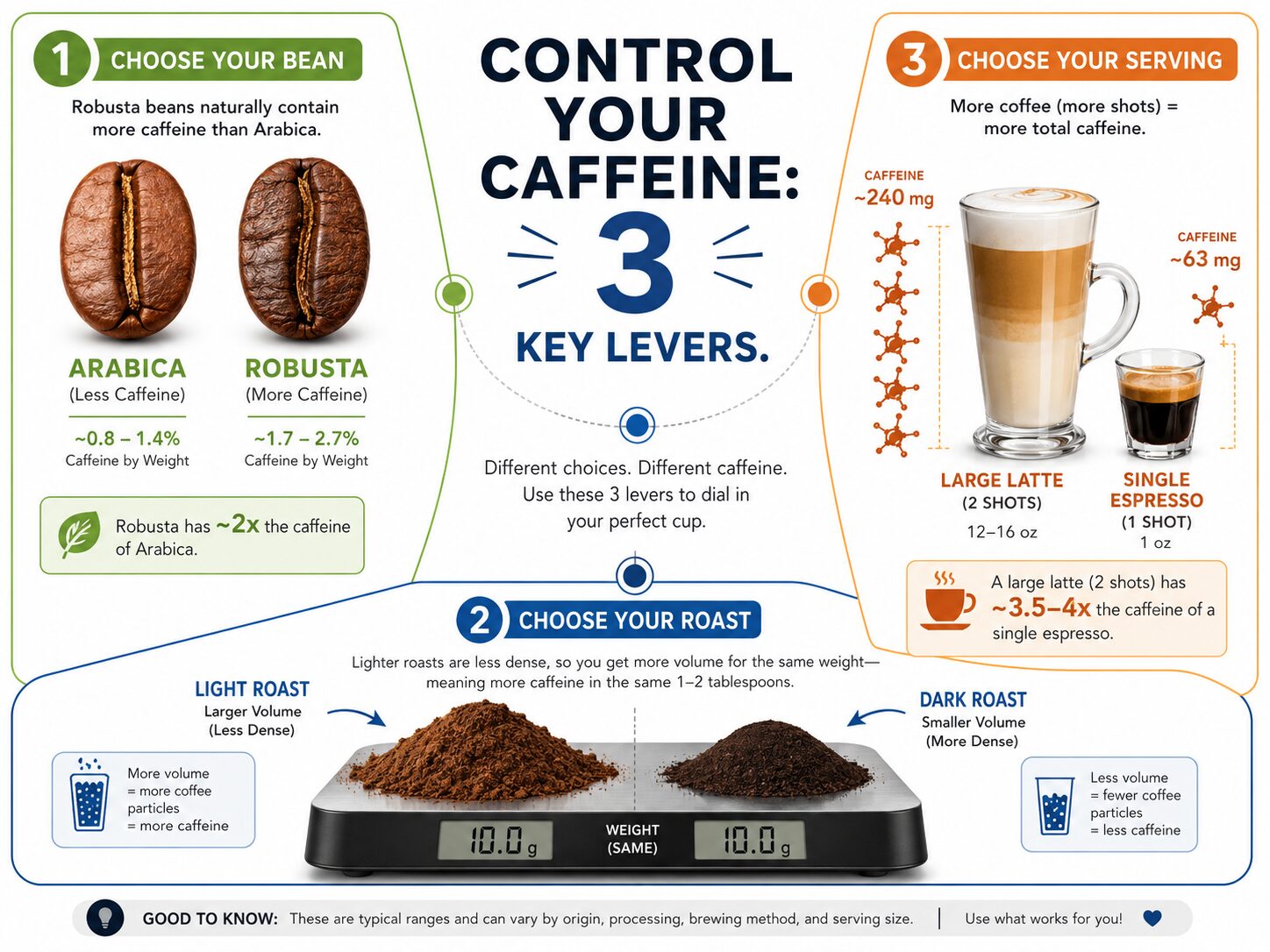
If the numbers feel abstract, use these levers to dial your daily dose up or down.
- Choose your bean. For less caffeine, stick with 100% Arabica. For more, look for blends with Robusta or “espresso” blends that often include it.
- Measure by weight, not volume. A tablespoon of dark roast is not the same as a tablespoon of light roast. A scale ensures dose consistency, which is the biggest factor in caffeine consistency.
- Know your drink build. At a cafe, ask how many shots are in your large latte. It’s often still just two. If you need more kick, request an extra shot or switch to an americano caffeine drink, where the caffeine content is clearer.
- Adjust brew time and grind. For espresso, a longer extraction (up to a point) pulls more caffeine. For drip or pour-over, a finer grind and longer contact time increase extraction.
- Consider half-caff. Many roasters offer a 50/50 blend of caffeinated and decaf beans. You get the full flavor with half the caffeine, a simple and effective hack.
Common mistake: Switching to espresso to “cut back” on caffeine, unless you are literally drinking one single shot and stopping, you’re likely consuming more caffeine by switching to multiple double-shot lattes or Americanos throughout the day.
The goal isn’t to memorize every number. It’s to understand the system. Dose, bean, and beverage size are your three control points.
Frequently Asked Questions
Does a double espresso have more caffeine than coffee?
Usually, yes. A standard double espresso uses about 36g of coffee and yields roughly 130mg of caffeine. A standard 12oz mug of drip coffee uses about 25g of coffee and yields about 95mg. The double shot wins on total caffeine because it starts with more coffee.
Why does espresso taste stronger if it has less caffeine?
Espresso tastes stronger due to concentration and roast. The high-pressure extraction pulls out more oils and bitter compounds (like chlorogenic acid) into a tiny volume, creating an intense flavor. Many espresso blends also use a darker roast profile, which emphasizes bitter, roasty notes. Caffeine itself is only a small part of the bitter taste.
Can I make drip coffee with espresso beans?
You can, but you might not like the result. “Espresso” beans are often just a marketing term for a darker roast or a specific blend. Using them in a drip machine can result in a bitter, oily cup because the dark roast extracts more quickly in a long brew. It won’t magically give your drip coffee espresso-level caffeine.
Does decaf espresso have any caffeine?
Yes. Decaffeinated coffee is not 100% caffeine-free. By U.S. and EU standards, decaf must have 97% of the caffeine removed. This means a decaf espresso shot could still contain 2-5mg of caffeine. It’s not zero.
How does cold brew compare?
Cold brew is a different beast. It uses a very long steep time (12-24 hours) with cold water, which extracts caffeine very efficiently but slower. Because it’s typically a concentrate diluted with water or milk, the final caffeine content per serving can range widely, from 100mg to over 200mg for a strong 16oz serving. It often surpasses both hot drip and espresso.
Before You Go
The fight between espresso and coffee isn’t about which one is “stronger.” It’s about what you’re actually drinking. A single shot of espresso is a concentrated punch, but its total caffeine is modest. Your big mug of drip coffee is a slower, larger delivery system that usually packs a bigger total stimulant payload.
If you’re tracking your intake, ignore the “per ounce” stats. Look at the dose of coffee grounds going in and the number of shots in your drink. Choose Arabica for less, Robusta for more. And remember, the bitter taste is a poor proxy for the caffeine content. Your body counts the milligrams, not the intensity of the roast.
