
Does Coffee Count as Water Intake? The Science-Backed Answer
Yes, coffee counts toward your daily water intake. For regular coffee drinkers consuming moderate amounts, typically 3 to 4 cups per day, the net hydrating effect is virtually identical to drinking plain water, according to clinical research like the Beverage Hydration Index study.
The persistent myth that coffee dehydrates you comes from a misunderstanding of caffeine’s mild, short-term diuretic effect. People assume the extra trip to the bathroom cancels out the water you just drank. That logic feels right. It’s also wrong for anyone with a daily coffee habit.
This guide breaks down the specific studies that prove coffee hydrates, explains the one big exception, and shows you how to balance your fluids without giving up your brew.
Key Takeaways
- The 2014 Beverage Hydration Index (BHI) study found black coffee has a hydration index of 0.96, showing no significant difference from water for regular drinkers.
- Caffeine naivety is the critical edge case: if you rarely drink coffee, the diuretic effect is stronger and hydration may be less efficient initially.
- Major health authorities like the UK’s NHS explicitly state tea and coffee count toward your fluid intake.
- “Moderate” intake in the research means about 300–400 mg of caffeine, roughly 3–4 standard cups of brewed coffee.
- Adding sugar, cream, or milk turns coffee into a source of calories and other nutrients, but it remains a source of fluid.
The Short Answer from Science
Forget the old warnings. Modern physiology research provides a clear, numeric answer.
A 2014 study in The American Journal of Clinical Nutrition introduced the Beverage Hydration Index (BHI), measuring how long fluids are retained compared to water. Black coffee, consumed by regular drinkers at a dose of 4mg caffeine per kg of body weight, scored a BHI of 0.96. Statistically, that’s a dead heat with plain water over a four-hour period.
The study’s dose is key. For a 70 kg (154 lb) person, 4mg/kg equals 280 mg of caffeine. That’s about two strong 12-ounce cups of drip coffee or three standard shots of espresso. The researchers concluded that for people accustomed to caffeine, coffee “provided similar hydration to water.” An earlier 2000 study in the Journal of the American College of Nutrition reached the same verdict, finding no meaningful difference in urine output between caffeinated and non-caffeinated drinks for habitual consumers.
Your body is smarter than the myth. It processes the water in coffee, which makes up over 98% of your cup, for hydration. The caffeine’s mild diuretic effect is offset by the volume of fluid. Think of it like a net calculation: you gain a full cup of water and lose a few extra tablespoons to urine. You’re still deeply in the positive.
TL;DR: Clinical trials show regular coffee drinkers get the same hydration from moderate coffee intake as from water. The beverage’ high water content far outweighs caffeine’s minor diuretic action.
Official Health Guidance Says Yes
You don’t have to take a lab’s word for it. National health services have updated their advice based on this evidence.
The United Kingdom’s National Health Service (NHS) is the most direct. Their public guidance page, “Water, drinks and your health,” states plainly: “All non-alcoholic drinks count towards your fluid intake. These include tea, coffee and fruit juice.” They recommend 6-8 glasses of fluid per day, not 6-8 glasses of water.
The U.S. Centers for Disease Control and Prevention (CDC) takes a similar, if slightly more cautious, position. The CDC lists “plain coffee” and “plain tea” under “Healthier Drink Options” that can contribute to daily fluid needs. They stop short of a blanket “counts as water” statement, focusing instead on promoting these drinks over sugary sodas and juices. This distinction matters for public messaging, but the practical takeaway is identical: coffee is a valid source of hydrating fluid.
This official stance simplifies daily tracking. If you’re aiming for eight cups of fluid, your morning French press, your afternoon black tea benefits, and your evening herbal infusion all contribute. Water is the baseline because it’s zero-calorie and universally accessible, not because it’s magically superior at hydrating your cells.
| Health Authority | Statement on Coffee/Fluid Intake | Key Wording |
|---|---|---|
| UK National Health Service (NHS) | Explicitly counts coffee/tea. | “All non-alcoholic drinks count towards your fluid intake. These include tea, coffee…” |
| U.S. Centers for Disease Control (CDC) | Includes coffee as a healthier fluid source. | Lists “plain coffee” and “plain tea” as “healthier drink options” for fluid. |
| Beverage Hydration Index (2014 Study) | Provides clinical evidence. | Coffee BHI = 0.96, “similar hydration to water” for regular consumers. |
When Coffee Might Not Hydrate as Well
The research has a crucial footnote. The hydration equivalence holds for “regular coffee drinkers” or “individuals accustomed to caffeine.” Your personal caffeine habit changes the equation.
Common mistake: Assuming your first coffee in months hydrates you like water, if you’re caffeine-naive, the diuretic effect is more pronounced and fluid retention can be slightly lower for that single dose.
The state of being “caffeine-naive” is the primary edge case. The 2014 BHI study authors noted that in non-habitual users, “caffeine ingestion can lead to a mild, transient diuresis.” Your body isn’t yet adapted to the compound, so the signal to flush out more water is stronger. If you only drink coffee occasionally, that one cup might not net you quite as much hydration as the same volume of water. The effect is short-term and mild, not dehydrating, but it’s enough to matter for precise calculations.
The second edge case is extreme volume. The studies talk about “moderate” consumption. What’s moderate? The research and health guidelines consistently point to 300–400 mg of caffeine per day. That’s your three to four cup ceiling. Consuming far beyond that, say, six or eight strong cups, introduces a larger total caffeine load that could push the diuretic effect. It’s less about each cup and more about the cumulative pharmacological dose.
Listen to your own physiology. If you’re drinking coffee and your urine remains light yellow and you don’t feel thirsty, your fluid balance is fine. If you’re pounding espresso shots all day and notice your mouth is dry and your urine is dark, that’s your body asking for more plain water to help process that load. This is especially true if your coffee is also your vehicle for a lot of brown sugar as a sweetener or high-calorie creamers, as the solute load increases.
TL;DR: Coffee hydrates differently if you’re not a regular drinker or if you consume very high amounts. For daily drinkers sticking to a few cups, the science is settled.
How to Actually Count Your Coffee
Turning this science into a daily habit requires a simple system.
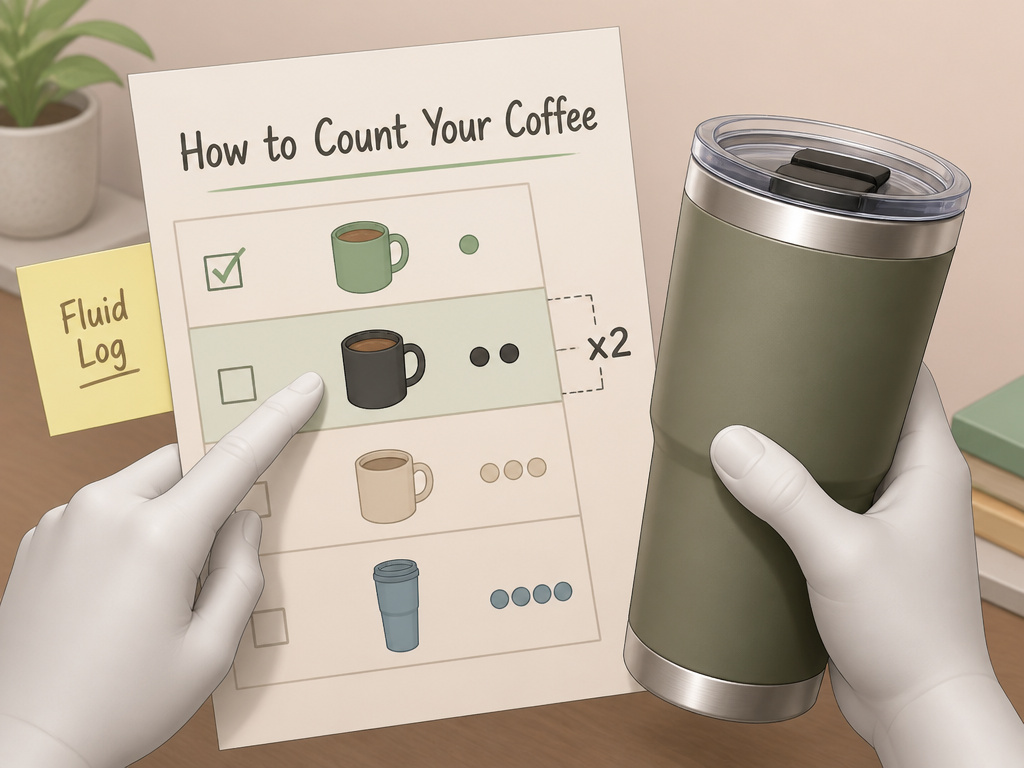
First, define your “cup.” A standard 8-ounce (240ml) mug of brewed coffee contains about 95–200 mg of caffeine. Use the middle of that range for mental math. If you drink from a 20-ounce travel tumbler, you’re having two to three “cups” in one go. My morning routine is a 500ml (about 17 oz) pour-over. I count that as two of my daily fluid servings and two of my caffeine servings.
Second, log it as fluid, not as water. I keep a rough mental tally: my large morning coffee is two glasses, my afternoon green tea antioxidants is one, and I aim for four to five glasses of plain water or sparkling water. That easily hits the NHS’s six to eight total. Apps can track this, but a sticky note on the kettle works just as well.
Third, adjust for additives. Black coffee is just flavored water. The moment you add milk, cream, or almond milk compatibility into the mix, you’re adding calories, fats, and nutrients. It’s still fluid, but now it’s also a snack. This is crucial for managing daily calories, as the calorie content of milk can add up quickly across multiple cups. Sweeteners like sugar or syrup also add calories without hydration benefits.
Here’s a quick reference for counting common coffee drinks:
| Coffee Drink | Count It As… | Notes |
|---|---|---|
| Black Coffee / Americano | Full fluid volume. | 12oz drink = ~12oz fluid. The standard for hydration studies. |
| Coffee with a Splash of Milk | Full fluid volume. | Negligible calorie impact for hydration purposes. |
| Latte / Cappuccino (8oz milk) | Fluid + 120+ calories. | The milk provides fluid but is a significant food item. |
| Sweetened Iced Coffee | Fluid + sugar calories. | Hydrating, but the sugar load is the primary health consideration. |
Finally, use thirst and urine color as your guides. These are your body’s real-time hydration dashboards. Light straw-colored urine means you’re well-hydrated, whether the fluid came from a Chemex or a tap. Dark yellow urine means you need more total fluid, and you should reach for water first.
Caffeine Compared to Other Beverages
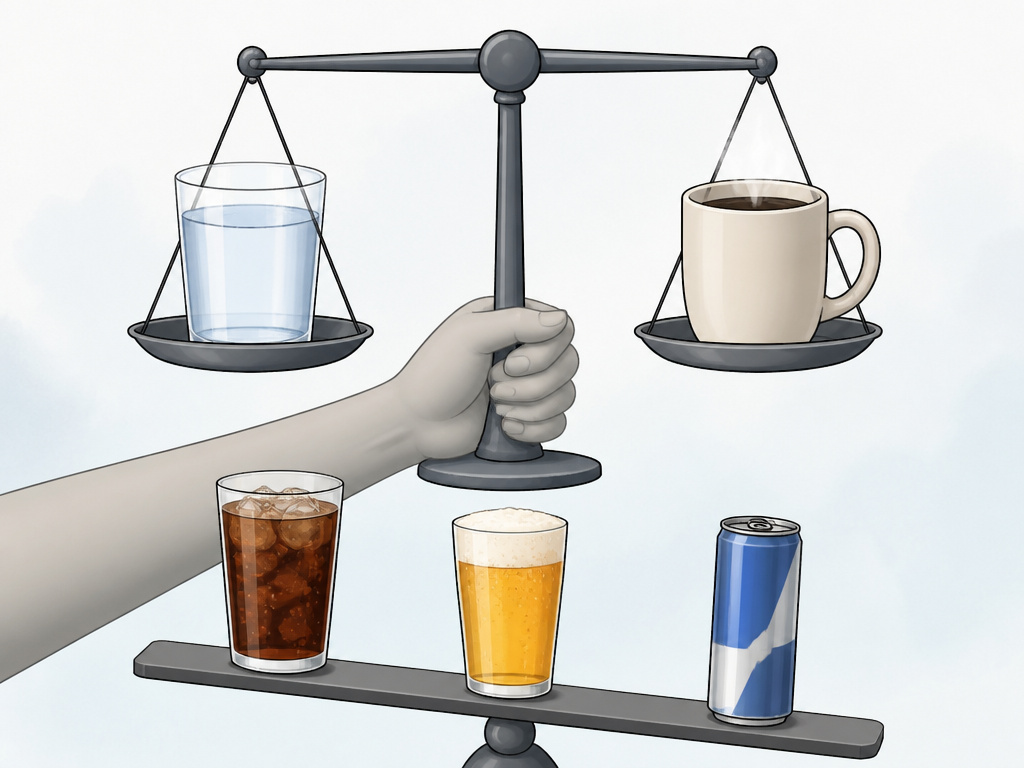
Where does coffee sit in the wider world of drinks? Understanding the caffeine content comparison helps contextualize its effects.
The diuretic potential of any drink is linked to its concentration of certain compounds. Caffeine is the one we talk about, but alcohol is a much more potent diuretic. That’s why a beer doesn’t hydrate you, but a coffee does. The BHI study placed coffee squarely in the “hydrating” cluster with water, oral rehydration solutions, and skim milk. Cola and diet cola also showed a high BHI, but their sugar or artificial sweetener content makes them a poor choice for primary hydration.
I used to worry my two daily coffees were putting me in a deficit. Then I realized I wasn’t thirsty afterward, and my performance during workouts didn’t drop. The anxiety was louder than my body’s actual signals.
Tea is an interesting parallel. It contains caffeine, but also compounds like L-theanine that can modulate its effects. A standard cup of black tea has about half the caffeine of a cup of coffee. Does it hydrate as well? According to the same principles, yes, the NHS groups them together. The lower caffeine in black tea might make it an even more efficient hydrating beverage for sensitive individuals. The story is similar for iced tea caffeine levels versus cold brew, where brewing method changes concentration.
The real outlier is energy drinks. They often contain caffeine doses equivalent to or higher than coffee, plus large amounts of sugar and other stimulants like taurine. The high sugar content creates an osmotic effect that can actually pull water into your digestive tract, complicating the hydration picture. Coffee’s simplicity, water plus coffee compounds, is why the science on it is so clean.
Frequently Asked Questions
Does coffee with milk count as water intake?
Yes, the liquid portion still contributes to your total fluid intake. However, the milk adds calories, fat, and protein, turning the drink into a combined source of hydration and nutrition. For pure hydration tracking, plain black coffee is the clearest equivalent to water.
How much coffee is too much for hydration?
Clinical studies define “moderate” intake as 300–400 mg of caffeine daily, roughly 3–4 cups of brewed coffee. Consuming significantly more than this can amplify caffeine’s diuretic effect and may reduce net hydration efficiency. Listen to your body; persistent thirst or dark urine are signs you need more plain water.
What about tea? Does it count the same as coffee?
Yes, official guidance from sources like the NHS groups tea and coffee together as fluids that contribute to daily intake. Tea generally contains less caffeine than coffee, so its net hydrating effect is similarly positive, if not more so for those sensitive to caffeine. The health benefits of tea and coffee both include this hydration contribution.
Why does coffee make me pee so much if it’s hydrating?
Caffeine is a mild bladder irritant and a diuretic, meaning it encourages your kidneys to release more sodium and water. You will pee more frequently after drinking coffee compared to drinking nothing. However, the volume of fluid you retain from the coffee itself is greater than the extra volume you lose, resulting in a net positive hydration balance. The feeling is more pronounced if you’re dehydrated or caffeine-naive.
Should I drink extra water if I drink coffee?
It’s a good practice, but not strictly necessary for hydration if you’re a regular, moderate coffee drinker. Drinking a glass of water alongside your coffee can help mitigate any minor diuretic effect, aid digestion, and cleanse your palate. It’s mandatory if you consume high amounts of coffee or feel any signs of dehydration.
The Bottom Line
The idea that coffee doesn’t count is a stubborn myth. The evidence from controlled clinical trials and major health organizations is unanimous: for the vast majority of daily drinkers, coffee hydrates you just like water does. Your morning brew isn’t a compromise; it’s a contribution.
The rule breaks down only at the extremes, if you’re new to caffeine or drinking potfuls by yourself. For everyone else, count those ounces toward your daily fluid goal. Pay more attention to what you put in the coffee than the coffee itself. The splash of milk, the spoonful of sugar, the pump of syrup, those are the variables that change the health equation, not the hydration math. Enjoy your cup. It’s doing more for you than you thought.
