
How Many Calories in Milk in Coffee? Official Data & Tips
How many calories in milk in coffee depends entirely on the type and amount of milk used. A standard 8-ounce cup of black coffee has about 2 calories. Adding milk ranges from 36 calories for unsweetened almond milk to 152 calories for whole dairy milk per 8-ounce cup.
Most people guess wrong because they think in types, not portions. They swap to oat milk for health but pour a full latte’s worth, unknowingly adding more calories than the 2% dairy they left behind. The math is simple once you have the right numbers.
This guide walks through the USDA’s official calorie data, translates it to real-world splashes and lattes, and explains a critical, non-obvious finding about dairy milk versus soy milk that changes how your body uses coffee’s compounds.
Key Takeaways
- Whole milk (3.25%) adds 152 calories per 8-ounce cup; a 1-tablespoon splash adds about 9 calories.
- Unsweetened almond milk is the lowest-calorie common option at ~37 calories per cup, but sweetened versions can double that.
- Dairy milk proteins (casein) can bind to and reduce the absorption of coffee’s beneficial chlorogenic acids by more than half; soy milk does not have this effect.
- A 16-ounce latte with whole milk contains about 300 calories from milk alone, turning a nearly calorie-free drink into a significant portion of a snack.
- Always check for “unsweetened” on plant-milk labels; added sugars are the primary driver of hidden calorie jumps.
The USDA Numbers: Calories Per Cup, Per Splash
Calorie counts from blogs are guesses. The U.S. Department of Agriculture’s FoodData Central is the primary source. These are the stable, measured values for fluid milk.
The difference between a tablespoon and a cup is the difference between ignoring calories and counting them. A splash in your morning drip is nutritionally trivial. The same milk in an afternoon cappuccino is not.
| Milk Type (8 fl oz / 1 cup) | Calories | Fat (g) | Best For |
|---|---|---|---|
| Whole Milk (3.25% fat) | 152 | 7.9 | Rich texture, traditional lattes |
| 2% Reduced-Fat Milk | 124 | 4.9 | Balancing flavor and lower calories |
| Skim / Nonfat Milk | 83 | 0.2 | Minimizing calorie and fat intake |
| Unsweetened Almond Milk | 37 | 2.7 | Lowest-calorie option; nutty flavor |
| Original Oat Milk (commercial) | 120-160 | 5-7 | Creamy texture, dairy-free |
| Unsweetened Soy Milk | 80-90 | 4-5 | High protein, no nutrient blocking |
TL;DR: Bookmark the table above. For a splash (1 tbsp), divide the cup calories by 16. Whole milk adds 9 calories per tablespoon; skim adds 5.
Common mistake: Assuming “oat milk” is low-calorie — original or barista blends often match 2% dairy milk in calories, and sweetened versions exceed it.
The USDA FoodData Central entry for whole milk lists 152 calories per 244-gram cup. This 3.25% milkfat standard is your baseline for creamy coffee. Every step down in fat cuts calories directly: 2% milk saves 28 calories per cup, skim saves 69.
Plant-based milks break the fat-calorie link. Unsweetened almond milk gets its minimal 37 calories mostly from healthy fats. Oat milk’s calories come from carbohydrates and added oils for frothing. This is why reading the nutrition label on the carton matters more than the category name.
For a real-world translation, a standard latte uses 8-10 ounces of milk. Using the table, a 10-ounce latte with whole milk delivers about 190 calories just from the milk. Switch to unsweetened almond milk for the same latte, and you’re at roughly 46 calories. That’s a 144-calorie difference, which over a week adds up.
Dairy vs. Plant-Based: A Calorie and Chemistry Showdown
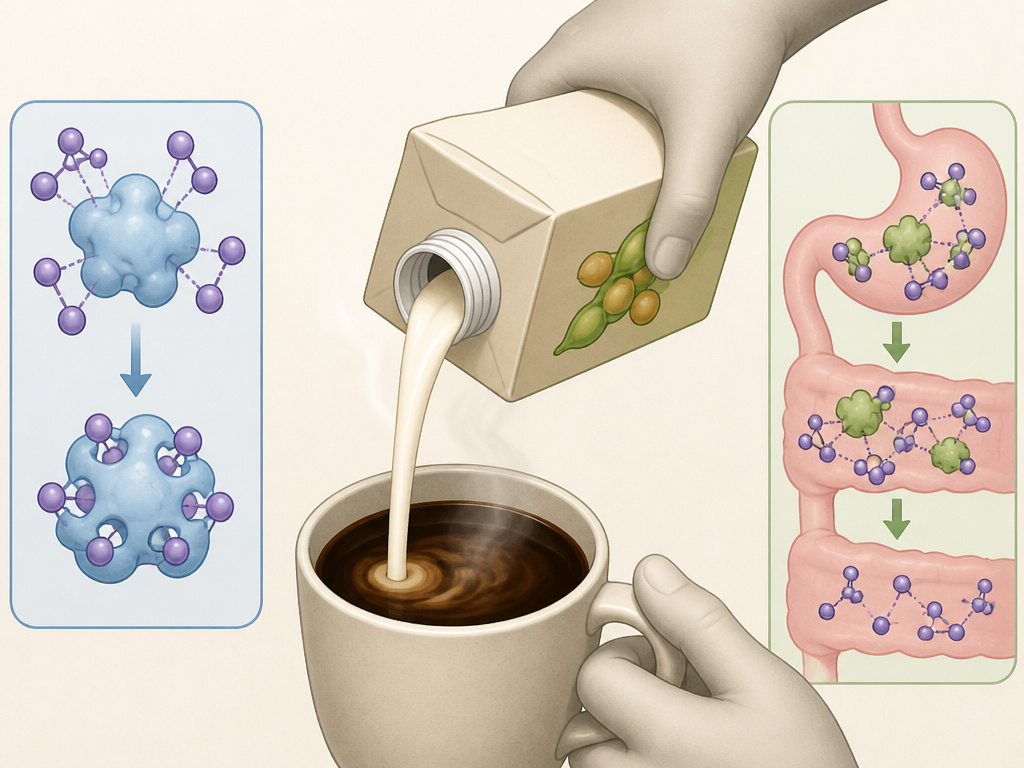
Choosing milk is not just calorie math. Dairy and plant-based milks interact with coffee on a chemical level that changes what your body gets from the drink beyond energy.
Dairy milk contains casein proteins. Research, including test-tube and human studies highlighted in nutritional science reviews, shows these proteins bind tightly to polyphenols like the chlorogenic acids in coffee. This binding can reduce your body’s absorption of these beneficial compounds by more than half. It’s a nutrient-blocking effect.
Soy milk proteins can also bind these compounds initially. But the difference is reversibility. Your gut bacteria can break the soy-polyphenol bonds later in the digestive process, allowing absorption to eventually occur. This is a key distinction that often goes unmentioned in basic calorie guides.
I switched to soy milk in my afternoon coffee after reading the absorption studies. The flavor is cleaner than oat milk, and I don’t feel like I’m wasting the good beans I ground that morning. Dairy milk now feels like a deliberate choice for indulgence, not a default.
Plant-based milks introduce their own calorie variables. The “original” or “barista” version of any plant milk almost always means “sweetened.” Added sugars are the silent calorie engine.
- Unsweetened Almond Milk: ~37 cal/cup. The go-to for minimal calories.
- Original Almond Milk: ~91 cal/cup. Added sugar accounts for the 54-calorie jump.
- Original Oat Milk: ~120-160 cal/cup. Calories come from carbs, oils, and often added sugar.
- Unsweetened Soy Milk: ~80-90 cal/cup. Higher in protein, which aids satiety.
TL;DR: Dairy can block coffee’s nutrients; soy doesn’t. For pure calorie control, unsweetened almond milk wins. For balanced nutrition, unsweetened soy is a strong contender.
How to Measure Your Actual Milk Calorie Intake
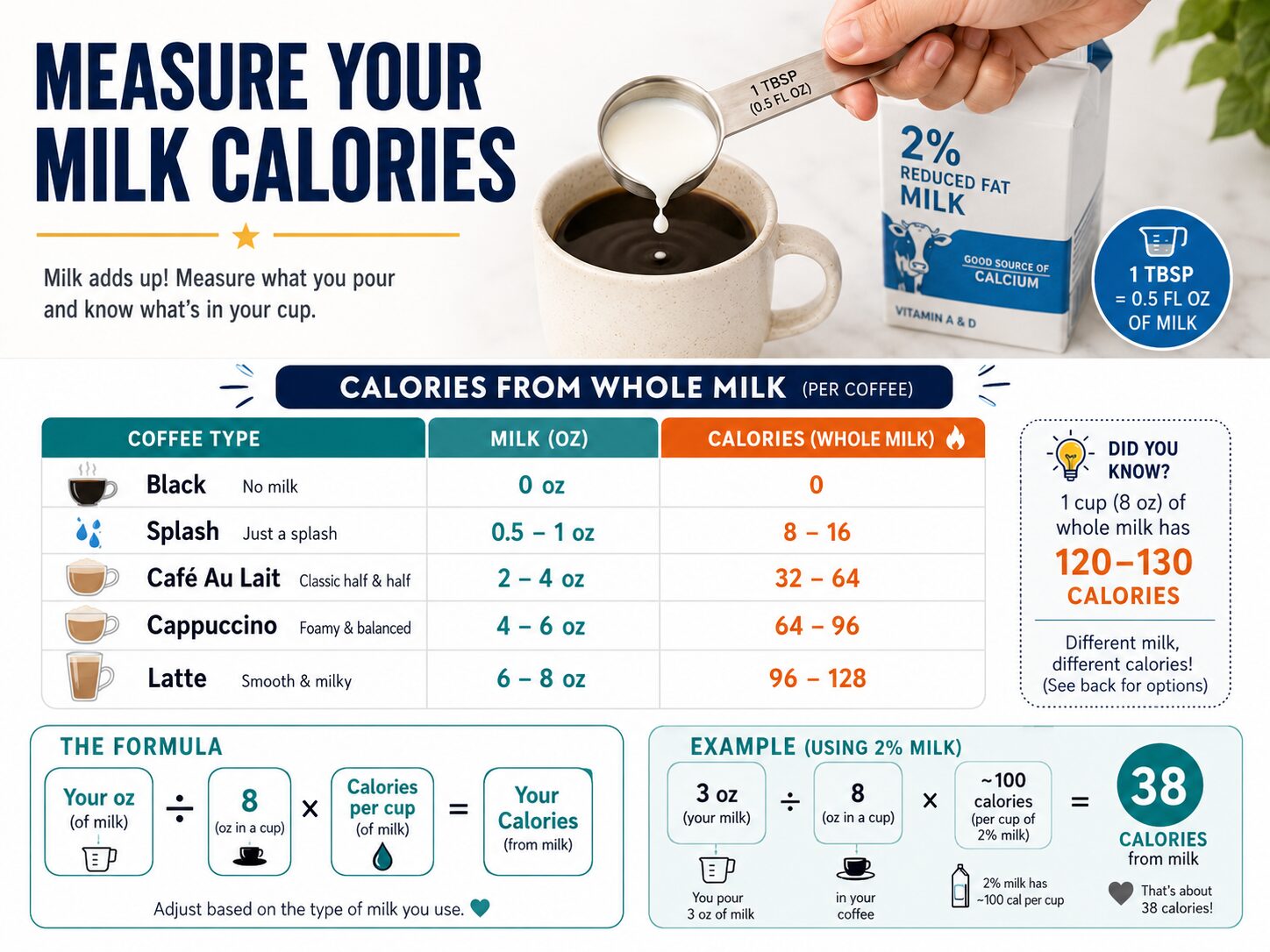
You cannot manage what you do not measure. “A splash” is not a unit. Here is the two-minute audit.
First, tomorrow morning, pour your typical milk amount into a separate vessel before adding it to your coffee. Use a liquid measuring tablespoon. Most mugs hold 10-12 ounces. How much of that is milk?
* Black Coffee / Americano: 0 oz milk. ~2 calories.
* Coffee with a “Splash”: 0.5 – 1 oz (1-2 tbsp). 5-19 calories (whole milk).
* Café Au Lait: 4-5 oz milk. 76-95 calories (whole milk).
* Cappuccino: 5-6 oz milk. 95-114 calories (whole milk).
* Latte: 8-10 oz milk. 152-190 calories (whole milk).
Second, identify your milk type using the carton. Is it “Whole,” “2%,” “Unsweetened Almond,” or “Original Oat Milk”? Find its calories per cup from the label or our USDA table.
The calculation is straightforward: (Your ounces of milk / 8) x (Calories per 8-ounce cup). For a 3-ounce pour of 2% milk: (3/8) * 124 = 46.5 calories.
Common mistake: Forgetting the second and third cup. One splash of whole milk is 9 calories. Three coffees a day is 27 calories. Over a month, that’s 810 calories, equivalent to two large slices of pizza. It adds up silently.
This is why understanding calories in an Americano or other black coffee options is valuable for calorie budgeting. They provide the coffee experience with a fixed, near-zero calorie base.
If you enjoy milk, budget for it. There is no “bad” choice, only uninformed ones. A latte with whole milk can be a satisfying, protein-rich afternoon treat. A splash of 2% milk in your morning brew is a negligible addition. The problem is the disconnect between the portion and the mental tally.
Low-Calorie Flavor Strategies Beyond Milk
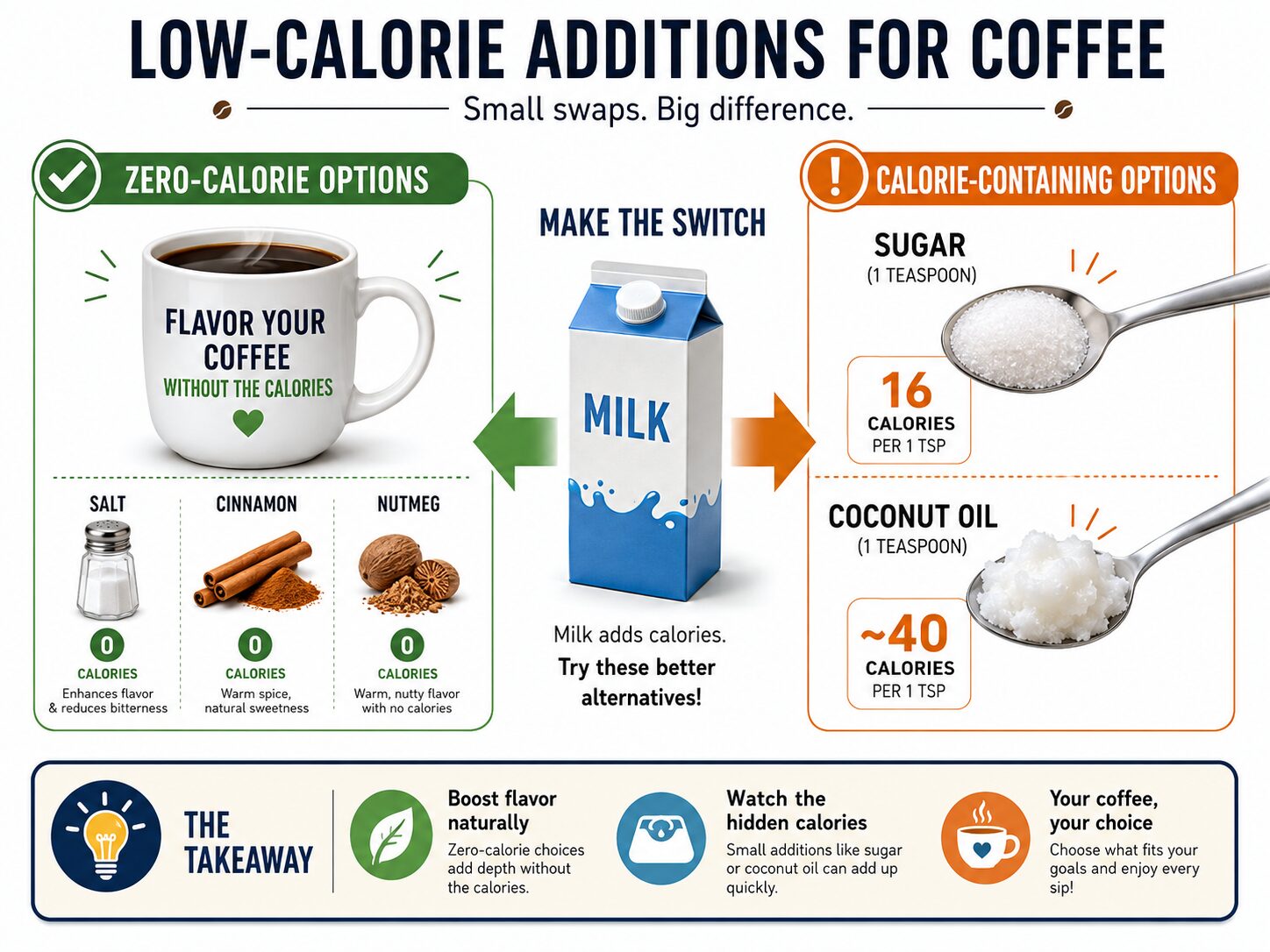
If calorie trimming is the goal, milk is just one lever. You can add flavor and texture for few or no calories.
Reduce Bitterness Without Calories:
Acidity and bitterness in coffee often prompt the milk-and-sugar reflex. A tiny pinch of salt in coffee neutralizes bitterness without adding sweetness or calories. It works by blocking bitter receptors on the tongue. Start with two granules on the tip of a spoon.
Add Spice for Zero Calories:
Cinnamon in coffee is a classic. A quarter teaspoon of ground cinnamon stirred into your grounds before brewing or sprinkled on top after adds aroma, flavor, and potential health benefits for zero calories. Cardamom, nutmeg, and cocoa powder work similarly.
Explore High-Fat, Low-Carb Additions:
If you’re following a ketogenic diet, calories from fat are treated differently. Adding coconut oil to coffee or a teaspoon of MCT oil in coffee adds significant calories (about 120 per tablespoon of coconut oil) but provides sustained energy without spiking blood sugar. This is for a specific dietary approach, not general calorie reduction.
Use Sweeteners Strategically:
If you need sweetness, understand the calorie trade-off. A teaspoon of white sugar has 16 calories. A teaspoon of brown sugar as a sweetener has roughly the same but adds molasses flavor. Non-nutritive sweeteners like stevia or monk fruit have zero calories but can leave an aftertaste.
| Flavor Strategy | Calorie Impact | Best Use Case |
|---|---|---|
| Pinch of Salt | 0 | Countering bitter, over-extracted coffee |
| Cinnamon / Spices | 0 | Adding aromatic complexity without sweetness |
| Sugar (1 tsp) | 16 | Traditional sweetening; minimal usage |
| Unsweetened Almond Milk | ~5 per tbsp | Adding liquid volume and nutty note |
| Coconut Oil (1 tsp) | ~40 | Keto or bulletproof coffee protocols |
The goal is intentionality. Craving creaminess? Choose a milk and measure it. Craving just flavor? Try spices first. This separates habit from choice.
Frequently Asked Questions
Does milk in coffee break a fast?
Yes, technically. Even a small splash of milk (30+ calories) can trigger an insulin response and break a metabolic fast. For a pure fast, drink your coffee black. For a more forgiving “dirty fast,” a teaspoon of heavy cream or MCT oil is sometimes used due to minimal impact on insulin.
Which milk has the least calories in coffee?
Unsweetened almond milk is typically the lowest, at about 37 calories per 8-ounce cup. Next is unsweetened cashew milk (~25-35 cal/cup), but it’s less common. Always verify “unsweetened” on the label.
How many calories are in a coffee with 2% milk?
It depends entirely on the amount. Use the formula: (ounces of milk / 8) x 124. A 12-ounce coffee with 4 ounces of 2% milk has (4/8)*124 = 62 calories from the milk.
Is oat milk or almond milk lower in calories for coffee?
Unsweetened almond milk is lower (~37 cal/cup vs. ~120 cal/cup for original oat milk). However, oat milk is creamier and froths better, which is why cafes use it. You are trading calories for texture and function.
Do the calories in milk change when frothed?
No. Frothing incorporates air but does not change the nutritional content. A cup of frothed whole milk still contains the 152 calories from the liquid milk you started with; it just takes up more volume.
Before You Go
The calories in your coffee are the calories in your milk. Start with the USDA data for whole, 2%, and skim milk—152, 124, and 83 calories per cup, respectively. Then measure your actual pour. A tablespoon is trivial; a latte is a snack.
For the lowest calorie count, choose unsweetened almond milk. For better nutrient absorption from your coffee, consider unsweetened soy milk over dairy. And if you’re just chasing flavor, cinnamon in coffee or a pinch of salt costs nothing.
Your daily ritual shouldn’t be a source of guesswork. Use the numbers, know your pour, and drink what you actually intend to.
