
How Much Caffeine Is in Black Coffee? The Factors That Matter
An 8-ounce cup of black coffee typically contains 95 to 165 milligrams of caffeine, but the real number hinges on three specific variables: the coffee bean itself (Arabica vs. Robusta), the brewing method (drip vs. espresso vs. cold brew), and the precise serving size you pour.
Most people grab a number from a search result and assume it’s fixed. It’s not. The difference between a light morning buzz and an anxious afternoon comes down to grams of coffee, minutes of steeping, and the type of bean in your grinder. A Starbucks Grande isn’t just a bigger cup, it’s a different caffeine event entirely.
This guide breaks down the caffeine in black coffee using primary source data, manufacturer specs, and the brewing science that explains why your cup is never exactly the same twice.
Key Takeaways
- The standard 95-165 mg per 8-ounce cup is a useless average. Your actual intake depends on whether you use 15 grams of coffee or 25 grams in your brewer.
- Robusta beans contain nearly double the caffeine of Arabica beans. A cup made with Robusta can easily push past 200 mg.
- Lighter roasts have slightly more caffeine by weight, but darker roasts are less dense. If you measure by volume (scoops), a scoop of dark roast might give you more caffeine.
- Cold brew concentrate is exceptionally high in caffeine per ounce, but it’s often diluted. A standard 16-ounce cold brew from a cafe typically contains 200 mg or more.
- Chain coffee caffeine is published and precise. A 16-ounce Starbucks Pike Place Roast has 310 mg. A 14-ounce Dunkin’ Original Blend has 210 mg.
The USDA Baseline and Why It’s Misleading
Government data gives us a starting point, but it’s a snapshot of an average that doesn’t exist in your kitchen. The USDA lists 40 mg of caffeine per 100 grams of brewed coffee prepared with tap water. That translates to about 95 mg in an 8-ounce cup.
For “Coffee, brewed, espresso, restaurant-prepared,” the USDA FoodData Central lists 212 mg of caffeine per 100g. For standard brewed coffee, it’s 40 mg per 100g. These figures represent laboratory-prepared averages, not your daily mug.
The problem is the “prepared with tap water” part. It assumes a standard extraction from a standard amount of ground coffee. Your machine, your grind size, and your coffee-to-water ratio are not in that lab. The 40 mg per 100g figure is a consensus phantom. Relying on it is like planning a road trip using the fuel efficiency of a car you don’t own.
TL;DR: The USDA’s 95 mg per cup is a lab average. Your homemade cup will differ based on your coffee weight and brewer.
Bean Type: The Caffeine Blueprint
The plant species sets the ceiling. Coffea arabica (Arabica) and Coffea canephora (Robusta) are the two you drink. Robusta is the caffeine heavyweight.
| Bean Type | Typical Caffeine Content (by weight) | Common Use | Flavor Profile |
|---|---|---|---|
| Arabica | ~1.2% – 1.5% | Specialty coffee, single-origin bags | Sweeter, more complex, acidic |
| Robusta | ~2.2% – 2.7% | Espresso blends, instant coffee | Strong, bitter, earthy |
A study in the journal Food & Function confirmed this stark divide, noting that bean origin and species cause the most significant baseline variation in your cup. If your bag doesn’t say “100% Arabica,” you’re likely drinking a blend with Robusta. That’s why a traditional Italian espresso blend can deliver a more potent kick than a single-origin pour-over, even in a smaller volume.
Common mistake: Assuming “strong, dark roast” means more caffeine. The bitter taste of dark roast comes from roasting, not caffeine. A light roast Arabica still has more caffeine per bean than a dark roast Arabica.
The choice is simple. For a higher caffeine content per scoop, choose a Robusta blend. For a more nuanced flavor with less caffeine, stick to 100% Arabica. Most supermarket coffee is a blend, which is why its caffeine content is so unpredictable.
Brewing Method: The Biggest Swing Factor
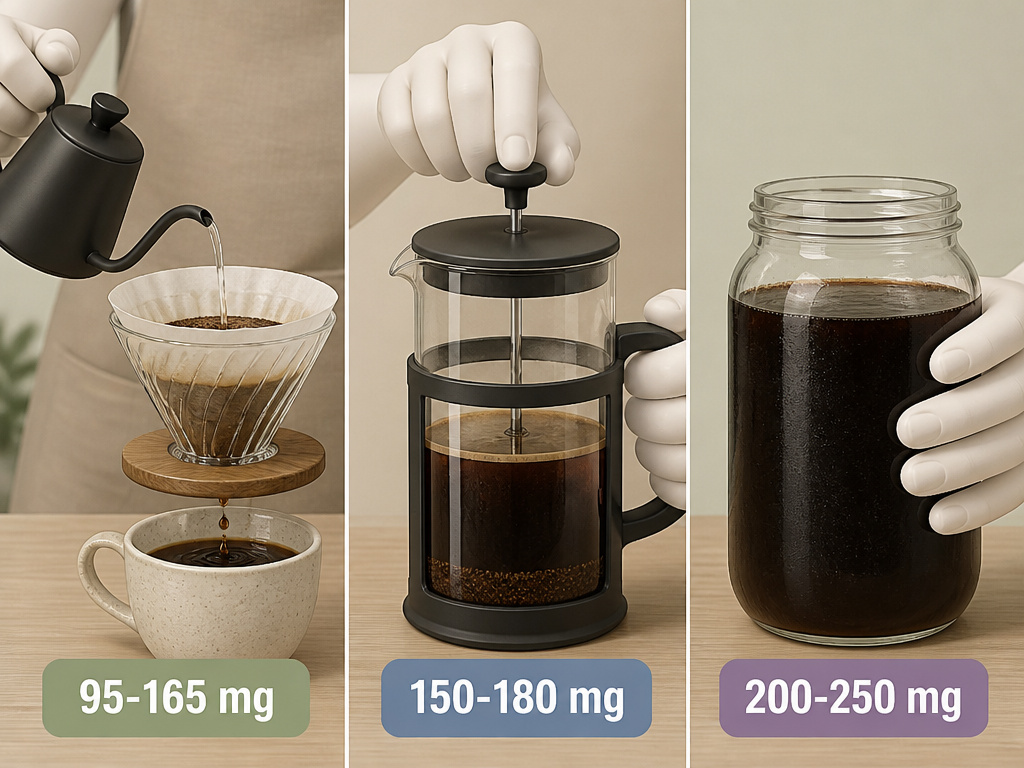
This is where the 95 mg cup can become a 300 mg cup. The method controls how much caffeine is pulled from the grounds into your water.
Drip / Pour-Over (The Standard)
This is the reference point: 95-165 mg per 8 ounces. The variation comes from your recipe. A standard recipe uses a 1:16 coffee-to-water ratio (e.g., 25g coffee to 400g water). Use 30g of coffee, and you’re at the top of that range. Use 20g, and you’re at the bottom. Your brewer’s temperature and how evenly it saturates the grounds matter, too.
Espresso (The Concentrate)
A 1-ounce shot of espresso contains 40-80 mg of caffeine. The concentration is high, but the volume is small. This is why comparing espresso caffeine content to drip coffee is confusing, you have to compare total servings. A double shot (2 oz) has 80-160 mg, putting it in the same ballpark as a cup of drip.
French Press / Immersion (The Full Extract)
Because the grounds steep in full contact with water for several minutes, immersion brewing extracts caffeine very efficiently. A French press typically yields caffeine in the upper half of the drip coffee range, often 150-180 mg per 8 ounces if you use a coarse grind and a 4-minute steep.
Cold Brew (The Powerhouse)
Cold brew breaks the rules. Steeping coarse grounds in cold water for 12-24 hours creates a concentrate that can have 150-250 mg of caffeine per 8 ounces. However, most cafes and recipes dilute that concentrate 1:1 with water or milk. Your final 16-ounce cold brew drink might have 200 mg total, strong, but not the concentrate-level hit you’d expect. It’s a great example of how brewing methods for caffeine extraction differ dramatically.
TL;DR: Brewing method is the largest variable after bean type. Immersion methods (French press, cold brew) maximize extraction, while espresso concentrates it in a tiny volume.
The Roast Level Myth, Explained
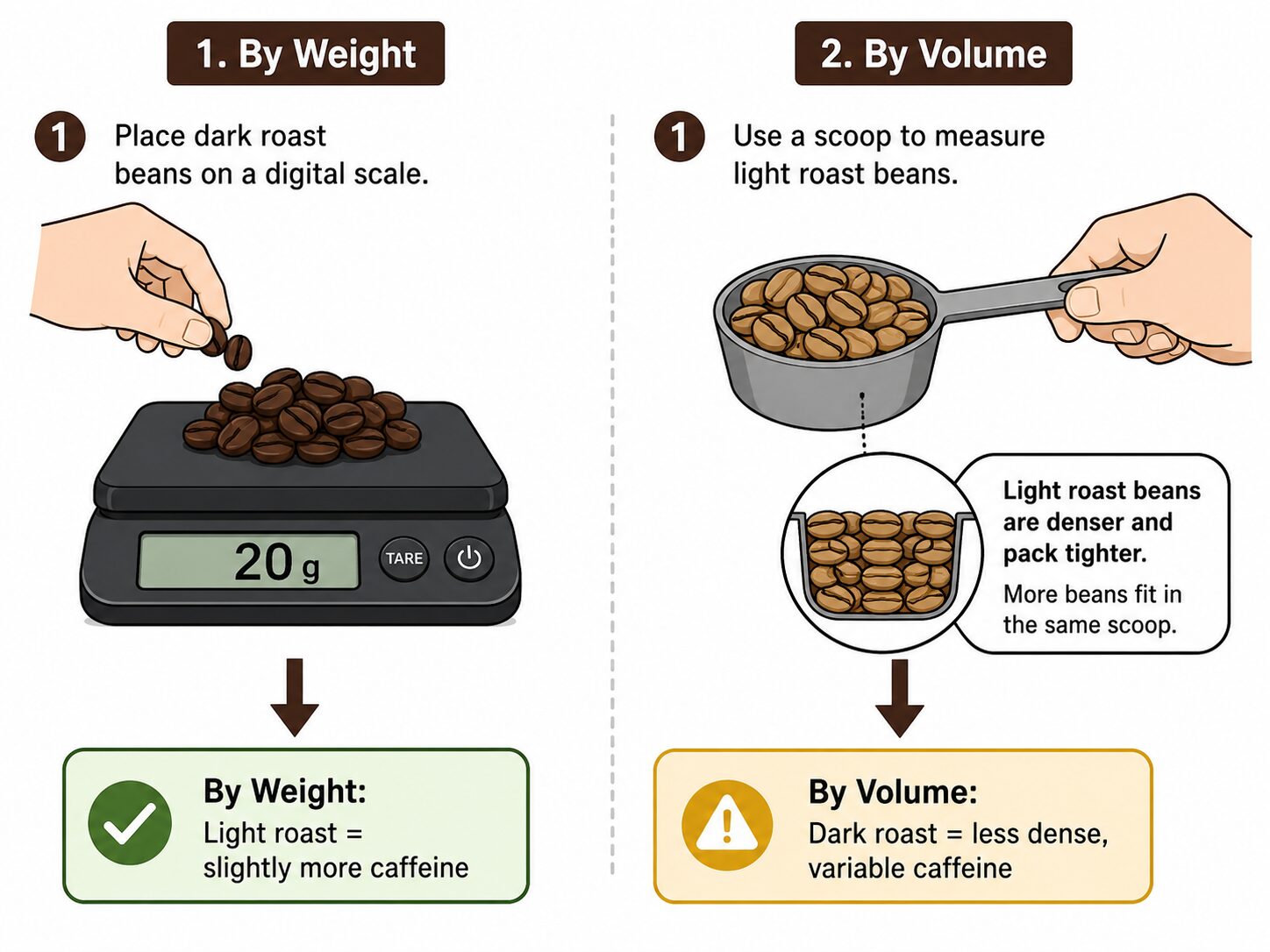
You’ve heard it: dark roast has more caffeine. You’ve also heard the opposite. Both can be true, depending on how you measure.
- By Weight (grams): Lighter roasts have slightly more caffeine. The roasting process degrades caffeine molecules. A longer, darker roast burns off a small percentage. If you weigh your beans before grinding, a dose of light roast beans contains a fraction more caffeine.
- By Volume (scoops): Darker roasts have less density. The beans expand and become more porous. A scoop of dark roast coffee weighs less than a scoop of light roast. Therefore, that lighter scoop might contain fewer beans and less total caffeine.
The practical takeaway? If you use a scale, the difference is minor, maybe a 5% variance. If you use a scoop, the variance is larger but unpredictable. A Scientific Reports caffeine study on filter coffee found that extraction yield changed more with roast than the inherent caffeine content did. The roast changes the ease of extraction, not just the starting amount.
For consistent caffeine, use a scale. The roast level debate is mostly a distraction from the bigger factors: bean type and brew time.
Real-World Numbers: Starbucks, Dunkin’, and Your Keurig
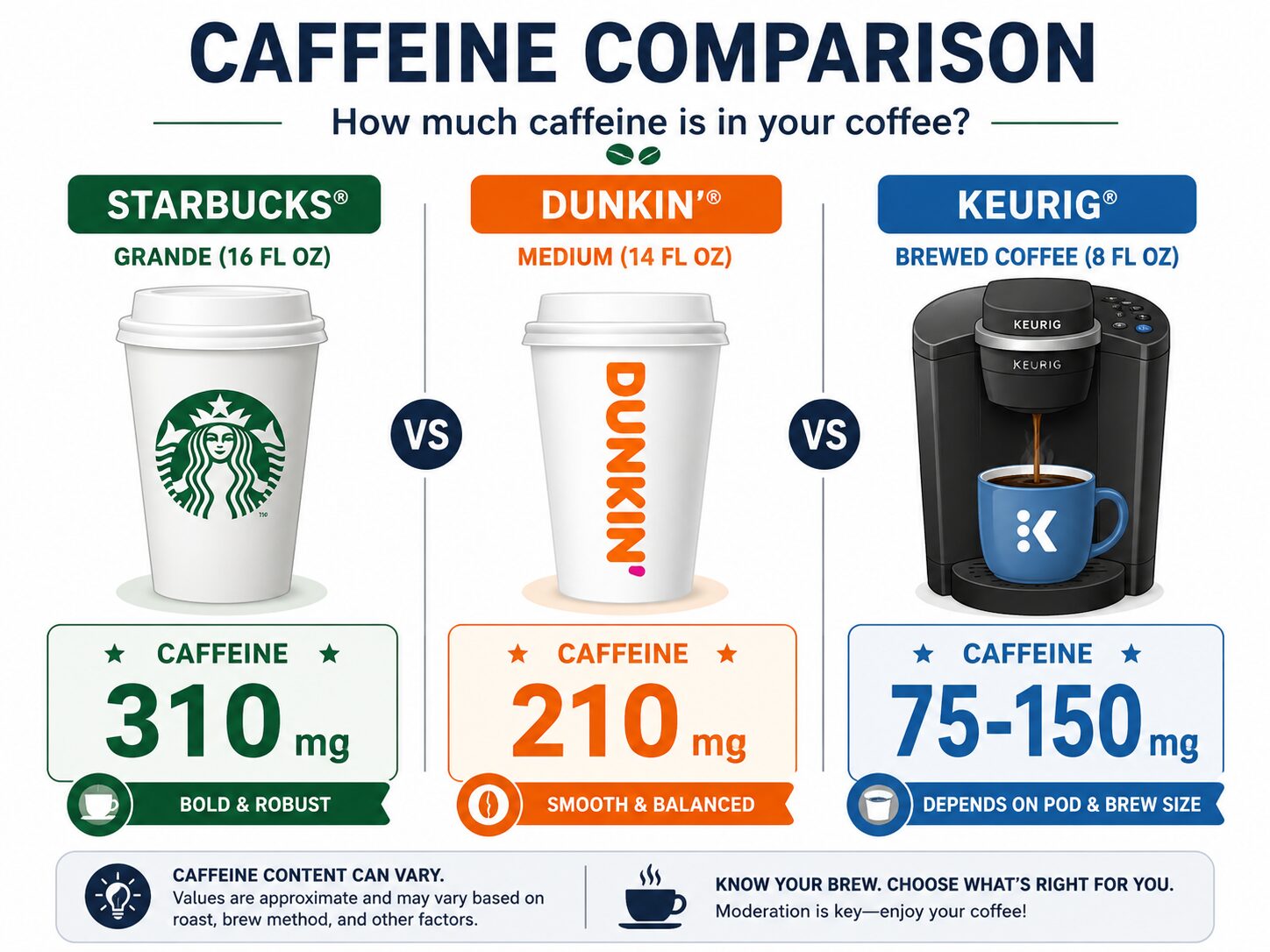
Forget averages. Major chains and pod manufacturers publish their data. This is the most reliable way to know what you’re drinking.
| Source | Serving Size | Caffeine (mg) | Notes |
| :— | :— | :— |
| Starbucks Pike Place Roast | Grande (16 fl oz) | 310 | Their brewed coffee is notably strong. A Tall (12 oz) has 235 mg. |
| Dunkin’ Original Blend | Medium (14 fl oz) | 210 | More in line with the classic “cup of coffee” expectation. |
| Keurig K-Cup (e.g., Green Mountain) | 8 fl oz brew | 75-150 | Varies wildly by pod. Light roasts and “extra bold” labels are on the higher end. |
| Home Drip (Generic) | 8 fl oz | 95-165 | Your result depends entirely on your recipe. |
The Starbucks number is the shocker for many. A 16-ounce Starbucks coffee has more caffeine than a standard 16-ounce Monster Energy caffeine drink (about 160 mg). It’s a potent dose. Meanwhile, a Keurig pod’s output is often weaker because the standard setting uses less coffee grounds for a faster brew.
If you’re tracking your intake, these published figures are essential. They show that a “medium coffee” isn’t a standard unit.
How It Compares: Tea, Energy Drinks, and Soda
Understanding black coffee’s caffeine content is easier with context. A typical 8-ounce cup (let’s say 120 mg) sits in the middle of a wide spectrum.
- Black Tea: An 8-ounce cup has 40-70 mg. The caffeine in black tea is about half that of coffee, and it releases more slowly due to tannins.
- Espresso Shot: A 1-ounce shot has 40-80 mg. It’s concentrated, but you drink less volume.
- Coca-Cola: A 12-ounce can has 34 mg. The caffeine in cola is trivial compared to coffee.
- Red Bull: An 8.4-ounce can has 80 mg. The caffeine in Red Bull is similar to a weak cup of coffee, but it’s combined with sugar and other stimulants.
- Cold Brew Concentrate: An 8-ounce serving can hit 200-250 mg. It’s the upper limit for standard coffee beverages.
This comparison reveals why switching to tea caffeine content can be a gentler choice, and why an energy drink might not pack the punch of your afternoon pour-over.
Managing Your Caffeine Intake
You now know the variables. To control your dose, you control the levers.
- Choose Your Bean: Stick to 100% Arabica for a lower-caffeine baseline. Actively seek Robusta if you want more.
- Measure by Weight: Use a kitchen scale for your coffee grounds. More grams equals more caffeine, directly. A 20g dose makes a milder cup than a 30g dose.
- Shorten the Brew: For immersion methods, a 3-minute steep extracts less caffeine than a 5-minute steep. For drip, a smaller brew cycle (like a single cup on your machine) often uses less coffee.
- Dilute Strong Brews: Add hot water to your French press cup or cold brew concentrate. This is how you enjoy the flavor without the full jolt.
- Know Your Sources: When buying out, remember the chain coffee numbers. A Starbucks Tall is a safer bet than a Venti if you’re sensitive.
If you’re looking to reduce intake, consider blending with decaffeinated coffee options or switching part of your routine to a caffeine-free alternative like herbal tea. Research from the NIH PMC research article on factors affecting caffeine content emphasizes that the coffee-to-water ratio is the single most controllable variable for the home brewer.
TL;DR: To lower caffeine, use less coffee by weight. To increase it, use more coffee or a Robusta blend. Everything else is fine-tuning.
Frequently Asked Questions
Does dark roast coffee have more caffeine than light roast?
No, by weight it has slightly less. The roasting process breaks down caffeine molecules. However, because dark roast beans are less dense, a scoop of dark roast may contain fewer beans and thus less total caffeine than a scoop of light roast. The difference is small compared to the impact of bean type or brew method.
Is cold brew higher in caffeine than hot coffee?
Yes, but with a caveat. Cold brew concentrate is extremely high in caffeine per ounce due to a high coffee-to-water ratio and long steep time. However, it’s usually diluted. A typical 16-ounce serving of prepared cold brew contains roughly 200 mg of caffeine, which is on the high end for a cup of coffee but not an astronomical amount.
How much caffeine is in a cup of black coffee from Starbucks?
It depends on the size and blend. A Grande (16 oz) of their standard Pike Place Roast contains 310 mg of caffeine. A Tall (12 oz) has 235 mg, and a Venti (20 oz) has 410 mg. Their blonde roast, which is a lighter roast, actually has slightly more caffeine per serving.
Does the type of coffee bean affect caffeine?
Absolutely. Robusta beans contain nearly double the caffeine of Arabica beans (about 2.2-2.7% vs. 1.2-1.5% by weight). A cup made with a Robusta blend will be significantly more stimulating than one made with 100% Arabica, even if the brewing method is identical.
Before You Go
The caffeine in your black coffee is not a mystery. It’s a formula. Start with the bean. Arabica or Robusta. Then apply the brewing method, which dictates extraction efficiency. Finally, account for the actual serving size, which is where chain coffee numbers can deceive you.
Forget the 95 mg average. Your cup is unique. If you want a consistent dose, weigh your coffee and time your brew. If you want a milder lift, choose Arabica and a shorter steep. And if you need that powerful kick, now you know how to build it. The control is in your grinder and your kettle.
{
“@context”: “https://schema.org”,
“@type”: “HowTo”,
“name”: “How to Calculate Caffeine in Your Black Coffee”,
“totalTime”: “PT5M”,
“tool”: [
{
“@type”: “HowToTool”,
“name”: “Standard 8-ounce measuring cup”
},
{
“@type”: “HowToTool”,
“name”: “Kitchen scale (optional)”
},
{
“@type”: “HowToTool”,
“name”: “Coffee brewer of choice”
}
],
“step”: [
{
“@type”: “HowToStep”,
“name”: “Identify your brew method and serving size”,
“text”: “Note whether you’re drinking drip coffee, espresso, French press, or cold brew, and measure the fluid ounces.”
},
{
“@type”: “HowToStep”,
“name”: “Apply the baseline range for your method”,
“text”: “Use 95-165 mg per 8 oz for drip, 40-80 mg per 1 oz shot for espresso, or 150-250 mg per 8 oz for cold brew concentrate.”
},
{
“@type”: “HowToStep”,
“name”: “Adjust for your specific coffee”,
“text”: “Factor in bean type (Robusta has nearly double the caffeine of Arabica) and roast level (darker roasts have slightly less caffeine by weight).”
},
{
“@type”: “HowToStep”,
“name”: “Check brand-specific data if available”,
“text”: “For chain coffee, reference published numbers: a Starbucks Grande (16 oz) Pike Place has 310 mg; a Dunkin’ Medium (14 oz) has 210 mg.”
}
]
}
{
“@context”: “https://schema.org”,
“@type”: “FAQPage”,
“mainEntity”: [
{
“@type”: “Question”,
“name”: “Does dark roast coffee have more caffeine than light roast?”,
“acceptedAnswer”: {
“@type”: “Answer”,
“text”: “No, by weight it has slightly less. The roasting process breaks down caffeine molecules. However, because dark roast beans are less dense, a scoop of dark roast may contain fewer beans and thus less total caffeine than a scoop of light roast. The difference is small compared to the impact of bean type or brew method.”
}
},
{
“@type”: “Question”,
“name”: “Is cold brew higher in caffeine than hot coffee?”,
“acceptedAnswer”: {
“@type”: “Answer”,
“text”: “Yes, but with a caveat. Cold brew concentrate is extremely high in caffeine per ounce due to a high coffee-to-water ratio and long steep time. However, it’s usually diluted. A typical 16-ounce serving of prepared cold brew contains roughly 200 mg of caffeine, which is on the high end for a cup of coffee but not an astronomical amount.”
}
},
{
“@type”: “Question”,
“name”: “How much caffeine is in a cup of black coffee from Starbucks?”,
“acceptedAnswer”: {
“@type”: “Answer”,
“text”: “It depends on the size and blend. A Grande (16 oz) of their standard Pike Place Roast contains 310 mg of caffeine. A Tall (12 oz) has 235 mg, and a Venti (20 oz) has 410 mg. Their blonde roast, which is a lighter roast, actually has slightly more caffeine per serving.”
}
},
{
“@type”: “Question”,
“name”: “Does the type of coffee bean affect caffeine?”,
“acceptedAnswer”: {
“@type”: “Answer”,
“text”: “Absolutely. Robusta beans contain nearly double the caffeine of Arabica beans (about 2.2-2.7% vs. 1.2-1.5% by weight). A cup made with a Robusta blend will be significantly more stimulating than one made with 100% Arabica, even if the brewing method is identical.”
}
}
]
}
