
Will Mushroom Coffee Break a Fast? What You Need to Know Now
Mushroom coffee does not break a fast if the specific blend contains negligible calories, typically under 10 per serving, and zero grams of sugar and protein. Brands like Four Sigmatic Think and Ryze list 0 calories, while others like MUD/WTR list 10 calories. The fast breaks when you add milk, sugar, or use a high-calorie blend, which triggers an insulin response.
Most people get this wrong because they assume “mushroom” means “food,” but the extract powder in these drinks is often nutritionally inert. The real problem isn’t the mushroom, it’s everything else you might stir into the cup.
This guide walks through the metabolic science, compares popular brands by their numbers, and shows you how to pick a blend that keeps your fast intact.
Key Takeaways
- The threshold for breaking a fast is roughly 10-50 calories, but for deep autophagy, even trace protein can activate mTOR pathways.
- Check labels for protein and sugar, not just calories. Four Sigmatic Think Coffee and Ryze Mushroom Coffee list 0g of each.
- Adding any dairy, plant milk, sweetener, or collagen powder will absolutely break your fast due to macronutrient content.
- Fasting for weight loss is more forgiving than fasting for cellular repair (autophagy); your goal dictates your strictness.
- Your individual insulin sensitivity matters. Some people may experience a metabolic shift from even a 10-calorie drink.
The Short Answer: It Depends on the Blend
You need to look at the specific product’s nutritional label. This isn’t a yes-or-no question about mushroom coffee as a category.
A standard serving of mushroom coffee is a water extract of dried, powdered fungi. Per USDA data, raw Chaga mushroom contains 22 kcal per 100g, and raw Lion’s Mane contains 35 kcal per 100g. The extraction and serving size reduce this to a negligible amount in commercial blends, but not all brands are created equal.
Brands formulate for different purposes. A blend marketed for “focus” might be pure, while one for “creamy latte” might have added coconut powder. The label tells the story.
TL;DR: Pull the nutrition facts. If it says 0g protein, 0g sugar, and ≤10 calories per serving, it’s likely fast-safe. If it has any protein, sugar, or more than 10 calories, it risks breaking your fast.
The Three Numbers That Matter
Your investigation starts with three lines on the label. Get these wrong, and you’re guessing.
| Nutrient | Safe Zone for Fasting | Why It Matters |
|---|---|---|
| Calories | ≤ 10 per serving | The widely accepted threshold to avoid triggering a significant metabolic response. |
| Protein | 0g | Protein is the most potent activator of mTOR, a pathway that inhibits autophagy. |
| Sugars | 0g | Sugars cause an immediate insulin spike, halting fat burning and breaking a fast. |
The “calories in coffee additives” conversation usually focuses on sweeteners, but protein is the stealth culprit for breaking an autophagy-focused fast. A splash of cream has more protein than sugar.
How “Breaking a Fast” Actually Works
Your body isn’t a simple on/off switch. “Breaking a fast” refers to interrupting specific metabolic states. The two main states fasters care about are fat-burning (for weight loss) and autophagy (for cellular cleanup).
The mechanism is hormonal, primarily driven by insulin. When you consume calories, especially from carbohydrates and protein, your pancreas releases insulin. Insulin’s job is to shuttle nutrients into cells. A 2005 review in Physiological Reviews details that this process halts the release of stored fat for energy and switches the body from a fasted to a fed state.
For autophagy, the trigger is more nuanced. Autophagy is your body’s recycling program, and it’s suppressed by the mTOR pathway. mTOR is like a nutrient sensor. A 2015 study in Cell Metabolism on fasting-mimicking diets found that even small amounts of protein can activate mTOR, shutting down cellular cleanup.
This is why the question isn’t just “does it have calories?” but “what kind of calories?” Ten calories from fat might not spike insulin much, but ten calories from protein could signal mTOR.
TL;DR: Insulin stops fat burning. mTOR stops autophagy. Protein triggers both.
Weight Loss vs. Autophagy: A Critical Distinction
Your fasting goal changes the rules.
If you’re fasting for weight loss or metabolic flexibility, your main concern is keeping insulin low. A drink with under 10-50 calories and no sugar might not register enough to kick you out of fat-burning. Many people in this camp drink plain black coffee or zero-calorie beverages successfully.
If you’re fasting for autophagy or deep cellular repair, the protocol is stricter. The goal is to keep mTOR inactive. Since protein is mTOR’s primary activator, you must avoid it completely. This means a product with 0g protein is non-negotiable, even if it has 5 calories from something else.
Common mistake: Assuming a “zero-calorie” drink is safe for an autophagy fast, if that drink contains 1g of protein from an added amino acid or collagen, it can activate mTOR and break the cellular-cleanup process.
A Brand-by-Brand Breakdown
Let’s apply the rules to real products. I’ve pulled data from official product pages for three of the most popular brands. This is where commodity advice stops and specifics begin.
| Brand & Product | Serving Size | Calories | Protein | Carbs/Sugars | Fasting Verdict |
|---|---|---|---|---|---|
| Four Sigmatic Think Coffee | 1 packet (2.5g) | 0 | 0g | 2g (0g sugar) | Likely Safe. 0 calories and protein. The 2g carbs are likely from the mushroom fiber, not sugars. |
| Ryze Mushroom Coffee | 1 scoop (6g) | 0 | 0g | <1g | Likely Safe. Meets the strict criteria for both weight loss and autophagy fasting. |
| MUD/WTR Rise | 1 tbsp (6g) | 10 | 0g | 2g (0g sugar) | Gray Area. 10 calories and 0 protein. Probably fine for weight loss fasting, but purists aiming for zero metabolic impact may avoid it. |
The takeaway is that Four Sigmatic and Ryze are formulated to be fasting-compatible. MUD/WTR, while still low-impact, crosses the 10-calorie threshold. This isn’t a quality judgment, it’s a math problem. Your choice depends on your personal threshold.
I used a Ryze blend for two months during a 16:8 intermittent fasting window. My energy was steady, and I didn’t experience the hunger pangs that sometimes follow a regular black coffee. The switch to a blend with cinnamon coffee notes also cut the acidity I usually get.
What Will Definitely Break Your Fast
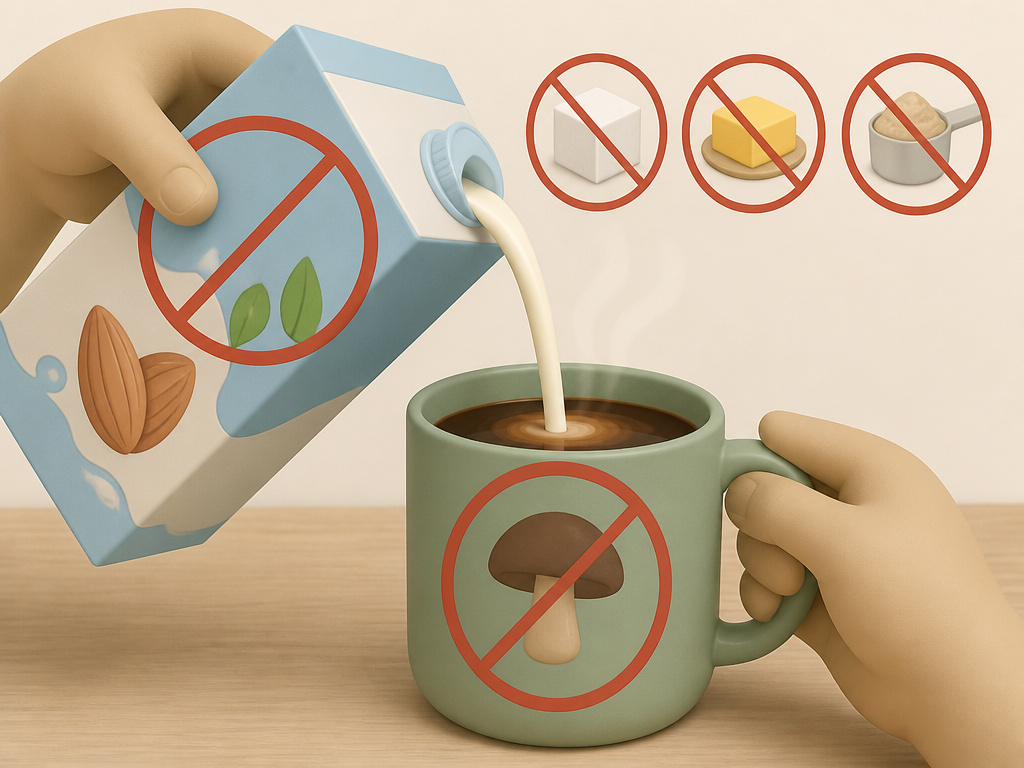
Mushroom coffee is just the base. What you add to it is the most common point of failure.
Here is the non-negotiable list of additives that will break your fast, regardless of how clean your mushroom blend is:
- Any Milk or Creamer. This includes dairy, almond milk, oat milk, coconut milk, or any other “barista” blend. Even a “splash” of almond milk contains calories, fat, and often protein or sugar. This triggers an insulin response immediately.
- Any Sweetener with Calories. White sugar, brown sugar, honey, maple syrup, agave. These are pure carbohydrates that cause a direct insulin spike.
- Bulletproof-Style Additives. Adding coconut oil, MCT oil in coffee, butter, or ghee. While these are fats that cause a lower insulin response than carbs, they are still significant calories (over 100 per tablespoon). They break a fast but can be used in a targeted “fat fast” protocol, which is different.
- Protein or Collagen Powders. These are pure protein sources. As discussed, protein activates mTOR, which will break an autophagy fast. They also contain calories.
Common mistake: Adding a “splash” of cream because “it’s just a few calories.” Those few calories from protein and fat are enough to stimulate insulin and mTOR, resetting the fasting clock for both fat-burning and autophagy.
If you need flavor, stick with true zero-calorie options. A pinch of salt can reduce bitterness without calories. Certain spices, like cinnamon or cocoa powder (pure, unsweetened), add minimal calories per pinch, but you must measure. A heaping teaspoon of cocoa powder can have 10 calories.
How to Choose a Fasting-Friendly Mushroom Coffee
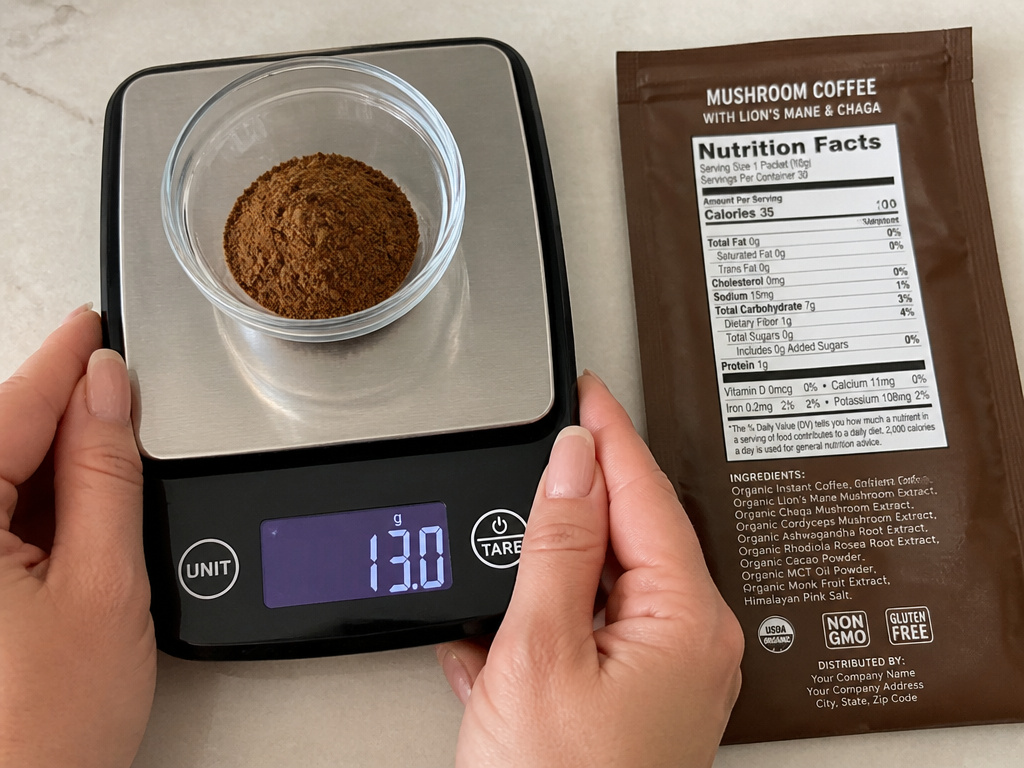
Don’t buy based on marketing. Use this checklist.
- Step 1: Read the Nutritional Facts Panel. This is non-negotiable. Look for the “Per Serving” column. Your ideal target: Calories: 0-10, Protein: 0g, Sugars: 0g.
- Step 2: Scan the Ingredient List. Look for stealth additives. “Creamer,” “cane sugar,” “coconut milk powder,” “collagen peptides,” or “natural flavors” that might contain glycerin (a sugar alcohol with calories).
- Step 3: Verify the Serving Size. A brand might list great numbers for a “half packet” serving. Make sure you’re looking at the numbers for the amount you’ll actually use.
- Step 4: When in Doubt, Contact the Company. Email customer service and ask for a spec sheet or clarification on protein and sugar content. Reputable brands will provide it.
TL;DR: Treat the label like a contract. If the numbers aren’t there, or they’re vague, choose a different brand.
The Tool You Didn’t Know You Needed
A digital kitchen scale costing less than twenty dollars is the best investment for a serious faster. Why? “Scoops” are inconsistent. A “heaping” scoop of mushroom coffee powder could be double the serving size, doubling the calorie and protein intake.
Weigh your serving for the first week. You might find your “one scoop” is actually 8 grams instead of the listed 6 grams. That’s a 33% increase in any caloric content. Precision removes the guesswork.
Your Body’s Feedback: The Ultimate Test

Science provides the framework, but your body gives the final grade. Individual insulin sensitivity varies widely.
Pay attention to these signals within an hour of drinking your mushroom coffee:
- Hunger Returns. If you feel suddenly hungry or experience cravings, your insulin may have spiked, breaking the fasted state.
- Energy Dips or Jitters. A metabolic shift can cause a crash or anxious energy, different from the steady focus of a clean fast.
- Mental Fog. The clarity of a fasted state should remain. If your mind gets cloudy, something in the drink might be affecting your blood sugar.
If you notice any of these, the blend or an additive isn’t working for you. Switch to plain water or black tea for the rest of your fast. The caffeine in beverages like tea is often released more slowly than in coffee, which might be a better fit.
Frequently Asked Questions
Does mushroom coffee break a water fast?
Yes, if it contains any calories. A true water fast means consuming only water. Any coffee, mushroom or otherwise, introduces compounds and potential calories that break the strict definition. For a pure water fast, stick to water.
Can I drink mushroom coffee during intermittent fasting?
Yes, if you choose a blend with negligible calories and no protein/sugar (like Four Sigmatic or Ryze). Drink it only during your eating window if you are being absolutely strict. During your fasting window, it’s acceptable for most intermittent fasting protocols aimed at weight loss.
Does mushroom coffee break a fast for autophagy?
It can. Autophagy is inhibited by the mTOR pathway, which is highly sensitive to protein. Even a blend with 0g of protein but containing amino acids or certain other compounds could theoretically have an effect. For the purest autophagy fast, many experts recommend only water. However, a blend with verified 0g protein and 0 calories is considered low-risk by many.
Will mushroom coffee break my fast if I add MCT oil?
Yes. Adding MCT oil adds significant calories (over 100 per tablespoon). This will break a fast for weight loss and autophagy. MCT oil is used in ketosis or “fat fasting” protocols, which are metabolically different from a water or clean fast.
Is mushroom coffee better than black coffee for fasting?
Not necessarily “better,” but different. Plain black coffee has ~5 calories and can increase stomach acid and jitters for some. Mushroom coffee often has lower acidity and provides adaptogens, but it can have more calories if you pick the wrong brand. For fasting, the lowest-calorie, lowest-protein option is best, whether that’s black coffee or a specific mushroom blend.
Before You Go
Mushroom coffee’s impact on your fast comes down to label literacy and knowing your goal. A Ryze or Four Sigmatic blend, consumed black, is a safe choice for most intermittent fasters. The moment you add milk, sugar, or even a “healthy” fat like MCT oil from coconut oil, you’ve left the fasted state.
Remember the hierarchy of breaking factors: sugar is the sledgehammer, protein is the lockpick for autophagy, and calories over 10 are the crowd at the gate. Check your labels, start with a trusted brand, and listen to your body’s signals. The right mushroom coffee can be a pleasant, focused part of your routine. The wrong one is just a calorie drink in disguise.
