
Can You Put Whey Protein in Coffee? How to Avoid Clumping
This post contains affiliate links. As an Amazon Associate, we earn from qualifying purchases.
Yes, you can put whey protein in coffee, but pouring powder directly into a steaming mug guarantees clumps. The proteins denature and bind together instantly above 158°F (70°C), turning your drink into a grainy mess. A smooth mix requires cooling the coffee first and pre-dissolving the powder in cold liquid.
Everyone tries the direct scoop method once. You watch the powder hit the black surface and instantly morph into floating, chewy islands. The spoon just pushes them around. That failure is a physics and chemistry lesson, not a cooking mistake.
This guide walks through the why, then gives you three proven methods that work. We will also look at what the heat does to the protein’s nutritional value and why your coffee’s acidity matters more than you think.
Key Takeaways
- Whey protein begins to denature and clump at temperatures above 158°F (70°C), a threshold most fresh coffee exceeds.
- Pre-mixing the powder with a few tablespoons of cold water or milk creates a buffer paste that prevents instant clumping when hot coffee is added.
- For guaranteed smoothness, use a blender bottle or immersion blender; the mechanical force overpowers the proteins’ tendency to bind.
- The nutritional profile (protein content, amino acids) of whey is largely unaffected by coffee heat, but its solubility and texture change completely.
- Cold brew or iced coffee eliminates the clumping problem entirely and is the most foolproof method.
The Science Behind the Clump
Pouring whey protein into hot coffee is a brutal introduction to thermal denaturation. The proteins, which are folded into specific shapes, unfold when heated. This exposes hydrophobic parts that desperately want to stick to each other.
Heating whey protein above 70°C (158°F) leads to significant changes in its structure, impacting solubility and potentially causing precipitation. This aggregation is more pronounced at pH values close to the protein’s isoelectric point.
Sources: Journal of Dairy Science (2013) & Food Hydrocolloids (2011)
Coffee is a double threat. It is hot, often around 195°F (90°C) right after brewing. It is also acidic, with a pH typically between 4.85 and 5.10. That pH range is dangerously close to whey protein’s isoelectric point (around 4.5-5.2), where its net charge is zero and it is least soluble. Heat plus that specific acidity makes aggregation, the technical term for clumping, almost inevitable.
TL;DR: Hot, acidic coffee is the perfect storm to unfold whey proteins and glue them together into lumps. Cooling the coffee first is a non-negotiable step.
Whey Concentrate vs. Isolate: Does It Matter?
All whey protein will clump in hot liquid, but not equally. The processing difference between concentrate and isolate changes the starting lineup.
Whey protein concentrate contains 70-80% protein by weight. The remaining 20-30% is lactose (milk sugar) and fats. Whey protein isolate is processed further to remove almost all of this lactose and fat, resulting in a product that is 90%+ pure protein.
| Type | Protein Purity | Likelihood to Clump in Hot Coffee | Best Use Case |
|---|---|---|---|
| Whey Concentrate | 70-80% | Higher | Cold brew, iced coffee, post-mixing |
| Whey Isolate | 90%+ | Moderate | All methods, slightly more forgiving |
The fats and lactose in concentrate can sometimes interfere with smooth mixing, but the isolate’s purity isn’t a free pass. Its proteins will still denature just as fast. The real advantage of an isolate is for those who are lactose-sensitive and want to avoid adding dairy-free coffee creamers to their routine. For mixing, your technique matters far more than the type of whey.
Your 3-Step Mixing Method, Ranked
These methods progress from “better than nothing” to “bulletproof.” The goal is always to manage the temperature shock to the protein.
Method 1: The Pre-Mix (The Minimum Viable Fix)
This is the bare minimum to avoid a cup full of rubbery blobs. It requires a second vessel.
- Brew and wait. Let your coffee sit for 2-3 minutes after brewing. This brings it down to around 160°F (71°C).
- Create a paste. In a separate cup or small bowl, add one scoop of whey protein. Add just enough cold liquid, two tablespoons of water, milk, or a plant-based milk alternative, to submerge the powder.
- Whisk aggressively. Use a fork or small whisk to beat the mixture into a completely smooth, lump-free paste. Any dry pockets here will become clumps later.
- Temper and combine. Slowly pour your cooled coffee into the cup with the protein paste, stirring constantly. The gradual temperature increase allows the proteins to integrate.
Common mistake: Adding the protein paste to the hot coffee instead of the coffee to the paste. Pouring the dense paste into the hot bath still causes mini-clumps at the interface. You want the hot liquid to flow into the paste.
This method works about 85% of the time. The other 15% is when your coffee was still too hot or you didn’t whisk hard enough.
Method 2: The Cool-Down Blend (The Reliable Standard)
This is the most consistent method for a single serving without extra gadgets. It uses temperature control as its primary tool.
- Brew your coffee directly into a large mug or a heat-safe blender bottle.
- Immediately add a handful of ice cubes or a refrigerated low-calorie coffee addition like cold milk. Stir until the coffee feels just warm to the touch, not hot.
- Add your scoop of whey protein powder directly onto the cooled coffee.
- Seal the blender bottle and shake vigorously for 20-30 seconds, or use a milk frother/immersion blender for 10 seconds.
The mechanical force from shaking or blending breaks up any protein aggregates that start to form. The cooler temperature means they form slower and are easier to disrupt. This is how I make mine most mornings. The texture is consistently smooth, and it’s faster than dirtying a second bowl.
Method 3: The Blender Bottle or Immersion Blender (The Guarantee)
For absolute, no-excuses smoothness, you need mechanical intervention from the start. This is the method recommended in many YouTube tutorials for a “high protein coffee recipe.”
- Add your cooled coffee (or even cold brew) to the blender bottle first.
- Drop in your scoop of whey protein.
- Add any other healthy coffee additives like MCT oil or a pinch of salt.
- Secure the lid and shake with purpose for 15-20 seconds. If using an immersion blender, blend for 5-7 seconds.
The wire whisk ball in a blender bottle is designed to obliterate clumps. An immersion blender does the same. This method completely overrides the denaturation chemistry with sheer physics. It never fails.
Does Hot Coffee Destroy the Protein?
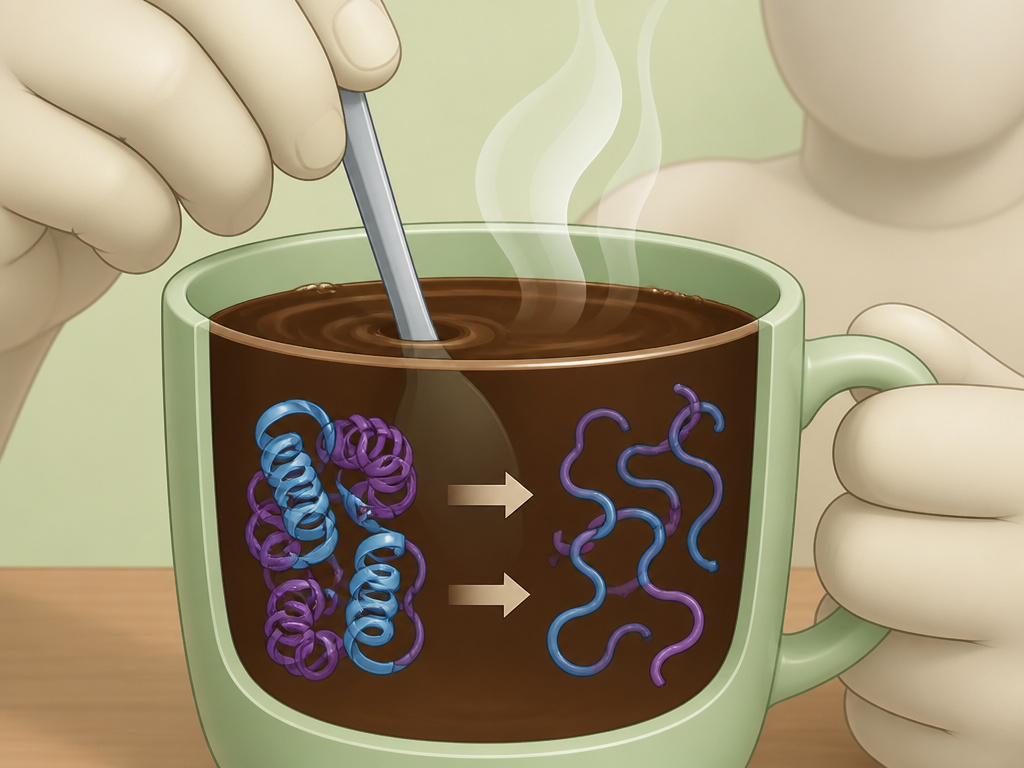
This is the biggest concern for people using protein for muscle repair. The short answer is no, the heat from coffee does not “destroy” the protein in a way that ruins its nutritional value.
Denaturation is not destruction. It is a change in the protein’s three-dimensional structure. Your digestive system denatures proteins anyway with stomach acid and enzymes to break them into amino acids. The primary nutritional components, the amino acid chains, remain intact. You will still get the same protein content, the same branched-chain amino acids (BCAAs).
What you lose is solubility and sometimes a slight amount of bioavailability if the clumps are so severe they pass through digestion undigested. That is why the texture issue is a practical concern, not just an aesthetic one. A gritty, clumpy drink might not deliver the protein as efficiently as a smooth one.
When to Absolutely Avoid Mixing Them
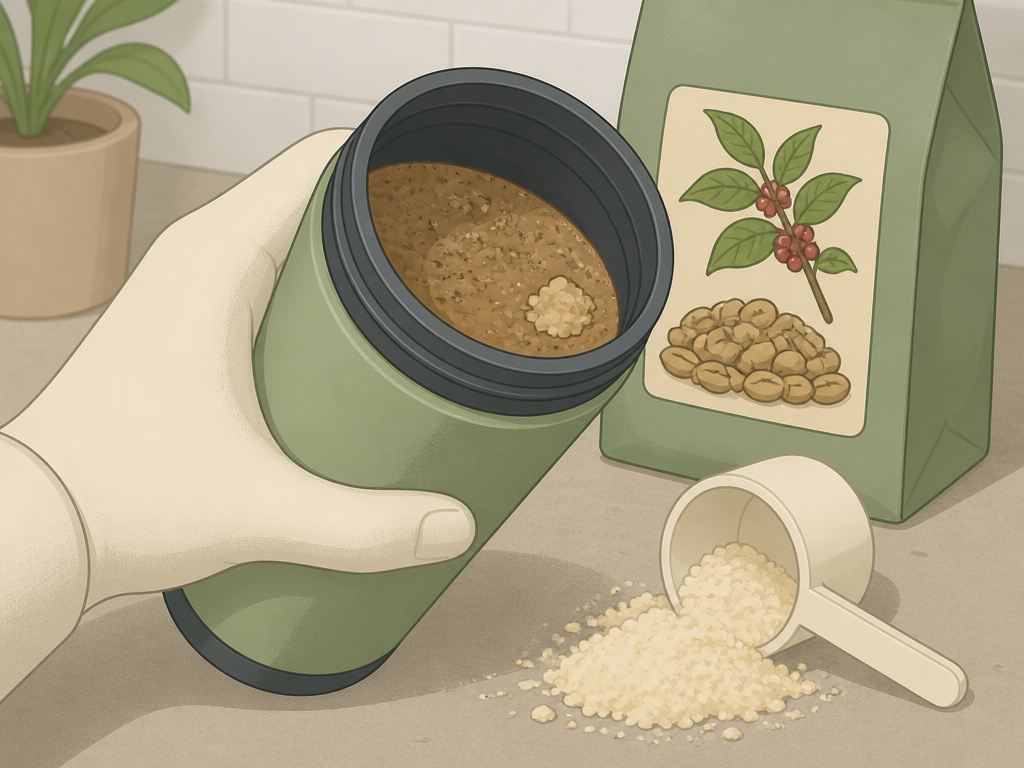
Some scenarios turn this from a tricky hack into a bad idea.
- With Light Roast or High-Acidity Coffees: A light roast Ethiopian Yirgacheffe can have a pH closer to 4.7. That nudges it right into whey protein’s clumping sweet spot. Even with perfect technique, you might get a slightly grainy texture.
- In a Thermal Travel Mug: If you pre-mix a protein coffee and seal it in an insulated mug for an hour, the retained heat will continue to slowly cook the proteins. It can develop a faint, chalky aftertaste by the time you finish it.
- For Flavor-Pure Coffee Tasting: If you’re trying to evaluate the nuanced notes of a new single-origin bean, adding whey protein with flavoring will obliterate them. Save the protein for your daily driver brew.
For these situations, consider having your coffee first, then a separate protein shake. Or, explore the acidity in beverages to find a lower-acid coffee that plays nicer.
The Cold Brew Loophole
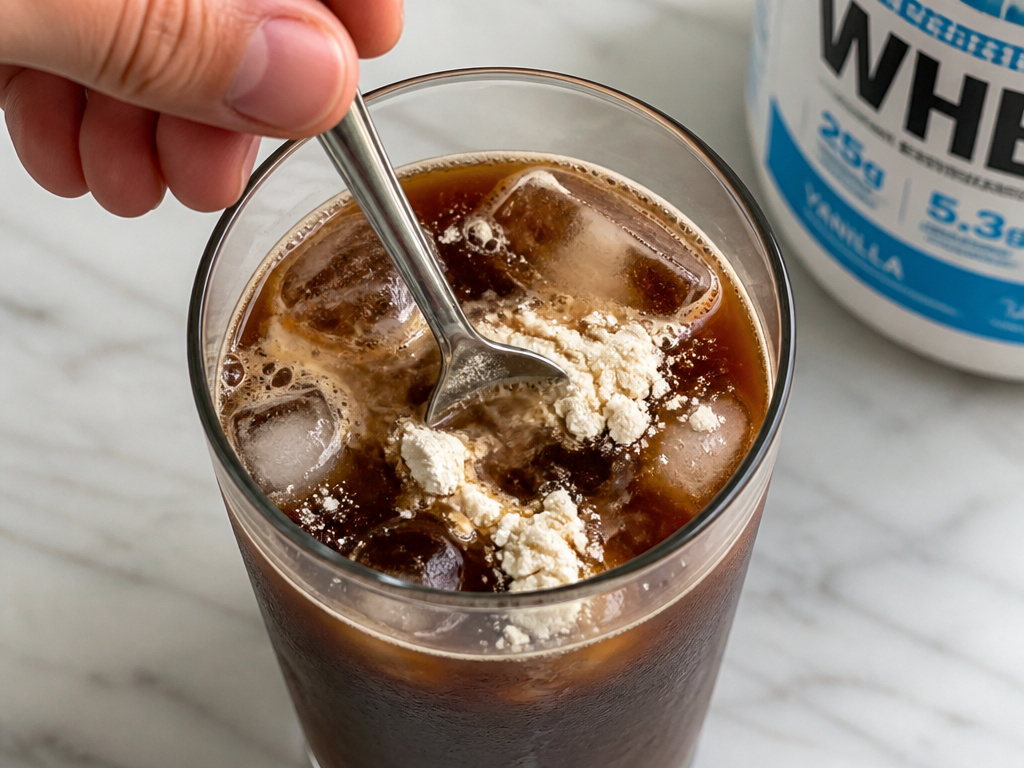
Cold brew coffee is the ultimate cheat code. Brewed with cold water over 12-24 hours, it never touches heat. Its pH is also often slightly higher (less acidic) than hot-brewed coffee.
Mixing whey protein into cold brew is trivial. You can literally stir a scoop into a glass of it with a spoon and get a nearly smooth result. The proteins have no thermal shock to react to. This is the most foolproof method by far and a great place to start if you’re new to the combination. It also aligns well with other healthy flavoring options for a ready-to-drink meal replacement.
Frequently Asked Questions
Does whey protein in coffee taste good?
It tastes like coffee with protein powder in it. Chocolate or vanilla protein can mimic a latte or mocha. Unflavored protein will make your coffee taste milky and slightly savory. The aftertaste is the biggest hurdle for many, which is why strong brewing or a dash of alternative coffee sweetener can help.
Can I just use a spoon to mix it?
You can try. You will fail. Without pre-mixing or mechanical blending, the spoon merely creates vortexes that trap dry powder inside clumps. The center of those clumps will remain chalky and undissolved.
Is it better to put protein in coffee or have them separately?
This depends on your goal. For convenience and combining two morning rituals, mixing is efficient. For optimal absorption and to avoid any potential nutrient interaction, having them separately spaced by 15-30 minutes might be marginally better. There is no strong evidence against mixing them, just practical texture challenges.
Will this make my coffee frothy?
Yes, especially if you use a blender bottle or immersion blender. The protein acts as a surfactant, trapping air and creating a stable foam. This can be a pleasant texture, similar to a cappuccino foam.
How does this compare to caffeine pills with a protein shake?
You get the same chemical combination but a completely different experience. Drinking a protein coffee is a ritual and a beverage. Taking a pill with a shake is a supplementation protocol. The caffeine content differences between a cup of coffee and a pill are also worth checking if you’re sensitive.
The Bottom Line
You can absolutely put whey protein in coffee if you respect the chemistry. The enemy is temperature shock. Cool your coffee below 160°F before introducing the powder, and always pre-dissolve it in a cold liquid first. For a guarantee, use a blender bottle.
The protein’s nutrition survives the heat, but its texture does not. If you’re constantly battling clumps, switch to cold brew. It is the simplest path to a smooth, high-protein coffee drink that actually tastes like something you want to finish.
