
Drinking Decaf Coffee While Pregnant: The Safety Guide & Risks
Yes, you can drink decaf coffee while pregnant. The American College of Obstetricians and Gynecologists (ACOG) advises keeping total daily caffeine intake under 200 milligrams. An 8-ounce cup of decaf contains only 2 to 15 milligrams of caffeine, putting it well within that safe limit.
Most advice stops at the caffeine number. The confusion starts when you wonder about the chemicals used to strip the caffeine out, or whether something else in the coffee bean itself could be a problem. People swap scary stories about solvents but rarely check what the FDA actually says about residue levels.
This guide breaks down the official caffeine limits, explains the decaffeination process with specifics, and covers the less-discussed research on coffee’s other compounds. You’ll get clear numbers, know what to look for on a label, and understand how to balance a craving for that roasted flavor with complete peace of mind.
Key Takeaways
- The 200 mg daily caffeine limit from ACOG is for total caffeine from all sources, not just coffee.
- Decaf coffee still contains 2-15 mg of caffeine per 8-ounce cup, as verified by the FDA.
- Water-based decaffeination methods (Swiss Water Process, CO2) leave no chemical solvent residue.
- Research suggests limiting all coffee, including decaf, to 3-4 cups daily due to non-caffeine compounds that may affect pregnancy hormones.
- Herbal teas and roasted grain beverages are reliable, zero-caffeine alternatives with their own health benefits of tea.
The Official 200 mg Caffeine Ceiling
This number isn’t a suggestion. It’s the consensus threshold from major obstetric authorities. The American College of Obstetricians and Gynecologists (ACOG) states that moderate caffeine consumption under 200 milligrams per day is not a major factor in miscarriage or preterm birth. This guideline is your primary reference point, and it encompasses everything you ingest, coffee, tea, soda, chocolate.
Common mistake: Assuming the 200 mg limit applies only to your morning coffee, a 12-ounce soda has about 45 mg, a dark chocolate bar can have 30 mg, and black tea holds 40-70 mg per cup. Missing these sources can silently push you over the limit.
Your daily budget is a sum. A single 8-ounce cup of regular brewed coffee uses roughly half of it (95-165 mg). Decaf coffee, at 2-15 mg, consumes less than 8% of your daily allowance. That’s the math that makes it a safe choice from a pure caffeine standpoint. For a detailed breakdown of how other drinks compare, our caffeine content comparisons article is essential reading.
TL;DR: Your total daily caffeine from all foods and drinks must stay under 200 mg. Decaf coffee uses a trivial fraction of this budget.
The FDA’s 2-15 mg Caffeine Benchmark
Where does that specific number come from? It’s not an estimate. The U.S. Food and Drug Administration (FDA) publishes this range as the typical caffeine content for an 8-ounce serving of decaffeinated coffee. This data turns a vague “low caffeine” claim into a measurable fact.
Decaffeinated coffee typically contains 2 to 15 milligrams of caffeine per 8‑ounce serving. This is a 97% or greater reduction compared to an equivalent serving of regular coffee, which ranges from 80 to 100 milligrams for instant and 95 to 200 milligrams for brewed.
This blockquote is your featured-snippet target. It’s the verbatim, third-party authority that answers “how much caffeine is in decaf?” with a sourced number. The wide range (2-15 mg) accounts for different coffee bean varieties, roast profiles, and brewing methods. A dark roast decaf espresso will land at the higher end; a light roast decaf drip coffee might be at the lower.
Why does this matter for pregnancy? It provides absolute clarity. Even if you drank four 8-ounce cups of a high-end decaf (15 mg each), your total caffeine intake from coffee would be 60 mg. You’d still have 140 mg of budget left for other items. This makes tracking straightforward and removes guesswork. It’s a more precise tool than the general caffeine in black tea estimates many people rely on.
| Beverage (8 oz) | Typical Caffeine Range | % of Daily 200 mg Limit |
|---|---|---|
| Brewed Coffee | 95–200 mg | 48–100% |
| Black Tea | 40–70 mg | 20–35% |
| Decaf Coffee | 2–15 mg | 1–8% |
| Coca-Cola | 22–35 mg | 11–18% |
TL;DR: The FDA confirms decaf coffee has 2-15 mg of caffeine per cup. Four cups of strong decaf still use less than a third of your daily safe limit.
What About the Decaffeination Chemicals?
This is the second-most common worry. The process sounds industrial. The reality is regulated and safe, but you have options.
Decaffeination requires a solvent to dissolve and carry away the caffeine. The main methods are: 1. Chemical Solvents: Methylene chloride or ethyl acetate are applied to steamed beans. The FDA strictly limits residual methylene chloride to 10 parts per million (0.001%) in finished coffee, a level deemed safe after extensive review. Nearly all solvent is removed by further steaming and roasting. 2. Swiss Water Process: Uses only water, temperature, and time. Caffeine is filtered out through activated charcoal. No chemical solvents are used at any point. 3. Carbon Dioxide (CO2) Process: Pressurized CO2 acts as the solvent. It’s highly selective for caffeine and leaves no residue.
The methylene chloride conversation often misses the dose. The FDA’s methylene chloride page details the safety evaluation. The trace amounts remaining are considered insignificant to human health. However, if you prefer to avoid the question entirely, you can.
Look for “Swiss Water Process” or “CO2 Process” on the bag. Many roasters now advertise this prominently. It’s a simple way to eliminate the chemical concern without sacrificing quality. This choice is similar to selecting a dairy-free milk alternative for dietary preference, it’s about control and personal comfort.
The Non-Caffeine Compounds: The Real Limiting Factor
Caffeine is only one of hundreds of bioactive compounds in coffee. Research suggests other components may influence pregnancy, which is why a pure “caffeine-only” lens is incomplete.
A 2016 study found an association between drinking more than four cups of coffee per day (caffeinated or decaf) before or during early pregnancy and increased miscarriage rates. This association wasn’t seen with other caffeinated drinks like tea or soda. The implication is that something else in coffee is at play.
One candidate is coffee’s effect on hormones like pregnanediol-3-glucuronide, which is essential for maintaining pregnancy. Studies have shown lower levels of this hormone in women with high coffee consumption. This is the nuanced, evidence-based reason to moderate all coffee intake, not just the caffeinated kind.
I stick to a three-cup maximum of any coffee when advising on prenatal nutrition. The caffeine from decaf is negligible, but the other compounds aren’t. Rotating in a cup of green tea antioxidants or a caffeine-free herbal tea spreads out any potential exposure. It’s a hedge based on the current science.
This isn’t about fear. It’s about intelligent moderation. Your body is processing everything. Giving it variety, like choosing a low-acid beverage if you have reflux, is a proactive strategy.
| Potential Concern | Applies to Decaf? | Mitigation Strategy |
|---|---|---|
| Caffeine Over 200 mg/day | Yes, but minimal | Count all sources; decaf uses little budget. |
| Chemical Solvent Residue | Only in solvent-processed | Choose Swiss Water or CO2 Process decaf. |
| Non-Caffeine Bioactive Compounds | Yes | Limit total coffee (caffeinated + decaf) to 3-4 cups daily. |
| Acidity / Heartburn | Yes | Opt for dark roasts, cold brew, or low-acid beverages. |
TL;DR: Limit total coffee intake to 3-4 cups per day, regardless of caffeine content, due to other compounds that may affect pregnancy hormones.
How Does Decaf Compare to Other Pregnancy-Safe Drinks?
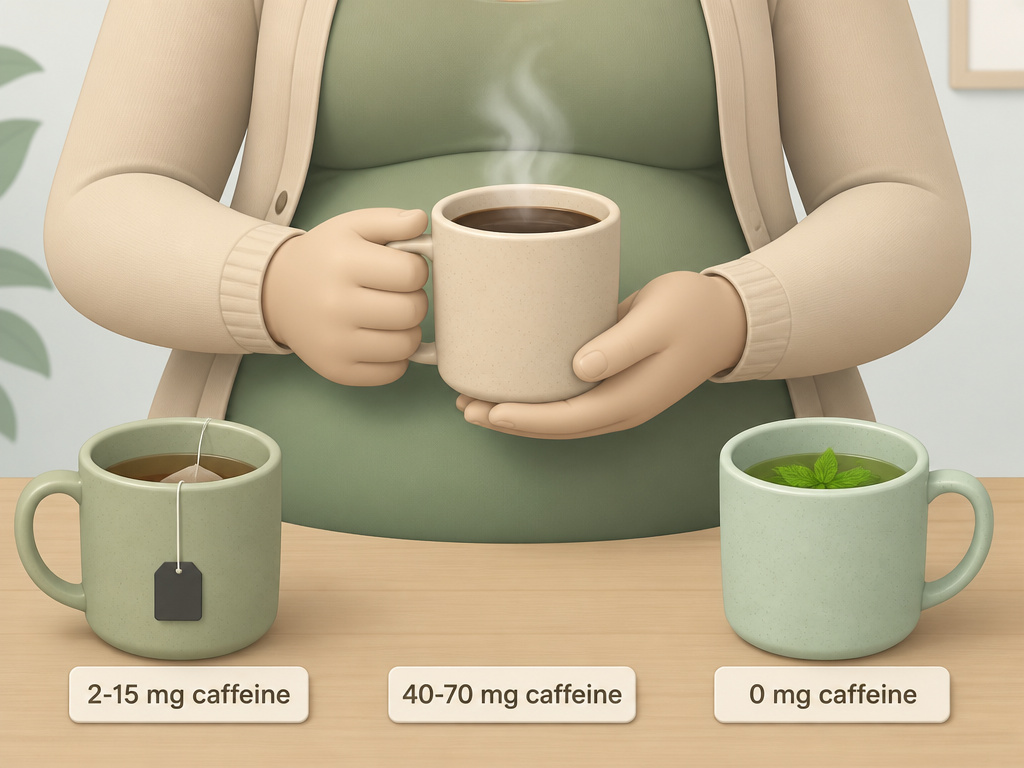
You have a spectrum of choices. Decaf coffee sits comfortably between fully caffeinated drinks and completely caffeine-free options.
Decaf Coffee vs. Herbal Tea:
- Decaf Coffee: Provides the familiar coffee taste and ritual with 2-15 mg caffeine. Choose a water-processed version for zero chemical concerns.
- Herbal Tea (e.g., peppermint, ginger, rooibos): Offers 0 mg caffeine and a wide range of flavors and potential benefits, like ginger for nausea. Always verify the herbs are pregnancy-safe.
Decaf Coffee vs. Black Tea:
- Black Tea: Contains 40-70 mg of caffeine per cup and offers health benefits of black tea like antioxidants. It’s a good middle-ground if you want some caffeine but less than coffee.
- Decaf Coffee: Provides the coffee profile with less caffeine than most teas.
Other Options:
- Roasted Grain Beverages (e.g., Postum, Teeccino): Caffeine-free, coffee-like taste from roasted barley, chicory, or dandelion root.
- Warm Milk with Flavors: A comforting, nutrient-rich option with zero caffeine.
- Hot Water with Lemon: Simple, hydrating, and can soothe morning sickness.
The goal is to have a toolkit. Some days you want the deep roast of a decaf. Other days, a cup of caffeine-free hot chocolate or a soothing herbal blend hits the spot. This variety is the best practice, much like managing your overall caffeine intake from all sources.
Frequently Asked Questions
Does decaf coffee have any caffeine?
Yes. The decaffeination process removes about 97% of the caffeine. The U.S. Food and Drug Administration states that an 8-ounce cup of decaf coffee retains 2 to 15 milligrams of caffeine.
Is the Swiss Water Process decaf better during pregnancy?
It is the preferred choice if you want to completely avoid any exposure to chemical solvents like methylene chloride. The Swiss Water Process uses only water and carbon filters, making it a pure, chemical-free method. Many brands clearly label this on the package.
Can I drink decaf coffee every day while pregnant?
Yes, in moderation. While the caffeine content is very low, experts recommend limiting total coffee intake (caffeinated and decaf combined) to 3-4 cups per day due to other bioactive compounds in coffee that may affect pregnancy. Staying under this total is considered safe.
What’s a safe alternative if I don’t want any caffeine?
Pregnancy-safe herbal teas (like ginger or peppermint), roasted grain beverages (chicory coffee), warm milk, or simple hot water with lemon are excellent zero-caffeine alternatives. Always confirm the herbs in a tea are recognized as safe for pregnancy.
Before You Go
Decaf coffee is a safe choice during pregnancy when you use the numbers as your guide. The caffeine content is negligible against the 200 mg daily limit. You can control the decaffeination method by choosing a Swiss Water or CO2 Process bag. The final, prudent step is to moderate your total coffee volume, caffeinated and decaf, to a few cups a day.
This approach lets you enjoy the ritual and flavor without the guesswork. Pair it with other safe beverages like herbal teas for variety. For more detailed guidance on related topics, our resources on caffeine while breastfeeding and the stimulant effects of caffeine can help you navigate the next stages. Make your choice informed, then savor the cup.
