
Can a Breastfeeding Mom Drink Coffee? The Safe Caffeine Guide
Yes, a breastfeeding mom can drink coffee. The consensus safe limit is 300 milligrams of caffeine per day, roughly equivalent to two to three 8-ounce cups of brewed coffee. Caffeine transfers into breastmilk at low concentrations, typically 0.8% to 1.5% of the maternal dose, and peaks about one hour after consumption.
The universal mistake is treating that 300mg number as a universal pass. It is not. That number assumes a healthy, full-term infant over a month old with mature liver function. For a premature baby or a fussy newborn, the real limit could be zero. The guideline also fails if you don’t know what 300mg actually looks like across different drinks and brewing methods.
This guide breaks down the official numbers from the NIH and CDC, shows you how to count your caffeine accurately, and gives you a timing strategy to minimize exposure. We’ll cover the specific signs of a sensitive baby and what to do if you see them.
Key Takeaways
- The 300mg daily limit from the CDC and NIH LactMed database is a ceiling, not a target. Start lower and observe.
- Caffeine’s half-life in a newborn is up to 97.5 hours versus 2.6–6.8 hours in an adult. This means it accumulates.
- The peak concentration in breastmilk happens about one hour after you drink your coffee. The best time to have it is right after a feeding.
- Sensitivity signs are fussiness, jitteriness, and poor sleep. They can appear even below the 300mg limit, especially in the first month.
- Your total caffeine count must include tea, soda, chocolate, and medication. A single energy drink can blow the budget.
The Official 300mg Guideline and Its Caveats
The 300-milligram figure isn’t a guess. It comes from the National Institutes of Health’s LactMed database, a peer-reviewed resource for clinicians. The entry states maternal intake up to 300 mg daily “produces no stimulation in most breastfed infants.” The CDC and the American Academy of Pediatrics echo this. But the second half of that LactMed sentence is the part people skip: “Very few adverse effects have been reported in infants of mothers consuming more than 300 mg daily.” The keyword is most. It also means effects have been reported above that line.
Common mistake: Assuming the 300mg limit is safe for a two-week-old, the half-life of caffeine in a full-term neonate can be 97.5 hours, so it builds up in their system with daily consumption, potentially leading to irritability even if you’re under the limit.
The guideline works for a robust, months-old infant. It fractures under two conditions: infant age and individual biology. A premature or newborn infant lacks the liver enzymes to process caffeine efficiently. The LactMed entry flags this explicitly. For these babies, the safe dose may be significantly lower, or you may need to avoid caffeine entirely for the first few weeks. The other crack is simple variation. Some babies are just more sensitive to stimulants.
TL;DR: The 300mg limit is a benchmark for older infants. For newborns and preemies, start at zero and add caffeine back slowly only after they show they can handle it.
Where That Caffeine Actually Goes
When you drink a coffee, the caffeine enters your bloodstream and a tiny fraction transfers into your breastmilk. The transfer rate is low, between 0.8% and 1.5% of the dose you consumed. If you drink a coffee with 100mg of caffeine, your baby gets the equivalent of about 1mg. That seems trivial. The problem is the baby’s weight and metabolism. A 10-pound infant is getting a micro-dose scaled to their tiny body.
The timing is predictable. Research shows caffeine concentration in breastmilk peaks about one hour after you ingest it. Levels then drop over the next several hours. This creates a clear strategy: drink your coffee immediately after nursing or pumping. By the time the next feeding comes around, the concentration in your milk has already started to fall. Waiting two or three hours is even better.
Calculating Your Real Caffeine Intake
You cannot manage to a 300mg limit if you don’t know what 300mg is. A “cup of coffee” is a useless measure. An 8-ounce cup of home-brewed coffee can range from 95mg to a stout 200mg of caffeine. A Starbucks grande (16oz) brewed coffee has about 310mg, already over the daily limit in one drink. You must account for all sources: black tea, green tea, soda, chocolate, and even some over-the-counter medications.
| Beverage / Food | Typical Serving | Caffeine Range (mg) |
|---|---|---|
| Brewed Coffee | 8 oz | 95–200 |
| Espresso | 1 shot (1 oz) | 64–75 |
| Black Tea | 8 oz | 40–70 |
| Green Tea | 8 oz | 20–45 |
| Cola | 12 oz | 30–40 |
| Dark Chocolate | 1 oz | 20–30 |
| Energy Drink | 8 oz | 70–150 |
This table reveals the traps. Having two large coffees and a square of dark chocolate puts you at risk of exceeding the limit. Switching to tea can be a good reduction strategy, but you still need to count it. Our deep dive on caffeine content in espresso vs coffee explains why brewing method changes everything. Similarly, understanding tea caffeine content helps you make informed swaps.
Common mistake: Forgetting hidden sources like chocolate or soda, they add up silently and can push a seemingly moderate coffee habit over the 300mg threshold.
TL;DR: Track every source. Use specific numbers, not “cups.” Two strong coffees plus a tea and a soda likely busts your budget.
The Critical Factor of Infant Age and Metabolism

This is the most non-negotiable part of the equation. An adult liver processes caffeine quickly, with a half-life of 2.6 to 6.8 hours. A newborn’s liver is immature. The half-life of caffeine in a full-term neonate can be as long as 97.5 hours. That means it takes their body up to four days to clear just half of the caffeine they receive. With daily maternal intake, the caffeine level in the infant’s system doesn’t plateau, it climbs.
For a premature infant, the situation is more pronounced. Their metabolic pathways are even less developed. The LactMed database and CDC guidance single out premature and newborn infants as being “more susceptible to adverse effects.” This isn’t a minor caution. It is the reason many pediatricians recommend avoiding caffeine entirely for the first month, especially if your baby was early.
The practical takeaway is that the 300mg guideline effectively increases with your baby’s age. At one month, you might tolerate 100mg. At three months, 200mg. By six months, with a baby sleeping longer stretches and feeding less frequently, the full 300mg might be fine. You scale up slowly, watching for signals.
How to Spot a Caffeine-Sensitive Baby
You need to know what you’re looking for. The signs are not subtle if you know the timeline. After you consume caffeine, it peaks in your milk at one hour and can affect your baby for several hours after that. Watch the 4- to 8-hour window following your coffee.
The signals include:
* Hyper-alertness or jitteriness: The baby is wide-eyed, arms and legs may tremble slightly, and they cannot settle.
* Uncharacteristic fussiness or irritability: They cry more than usual and are difficult to console, unrelated to hunger or a dirty diaper.
* Short, fitful sleep or refusal to sleep: They fight naps, wake frequently, or only sleep in short bursts.
If you see this pattern repeatedly after you have caffeine, you have a sensitive baby. The solution is not to panic. It’s to cut back or cut out caffeine for a week, see if the behavior improves, and then try reintroducing a much smaller amount, like half a cup of coffee, to test the waters. This process of observation and adjustment is more valuable than any fixed number. For related digestive sensitivities, our article on coffee stomach discomfort outlines how individual physiology varies.
A Practical Strategy: Timing and Alternatives
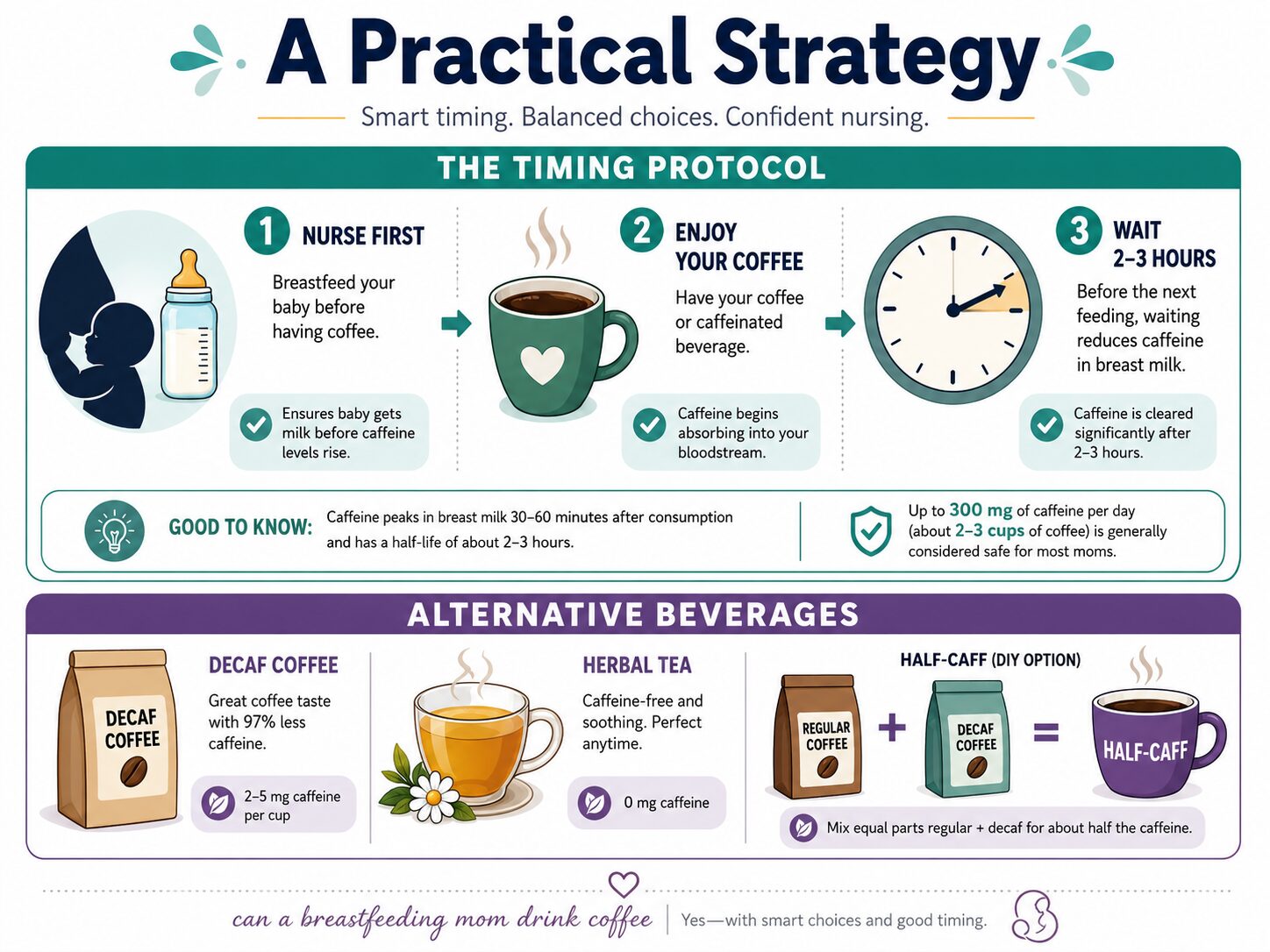
The goal is to enjoy your coffee without disrupting your baby. The strategy has two parts: when you drink it and what you drink.
The Timing Protocol:
- Feed or pump your baby.
- Then make and drink your coffee.
- Aim for the next feeding to be 2-3 hours later, when the caffeine concentration in your milk is lower.
This simple sequence leverages the one-hour peak. It’s the most effective thing you can do to minimize dose.
Alternative Beverages:
If you need to reduce or eliminate caffeine, you have options.
* Decaffeinated Coffee: Good decaf removes 97% or more of the caffeine. A cup might have 2-5mg, which is negligible.
* Herbal Tea: Most herbal teas are naturally caffeine-free (check labels, some blends have black or green tea). Chamomile, peppermint, and rooibos are safe choices.
* Half-Caff: Brew your pot with half regular and half decaffeinated beans. This is an easy way to halve your dose without changing routine.
Exploring low-acid beverages can also help if general digestive comfort for you is a concern. For a broader look at options, the health benefits comparison between tea and coffee provides context for making a switch.
I switched to half-caff for the first four months with my second child. The full-strength stuff made him twitchy and angry by afternoon naptime. Half-caff gave me the ritual and warmth without the four-hour fallout. It was a compromise that worked.
TL;DR: Drink after feeding, not before. Use decaf or half-caff as tools to dial in the right dose for your specific baby.
What About Energy Drinks and Other High-Caffeine Sources?
Energy drinks are a different category. A single 8-ounce can of a mainstream brand like Red Bull or Monster can contain 70 to 150mg of caffeine from the extract alone. But that’s not the only issue. They also contain high levels of sugar, artificial sweeteners, and a cocktail of other stimulants like taurine and guarana. The transfer of these additional compounds into breastmilk is not well studied.
The CDC’s maternal diet guidelines focus on balanced nutrition and do not specifically endorse energy drinks for breastfeeding mothers. The concentrated dose and extra ingredients introduce unnecessary variables. It is far more prudent to get your caffeine from a single-source beverage like coffee or tea, where the content is more predictable and the ingredient list is simple.
Our comparisons of Red Bull vs coffee and Monster Energy vs coffee detail the stark differences in serving sizes and additional ingredients. The consensus from health authorities on energy drinks vs coffee is clear: coffee is the known, studied quantity for breastfeeding.
Frequently Asked Questions
Can one cup of coffee a day affect my breastfed baby?
Probably not, but it depends on the cup and the baby. A standard 8-ounce cup of coffee (95-200mg) is within the safe limit for an older infant. However, if your baby is under one month old, premature, or naturally sensitive to stimulants, even one cup could cause fussiness or sleep issues. Observe your baby’s behavior in the hours after your coffee.
How long should I wait to breastfeed after drinking coffee?
The optimal wait is 2-3 hours. Caffeine peaks in your breastmilk about one hour after consumption, so waiting a couple of hours allows the concentration to drop significantly. A practical method is to drink your coffee immediately after a feeding session to maximize the time until the next one.
Does caffeine decrease milk supply?
No, moderate caffeine consumption does not decrease milk production. However, dehydration can affect supply. Since caffeine is a mild diuretic, ensure you drink an extra glass of water for each caffeinated beverage to stay well-hydrated. The primary concern with caffeine is its effect on the baby’s behavior, not on supply.
Are there any long-term effects on the baby from drinking coffee while breastfeeding?
According to long-term studies cited in resources like the NIH’s LactMed caffeine monograph, there is no evidence that moderate maternal caffeine consumption causes long-term developmental problems in children. The documented effects are short-term and behavioral, like sleep disruption or irritability, which resolve when caffeine intake is reduced.
What if I accidentally had more than 300mg of caffeine?
Don’t panic. A single occasional exceedance is unlikely to cause harm. Hydrate well with water, and space out your next feeding if possible. Monitor your baby for signs of sensitivity over the next 8-12 hours. The risk comes from chronic, daily overconsumption, not a one-time event. Simply return to your normal limit the next day.
The Bottom Line
You can have your coffee. The 300mg daily limit from the CDC and NIH is a reliable guardrail for most mothers with infants over a month old. The work is in the details: measuring your actual intake across all sources, timing your consumption right after a feed, and watching your baby like a hawk for signs of jitteriness or sleep refusal.
The rule bends for newborns and preemies, their long caffeine half-life means caution is the default. When in doubt, cut back, use decaf, or pause entirely for a few weeks. The coffee will still be there. The fleeting, quiet moments with a content, sleeping baby are what you’re protecting.
