Mushroom Coffee for Diabetics: Is It Good & What Dose Works?
Mushroom coffee might help type 2 diabetes by improving insulin sensitivity, but the dose in most commercial blends is too low to match the research. You need 750 to 3,000 milligrams of a specific mushroom extract per day, while a typical cup of mushroom coffee delivers only 100 to 250 milligrams of a blended powder.
Most people get that wrong. They buy a trendy mushroom coffee blend, see “lion’s mane and reishi” on the label, and assume they’re getting a therapeutic dose. The packaging rarely mentions that the studied benefits come from pure extracts at volumes several times higher.
This guide breaks down the real research on mushrooms and blood sugar, explains why most pre-mixed coffees fall short, and shows you how to build a protocol that actually follows the science. We’ll cover the specific species with evidence, the critical drug interactions you must know, and a practical way to add mushrooms to your routine without wasting money on under-dosed products.
Key Takeaways
- Commercial mushroom coffee blends contain 100-250 mg of mushroom powder per cup, but clinical studies showing benefits for blood sugar used 750-3,000 mg per day of single-species extract.
- Reishi mushrooms have documented anticoagulant effects and can interact dangerously with blood thinners like warfarin; a 2014 case report in Pharmacotherapy documented prolonged bleeding.
- Chaga mushrooms are high in oxalates, which may increase kidney stone risk, a significant concern for some individuals with diabetes who are already at higher risk.
- The caffeine in mushroom coffee (40-80 mg per cup) still affects insulin sensitivity; pairing your cup with a high-protein meal or a walk can blunt the potential glucose spike.
- For a measurable effect, skip the pre-mixed blends and add a measured dose of a reputable, single-species mushroom extract powder directly to your regular coffee.
The Promise and the Powder
The idea isn’t crazy. A 2021 prospective cohort study published in the Journal of Epidemiology and Community Health followed over 15,000 Korean adults and found that those who ate mushrooms regularly had a significantly lower risk of developing type 2 diabetes. The incidence rate ratio was 0.65 for men and 0.70 for women, meaning mushroom eaters were about 30% less likely to develop the condition. That’s a strong epidemiological signal.
A prospective cohort study among Korean adults aged ≥40 years found that dietary mushroom consumption was inversely associated with the incidence of type 2 diabetes in both men and women. This association remained robust after adjusting for dietary factors.
But that study tracked people eating whole, culinary mushrooms like button mushrooms (Agaricus bisporus) and oyster mushrooms (Pleurotus ostreatus). It wasn’t about a powdered extract blended into coffee. The leap from “eating mushrooms” to “drinking mushroom coffee” is where the marketing gets ahead of the science.
The mechanism researchers point to involves beta-glucans, special fibers in mushrooms that may improve insulin sensitivity and slow carbohydrate absorption. Other compounds, like antioxidants and specific polysaccharides, might also play a role in reducing inflammation, a key driver of insulin resistance.
TL;DR: Eating whole mushrooms is linked to a lower diabetes risk in large population studies. The beneficial compounds are concentrated in extracts, but the amount in your coffee mug is the real question.
How Much Mushroom Extract Is Actually in a Cup?
Here is the central disconnect. You open a bag of mushroom coffee expecting a health boost, but the label tells a different story.
Most commercial mushroom coffee blends list their “mushroom blend” or “fruiting body extract” content right on the packaging. The number is consistently small. You’ll see 100 mg, 200 mg, sometimes 250 mg per serving. That’s the total for all mushroom species combined, lion’s mane, chaga, reishi, cordyceps, all sharing that tiny weight.
Now look at the human trials. A study on maitake mushroom (Grifola gargal) extract for type 2 diabetics used a daily dose in the grams. Research on reishi (Ganoderma lucidum) for glycemic control often uses 1.5 to 3 grams (1,500 to 3,000 mg) per day. A systematic review in Nutrition Research and Practice noted that dried Pleurotus ostreatus (oyster mushroom) showed beneficial findings for fasting blood glucose, again, at extract doses far exceeding what’s in your coffee.
The math is simple and unforgiving. If a positive study used 1,500 mg of reishi extract daily, and your mushroom coffee gives you 200 mg of a blended powder, you’d need to drink seven or eight cups a day to match the research dose. And that’s assuming the blend is pure reishi, which it isn’t.
| Product / Study | Mushroom Type | Daily Dose | Notable Outcome |
|---|---|---|---|
| Typical Mushroom Coffee | Multi-species blend | 100-250 mg per cup | Marketing claims based on higher-dose studies |
| Maitake Extract Study (Konno et al., 2001) | Grifola gargal (Maitake) | 750-3,000 mg | Investigated hypoglycemic effect on type 2 patients |
| Reishi Extract Research | Ganoderma lucidum (Reishi) | 1,500-3,000 mg | Used in studies for glycemic control and immune modulation |
| Oyster Mushroom Study (Systematic Review) | Pleurotus ostreatus | Dried powder, gram quantities | Showed beneficial findings for FBG and postprandial glucose |
TL;DR: The dose makes the medicine. Most mushroom coffees contain 100-250 mg of blend per cup, while clinical research uses 750-3,000 mg of a single extract. They are not the same product.
The Caffeine Question

Mushroom coffee still contains coffee. A standard cup might have 40-80 mg of caffeine, compared to 80-120 mg in regular coffee. That lower amount is often marketed as a “smooth energy” benefit. For blood sugar management, caffeine itself is a variable you must account for.
Caffeine can raise adrenaline levels, which in turn can make your body’s cells temporarily more resistant to insulin. For some people, especially those with diminished insulin reserves, this can lead to a short-term rise in blood glucose after drinking coffee. It doesn’t happen to everyone, some continuous glucose monitor tests show no spike, but it’s a documented mechanism.
The caffeine in tea is often released more slowly than coffee caffeine due to other compounds like L-theanine, which is one reason some people explore green tea benefits as an alternative.
If you are sensitive to caffeine’s effects on your glucose, timing and context matter. Having your mushroom coffee with a high-protein, high-fat breakfast can significantly slow the absorption of any carbohydrates and blunt a potential spike. Taking your cup and going for a 15-minute walk immediately after can also help your muscles uptake glucose more efficiently.
Common mistake: Assuming the mushrooms negate caffeine’s effects, the 40-80 mg of caffeine in mushroom coffee can still impact insulin sensitivity for some individuals, leading to a glucose rise if consumed alone on an empty stomach.
TL;DR: Mushroom coffee has less caffeine than regular coffee, but the caffeine that is there can still affect insulin sensitivity. Pair it with food or activity.
Specific Mushrooms and the Evidence
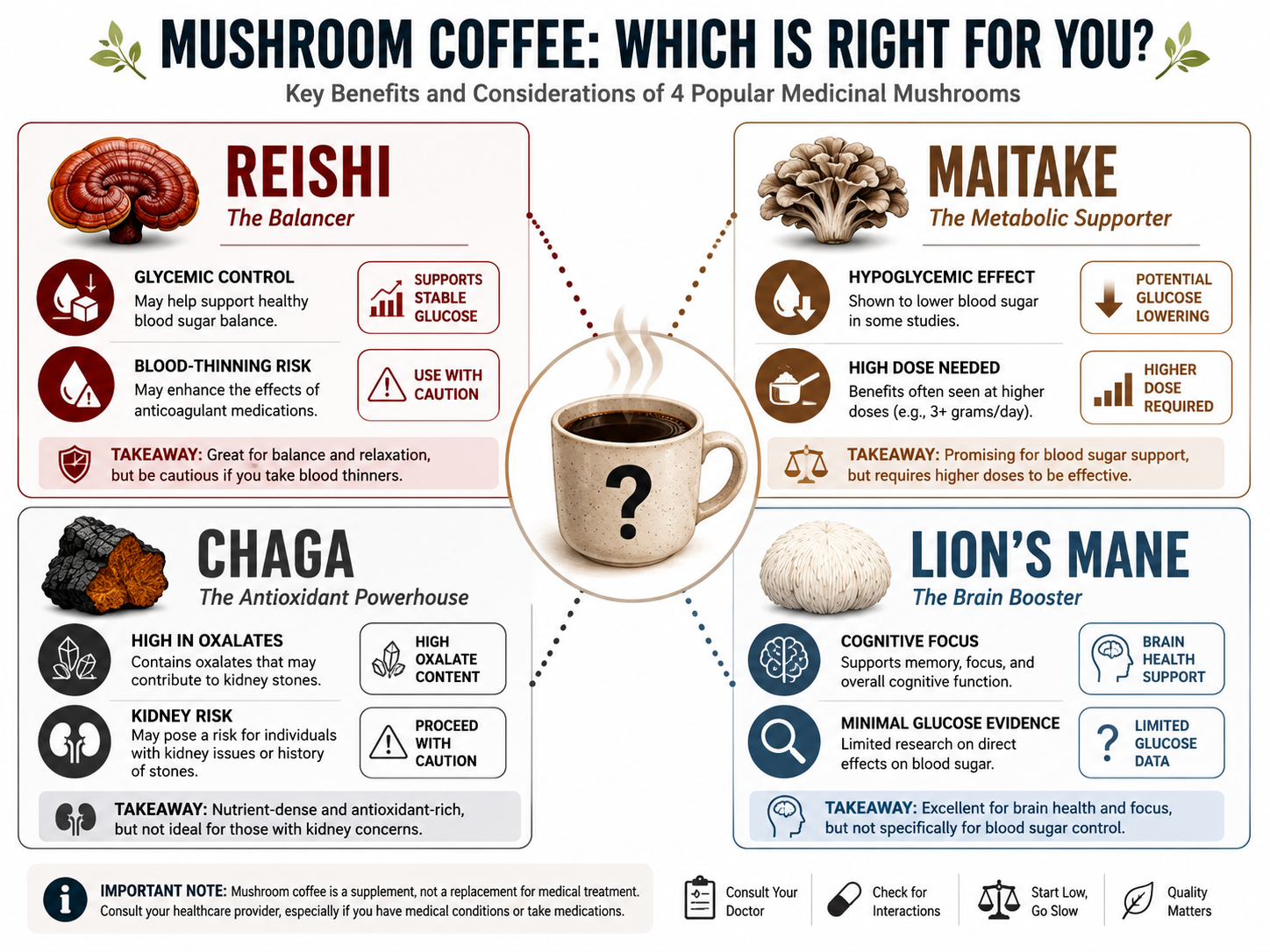
Not all medicinal mushrooms are created equal, and the research is species-specific. Throwing a blend of six different mushrooms into a product dilutes the already small dose of any one of them. Here’s what the science says about the most common players.
Reishi (Ganoderma lucidum): This is the heavyweight for immune modulation and, in some studies, glycemic control. The catch is its blood-thinning properties. Reishi contains compounds that can inhibit platelet aggregation. A 2014 case report in Pharmacotherapy documented a patient on warfarin who experienced prolonged bleeding after taking reishi supplements. If you are on blood thinners or have a bleeding disorder, reishi is a hard stop unless your doctor approves it.
Maitake (Grifola frondosa): The 2001 study by Konno et al. in Diabetologia is the cornerstone here, investigating a “possible hypoglycaemic effect” on type 2 diabetic patients. It’s promising, but again, the dose used was in the gram range, not the milligram range found in coffee blends.
Chaga (Inonotus obliquus): Chaga is praised for its antioxidant content. However, it is also exceptionally high in oxalates, natural compounds that can contribute to kidney stone formation. For individuals with diabetes, who already have a higher risk of kidney issues, this is a serious consideration. The Cleveland Clinic mushroom coffee overview explicitly flags chaga’s oxalate content as a risk factor.
Lion’s Mane (Hericium erinaceus): The lion’s share of research on this mushroom focuses on cognitive function and nerve growth factor synthesis. Direct evidence for blood sugar control is minimal. It’s likely in the blend for its nootropic reputation, not its anti-diabetic properties.
Cordyceps: Known for supporting energy and endurance, cordyceps has some research suggesting it may improve glucose metabolism and insulin sensitivity in animal models. Human data is less robust.
If your primary goal is blood sugar management, a blend containing mostly lion’s mane and cordyceps with a sprinkle of reishi is targeting the wrong mechanisms. You’d want a product emphasizing reishi or maitake, at a clinically relevant dose, which you won’t find in coffee.
TL;DR: Reishi has blood-thinning risks, chaga has oxalate risks, and lion’s mane lacks direct glucose evidence. Blends obscure these specifics and under-dose each ingredient.
Who Should Avoid Mushroom Coffee?

The general advice to “consult your doctor” is vague. Here are the concrete groups who should pause, based on the non-commodity research and documented case reports.
- Individuals on blood thinners (warfarin, aspirin, clopidogrel, etc.): Reishi’s anticoagulant effect is real and documented. Adding it to your regimen could potentiate the drug, leading to bruising or prolonged bleeding.
- Individuals with a history of kidney stones: Chaga’s high oxalate content is a direct risk factor. Choosing a blend without chaga is essential, but most blends don’t specify exact amounts of each species.
- Individuals with autoimmune conditions: Mushrooms stimulate immune activity. While evidence is limited, the theoretical risk of exacerbating an autoimmune condition means caution is warranted.
- Pregnant or nursing women: There is simply insufficient safety data for medicinal mushroom supplementation during these periods.
- Individuals with mushroom allergies: Allergic reactions, while rare, have been documented.
- Individuals on diabetes medication: This is crucial. If a mushroom extract does have a significant glucose-lowering effect, combining it with medication like metformin or insulin could lead to hypoglycemia. This interaction is flagged in the mushroom consumption cardiometabolic health study and other reviews.
Before you start: If you take any prescription medication, especially for blood thinning or diabetes, you must discuss mushroom supplements with your healthcare provider. A 2014 case report shows reishi can dangerously prolong bleeding time in patients on warfarin.
The allure of a natural product can make it seem harmless. It isn’t. These are biologically active compounds, and their interaction with pharmaceuticals is a documented field of study.
TL;DR: Drug interactions are the most serious risk. Reishi + blood thinners and maitake + diabetes meds require a doctor’s consultation.
Mushroom Coffee vs. Regular Coffee: A Practical Comparison
Is swapping your regular cup for a mushroom blend the right move? The answer depends entirely on your goals. This table breaks it down by the metrics that matter.
| Aspect | Regular Black Coffee | Commercial Mushroom Coffee Blend | Verdict |
|---|---|---|---|
| Caffeine Content | 80-120 mg per 8 oz cup | 40-80 mg per 8 oz cup | Mushroom coffee wins for lower caffeine. |
| Potential Glucose Impact | Caffeine may raise blood sugar in some. | Caffeine may raise blood sugar in some; mushroom dose too low to counter it. | Draw. The mushrooms don’t change the caffeine equation. |
| Cost per Serving | $0.25 – $0.50 | $1.50 – $3.00 | Regular coffee wins by a large margin. |
| Active Mushroom Dose | 0 mg | 100-250 mg blend | Mushroom coffee contains a dose, but it’s 3-10x lower than studied doses. |
| Drug Interaction Risk | Low (caffeine only). | Moderate. Contains reishi (blood thinners) and may affect diabetes meds. | Regular coffee is safer for medicated individuals. |
| Taste & Texture | Familiar, can be bitter. | Earthy, sometimes gritty or thin. | Personal preference. Many find mushroom coffee less palatable. |
If you enjoy the earthy taste and want a lower-caffeine option, mushroom coffee is a fine choice, as long as you aren’t on conflicting medications and you manage your expectations about the health payoff. View it as a slightly different beverage, not a therapeutic intervention.
For a different approach to modifying your coffee’s health profile, consider adding fats to coffee like coconut oil or MCT oil coffee benefits for sustained energy, or explore antioxidant benefits of cinnamon for glucose management.
TL;DR: Mushroom coffee costs more, has less caffeine, and carries higher interaction risks than regular coffee. The health benefits at the served dose are speculative.
How to Get the Real Benefits (If You Want Them)
If the research on mushrooms and metabolic health intrigues you, buying pre-mixed coffee is the least effective and most expensive way to explore it. Here is a more direct protocol that follows the science.
- Identify your target mushroom. Based on the evidence, reishi and maitake have the strongest links to glucose metabolism. Pick one to start.
- Source a reputable extract powder. Look for a product from a company that uses third-party testing, specifies the beta-glucan or polysaccharide content, and uses extraction methods (like hot water or dual extraction) to make the compounds bioavailable. This is not a “mushroom coffee” product; it’s a standalone supplement powder.
- Dose deliberately. Start at the lower end of the studied range, say, 500 mg of your chosen extract per day. You can mix this powder into your regular coffee, a smoothie, or simply take it with water.
- Monitor and adjust. If you are managing diabetes, track your blood glucose response carefully, especially if you are on medication. After a few weeks, you can consider increasing the dose toward the 1,000-1,500 mg range used in studies.
- Cycle if needed. Some practitioners suggest taking breaks from medicinal mushrooms to prevent your body from adapting. A common pattern is five days on, two days off, or three weeks on, one week off.
This approach gives you control over the species, the dose, and the quality. It also allows you to avoid undesirable ingredients like chaga if oxalates are a concern. You’ll likely spend less per gram of actual mushroom extract than you would on trendy coffee blends.
For those looking for simpler dietary tweaks, switching to low-sugar coffee additions like almond milk or being mindful of the calorie content of milk can be more impactful first steps.
Frequently Asked Questions
Does mushroom coffee lower blood sugar?
The mushroom extracts studied for glycemic control (reishi, maitake) are used at doses of 750 to 3,000 mg per day. A cup of mushroom coffee contains about 100-250 mg of a blended powder. At that concentration, any blood sugar-lowering effect is likely negligible.
Can I drink mushroom coffee if I take metformin?
You should consult your doctor first. If the mushroom extract has a glucose-lowering effect, combining it with metformin could increase your risk of hypoglycemia. This is a theoretical but serious interaction that requires medical supervision.
Is mushroom coffee better than regular coffee for diabetes?
Not necessarily. The lower caffeine content (40-80 mg vs 80-120 mg) might be slightly better for caffeine-sensitive individuals, but the mushroom dose is too low to confer the studied benefits. Regular coffee with cinnamon for glucose management might be a more evidence-supported choice.
What are the dangers of mushroom coffee?
The main dangers are drug interactions. Reishi can amplify the effect of blood thinners like warfarin. Chaga is high in oxalates, which can contribute to kidney stones. Anyone with autoimmune conditions, kidney issues, or who is pregnant should avoid it unless cleared by a doctor.
How much mushroom coffee should a diabetic drink?
There is no established therapeutic dose for mushroom coffee because the commercial product is not standardized to the studied extracts. If you enjoy it as a lower-caffeine beverage, one cup a day is fine, but don’t expect it to replace medication or diet.
Are there any sugar-free mushroom coffee options?
Most mushroom coffee blends are unsweetened, containing only coffee and mushroom powder. Always check the label for added sugars or “natural flavors,” which can be a source of hidden carbs. For sweetness without sugar, explore alternative coffee sweeteners or natural sweeteners for coffee.
Before You Go
Mushroom coffee sits at an awkward crossroads. The underlying science on certain mushrooms and metabolic health is promising, but the commercial product delivers a fraction of the dose used in that research. You are paying a premium for a feel-good story and a dusting of powder.
For someone with diabetes, the more impactful actions are likely elsewhere: dialing in your carbohydrate intake, managing stress and sleep, and getting regular exercise. If you want to explore medicinal mushrooms, do it with purpose, buy a quality extract from a reputable brand, dose it intentionally, and monitor your body’s response with your doctor’s knowledge.
The earthy flavor and lower caffeine might be reason enough to try it. Just don’t mistake the marketing for the medicine. Your glucose meter won’t be fooled by 200 milligrams of a blended powder, but it will notice the healthy coffee additives you choose and the managing dietary intake habits you build around your cup.
{
“@context”: “https://schema.org”,
“@type”: “HowTo”,
“name”: “How to Evaluate Mushroom Coffee for Type 2 Diabetes Management”,
“totalTime”: “PT10M”,
“tool”: [
{
“@type”: “HowToTool”,
“name”: “Digital kitchen scale measuring in milligrams”
},
{
“@type”: “HowToTool”,
“name”: “Reputable mushroom extract powder (lion’s mane, reishi, cordyceps)”
},
{
“@type”: “HowToTool”,
“name”: “Standard drip coffee maker or French press”
}
],
“step”: [
{
“@type”: “HowToStep”,
“name”: “Check your commercial blend’s label”,
“text”: “Find the ‘mushroom blend’ or ‘fruiting body extract’ amount per serving, listed in milligrams. Most commercial mushroom coffees contain 100-250 mg.”
},
{
“@type”: “HowToStep”,
“name”: “Compare to clinical study doses”,
“text”: “Note that positive human trials for glucose control used 750-3,000 mg of single-species extract per day, not a blend.”
},
{
“@type”: “HowToStep”,
“name”: “Calculate your personal dose”,
“text”: “If managing blood sugar is the goal, consider adding a separate, measured dose of a researched mushroom extract powder to your regular coffee, aiming for at least 1,000 mg of a single species.”
},
{
“@type”: “HowToStep”,
“name”: “Monitor for interactions”,
“text”: “If you take blood thinners like warfarin or diabetes medication, consult your doctor before adding reishi or maitake extracts, as they can potentiate drug effects.”
}
]
}
{
“@context”: “https://schema.org”,
“@type”: “FAQPage”,
“mainEntity”: [
{
“@type”: “Question”,
“name”: “Does mushroom coffee lower blood sugar?”,
“acceptedAnswer”: {
“@type”: “Answer”,
“text”: “The mushroom extracts studied for glycemic control (reishi, maitake) are used at doses of 750 to 3,000 mg per day. A cup of mushroom coffee contains about 100-250 mg of a blended powder. At that concentration, any blood sugar-lowering effect is likely negligible.”
}
},
{
“@type”: “Question”,
“name”: “Can I drink mushroom coffee if I take metformin?”,
“acceptedAnswer”: {
“@type”: “Answer”,
“text”: “You should consult your doctor first. If the mushroom extract has a glucose-lowering effect, combining it with metformin could increase your risk of hypoglycemia. This is a theoretical but serious interaction that requires medical supervision.”
}
},
{
“@type”: “Question”,
“name”: “Is mushroom coffee better than regular coffee for diabetes?”,
“acceptedAnswer”: {
“@type”: “Answer”,
“text”: “Not necessarily. The lower caffeine content (40-80 mg vs 80-120 mg) might be slightly better for caffeine-sensitive individuals, but the mushroom dose is too low to confer the studied benefits. Regular coffee with cinnamon for glucose management might be a more evidence-supported choice.”
}
},
{
“@type”: “Question”,
“name”: “What are the dangers of mushroom coffee?”,
“acceptedAnswer”: {
“@type”: “Answer”,
“text”: “The main dangers are drug interactions. Reishi can amplify the effect of blood thinners like warfarin. Chaga is high in oxalates, which can contribute to kidney stones. Anyone with autoimmune conditions, kidney issues, or who is pregnant should avoid it unless cleared by a doctor.”
}
},
{
“@type”: “Question”,
“name”: “How much mushroom coffee should a diabetic drink?”,
“acceptedAnswer”: {
“@type”: “Answer”,
“text”: “There is no established therapeutic dose for mushroom coffee because the commercial product is not standardized to the studied extracts. If you enjoy it as a lower-caffeine beverage, one cup a day is fine, but don’t expect it to replace medication or diet.”
}
},
{
“@type”: “Question”,
“name”: “Are there any sugar-free mushroom coffee options?”,
“acceptedAnswer”: {
“@type”: “Answer”,
“text”: “Most mushroom coffee blends are unsweetened, containing only coffee and mushroom powder. Always check the label for added sugars or \”natural flavors,\” which can be a source of hidden carbs. For sweetness without sugar, explore alternative coffee sweeteners or natural sweeteners for coffee.”
}
}
]
}
