
Is It Bad to Drink Coffee at Night? Your Personal Cutoff Guide
Is it bad to drink coffee at night? Yes, drinking coffee within 6 hours of bedtime objectively reduces total sleep time by about an hour, delays sleep onset, and suppresses deep slow-wave sleep, even if you don’t consciously feel the disruption.
Most people get this wrong because they rely on subjective feeling. You might not feel jittery, so you assume the coffee has worn off. The research shows your nervous system and sleep architecture disagree. This guide breaks down the specific studies, the genetic and lifestyle variables that change your personal rule, and what to drink instead.
Key Takeaways
- A 400 mg caffeine dose (about 4 cups) 6 hours before bed still reduces total sleep by one full hour, per the 2013 Drake et al. study.
- Your CYP1A2 gene variant dictates if you clear caffeine in 3 hours (fast metabolizer) or 8+ hours (slow metabolizer), making generic advice useless.
- Late caffeine intake cuts dream recall frequency in half, from 5.6 to 2.9 days per week, according to a 2025 mixed-methods study.
- Oral contraceptives double caffeine’s half-life to 10-12 hours, while smoking cuts it to 3-4 hours.
- For a true evening coffee experience, freeze whole beans and grind them directly from frozen to minimize oxidation and preserve flavor for a late decaf brew.
The 6-Hour Caffeine Cutoff Isn’t a Myth
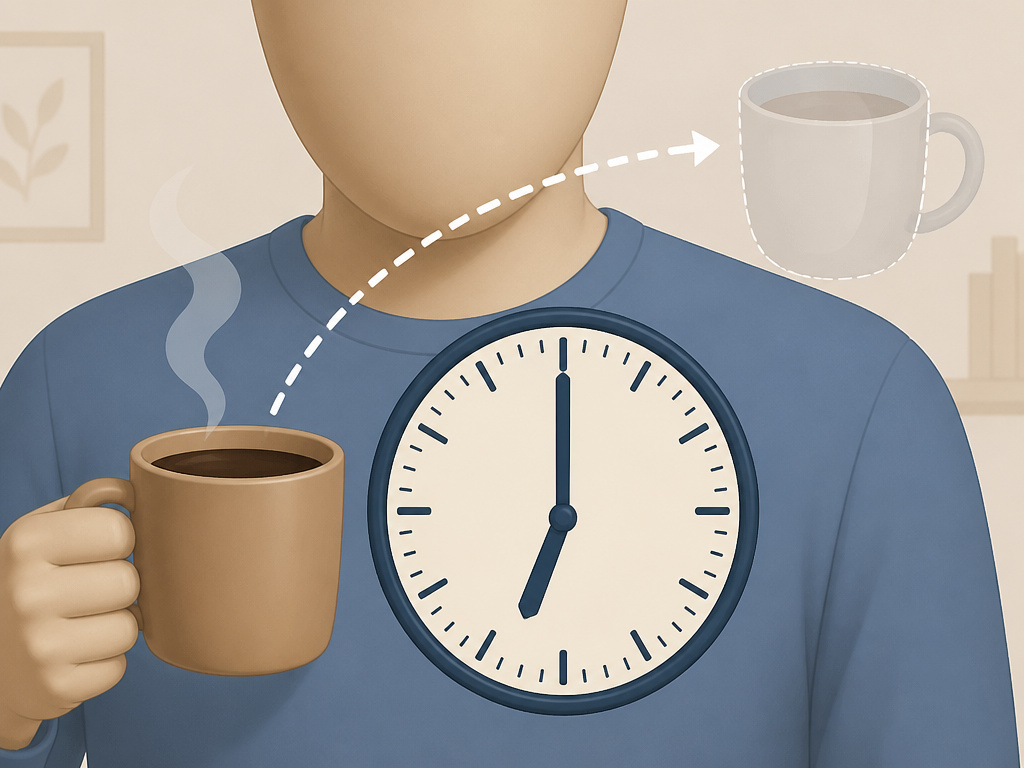
It comes from a hard number. The biological half-life of caffeine in a healthy adult is 5 to 6 hours. This means six hours after your last sip, roughly half the caffeine is still circulating in your bloodstream. For a standard 200 mg serving from a strong pour-over, that’s 100 mg of active stimulant at the 6-hour mark.
Caffeine consumed after 6 PM significantly prolonged perceived sleep onset latency to 46.2 minutes versus 19.8 minutes for early/no late intake, and reduced dream recall frequency from 5.6 to 2.9 days per week.
The landmark study here is the 2013 Drake et al. trial published in the Journal of Clinical Sleep Medicine. They gave 12 healthy adults 400 mg of caffeine at three different times: at bedtime, 3 hours before bed, and 6 hours before bed. The 6-hour group still lost an average of one hour of total sleep. The 3-hour group took about 30 minutes longer to fall asleep and also lost an hour. The bedtime group had both problems worse. The critical finding? Participants often reported sleeping fine. Their subjective perception was wrong.
TL;DR: The 6-hour rule is a minimum baseline for average metabolizers. It prevents the worst sleep loss, but optimal cutoff is earlier.
Your Personal Caffeine Calculator
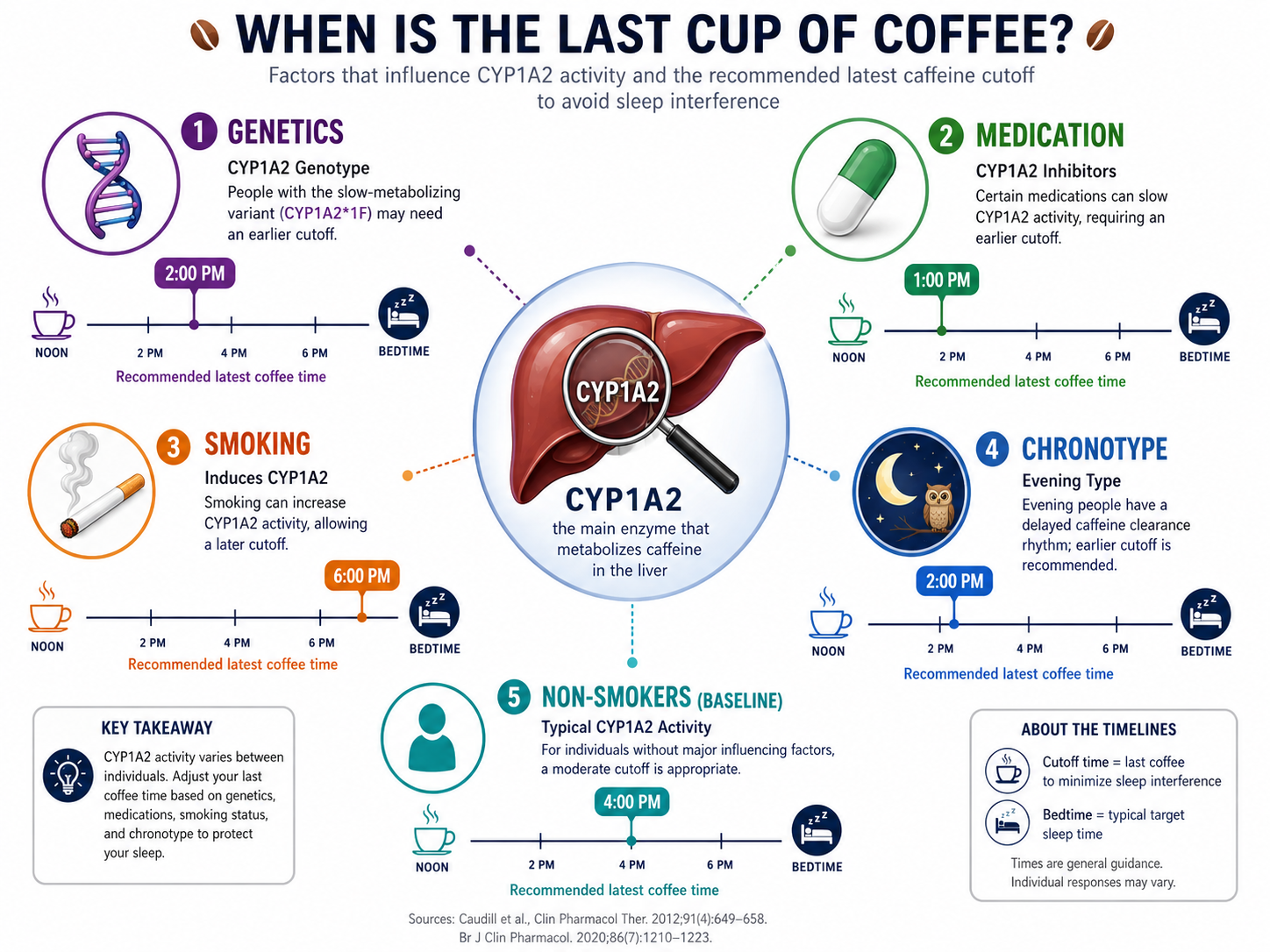
A generic cutoff fails because of biology. Your personal equation includes genetics, medication, and even your sleep chronotype.
| Factor | Effect on Caffeine Clearance | Adjust Your Cutoff |
|---|---|---|
| CYP1A2 “Fast Metabolizer” Gene | Clears caffeine in ~3 hours. About 10% of people. | You may tolerate coffee 4-5 hours before bed. |
| CYP1A2 “Slow Metabolizer” Gene | Clears caffeine in 8+ hours. About 40% of people. | Add a 3-4 hour buffer to the 6-hour rule. |
| Taking Oral Contraceptives | Slows metabolism drastically (10-12 hour half-life). | Cut off caffeine by early afternoon (12-1 PM). |
| Smoker | Accelerates metabolism (3-4 hour half-life). | The standard 6-hour rule is likely safe. |
| “Night Owl” Chronotype | Greater vulnerability to sleep disruption. | Add a 1-2 hour buffer due to sensitivity. |
The CYP1A2 gene controls the liver enzyme that breaks down 95% of ingested caffeine. You can’t change your genes, but you can listen to your body. If you regularly drink coffee after 4 PM and then lie awake with a racing mind, you’re likely a slow metabolizer. The fix isn’t willpower. It’s moving your last cup to 2 PM.
Common mistake: Assuming “decaf” means caffeine-free — most decaf coffee still has 2-15 mg per cup. If you’re extremely sensitive, even this trace amount after dinner can trigger the alertness response.
What “Bad” Really Means: Sleep Architecture Theft
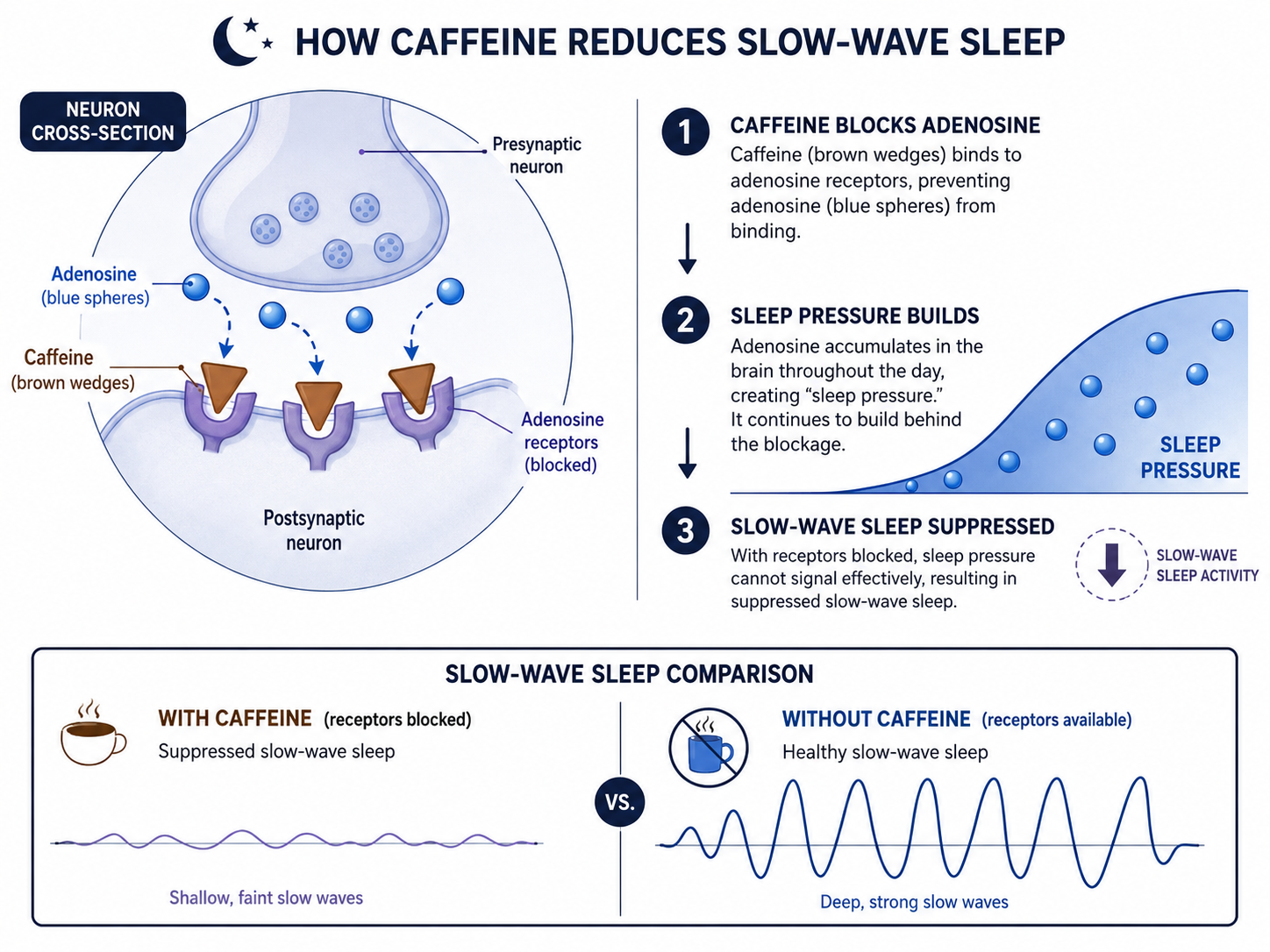
When we ask if nightly coffee is bad, we usually mean “will it keep me awake?” The more insidious damage is to sleep quality, not just quantity. Caffeine is an adenosine receptor antagonist. Adenosine is the neurochemical that builds up all day to make you sleepy. Caffeine blocks its signal, but it doesn’t stop its production.
Once the caffeine clears, you get a tidal wave of sleep pressure. You might crash hard. But the architecture of the sleep you get is poorer.
A 2025 meta-analysis in ScienceDirect, reviewing 22 trials, confirmed caffeine reduces slow-wave sleep proportions and overall sleep efficiency. Slow-wave sleep is deep, restorative sleep crucial for physical recovery and memory consolidation. Another analysis from Wroclaw Medical University in Nutrients concluded caffeine suppresses slow-wave brain activity. You might sleep for 7 hours, but you’ll wake up feeling less restored than if you’d slept 6 hours without caffeine interference.
The Springer caffeine timing study added a fascinating cultural and psychological layer: late caffeine intake cut participants’ dream recall frequency nearly in half. The researchers found an inverse correlation with wake-after-sleep onset. More caffeine, fewer remembered dreams, more mid-sleep awakenings. Your evening cup might be robbing you of dreams.
Who Should Be Most Strict? (Students and Night Workers, Listen Up)
Some groups are disproportionately affected. The same Springer study found students and evening chronotypes (“night owls”) showed greater vulnerability. For students, late caffeine added an extra 12.4 minutes to perceived sleep onset latency. For night owls, it was 14.2 extra minutes.
The mechanism here isn’t just pharmacokinetics. It’s lifestyle and circadian biology. Students often use caffeine to power through late-night study sessions, directly pitting the stimulant against their already delayed sleep window. Night shift workers use caffeine to stay alert against their natural circadian dip, which can help in the moment but makes daytime sleep even more fragmented.
If you’re in these groups, the standard advice is not for you. Your cutoff needs to be more aggressive. Think “last cup with lunch.” The goal is to protect your sleep window, not just mitigate the drug’s presence.
For those managing specific conditions, understanding your caffeine while breastfeeding limits or how coffee might influence coffee and digestion is part of a holistic view on consumption timing.
How to Salvage the Evening Coffee Ritual
The craving for a warm, flavorful cup in the evening isn’t just about caffeine. It’s about ritual, comfort, and taste. You don’t have to give that up. You need to strategize.
First, genuinely switch to decaf. But be a decaf snob. Mass-produced decaf often uses harsh chemical solvents and the beans are low-quality to start. Seek out Swiss Water Process or CO2 Process decaf from specialty roasters. These methods preserve flavor compounds better. A good decaf should taste like coffee, not just brown water.
Second, consider your other evening drink options. A cup of black tea caffeine is lower than coffee but still present. For a truly calming alternative, explore the L-theanine content in green tea, which promotes relaxed alertness.
Third, optimize your bean storage if you grind fresh for decaf. Coffee stales fastest after grinding. The old rule was “never freeze coffee,” but that was for ground coffee in unsealed containers. The new rule, championed by experts like James Hoffmann, is to freeze whole beans.
The Hoffman Freeze Method:
- Divide a fresh bag of whole beans into weekly portions.
- Vacuum-seal each portion or use a heavy-duty freezer bag, squeezing out all air.
- Store in a standard home freezer at −18 °C (0 °F).
- When needed, remove one portion, grind it directly from frozen (do not thaw), and immediately return the bag to the freezer.
Grinding frozen leads to a more uniform particle size and minimizes oxidation. This keeps your decaf tasting vibrant for that 8 PM cup. Just remember to account for the brewing factors that change with grind size.
The 4-Step Audit to Find Your True Cutoff
Don’t guess. Experiment.
- Establish a baseline week. Drink coffee as you normally do, but log your last cup time, bedtime, and estimated sleep onset. Use a simple notes app.
- Enforce a trial cutoff. Pick a time 8 hours before your target sleep. Stick to it strictly for 5 days. No chocolate, no soda, no iced tea caffeine after the cutoff.
- Measure the outcome. Note: how quickly you fall asleep, how often you wake up, and your energy level at 10 AM the next day. The 10 AM metric is key—it removes morning grogginess from the equation.
- Adjust and repeat. If sleep improved, great. Hold that cutoff. If no change, you might be a fast metabolizer. Try moving the cutoff 30 minutes later the next week. If sleep was worse, move it earlier.
This process treats your body like the unique system it is. It moves you past generic advice into personalized data.
Frequently Asked Questions
Does drinking coffee at night cause weight gain?
Not directly. However, by reducing sleep quality and duration, it disrupts hormones like leptin and ghrelin that regulate hunger. Poor sleep often leads to increased cravings for high-calorie, sugary foods the next day, which can contribute to weight gain over time.
Can I build a tolerance to caffeine’s sleep effects?
You can build a tolerance to the subjective alertness and jittery feelings. The objective disruption to sleep architecture—particularly the reduction in slow-wave sleep—shows less tolerance. Your body may not feel the caffeine, but your sleep cycles still register its presence.
Is espresso better than drip coffee at night because it’s smaller?
No. The volume is irrelevant; the total caffeine dose is what matters. A single 30ml espresso shot typically contains 60-100 mg of caffeine. A 250ml mug of drip coffee might have 100-150 mg. If you drink two espressos, you’ve consumed more caffeine than one mug of drip. Always think in milligrams, not milliliters.
What about decaf coffee before bed?
high-quality, properly processed decaf is the best coffee option for evening. Remember it’s not caffeine-free. The 2-15 mg residual caffeine is negligible for most, but if you are exquisitely sensitive, it could still be a problem. Pair it with a consistent nighttime routine to signal to your body that sleep is coming.
Does the type of coffee bean matter for sleep?
The caffeine content between Arabica and Robusta beans matters more than the “type” for sleep. Robusta beans contain nearly double the caffeine of Arabica. A dark roast versus light roast has a minimal difference in caffeine content by weight. The bigger factor is your brewing method, which determines extraction efficiency and final caffeine per cup.
The Bottom Line
Drinking coffee at night is bad for sleep in a measurable, dose-dependent way. The 6-hour rule is a starting point, not a finish line. Your personal cutoff is dictated by your genes, your medications, and your lifestyle. The goal isn’t to villainize coffee but to respect its potency as a psychoactive substance. Enjoy your morning cup, savor a well-made decaf after dinner, and let your sleep be deep and dream-filled. Protect that rest as fiercely as you pursue the perfect brew. Your brain, and your morning self, will thank you.
{
“@context”: “https://schema.org”,
“@type”: “HowTo”,
“name”: “How to Calculate Your Personal Caffeine Cutoff for Better Sleep”,
“totalTime”: “PT5M”,
“step”: [
{
“@type”: “HowToStep”,
“name”: “Identify your usual bedtime”,
“text”: “Write down the time you aim to be asleep, not just in bed. This is your target sleep time.”
},
{
“@type”: “HowToStep”,
“name”: “Apply the 6-hour half-life rule”,
“text”: “Subtract 6 hours from your target sleep time. For a 10:30 PM bedtime, your initial cutoff is 4:30 PM.”
},
{
“@type”: “HowToStep”,
“name”: “Adjust for your personal factors”,
“text”: “If you are a slow metabolizer, on oral contraceptives, or highly sensitive, add 2-4 hours to that buffer. If you smoke, you may subtract an hour.”
},
{
“@type”: “HowToStep”,
“name”: “Test and observe for one week”,
“text”: “Stick to your calculated cutoff. Track sleep onset latency and morning alertness. Adjust the cutoff earlier if you still feel wired at bedtime.”
}
]
}
{
“@context”: “https://schema.org”,
“@type”: “FAQPage”,
“mainEntity”: [
{
“@type”: “Question”,
“name”: “Does drinking coffee at night cause weight gain?”,
“acceptedAnswer”: {
“@type”: “Answer”,
“text”: “Not directly. However, by reducing sleep quality and duration, it disrupts hormones like leptin and ghrelin that regulate hunger. Poor sleep often leads to increased cravings for high-calorie, sugary foods the next day, which can contribute to weight gain over time.”
}
},
{
“@type”: “Question”,
“name”: “Can I build a tolerance to caffeine’s sleep effects?”,
“acceptedAnswer”: {
“@type”: “Answer”,
“text”: “You can build a tolerance to the subjective alertness and jittery feelings. The objective disruption to sleep architecture—particularly the reduction in slow-wave sleep—shows less tolerance. Your body may not feel the caffeine, but your sleep cycles still register its presence.”
}
},
{
“@type”: “Question”,
“name”: “Is espresso better than drip coffee at night because it’s smaller?”,
“acceptedAnswer”: {
“@type”: “Answer”,
“text”: “No. The volume is irrelevant; the total caffeine dose is what matters. A single 30ml espresso shot typically contains 60-100 mg of caffeine. A 250ml mug of drip coffee might have 100-150 mg. If you drink two espressos, you’ve consumed more caffeine than one mug of drip. Always think in milligrams, not milliliters.”
}
},
{
“@type”: “Question”,
“name”: “What about decaf coffee before bed?”,
“acceptedAnswer”: {
“@type”: “Answer”,
“text”: “high-quality, properly processed decaf is the best coffee option for evening. Remember it’s not caffeine-free. The 2-15 mg residual caffeine is negligible for most, but if you are exquisitely sensitive, it could still be a problem. Pair it with a consistent nighttime routine to signal to your body that sleep is coming.”
}
},
{
“@type”: “Question”,
“name”: “Does the type of coffee bean matter for sleep?”,
“acceptedAnswer”: {
“@type”: “Answer”,
“text”: “The caffeine content between Arabica and Robusta beans matters more than the \”type\” for sleep. Robusta beans contain nearly double the caffeine of Arabica. A dark roast versus light roast has a minimal difference in caffeine content by weight. The bigger factor is your brewing method, which determines extraction efficiency and final caffeine per cup.”
}
}
]
}
