
How Much Cinnamon in Coffee | The Pinch That Turns to Grit
Start with 1/8 teaspoon of ground cinnamon per 8-ounce cup of coffee. That’s a two-finger pinch. For a full pot, scale up to 1/2 to 3/4 teaspoon. This dose adds flavor without overwhelming the brew or turning it gritty.
Most people get this wrong by treating cinnamon like sugar. They sprinkle it on top of a finished cup. The powder floats, then sinks in dry clumps. You get a mouthful of spice sludge at the bottom. It ruins the texture and wastes the flavor.
This guide breaks down the exact amounts for every brew method. We’ll cover how to mix it properly, why your milk won’t froth if you add too much, and the one type of cinnamon that changes everything.
Key Takeaways
- Use 1/8 tsp ground cinnamon per 8 oz cup. For a 12-cup pot, that’s 3/4 tsp total.
- Always mix cinnamon into the grounds before brewing or whisk it into hot liquid. Sprinkling on top causes gritty sludge.
- Cassia cinnamon is stronger and spicier. Ceylon cinnamon is milder and sweeter. Your dose changes based on which one you use.
- Adding more than 1/4 tsp per cup can kill milk foam and make coffee taste powdery.
- A cinnamon stick steeps without grit and offers more control, but needs 5-10 minutes in hot coffee.
The Golden Ratio: How Much Cinnamon Per Cup?
Forget vague “pinches.” A standard 8-ounce mug needs 1/8 teaspoon of ground cinnamon. Visually, that’s the amount you can hold between your thumb and two fingers. It’s a starting point, not a rule.
The solubility of ground cinnamon in hot water is poor. Without vigorous mixing, over 60% of the particles will remain undissolved, settling as sediment. This is why method matters as much as measurement.
Exceeding 1/4 teaspoon per cup crosses a threshold. The coffee starts tasting dusty. The spice overpowers the bean’s origin notes. If you’re using a milk frother, that extra powder will destabilize the foam. It collapses before you can pour it.
Common mistake: Doubling the dose for a “stronger” flavor, this just makes the coffee bitter and powdery. The spice compounds become astringent in high concentration.
Scaling for a full pot is straightforward. A standard 12-cup coffee maker brews about 60 ounces. You need between 1/2 and 3/4 teaspoon of cinnamon for the entire batch. Start at the lower end. You can always add more to your individual cup.
TL;DR: 1/8 tsp per cup, 3/4 tsp max per pot. More is not better, it’s gritty.
Brew Method Matters: Where to Add the Cinnamon
Your machine changes the game. The goal is to expose the cinnamon to maximum agitation and heat. This extracts flavor and prevents clumping.
For Drip Coffee Makers and Pour-Overs: Add the measured cinnamon directly to your ground coffee in the filter basket. The brewing water will pass through both, extracting evenly. This is the most foolproof method. The filter catches any fine particles that don’t dissolve.
For French Press: Mix the cinnamon with your coarse grounds before adding hot water. Stir the slurry after you pour in the water to ensure the spice is fully wetted. If you just dump it on top, it’ll float and not steep properly.
For Espresso: Do not add cinnamon to the portafilter. It can gum up the finely ground coffee and cause channeling. Instead, add a tiny pinch (about 1/16 tsp) to your cup first, then pull the shot directly over it. The high-pressure stream will help mix it.
| Brew Method | Best Placement | Why It Works |
|---|---|---|
| Drip Machine | In filter with grounds | Water filtration captures grit; even extraction. |
| French Press | Mixed with grounds before water | Immersion brewing allows full steeping; stirring prevents clumps. |
| Espresso | In cup, shot pulled over it | Pressure and heat from the shot provide instant, forceful mixing. |
| Instant Coffee | Whisked into the hot water | Manual agitation is required to dissolve the powder in the absence of a filter. |
For Cold Brew: Add cinnamon to the coarse grounds in your steep container. The long, cold immersion time will slowly extract a smooth, subtle flavor without any grit. Adding it later to finished cold brew is a recipe for undissolved flakes.
The Gritty Truth: Why Your Cinnamon Won’t Dissolve
Cinnamon is tree bark. Even finely ground, it contains insoluble cellulose fibers. They don’t melt in water. They sink.
The mistake happens in the last five seconds. You brew a perfect cup, then casually sprinkle cinnamon on the surface. The powder hydrates unevenly. It forms microscopic clumps that are too heavy to stay suspended. They drift to the bottom and create a sludgy layer.
You notice it on the last sip. It’s unpleasant.
The fix is mechanical. You need to introduce shear force.
– Use a small whisk or a milk frother for 10-15 seconds in your hot coffee.
– Pour your coffee into a lidded jar and shake it vigorously.
– Brew it with the grounds, as outlined above.
A cinnamon stick avoids this entirely. It’s the bark in its whole form. The flavors leach out without shedding gritty particles. Steep it in your hot coffee for 5-10 minutes. It gives you more control. Pull it out when the flavor is right.
Ceylon vs. Cassia: Your Cinnamon Choice Changes the Dose

Not all cinnamon is the same. The type in your pantry dictates your starting amount.
Cassia Cinnamon is the common, inexpensive variety. It’s what you find in every supermarket. The flavor is bold, spicy, and slightly bitter. It has a higher concentration of cinnamaldehyde, the compound that gives it that classic “red hot” punch. Because it’s stronger, you should use slightly less, stick to that 1/8 teaspoon guide.
Ceylon Cinnamon is often called “true cinnamon.” It’s lighter in color, with a more complex, sweet, and floral aroma. It’s milder. You can use a more generous 1/4 teaspoon per cup to achieve a noticeable flavor. It’s the preferred choice for those who want the spice note without the heat.
Common mistake: Using a heaping teaspoon of Cassia cinnamon because a recipe called for “cinnamon”, the resulting brew will be unpleasantly sharp and medicinal.
| Cinnamon Type | Flavor Profile | Recommended Start Dose (per 8 oz cup) | Best For |
|---|---|---|---|
| Cassia | Strong, spicy, woody | 1/8 teaspoon | Bold, spiced coffees; pairing with dark roast. |
| Ceylon | Mild, sweet, floral | 1/4 teaspoon | Subtle flavor enhancement; light roast coffee. |
If you’re exploring the health benefits of cinnamon coffee, note that Cassia contains much higher levels of coumarin. This compound can be harmful in very large, daily doses. Ceylon is the safer choice for regular consumption.
When Things Go Wrong: Frothing, Clumping, and Bitterness

Cinnamon can break your coffee. Here’s how to diagnose the problems.
Problem: Milk Won’t Froth.
You’re making a latte. You add cinnamon to your milk before frothing. The foam is thin and collapses instantly.
Cause: Solid particles, like cinnamon powder, puncture the protein matrix that holds air in foam.
Fix: Froth your milk plain. Add the cinnamon to your espresso shot in the cup first, then pour the milk over it. The foam will survive. For other healthy coffee additives like oils, the same principle applies, add them after frothing.
Problem: A Sludge at the Bottom.
Your coffee has a sandy, gritty texture.
Cause: Poor dissolution. The cinnamon was added post-brew without mixing.
Fix: Whisk it next time. For now, don’t drink the last half-inch. Consider a cinnamon stick for future cups.
Problem: Coffee Tastes Bitter, Not Spicy.
The cinnamon made your smooth brew astringent.
Cause: Overdosing, especially with Cassia cinnamon. The compounds become overpowering.
Fix: Dilute the cup with more hot water or milk. Next time, reduce your dose by half. Remember, it’s a seasoning, not a main ingredient. This is similar to the principle of using a pinch of salt in coffee to reduce bitterness, not create it.
If you enjoy experimenting with flavors, pairing cinnamon with brown sugar as a sweetener creates a deep, caramel-like note. Just account for the combined sweetness.
The Pro’s Playbook: Advanced Tips and Combos
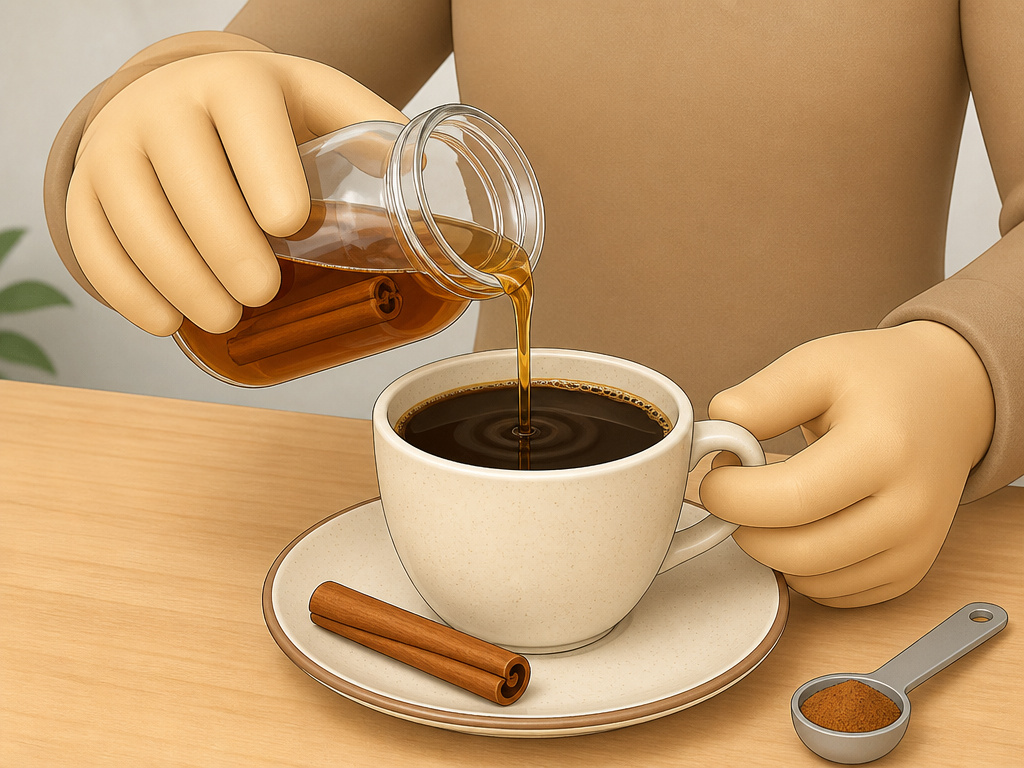
Once you’ve mastered the basic dose, you can layer flavors.
The Spiced Mocha: Add 1/8 tsp cinnamon and 1 tbsp cocoa powder to your grounds before brewing. The result is a rich, spiced hot chocolate-coffee hybrid without added sugar.
Cinnamon-Infused Simple Syrup: This eliminates grit forever. Simmer 1 cup water, 1 cup sugar, and 3 broken cinnamon sticks for 10 minutes. Let cool and strain. Add a teaspoon to your coffee for sweet, smooth spice. It works perfectly in iced coffee.
The “Dirty Chai” Latte: Brew a strong cup of chai tea. Add a shot of espresso and a 1/8 tsp dose of cinnamon. The spices from the chai and the cinnamon merge with the coffee for a complex, warming drink.
For a dairy-free version, use a creamy plant-based milk. Just be aware that some, like almond milk in coffee, can separate with high heat or acidity. Add your cinnamon after heating the milk for the best result.
If you’re mindful of coffee’s digestive effects, introducing a strong spice like cinnamon can be an additional irritant for some. Start with a very small amount to see how your system reacts.
Frequently Asked Questions
Can I put cinnamon in my coffee grounds?
Yes. This is the best method for drip, pour-over, and French press coffee. It ensures even extraction and filters out any undissolved particles. Use 1/8 teaspoon per 8 ounces of water, mixed with the grounds.
Does cinnamon dissolve in coffee?
No, not completely. Ground cinnamon contains insoluble fibers. It will always leave some sediment unless it is filtered out or vigorously mixed into the liquid. Using a cinnamon stick or an infused syrup avoids this issue entirely.
How much cinnamon is too much in coffee?
Exceeding 1/2 teaspoon per 8-ounce cup is too much. At this point, the flavor becomes overwhelmingly spicy and powdery, it can ruin milk foam, and with Cassia cinnamon, it introduces a high amount of coumarin.
What’s the best cinnamon for coffee?
For a mild, sweet flavor, choose Ceylon cinnamon. For a stronger, classic spice punch, use Cassia. If you drink cinnamon coffee daily, Ceylon is the safer long-term choice due to its lower coumarin content.
Can I add cinnamon to cold brew?
Absolutely. Add it to the coarse grounds before the long steeping process. This allows the flavor to extract slowly and smoothly into the cold water without any grittiness in the final brew.
Does cinnamon break a fast?
Pure cinnamon, in the small amounts used for coffee (1/8 tsp), contains negligible calories and is unlikely to break a metabolic fast. However, if fat-loss fasting is your goal, it’s best to consume only black coffee, water, and tea. For more on beverage comparisons, see our look at tea versus coffee.
The Bottom Line
Measure your cinnamon. Start with 1/8 teaspoon per cup. Mix it with your coffee grounds or whisk it fiercely into the hot brew. That’s the barrier between a spiced delight and a gritty punishment.
Choose Ceylon for a subtle, daily sip and Cassia for a periodic spice kick. Avoid the lazy sprinkle on top. Your last sip should taste as good as your first.
It’s a simple addition that transforms a routine. But like any good transformation, it demands a little attention to detail. Get the dose right, and your coffee becomes something new.
{
“@context”: “https://schema.org”,
“@type”: “HowTo”,
“name”: “How to Add the Right Amount of Cinnamon to Coffee”,
“totalTime”: “PT2M”,
“tool”: [
{
“@type”: “HowToTool”,
“name”: “Measuring teaspoon”
},
{
“@type”: “HowToTool”,
“name”: “Small whisk or milk frother”
}
],
“supply”: [
{
“@type”: “HowToSupply”,
“name”: “Ground coffee”
},
{
“@type”: “HowToSupply”,
“name”: “Ground cinnamon or a cinnamon stick”
}
],
“step”: [
{
“@type”: “HowToStep”,
“name”: “Measure the cinnamon”,
“text”: “For a standard 8-ounce cup, start with 1/8 teaspoon of ground cinnamon. This is roughly a two-finger pinch.”
},
{
“@type”: “HowToStep”,
“name”: “Choose your mixing method”,
“text”: “For best dissolution, add the cinnamon to your coffee grounds before brewing, or whisk it vigorously into hot brewed coffee.”
},
{
“@type”: “HowToStep”,
“name”: “Adjust to taste”,
“text”: “Taste the coffee. If you want more spice, add another small pinch. For a subtle hint, use just the tip of a teaspoon.”
},
{
“@type”: “HowToStep”,
“name”: “Avoid grittiness”,
“text”: “Never dump dry cinnamon on top of finished coffee. It will clump and sink, creating a gritty layer at the bottom of your mug.”
}
]
}
{
“@context”: “https://schema.org”,
“@type”: “FAQPage”,
“mainEntity”: [
{
“@type”: “Question”,
“name”: “Can I put cinnamon in my coffee grounds?”,
“acceptedAnswer”: {
“@type”: “Answer”,
“text”: “Yes. This is the best method for drip, pour-over, and French press coffee. It ensures even extraction and filters out any undissolved particles. Use 1/8 teaspoon per 8 ounces of water, mixed with the grounds.”
}
},
{
“@type”: “Question”,
“name”: “Does cinnamon dissolve in coffee?”,
“acceptedAnswer”: {
“@type”: “Answer”,
“text”: “No, not completely. Ground cinnamon contains insoluble fibers. It will always leave some sediment unless it is filtered out or vigorously mixed into the liquid. Using a cinnamon stick or an infused syrup avoids this issue entirely.”
}
},
{
“@type”: “Question”,
“name”: “How much cinnamon is too much in coffee?”,
“acceptedAnswer”: {
“@type”: “Answer”,
“text”: “Exceeding 1/2 teaspoon per 8-ounce cup is too much. At this point, the flavor becomes overwhelmingly spicy and powdery, it can ruin milk foam, and with Cassia cinnamon, it introduces a high amount of coumarin.”
}
},
{
“@type”: “Question”,
“name”: “What’s the best cinnamon for coffee?”,
“acceptedAnswer”: {
“@type”: “Answer”,
“text”: “For a mild, sweet flavor, choose Ceylon cinnamon. For a stronger, classic spice punch, use Cassia. If you drink cinnamon coffee daily, Ceylon is the safer long-term choice due to its lower coumarin content.”
}
},
{
“@type”: “Question”,
“name”: “Can I add cinnamon to cold brew?”,
“acceptedAnswer”: {
“@type”: “Answer”,
“text”: “Absolutely. Add it to the coarse grounds before the long steeping process. This allows the flavor to extract slowly and smoothly into the cold water without any grittiness in the final brew.”
}
},
{
“@type”: “Question”,
“name”: “Does cinnamon break a fast?”,
“acceptedAnswer”: {
“@type”: “Answer”,
“text”: “Pure cinnamon, in the small amounts used for coffee (1/8 tsp), contains negligible calories and is unlikely to break a metabolic fast. However, if fat-loss fasting is your goal, it’s best to consume only black coffee, water, and tea. For more on beverage comparisons, see our look at tea versus coffee.”
}
}
]
}
