
How Much Caffeine Does a Teaspoon of Instant Coffee Have?
A standard teaspoon (about 2 grams) of instant coffee powder contains roughly 62.8 milligrams of caffeine, based on the USDA’s primary data of 3140 mg per 100g. This number shifts with granule density, fine powder packs more caffeine per spoon than coarse granules.
Most articles give you a fuzzy range between 30 and 90 milligrams. That span is so wide it’s almost useless. You might as well guess. The real answer lives in a government database, and it points to a specific number with a clear reason for variation.
This guide locks onto the USDA’s figure, explains why your spoon might deliver more or less, and shows you how instant coffee compares to everything from a shot of espresso to a can of Red Bull.
Key Takeaways
- The USDA’s FoodData Central lists instant coffee powder at 3140 mg of caffeine per 100g. A 2-gram teaspoon therefore delivers ~62.8 mg.
- Granule density is everything. A teaspoon of fine powder like Nescafé Classic can weigh 2.5g, hitting nearly 80mg caffeine. A teaspoon of coarse granules might be 1.8g, dropping to about 56mg.
- Brand-specific sachets are the most precise measure. A Nescafé Original 1.8g sachet contains 50-65 mg, confirming the USDA average.
- Compared to brewed coffee, instant offers a lighter, faster boost. It has about half the caffeine concentration of a standard drip brew.
- To manage intake, weigh your scoop. Two heaping teaspoons of fine powder can easily surpass 150mg, edging into a strong drip coffee’s territory.
The USDA’s Official Number: 62.8mg Per Teaspoon
Forget the aggregated blog estimates. The authoritative source is the USDA’s FoodData Central, entry FDC ID: 171887 for “Coffee, instant, regular, powder.” It states a caffeine content of 3140 milligrams per 100 grams.
The USDA FoodData Central entry for instant coffee powder lists a caffeine concentration of 3140 mg per 100g. Using the standard culinary assumption that a level teaspoon of powder weighs approximately 2 grams, the calculated caffeine content is 62.8 mg per teaspoon.
Do the math: 3140 mg ÷ 100g = 31.4 mg per gram. 31.4 mg/g × 2 g = 62.8 mg. That’s your baseline. This figure is why most reputable sources, including Health Canada, cite a range of 65-100 mg for an 8-oz cup, that cup typically uses a bit more than one teaspoon.
The number is solid. But your kitchen isn’t a laboratory. The variable is the weight of your “teaspoon.” This is where the granule density of your specific brand takes over.
Why Your Spoon Might Hold 80mg (or 50mg)
Instant coffee isn’t a uniform substance. It comes as fine, dusty powder or as larger, agglomerated granules. Density changes everything.
A tightly packed, fine powder can weigh 2.5 grams in a leveled teaspoon. That same volume of coarse, airy granules might only be 1.8 grams. Run the USDA constant again:
– Fine Powder (2.5g): 31.4 mg/g × 2.5 g = 78.5 mg
– Coarse Granules (1.8g): 31.4 mg/g × 1.8 g = 56.5 mg
That’s a 22-milligram swing from the same spoon. This physical reality is why the internet’s “30-90 mg” range exists. They’re measuring volume, not weight. The USDA measures weight.
TL;DR: The USDA says 62.8mg per 2-gram teaspoon. Your actual spoon weighs between 1.8g and 2.5g based on granule fineness, putting your real caffeine between 56mg and 78mg.
What the Brands Actually Say: Sachets Don’t Lie
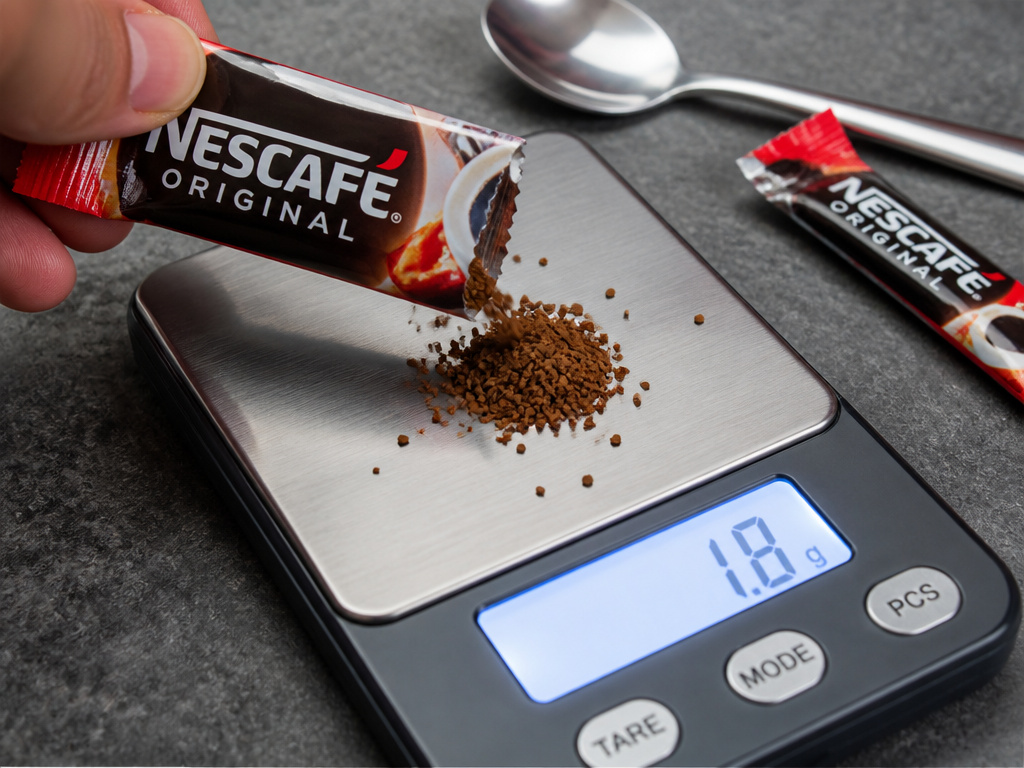
While the USDA provides the gold-standard average, specific brands publish their data. This is where theory meets the foil packet in your hand.
Take Nescafé Original, one of the world’s most popular instants. Their official serving is a 1.8-gram sachet. Independent lab tests, like those cited in the NIH study on coffee product contents, place the caffeine in that 1.8g serving between 50 and 65 milligrams.
Do the verification: 65 mg ÷ 1.8 g = ~36.1 mg/g. That’s slightly higher than the USDA’s 31.4 mg/g, but well within the expected variance for a specific bean blend and extraction process. It confirms the model. A Nescafé sachet delivers a predictable hit.
Other brands, especially “extra strong” or “dark roast” variants, may calibrate differently. The only way to know is to check the nutritional panel, if they provide caffeine per serving at all. Most don’t. That’s why we fall back on the USDA constant and the weight of your scoop.
Common mistake: Assuming all teaspoons are equal, using a heaping scoop of fine powder can increase your caffeine dose by over 25% without you realizing it. The cup tastes stronger, but you blame the roast, not the scale.
How Instant Coffee Stacks Up Against Other Caffeine Sources
Knowing it’s about 62.8mg per teaspoon is one thing. Understanding what that means in your daily routine is another. Let’s compare.
| Beverage (Standard Serving) | Typical Caffeine Range | How Many Teaspoons of Instant? |
|---|---|---|
| Instant Coffee (8 oz cup) | 65-100 mg | ~1 to 1.5 tsp |
| Drip Brewed Coffee (8 oz) | 95-165 mg | ~1.5 to 2.5 tsp |
| Espresso (1 oz shot) | 47-75 mg | ~0.75 to 1.2 tsp |
| Black Tea (8 oz) | 40-70 mg | ~0.6 to 1.1 tsp |
| Red Bull (8.4 oz can) | 75-80 mg | ~1.2 tsp |
| Coca-Cola (12 oz can) | 34-45 mg | ~0.5 to 0.7 tsp |
The table reveals a key insight. That single ounce of espresso caffeine content is often comparable to a teaspoon of instant in absolute milligrams. But the experience is different due to concentration and speed of consumption. Instant coffee in a full cup provides a slower, more sustained release.
This comparison is crucial for managing your intake. If you switch from two daily drip coffees (potentially 300+ mg) to two instant coffees (around 130-200 mg), you’ve significantly cut your caffeine load. Conversely, if you load three heaping teaspoons into your morning mug, you might be exceeding a strong brewed coffee vs espresso caffeine level without realizing it.
For a deeper look at how milk changes the equation, our guide on cappuccino caffeine levels breaks down how preparation dilutes potency.
The Physics and Chemistry Behind the Number
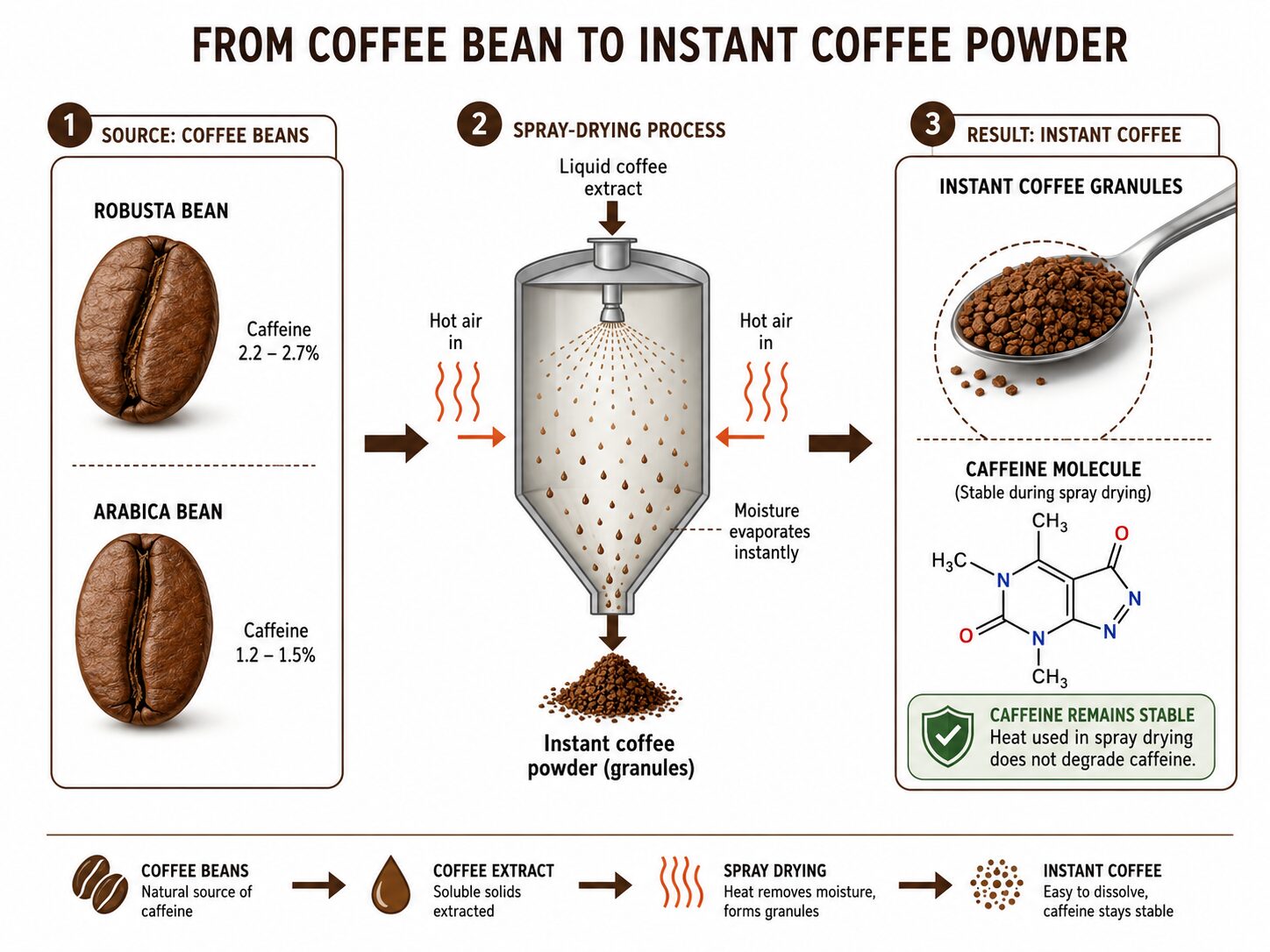
Why is instant coffee lower in caffeine than brewed? The answer is in the production process and the bean itself.
Instant coffee is made by brewing a highly concentrated coffee liquor, then removing the water through spray-drying or freeze-drying. This process exposes the coffee compounds to heat and oxygen. While caffeine is remarkably stable, some of the more volatile aromatic compounds and certain chlorogenic acids degrade. The caffeine concentration remains largely intact relative to the dry mass.
However, the starting bean matters. Robusta beans, often used in instant blends for their bold, bitter flavor and higher yield, naturally contain almost double the caffeine of Arabica beans. A budget instant using a high-Robusta blend could have a higher mg/g caffeine than the USDA’s “regular” average. This is a primary finding in the evaluation of popular coffee servings, which found wide variances even within the same beverage category.
The chemical profile also affects how you feel the caffeine. The lower levels of certain acids in instant might change the absorption rate compared to a fresh brew, potentially affecting the perceived “sharpness” of the energy boost. It’s not just the milligrams; it’s the matrix they arrive in.
How to Accurately Measure Your Caffeine Dose
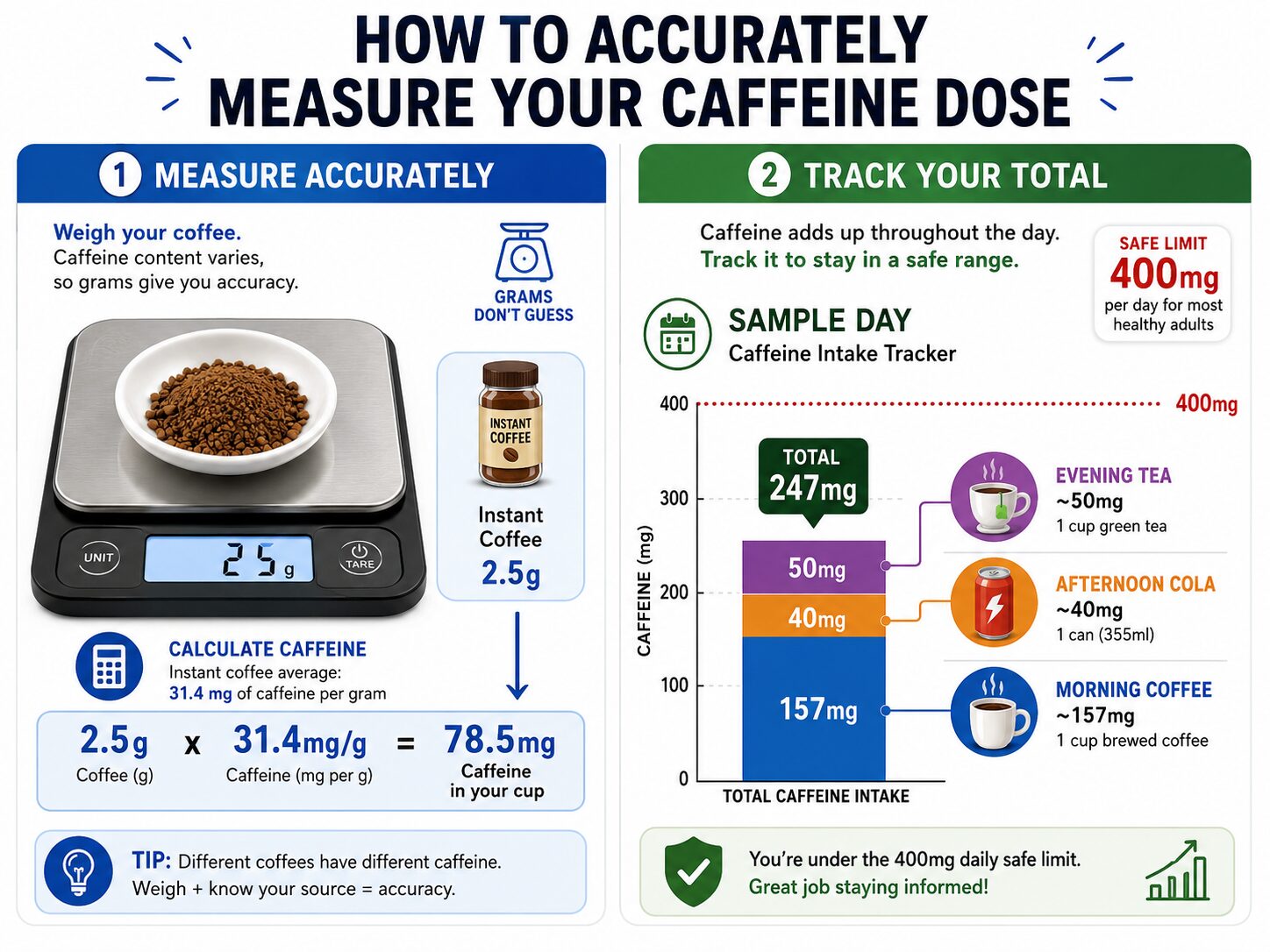
If you care about the number, for health, sleep, or anxiety reasons, estimation won’t cut it. You need a method.
- Weigh Your Coffee. This is non-negotiable. A $15 digital kitchen scale with 0.1-gram precision is the best tool for the job. Tare a small dish, add your usual scoop, and note the weight.
- Apply the Constant. Multiply the weight in grams by 31.4 (the USDA’s mg/g). That’s your estimated caffeine in milligrams.
- Adjust for Your Brand. If you use a major brand like Nescafé, search for “[Brand] + caffeine content per serving.” You might find a more precise number than the USDA average.
- Track Your Total. Remember, caffeine adds up. That includes your caffeine in tea, your afternoon soda, and even decaf coffee (which has trace amounts). Our comparison of caffeine in hot chocolate vs coffee shows even non-coffee sources contribute.
What does a sample day look like?
– Morning: 2 tsp of fine powder (~2.5g each) = ~157 mg
– Afternoon: 1 can of cola = ~40 mg
– Evening: 1 cup of black tea caffeine = ~50 mg
– Total: ~247 mg
That’s within the commonly cited 400 mg daily safe limit for most adults, but it illustrates how the teaspoon is just one part of the puzzle.
Common mistake: Ignoring the caffeine in over-the-counter pain relievers or pre-workout supplements. These can add 100-200 mg in a single dose, turning a moderate coffee habit into a high-intake day.
Frequently Asked Questions
Does darker roast instant coffee have more caffeine?
No. Roast level affects flavor, not caffeine content in the dry powder. The caffeine per gram remains virtually identical between light, medium, and dark roast instant coffee. The myth that dark roast has more caffeine often comes from using a denser volume of darker beans when brewing, which doesn’t apply to the standardized powder.
Is the caffeine in instant coffee weaker or stronger feeling?
It can feel different. Instant coffee often has a different chemical profile, with fewer accompanying compounds like chlorogenic acids. Some people report a “cleaner” or less jittery boost from instant, while others find it less satisfying. The total milligrams matter most, but the entourage effect of other coffee compounds influences the subjective experience.
How does decaf instant coffee work?
Decaf instant coffee undergoes a solvent-based, water-based, or CO2-based process to remove at least 97% of the caffeine from the beans before they are brewed and dried into instant powder. A teaspoon of decaf instant typically contains 1-3 mg of caffeine, compared to 62.8 mg in regular.
Can I use instant coffee for a caffeine boost before a workout?
Absolutely. The caffeine is just as bioavailable. For a predictable dose, use a pre-measured sachet (e.g., 50-65 mg). Mix it with a small amount of water for a concentrated shot. This avoids the bloating of a full cup of liquid. It’s a more controlled approach than the extreme spikes from some energy drink caffeine content.
Why does my instant coffee sometimes taste bitter and make me jittery?
You’re likely using too much powder. A heaping teaspoon of fine powder can easily deliver 80+ mg of caffeine. Combined with over-extraction from using boiling water (which “burns” the delicate instant granules), you get a bitter, high-caffeine cup. Try using cooler water (just off the boil) and leveling your spoon.
The Bottom Line
A teaspoon of instant coffee holds about 62.8 milligrams of caffeine, grounded in USDA data. That number isn’t a guess, it’s a calculation from a primary source. Your real-world dose dances around that figure based on one physical property: how much your specific granules weigh per spoonful.
To take control, weigh your coffee once. See if your usual scoop is 1.8 grams or 2.5 grams. That single act replaces a decade of internet speculation. Whether you’re using instant to moderate your intake or to get a reliable, quick lift, the power is in the gram, not the gossip. Now you know the number. Your teaspoon, your call.
{
“@context”: “https://schema.org”,
“@type”: “HowTo”,
“name”: “How to Calculate Caffeine in a Teaspoon of Instant Coffee”,
“totalTime”: “PT5M”,
“tool”: [
{
“@type”: “HowToTool”,
“name”: “Digital kitchen scale (0.1g precision)”
},
{
“@type”: “HowToTool”,
“name”: “Standard measuring teaspoon”
},
{
“@type”: “HowToTool”,
“name”: “Instant coffee jar”
}
],
“step”: [
{
“@type”: “HowToStep”,
“name”: “Weigh your teaspoon of coffee”,
“text”: “Place your empty teaspoon on the scale, tare it to zero, then fill it with a level scoop of your instant coffee powder. Note the weight in grams.”
},
{
“@type”: “HowToStep”,
“name”: “Apply the USDA caffeine concentration”,
“text”: “The USDA lists instant coffee powder at 3140 mg of caffeine per 100 grams. Multiply your scoop’s weight in grams by 31.4 to find its estimated caffeine in milligrams.”
},
{
“@type”: “HowToStep”,
“name”: “Account for brand and granule type”,
“text”: “Recognize that finer powders weigh more per teaspoon. If your scoop weighed over 2.5g, your caffeine is higher than the 62.8mg baseline. Coarse granules mean less caffeine per spoon.”
},
{
“@type”: “HowToStep”,
“name”: “Compare to your typical serving”,
“text”: “Most people use 1-2 teaspoons per cup. Double your single-teaspoon calculation to estimate your actual drink’s caffeine load.”
}
]
}
{
“@context”: “https://schema.org”,
“@type”: “FAQPage”,
“mainEntity”: [
{
“@type”: “Question”,
“name”: “Does darker roast instant coffee have more caffeine?”,
“acceptedAnswer”: {
“@type”: “Answer”,
“text”: “No. Roast level affects flavor, not caffeine content in the dry powder. The caffeine per gram remains virtually identical between light, medium, and dark roast instant coffee. The myth that dark roast has more caffeine often comes from using a denser volume of darker beans when brewing, which doesn’t apply to the standardized powder.”
}
},
{
“@type”: “Question”,
“name”: “Is the caffeine in instant coffee weaker or stronger feeling?”,
“acceptedAnswer”: {
“@type”: “Answer”,
“text”: “It can feel different. Instant coffee often has a different chemical profile, with fewer accompanying compounds like chlorogenic acids. Some people report a \”cleaner\” or less jittery boost from instant, while others find it less satisfying. The total milligrams matter most, but the entourage effect of other coffee compounds influences the subjective experience.”
}
},
{
“@type”: “Question”,
“name”: “How does decaf instant coffee work?”,
“acceptedAnswer”: {
“@type”: “Answer”,
“text”: “Decaf instant coffee undergoes a solvent-based, water-based, or CO2-based process to remove at least 97% of the caffeine from the beans before they are brewed and dried into instant powder. A teaspoon of decaf instant typically contains 1-3 mg of caffeine, compared to 62.8 mg in regular.”
}
},
{
“@type”: “Question”,
“name”: “Can I use instant coffee for a caffeine boost before a workout?”,
“acceptedAnswer”: {
“@type”: “Answer”,
“text”: “Absolutely. The caffeine is just as bioavailable. For a predictable dose, use a pre-measured sachet (e.g., 50-65 mg). Mix it with a small amount of water for a concentrated shot. This avoids the bloating of a full cup of liquid. It’s a more controlled approach than the extreme spikes from some energy drink caffeine content.”
}
},
{
“@type”: “Question”,
“name”: “Why does my instant coffee sometimes taste bitter and make me jittery?”,
“acceptedAnswer”: {
“@type”: “Answer”,
“text”: “You’re likely using too much powder. A heaping teaspoon of fine powder can easily deliver 80+ mg of caffeine. Combined with over-extraction from using boiling water (which \”burns\” the delicate instant granules), you get a bitter, high-caffeine cup. Try using cooler water (just off the boil) and leveling your spoon.”
}
}
]
}
