
How Much Caffeine Is in a Pot of Coffee? The Real 1140mg Myth
How much caffeine is in a pot of coffee? A standard 12-cup pot contains 1140–2400mg, not a fixed 1140mg. The exact amount depends on your coffee brand, roast type, and machine. The common 95mg-per-cup estimate fails because a coffee maker’s ‘cup’ is only 5 ounces, not a typical 8–16 ounce mug.
A standard 12-cup pot of coffee, using a typical brew ratio, contains between 1140 and 2400 milligrams of caffeine. The massive range comes from your bean choice, your grind, your machine, and the brand of coffee you buy. A Starbucks Pike Place roast pot packs nearly double the caffeine of a home-brewed light roast. The common 95mg-per-cup estimate fails because coffee makers define a ‘cup’ as 5 ounces, not 8, and most people fill a mug with 12 to 16 ounces.
Everyone uses the same average number. They multiply 95 milligrams by 12 and call it a day. That math is clean, simple, and almost always wrong. It ignores the brand in your cabinet, the dark roast myth, and the fact that your ‘cup’ is probably a 16-ounce tumbler. You end up thinking you had 1140mg when you actually consumed 1800mg. That extra 660mg is the difference between a focused afternoon and jittery insomnia at midnight.
This guide walks through the real math. We’ll use data from the USDA, Starbucks, and Dunkin’ to show how brand alone swings your total by hundreds of milligrams. You’ll see why dark roast isn’t weaker, how cold brew concentrates caffeine, and what ‘decaf’ really means. We’ll also cover how that caffeine lingers, a quarter of your noon coffee is still in your system at midnight.
Key Takeaways
- A ‘cup’ on your coffee maker is 5–6 ounces, not 8. A 12-cup pot yields 60–72 oz, not 96 oz.
- Starbucks brewed coffee contains nearly double the caffeine per ounce compared to the USDA standard.
- Dark roast beans have slightly less caffeine by weight, but you use more grams per pot because they’re less dense, the final brew’s caffeine content often equals a light roast.
- Decaffeinated coffee still has caffeine, about 2–5% of the original amount. A pot of decaf can deliver 25–60mg.
- Caffeine has a half-life of 6–7 hours. A quarter of the caffeine from a noon coffee is still active in your brain at midnight.
The Standard Pot Math (and Why It’s Wrong)
Most articles point to the USDA’s FoodData Central entry for brewed coffee. It lists 95mg of caffeine per 8-fluid-ounce serving. They then multiply 95 by 12, land on 1140mg, and publish. That’s the commodity answer. It’s not useless, but it misses three critical details that change the total by 50% or more.
First, the serving size. The USDA uses an 8-ounce ‘cup’ because that’s the standard nutritional measurement. Your coffee maker does not. Mr. Coffee, Cuisinart, and Breville all define one ‘cup’ as 5 to 6 ounces. Their 12-cup machines produce 60 to 72 ounces of brewed coffee, not 96. If you use the 95mg-per-8-oz figure, you must first scale it down to the machine’s output. A 60-ounce pot holds the caffeine equivalent of 7.5 eight-ounce cups, not 12.
Second, the brew ratio. The USDA figure assumes a standard preparation, 1 to 2 tablespoons of ground coffee per 6 ounces of water. If you use a heaping scoop, a finer grind, or a stronger ratio, you extract more caffeine. A study in Foods journal noted that extraction yield, how much soluble material you pull from the grounds, directly impacts caffeine content. A stronger ratio can push a 60-ounce pot from 712mg to over 1000mg.
Third, the source. The USDA data is a generic composite. It doesn’t account for the bean in your bag.
A 2023 analysis published in PubMed Central evaluated caffeine content across popular commercial coffees and found a staggering 300% variation between the lowest and highest samples, even when prepared identically.
Your total isn’t 1140mg. It’s whatever your specific bag of beans yields in your specific machine. The rest of this article is about finding your number.
TL;DR: Your 12-cup coffee maker brews 60–72 ounces, not 96. Using the standard 95mg-per-8-ounce estimate on that smaller volume gives you a baseline of 712–855mg, before you even factor in your beans.
Your Coffee Brand Is the Biggest Variable
Walk down a grocery aisle. Every bag makes a promise about flavor, but almost none list caffeine. You’re left guessing. The brand alone can swing your pot’s total by 500 milligrams.
Starbucks publishes its numbers. A 16-ounce (Grande) brewed coffee, their Pike Place Roast, contains 310mg of caffeine. That’s 19.4mg per ounce. Scale that to a 60-ounce pot: 1,164mg. To a 72-ounce pot: 1,397mg. Their dark roast is within 5% of that. Starbucks coffee is dense with caffeine.
Dunkin’ is different. Their 14-ounce medium Original Blend coffee has 210mg, which is 15mg per ounce. A 60-ounce pot made with Dunkin’ beans would deliver roughly 900mg. A 72-ounce pot hits 1,080mg. That’s a 300mg difference from Starbucks for the same volume of liquid.
Keurig pods introduce another layer. A standard K-Cup brews 8 ounces and contains between 75 and 150mg. An ‘extra bold’ pod can exceed 200mg. To fill a 60-ounce carafe, you’d need 7.5 pods. Using a mid-range pod (112mg), that’s 840mg total. Using the strongest pods, you’re looking at 1,500mg or more. The convenience costs you consistency.
Then there are the high-octane brands. Death Wish Coffee claims 728mg per 12-ounce serving. That’s 60.7mg per ounce. A 60-ounce pot of that would deliver 3,642mg. You would not sleep for two days.
| Brand / Bean Type | Caffeine per 8 oz (approx) | Caffeine per 60 oz Pot | Key Differentiator |
|---|---|---|---|
| USDA Standard (Brewed) | 95 mg | 712 mg | Generic baseline |
| Starbucks Pike Place | 155 mg | 1,164 mg | High bean density |
| Dunkin’ Original Blend | 120 mg | 900 mg | Lighter roast profile |
| Keurig K-Cup (Avg) | 112 mg | 840 mg | Pod-to-pod variance |
| Death Wish Coffee | 485 mg | 3,642 mg | Fortified robusta blend |
The table shows the problem with averages. If you switch from Dunkin’ to Starbucks, your morning pot’s caffeine jumps nearly 30% without you pouring a single extra ounce.
Common mistake: Assuming all ‘medium roast’ coffee has the same caffeine content, a Starbucks medium has nearly 30% more caffeine per ounce than a Dunkin’ medium because of bean selection and blend.
Your brand choice is the first number you need to lock down. Check the manufacturer’s website. If they don’t publish it, you’re guessing. In that case, assume you’re near the USDA’s 95mg per 8-ounce mark, but know you could be off by hundreds of milligrams.
Dark Roast, Light Roast, and the Caffeine Myth
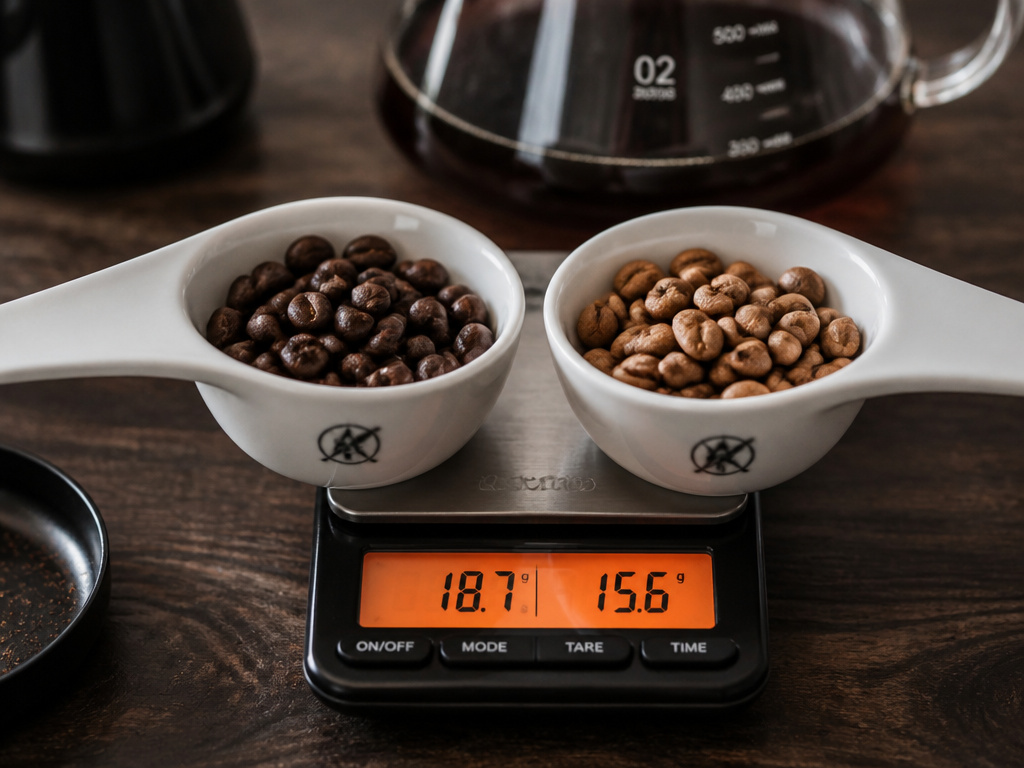
You’ve heard it: dark roast is stronger, light roast is smoother. That’s about flavor, not caffeine. The caffeine myth is more persistent. People think dark roast has more caffeine because it tastes bolder. Or they think light roast has more because the bean is less cooked. Both are wrong in a way that matters for your pot.
Here’s the chemistry. Caffeine is stable up to about 235°C. Roasting temperatures for coffee typically peak between 200°C and 230°C. Very little caffeine is destroyed during roasting. A study in the journal Food & Function confirmed that variations in caffeine content due to roast level are minimal, often less than 5%. The real difference is density.
A dark roast bean is less dense. It has expanded more from internal gases. When you scoop it, you’re getting fewer grams of coffee per scoop. If you measure by volume, using a tablespoon, a scoop of dark roast contains less actual coffee mass than a scoop of light roast. But if you measure by weight, you use the same mass for both. Most home brewers use a scoop.
I used to think my French press with dark roast was a caffeine bomb. I weighed it. My ‘heaping tablespoon’ of dark beans was 9 grams. The same scoop of light roast was 11 grams. That’s a 22% difference in coffee mass going into the pot. The dark roast pot was weaker.
The fix is a scale. Weigh your grounds. Aim for a brew ratio of 1:16, 55 grams of coffee for 60 ounces of water (about 1,800ml). Whether the beans are dark or light, 55 grams of coffee will extract a roughly consistent amount of caffeine. The Foods journal analysis of brewing methods shows that extraction yield, not roast color, is the primary driver.
If you don’t weigh, assume your dark roast pot has slightly less caffeine than your light roast pot. The difference might be 50–100mg total, not the 300–400mg swing that the myth suggests.
TL;DR: Roast level changes bean density, not caffeine stability. Weigh your grounds to control caffeine input; a tablespoon of dark roast contains less coffee by mass than a tablespoon of light roast.
Not All Brewing Methods Are Equal
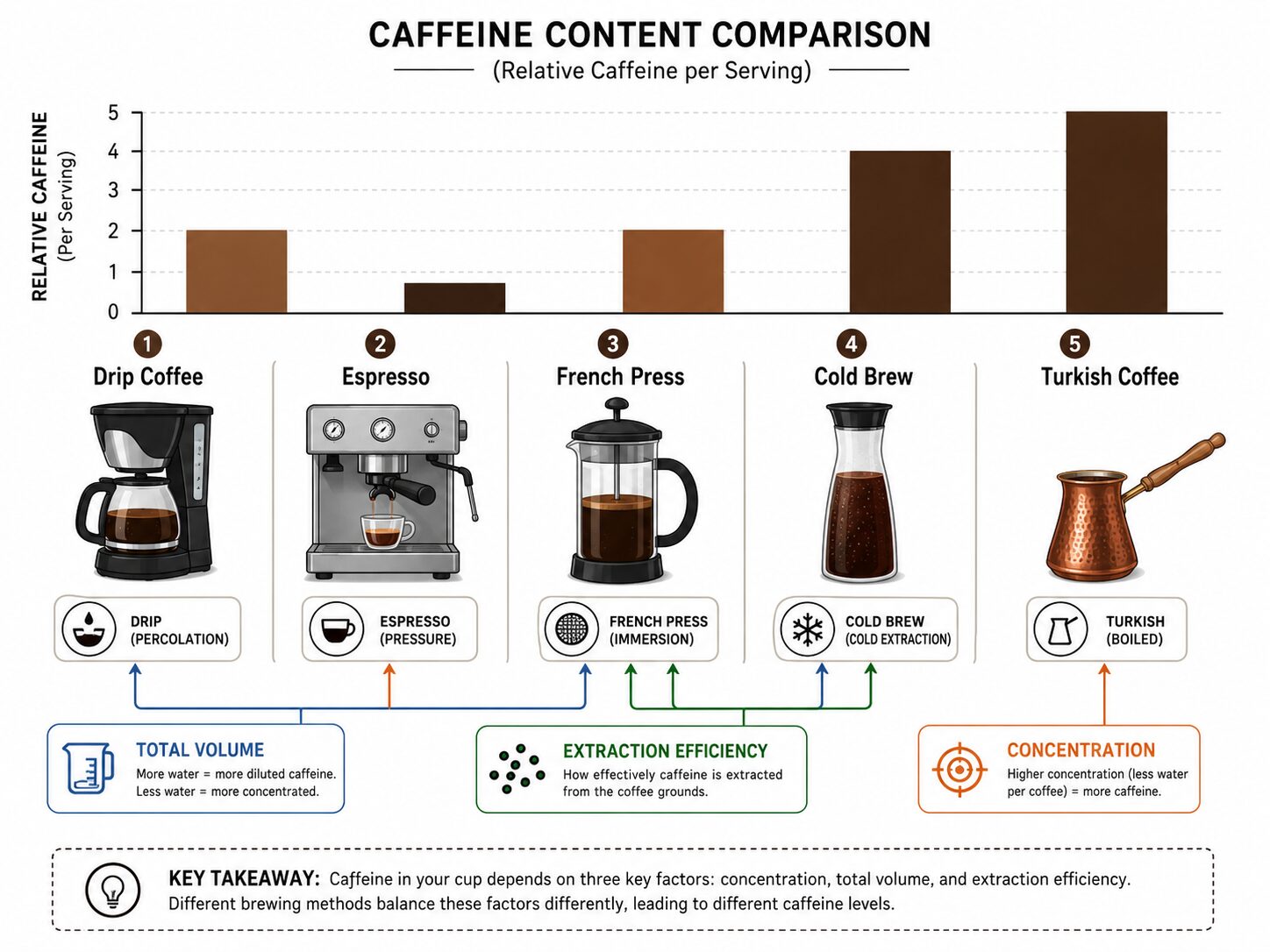
Drip coffee is the standard. Other methods concentrate caffeine or waste it. Your brewer decides how efficiently caffeine moves from the bean to your cup.
Espresso is the obvious outlier. A 1-ounce shot of espresso averages 64mg of caffeine. Ounce for ounce, it’s more concentrated than drip coffee. But you drink less volume. A single shot has less total caffeine than an 8-ounce cup of drip. A double shot (2oz, ~128mg) still falls short of a 12-ounce mug of Starbucks (233mg). Comparing caffeine in espresso to drip coffee is about concentration, not total dose.
French press and pour-over are similar to drip in extraction. They might even pull slightly more caffeine if you use a finer grind or longer steep time. The difference is usually within 10%.
Cold brew is the stealth contender. It uses a higher coffee-to-water ratio, often double that of drip, and steeps for 12 to 24 hours. The result is a concentrate that can hit 200mg of caffeine per 8-ounce serving when diluted. A full pot of diluted cold brew could easily reach 1500mg. It tastes smooth, but it packs a punch.
Turkish coffee is in its own league. Finely ground coffee is boiled with water and sugar, then served unfiltered. You drink the grounds. A small 3-ounce cup can contain 50–70mg of caffeine. A pot of Turkish coffee, because you’re consuming the slurry, delivers a massive total dose. It’s the most efficient extraction method of all.
Common mistake: Equating bitterness with caffeine, cold brew is low in acidity and tastes smooth, but its caffeine concentration can be double that of a similarly sized drip coffee.
Your machine matters, too. A single-serve pod system like Keurig extracts differently than a full-pot drip machine. The NIH caffeine content evaluation of popular coffees found significant variation even within the same brand across different brew methods. The takeaway is simple. If you change your brewer, you change your caffeine math.
Decaf Isn’t Caffeine-Free
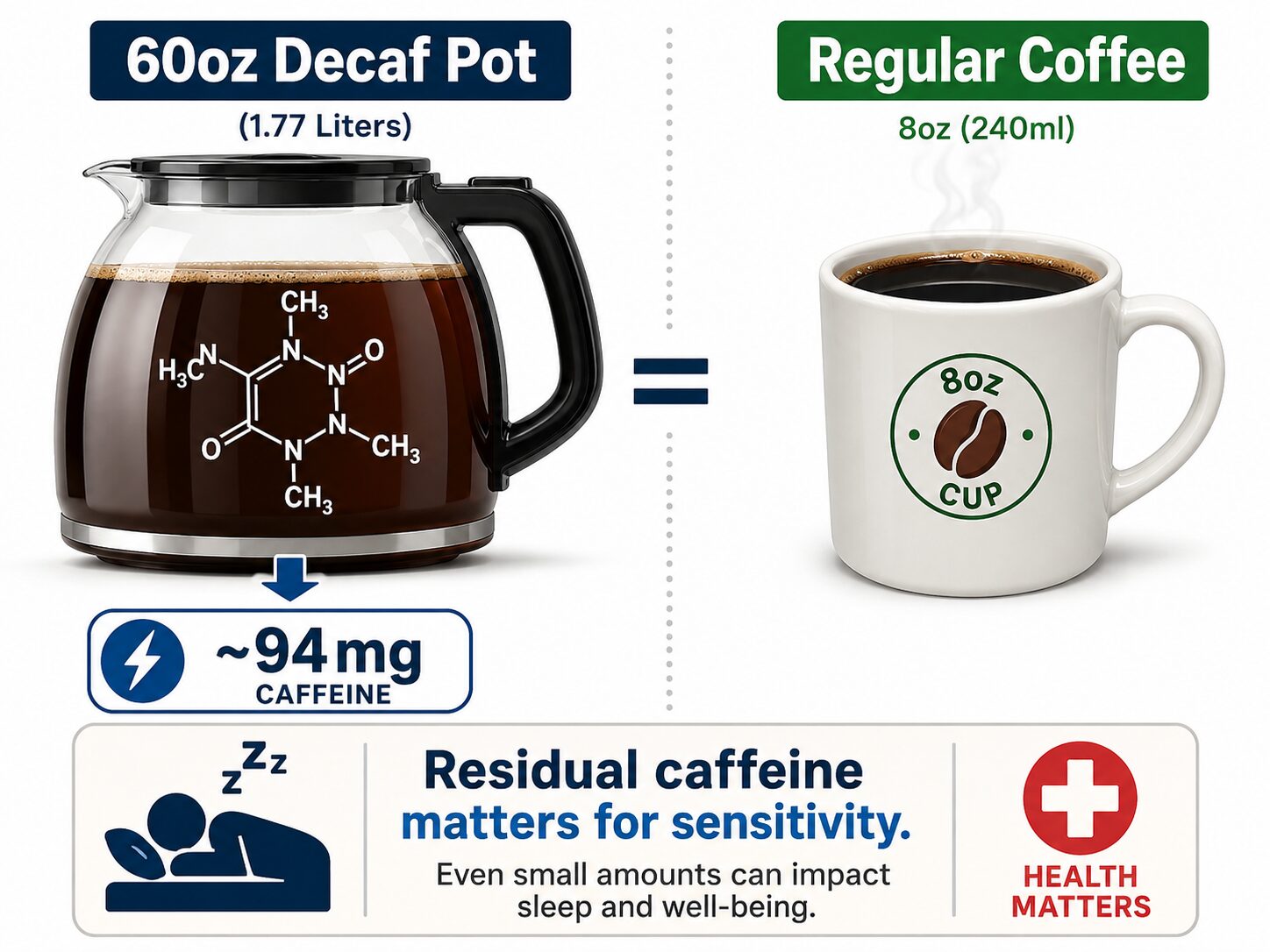
Order a decaf pot after dinner. You’ll sleep fine, right? Probably. But you didn’t drink zero caffeine. The decaffeination process removes about 97–99.9% of the caffeine. The leftover 0.1–3% adds up across a full pot.
Starbucks lists its decaf Pike Place Roast at 25mg per 16-ounce Grande. That’s 1.56mg per ounce. A 60-ounce pot of decaf Starbucks would still deliver about 94mg of caffeine. That’s the equivalent of a full 8-ounce cup of regular coffee from the USDA standard.
Home-brewed decaf varies by brand and process. The Swiss Water Process and direct solvent methods leave different residues. You might get 2mg per 8-ounce cup, or you might get 7mg. A 60-ounce pot could range from 15mg to 52mg.
For most people, that’s negligible. For someone extremely sensitive to caffeine or trying to eliminate it completely, it’s a problem. They might switch to a truly caffeine-free alternative like herbal tea, only to find their decaf coffee was the culprit behind their restless night.
If you’re monitoring intake for medical reasons, like managing anxiety or a heart condition, treat decaf as a low-caffeine beverage, not a no-caffeine beverage. The PubMed Central filter coffee analysis includes decaffeinated samples and confirms this residual range.
How to Calculate Your Actual Pot
Stop guessing. You need four numbers: your coffee’s caffeine per ounce, your coffee’s mass in grams, your water volume in ounces, and your mug size.
First, find your coffee’s caffeine density. If your brand publishes data (like Starbucks or Dunkin’), use their mg-per-ounce figure. If not, use the USDA’s 11.875mg per ounce (95mg ÷ 8oz) as a cautious baseline. Remember, specialty or robusta-heavy blends will be higher.
Second, weigh your grounds. This is non-negotiable. A ‘scoop’ is useless. A standard 12-cup drip machine needs about 72–96 grams of coffee for 60–72 ounces of water. That’s a 1:16 to 1:18 brew ratio. Put your carafe on a scale, tare it, and pour in water until you hit 60 ounces. Then weigh your beans.
Third, do the math.
1. Find your coffee’s mg-per-ounce (e.g., Starbucks Pike Place: 19.4mg/oz).
2. Multiply by your pot’s total ounces (e.g., 60 oz × 19.4mg/oz = 1,164mg).
3. This is the total caffeine in the entire carafe.
Fourth, portion it out. Your mug holds 12, 16, maybe 20 ounces. Divide the carafe’s total caffeine by the number of ounces in your mug to find your per-serving dose. If the carafe has 1,164mg and you drink a 16-ounce mug, that’s 310mg per serving, exactly the Starbucks Grande number.
If you use a scale and known brand data, your error drops to under 10%. If you guess, you’re easily 40% off. That’s the difference between a manageable 200mg breakfast and a jittery 350mg one.
Your Body Doesn’t Process It All at Once
You finish a 16-ounce mug at 8 a.m. By noon, you feel a slump. You reach for another. That second mug stacks on top of the first. Caffeine has a half-life of 6 to 7 hours in most adults. Half of the caffeine from your 8 a.m. coffee is still circulating at 2 p.m.
The quarter-life is the real sleep killer. About 25% of that morning caffeine is still active in your system 12 hours later. If you drank a 310mg Starbucks Grande at noon, around 77.5mg is still affecting your brain at midnight. That’s like drinking a quarter-cup of coffee right before bed.
This timeline comes from pharmacokinetic studies cited in the Royal Society of Chemistry article on caffeine metabolism. Your genetics influence it. Some people possess a gene variant in the CYP1A2 enzyme that makes them ‘fast metabolizers,’ breaking caffeine down twice as quickly. Slow metabolizers feel the effects longer.
The practical rule is to map your cutoff time. If you’re sensitive, stop all caffeine at least 8 hours before your target bedtime. For a 10 p.m. bedtime, that’s a 2 p.m. cutoff. That includes sodas, Coca-Cola caffeine, and even chocolate. A late-afternoon iced tea caffeine boost can linger just as long as coffee.
I used to have a 4 p.m. espresso. I couldn’t figure out why I’d stare at the ceiling until 1 a.m. even though I ‘fell asleep’ fine. Cutting off caffeine by 2 p.m. added two hours of solid sleep within a week.
Tracking your total daily intake matters more than any single pot. That 4 p.m. coffee might be your fourth serving. A pot shared between two people is one thing. Drinking three-quarters of it yourself is another.
Frequently Asked Questions
How much caffeine is in a 12-cup pot of coffee?
Between 1140mg and 2400mg. The low end assumes a generic brew at the USDA standard (95mg per 8-ounce cup). The high end accounts for high-caffeine brands like Starbucks or Death Wish Coffee and stronger brew ratios. Your actual pot depends entirely on your beans and your machine.
Does dark roast coffee have more caffeine?
No. Dark roast beans are less dense, so a scoop contains less coffee by mass. If you measure by weight, the caffeine content between light and dark roast for the same mass is nearly identical. The bold flavor comes from roasting, not extra caffeine.
Is decaf coffee completely caffeine-free?
No. Decaffeinated coffee retains 2–5% of its original caffeine. A 16-ounce Starbucks decaf contains 25mg. A full 60-ounce pot of home-brewed decaf can deliver 50–100mg of caffeine, equivalent to a small regular coffee.
How long does caffeine stay in your system?
Caffeine’s half-life is 6–7 hours for most adults. A quarter of the caffeine you consume is still active 12 hours later. If you drink a 200mg coffee at 4 p.m., about 50mg is still in your system at 4 a.m.
Which has more caffeine: coffee or an energy drink?
It depends on the serving. A 16-ounce Starbucks coffee has 310mg. A 16-ounce can of Monster Energy caffeine has about 160mg. Coffee typically wins per ounce, but some concentrated energy shots exceed 300mg in a small volume. Compare your actual serving sizes.
The Bottom Line
Forget the 95mg-per-cup average. Your pot’s caffeine content is a product of your brand, your scale, and your machine. Weigh your grounds. Check your brand’s published numbers if they exist. And remember that a ‘cup’ on your brewer is 5 ounces, not 8.
The math isn’t complicated once you have the right inputs. A scale costs $15 and removes the biggest variable. Use it once to see what 60 ounces of water looks like in your carafe, and what 72 grams of coffee looks like in your basket. That single experiment will get you closer to the true number than any generic article ever could.
Then watch the clock. That afternoon pick-me-up has a quarter-life that stretches past midnight. Your total daily intake from all sources, coffee, soda, tea caffeine content, even hot chocolate caffeine, adds up faster than you think. The pot is just the starting point.
{
“@context”: “https://schema.org”,
“@type”: “HowTo”,
“name”: “How to Calculate Caffeine in a Pot of Coffee”,
“totalTime”: “PT5M”,
“tool”: [
{
“@type”: “HowToTool”,
“name”: “Standard 12-cup coffee maker”
},
{
“@type”: “HowToTool”,
“name”: “Kitchen scale”
},
{
“@type”: “HowToTool”,
“name”: “Calculator or phone”
}
],
“step”: [
{
“@type”: “HowToStep”,
“name”: “Identify your coffee brand and roast”,
“text”: “Check the bag or manufacturer’s website for specific caffeine information. Generic averages are often wrong.”
},
{
“@type”: “HowToStep”,
“name”: “Measure your grounds”,
“text”: “Weigh the coffee grounds you use. A standard 12-cup pot uses about 72-96 grams of coffee, not a fixed scoop count.”
},
{
“@type”: “HowToStep”,
“name”: “Calculate using known benchmarks”,
“text”: “Use the USDA benchmark of 95mg per 8oz cup of brewed coffee as a baseline, then adjust for your specific bean and ratio.”
},
{
“@type”: “HowToStep”,
“name”: “Adjust for serving size”,
“text”: “A ‘cup’ on a coffee maker is 5-6 oz. A 12-cup pot yields 60-72 oz of liquid, not 96 oz. Recalculate your total caffeine based on the actual fluid ounces you drink.”
}
]
}
{
“@context”: “https://schema.org”,
“@type”: “FAQPage”,
“mainEntity”: [
{
“@type”: “Question”,
“name”: “How much caffeine is in a 12-cup pot of coffee?”,
“acceptedAnswer”: {
“@type”: “Answer”,
“text”: “Between 1140mg and 2400mg. The low end assumes a generic brew at the USDA standard (95mg per 8-ounce cup). The high end accounts for high-caffeine brands like Starbucks or Death Wish Coffee and stronger brew ratios. Your actual pot depends entirely on your beans and your machine.”
}
},
{
“@type”: “Question”,
“name”: “Does dark roast coffee have more caffeine?”,
“acceptedAnswer”: {
“@type”: “Answer”,
“text”: “No. Dark roast beans are less dense, so a scoop contains less coffee by mass. If you measure by weight, the caffeine content between light and dark roast for the same mass is nearly identical. The bold flavor comes from roasting, not extra caffeine.”
}
},
{
“@type”: “Question”,
“name”: “Is decaf coffee completely caffeine-free?”,
“acceptedAnswer”: {
“@type”: “Answer”,
“text”: “No. Decaffeinated coffee retains 2–5% of its original caffeine. A 16-ounce Starbucks decaf contains 25mg. A full 60-ounce pot of home-brewed decaf can deliver 50–100mg of caffeine, equivalent to a small regular coffee.”
}
},
{
“@type”: “Question”,
“name”: “How long does caffeine stay in your system?”,
“acceptedAnswer”: {
“@type”: “Answer”,
“text”: “Caffeine’s half-life is 6–7 hours for most adults. A quarter of the caffeine you consume is still active 12 hours later. If you drink a 200mg coffee at 4 p.m., about 50mg is still in your system at 4 a.m.”
}
},
{
“@type”: “Question”,
“name”: “Which has more caffeine: coffee or an energy drink?”,
“acceptedAnswer”: {
“@type”: “Answer”,
“text”: “It depends on the serving. A 16-ounce Starbucks coffee has 310mg. A 16-ounce can of Monster Energy caffeine has about 160mg. Coffee typically wins per ounce, but some concentrated energy shots exceed 300mg in a small volume. Compare your actual serving sizes.”
}
}
]
}
