
Coffee Latte Calories: Official USDA Data and What Alters Them
A standard 12-ounce coffee latte made with whole milk contains about 150–170 calories. The USDA’s FoodData Central lists a commercially prepared latte with whole milk at 103 calories per 100 grams, which scales to 174 calories for a 12-ounce drink. Swap to skim milk and it drops to around 120 calories; add four pumps of vanilla syrup and you’re back over 200.
Most people guess high or low by a wide margin because they forget the milk volume. A latte is mostly steamed milk, not mostly coffee. That misjudgment throws every calorie estimate off by 50 calories or more before you even touch the sugar.
This guide breaks down the numbers from the USDA and major chains, shows you what moves the needle, and gives you a method to calculate the calories in your own homemade version.
Key Takeaways
- The USDA’s benchmark for a commercially prepared whole-milk latte is 103 calories per 100 grams. For a standard 12-ounce drink, that’s roughly 174 calories.
- Milk choice is the biggest lever. Switching from whole milk to almond milk can cut the calorie count of a Grande Starbucks latte from 190 to 100.
- Syrups are stealth calorie bombs. Each standard pump of flavored syrup adds about 20 calories. A flavored “Vanilla Latte” often has four pumps.
- Whipped cream adds 50–100 calories on top of everything else. It’s the single highest-calorie add-on per gram.
- You can build a latte under 100 calories: use skim milk or unsweetened almond milk, skip the syrup, and opt for a sprinkle of cinnamon or a drop of vanilla extract.
The Core Math: Espresso, Milk, and Air
A latte’s calorie count isn’t a mystery. It’s the sum of its parts: espresso, milk, and any additives. The espresso contributes almost nothing. A single shot (about 30 ml) has roughly 3 calories. A double is around 6. The real math is in the milk.
The U.S. Department of Agriculture maintains the primary food database, FoodData Central. Its entry for “Beverages, coffee, latte, with whole milk, commercially prepared” is the gold-standard baseline: 103 calories per 100 grams. For “Beverages, coffee, latte, with skim milk, commercially prepared,” it’s 67 calories per 100 grams.
A 100-gram serving of a commercially prepared whole-milk latte contains 103 calories, 4.8 grams of fat, 9.7 grams of carbs (9.5g sugars), and 5.4 grams of protein. The skim-milk version contains 67 calories, 0.3g fat, 12.1g carbs (11.8g sugars), and 4.8g protein. These figures assume no added sweeteners.
Your average takeout latte is 12 ounces, or about 340 grams. Scaling the USDA numbers, a 12-ounce whole-milk latte lands around 174 calories. The skim-milk version is about 114 calories. The difference is entirely in the milk fat.
The foam matters too. A properly steamed latte has about 1 cm of microfoam. That’s mostly air, which adds volume without significant mass or calories. A cappuccino has more foam, so it uses slightly less milk for the same cup size. That’s why a cappuccino often has 10-20 fewer calories than a latte of the same volume.
TL;DR: A 12-ounce latte is roughly 170 calories with whole milk, 115 with skim. The espresso is negligible; the milk is everything.
Chain Latte Calorie Counts (Starbucks, Dunkin’, McDonald’s)
Chain drinks use standardized recipes, which means their published numbers are precise. They also reveal how small formula changes create big calorie differences.
| Drink (16 fl oz / Medium) | Milk Type | Calories | Key Differentiator |
|---|---|---|---|
| Starbucks Grande Caffè Latte | 2% | 190 | Default milk is 2%, not whole |
| Dunkin’ Medium Latte | Whole | 210 | Default whole milk adds fat |
| McDonald’s Medium Latte | Whole | 190 | Similar to Starbucks but with whole milk |
Starbucks uses 2% milk as its standard. That’s why a Grande Caffè Latte hits 190 calories. If you customize it to whole milk, it jumps to about 220. Switch to nonfat milk and it drops to 130.
Dunkin’ defaults to whole milk. Their Medium Latte sits at 210 calories. Asking for skim milk there brings it down to 140.
McDonald’s McCafé Medium Latte with whole milk is 190 calories. Their small (12 oz) is 150, and their large (21 oz) is 250.
These numbers are for the plain, unflavored drink. The moment you add a flavor, you add syrup.
Common mistake: Ordering a “Vanilla Latte” without specifying syrup pumps — baristas typically add the full standard recipe, which is 4 pumps for a Grande at Starbucks. That’s an extra 80 calories you might not have accounted for.
What Adds Calories Fast (And What Doesn’t)
You can think of latte add-ins in three tiers: syrups and sugars (high impact), milk swaps (variable), and spices or extracts (negligible).
Syrups and Sweeteners are the heavy lifters. A single pump of Starbucks’ classic syrup is about 20 calories. A Grande flavored latte gets four pumps, adding 80 calories. A venti gets six pumps, or 120 extra calories. Whipped cream is the champion add-on, adding 50–110 calories depending on the size and how heavily it’s applied.
Milk Swaps can cut or increase calories dramatically. The biggest savings come from switching dairy to unsweetened plant milk.
| Milk Type (for a 12 oz latte) | ~Calories | Notes |
|---|---|---|
| Skim Milk | 110–120 | Lowest-calorie dairy option |
| Unsweetened Almond Milk | 60–80 | Very low in calories and fat |
| Unsweetened Oat Milk | 120–150 | Higher in carbs than almond |
| 2% Milk | 150–170 | Standard at many cafes |
| Whole Milk | 170–190 | Highest-calorie dairy option |
| Sweetened Soy or Oat Milk | 140–180 | Watch for added sugars |
Spices and Extracts are essentially free. A dash of cinnamon, nutmeg, or cocoa powder adds a gram of carbs at most. A drop of vanilla or almond extract might have 2–3 calories. These are your best tools for flavor without the penalty.
The choice of sweetener also matters. A teaspoon of granulated sugar is 16 calories. A packet of honey or agave is around 20. Liquid stevia or monk fruit drops? Zero.
TL;DR: Syrups and whipped cream can double your drink’s calories. Switching to unsweetened almond milk can cut them in half. Spices cost you nothing.
How to Calculate Your Homemade Latte Calories

You don’t need a nutrition degree. You need a scale and three numbers.
First, measure your milk. Steam or heat the amount you’ll use. A standard home latte might use 6–8 ounces (180–240 ml). Weigh it in grams for the most accurate calculation.
Second, find your milk’s calorie density per 100 ml. This is on the carton. If it’s not, here are reliable averages:
* Whole milk: ~62 calories per 100 ml
* 2% milk: ~50 calories per 100 ml
* Skim milk: ~35 calories per 100 ml
* Unsweetened almond milk: ~15 calories per 100 ml
* Unsweetened oat milk: ~45 calories per 100 ml
Third, add the espresso. One shot (30 ml) is about 3 calories.
The formula is: (Milk volume in ml / 100) x Calories per 100ml + Espresso calories + Additive calories.
Let’s run an example. You make an 8-ounce (240 ml) latte with 2% milk and add one teaspoon of sugar.
* Milk: (240 / 100) x 50 = 120 calories
* Espresso: 3 calories (single shot)
* Sugar: 16 calories
* Total: 139 calories
If you used the same volume of unsweetened almond milk, the math changes: (240 / 100) x 15 = 36 calories, plus 3 for espresso, totals 39 calories. No sugar needed.
This method works for any combination. It turns guessing into knowing. For more on tailoring your drink, our guide to low-calorie milk options breaks down the pros and cons of each swap.
The Skinny Latte vs. The “Healthy” Latte Trap
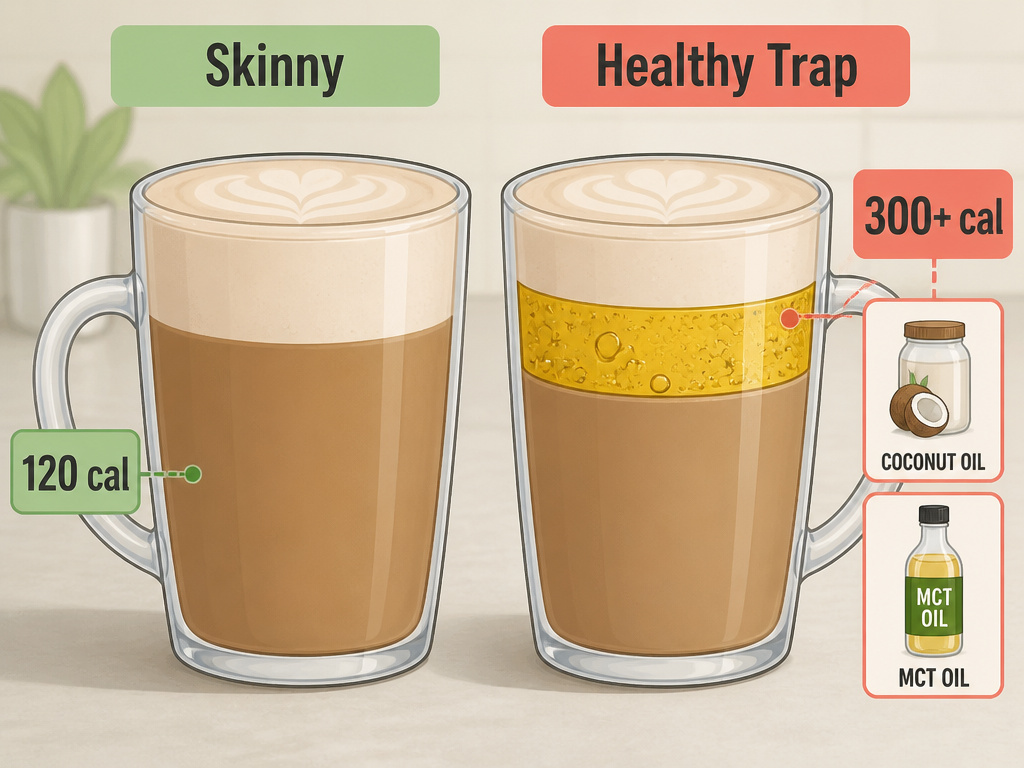
A “skinny” latte usually means nonfat milk and sugar-free syrup. At Starbucks, a Grande Skinny Vanilla Latte is 120 calories. That’s a solid low-calorie win.
The trap is the “healthy” latte. This is where things like coconut oil, MCT oil, or butter get added. A tablespoon of coconut oil has about 120 calories. A tablespoon of MCT oil has around 115. Adding these for purported keto or energy benefits can turn your latte into a 300+ calorie meal replacement, not a drink.
I tried the bulletproof-style latte with a tablespoon of MCT oil for a week. By day three, the oil separated and floated on top of my coffee unless I used a blender. It also added a slick mouthfeel I never got used to. The energy boost was real, but so was the 250-calorie breakfast I was drinking.
Other “functional” add-ins like collagen peptides (35 calories per scoop) or protein powder (100+ calories) also add up. They have their place, but they move your latte from beverage territory into snack territory.
If your goal is pure calorie reduction, stick with the skinny formula: nonfat or almond milk, sugar-free syrup, and skip the whipped cream. If you’re using the latte as a vehicle for fats or protein, count those calories consciously. The Harvard Nutrition Source coffee guide notes that while coffee itself has minimal calories, what you add to it determines its overall health impact.
Frequently Asked Questions
Does a latte have more calories than regular coffee?
Yes, significantly. A black coffee has about 5 calories. A 12-ounce latte has 150–200 calories. The difference is the steamed milk.
How many calories are in a latte with almond milk?
It depends if the almond milk is sweetened. Unsweetened almond milk has about 15 calories per 100 ml. A 12-ounce latte with unsweetened almond milk and espresso would have roughly 50–60 calories. Sweetened versions can have 80–100 calories for the same drink.
Is a cappuccino lower in calories than a latte?
Usually, yes. A cappuccino has more foam and less liquid milk than a latte of the same size. This often means 10–30 fewer calories. A Starbucks Grande Cappuccino with 2% milk has 120 calories, compared to 190 for the latte.
Do sugar-free syrups have calories?
Most sugar-free syrups use artificial sweeteners like sucralose and have 0–5 calories per pump. They are an effective way to add flavor without the calorie load of regular syrup.
How can I reduce the calories in my latte without sacrificing taste?
First, switch your milk to skim or unsweetened almond milk. Second, use sugar-free syrups or a zero-calorie sweetener like stevia. Third, add flavor with spices like cinnamon or nutmeg, which add negligible calories. Finally, always skip the whipped cream.
The Bottom Line
A plain latte’s calories come from milk. The USDA says 103 per 100 grams for whole milk, 67 for skim. Chain drinks range from 130 to 210 for a medium, with milk type being the biggest variable. Syrups and whipped cream can double that count.
To hit a specific calorie target, measure your milk, know its calorie density, and account for every pump and sprinkle. Switching to skim milk or unsweetened almond milk makes the biggest cut. Using cinnamon or a pinch of salt for flavor costs you nothing.
If you love the ritual but not the calorie load, the math is on your side. A 60-calorie homemade almond milk latte is entirely possible. You just have to steam the right stuff.
{
“@context”: “https://schema.org”,
“@type”: “HowTo”,
“name”: “How to Calculate Calories in a Coffee Latte”,
“totalTime”: “PT5M”,
“tool”: [
{
“@type”: “HowToTool”,
“name”: “Kitchen scale (grams)”
},
{
“@type”: “HowToTool”,
“name”: “Measuring cup (milliliters)”
},
{
“@type”: “HowToTool”,
“name”: “Espresso machine or strong coffee maker”
}
],
“step”: [
{
“@type”: “HowToStep”,
“name”: “Measure your milk”,
“text”: “Weigh or measure the milk you will steam. A standard 12-ounce latte uses about 240 ml (8 oz) of milk.”
},
{
“@type”: “HowToStep”,
“name”: “Find the milk’s calorie density”,
“text”: “Check the nutrition label or a database like USDA FoodData Central. Whole milk has about 62 calories per 100 ml, 2% has 50, and skim has 35.”
},
{
“@type”: “HowToStep”,
“name”: “Add espresso calories”,
“text”: “A single shot of espresso (30 ml) contains roughly 3 calories. A double shot is about 6 calories.”
},
{
“@type”: “HowToStep”,
“name”: “Account for additives”,
“text”: “Add calories for any syrup (20 per pump), sugar (16 per teaspoon), or whipped cream (50-100 calories).”
},
{
“@type”: “HowToStep”,
“name”: “Calculate the total”,
“text”: “Add the milk calories, espresso calories, and additive calories together for your drink’s total.”
}
]
}
{
“@context”: “https://schema.org”,
“@type”: “FAQPage”,
“mainEntity”: [
{
“@type”: “Question”,
“name”: “Does a latte have more calories than regular coffee?”,
“acceptedAnswer”: {
“@type”: “Answer”,
“text”: “Yes, significantly. A black coffee has about 5 calories. A 12-ounce latte has 150–200 calories. The difference is the steamed milk.”
}
},
{
“@type”: “Question”,
“name”: “How many calories are in a latte with almond milk?”,
“acceptedAnswer”: {
“@type”: “Answer”,
“text”: “It depends if the almond milk is sweetened. Unsweetened almond milk has about 15 calories per 100 ml. A 12-ounce latte with unsweetened almond milk and espresso would have roughly 50–60 calories. Sweetened versions can have 80–100 calories for the same drink.”
}
},
{
“@type”: “Question”,
“name”: “Is a cappuccino lower in calories than a latte?”,
“acceptedAnswer”: {
“@type”: “Answer”,
“text”: “Usually, yes. A cappuccino has more foam and less liquid milk than a latte of the same size. This often means 10–30 fewer calories. A Starbucks Grande Cappuccino with 2% milk has 120 calories, compared to 190 for the latte.”
}
},
{
“@type”: “Question”,
“name”: “Do sugar-free syrups have calories?”,
“acceptedAnswer”: {
“@type”: “Answer”,
“text”: “Most sugar-free syrups use artificial sweeteners like sucralose and have 0–5 calories per pump. They are an effective way to add flavor without the calorie load of regular syrup.”
}
},
{
“@type”: “Question”,
“name”: “How can I reduce the calories in my latte without sacrificing taste?”,
“acceptedAnswer”: {
“@type”: “Answer”,
“text”: “First, switch your milk to skim or unsweetened almond milk. Second, use sugar-free syrups or a zero-calorie sweetener like stevia. Third, add flavor with spices like cinnamon or nutmeg, which add negligible calories. Finally, always skip the whipped cream.”
}
}
]
}
