
Does Coffee Cause Acid Reflux? The Evidence-Based Answer
No, population-level research does not support a blanket statement that coffee causes acid reflux (GERD). Major clinical guidelines, including a 2022 review from the American College of Gastroenterology, advise against routinely eliminating coffee for all GERD patients. However, coffee can relax the lower esophageal sphincter and stimulate stomach acid, so individual sensitivity is very real and a primary reason for the widespread belief.
The universal mistake is assuming the personal experience of heartburn after a cup applies to everyone. Medical advice got stuck on that anecdotal link for decades, while larger studies kept failing to find a strong signal. Now the guidance is shifting from “coffee is bad for reflux” to “coffee might be a trigger for you.”
This guide walks through the conflicting evidence, explains why you might feel symptoms even when the stats say you shouldn’t, and gives you a set of concrete, barista-tested strategies to keep coffee in your life if you’re one of the sensitive ones.
Key Takeaways
- The 2022 American College of Gastroenterology guideline suggests against routine global elimination of coffee for GERD patients, citing low-certainty evidence.
- A 2021 meta-analysis of over 100,000 people found no significant association between coffee consumption and GERD symptoms at the population level.
- Both regular and decaffeinated coffee stimulate gastric acid secretion, meaning caffeine isn’t the only compound involved.
- If you are individually sensitive, mitigation is more effective than total abstinence: choose dark roast or low-acid beans, brew cold, and never drink on an empty stomach.
- The mechanism isn’t just about acid; coffee can transiently relax the lower esophageal sphincter (LES), allowing stomach contents to splash upward.
What Does the Science Actually Say?
Forget the old wives’ tales and blog posts repeating decades-old assumptions. The current scientific consensus, drawn from systematic reviews and clinical guidelines, is surprisingly clear. The 2022 American College of Gastroenterology Clinical Guideline for GERD makes a conditional recommendation against the routine global elimination of food triggers like coffee. The authors note the certainty of evidence is low, but the direction is unmistakable: don’t tell every reflux patient to quit coffee.
This aligns with a larger 2021 meta-analysis published in Diseases of the Esophagus. That study pooled data from 15 studies and 107,314 participants. Its conclusion? “Current evidence does not support a significant association between coffee consumption and GERD symptoms.” Some individual studies showed a link, but when all the data was crunched together, the signal vanished.
A 2021 systematic review and meta-analysis in Diseases of the Esophagus analyzed 15 studies involving 107,314 participants. The pooled analysis concluded there is no significant association between coffee consumption and GERD symptoms, highlighting that effects are likely individual-specific.
These findings are reinforced by other research, like a large-scale cross-sectional study of 8,013 healthy subjects in Japan published in PLOS ONE, which found no association between coffee drinking and reflux esophagitis. The body of evidence is why reputable medical institutions have softened their stance. The story is more nuanced than “coffee equals heartburn.”
TL;DR: Top-tier clinical guidelines and large-scale reviews no longer support telling all GERD patients to avoid coffee. The population-level data shows a weak or non-existent link.
Why Does Coffee Feel Like It Causes Reflux?
If the science is so clear, why does a strong espresso leave so many people reaching for the Tums? The answer lies in biology and individual variation. Coffee has two documented physiological effects that can theoretically contribute to reflux symptoms.
First, it can cause transient relaxation of the lower esophageal sphincter (LES). That’s the muscular valve that keeps your stomach contents where they belong. A brief loosening might allow acid to creep up. Second, coffee stimulates gastric acid secretion. A 1988 study in the Scandinavian Journal of Gastroenterology found both regular and decaf coffee did this, implicating compounds beyond caffeine, like chlorogenic acids.
For most people, these effects are minor and their bodies compensate. For a subset, the response is pronounced. This is the core of the “individual sensitivity” edge case noted in the research. Your genetics, the existing tone of your LES, and your stomach’s sensitivity to acid all play a role. When a doctor says “coffee might be a trigger for you,” they’re acknowledging this biological lottery, not contradicting the broader statistics.
Common mistake: Swapping to decaf and expecting all symptoms to vanish — since decaf also stimulates acid production, you might only see a partial improvement if acid is your main issue.
The timing matters, too. Drinking a large, acidic cup on an empty stomach first thing in the morning is a classic trigger scenario. You’re hitting a relaxed LES with a bolus of acid-stimulating liquid and no food buffer. It’s a perfect storm your body might not handle well, even if population studies give coffee a pass.
| Physiological Effect | Potential Consequence | Who’s Most Affected? |
|---|---|---|
| LES relaxation | Allows stomach acid to reflux into esophagus | Individuals with inherently weak LES tone |
| Gastric acid stimulation | Increases the volume and acidity of stomach contents | People with high gastric acid sensitivity |
| Direct acidity of brew | May irritate an already inflamed esophageal lining | Those with active esophagitis or sensitive mucosa |
TL;DR: Coffee relaxes a key valve and tells your stomach to make more acid. Most people handle this fine, but if you’re biologically predisposed, it can tip you into symptom territory.
How to Enjoy Coffee If You’re Sensitive
You don’t have to choose between coffee and comfort. The goal is strategic modification, not surrender. The advice from gastroenterologists and seasoned coffee drinkers converges on a few high-impact tweaks. This isn’t about drinking worse coffee; it’s about drinking smarter coffee.
Start with the bean and the brew. Dark roast beans are less acidic than light roasts—the longer roasting process breaks down more acid-producing compounds. Seek out brands marketed as “low-acid” or “stomach-friendly.” The brewing method is your biggest lever. Cold brew is the champion here. The cold, slow extraction process pulls far fewer acidic compounds from the grounds, resulting in a smooth, low-acid concentrate. Dilute it with water or milk for a remarkably gentle cup.
The context of your drink is as important as its contents. Never, ever drink coffee on an empty stomach. Have it after a meal, when your stomach is busy digesting and buffering. Limit your total intake—stick to one, maybe two cups max. Finish your last cup at least six hours before you lie down for bed. Gravity is your friend against reflux; staying upright gives your system time to process.
Finally, look inside your cup. Try decaf for a week. If your symptoms improve but don’t disappear, you know caffeine is only part of the puzzle. Ditch the sugar and go easy on full-fat dairy; both can slow digestion and aggravate reflux for some. A splash of almond milk in coffee can be a gentler alternative. Some even find a pinch of salt cuts perceived bitterness and acidity.
TL;DR: Switch to dark roast or low-acid beans, brew cold, always drink after food, and limit your dose. This protocol lets most sensitive people keep coffee in their routine.
The Decaf, Dark Roast, and Cold Brew Deep Dive
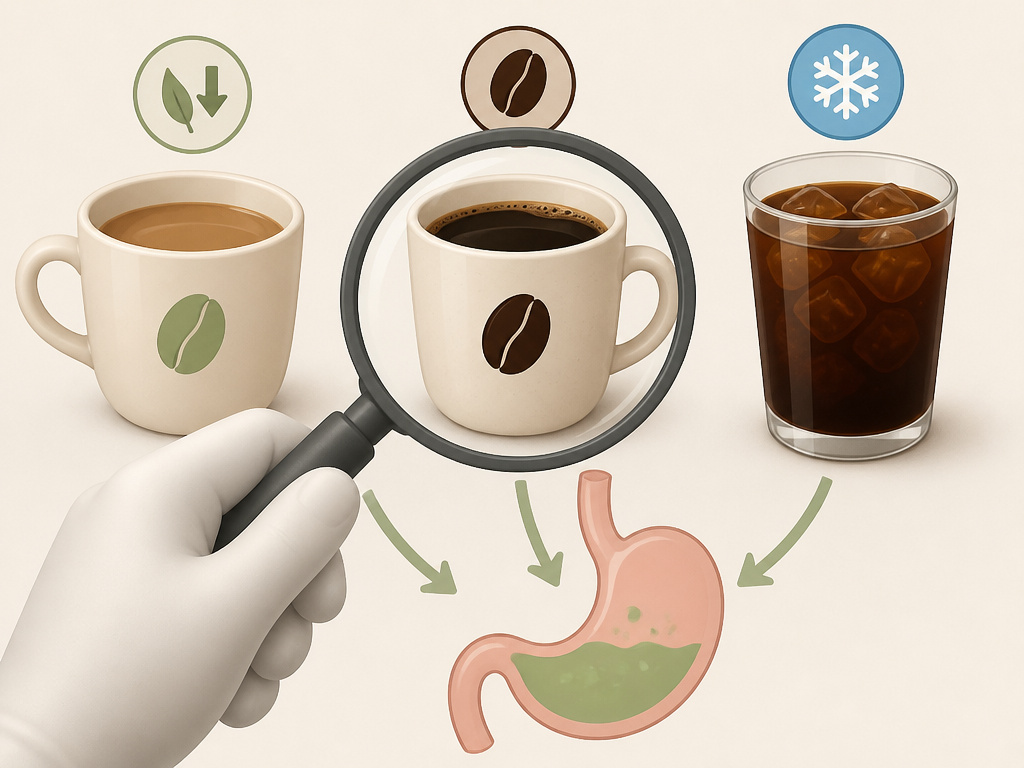
Let’s dismantle the three most common mitigation myths. Each one works, but for specific reasons. Understanding the “why” helps you apply them correctly.
Decaffeinated Coffee: The myth is that caffeine is the sole villain. The 1988 study showing decaf also stimulates acid secretion proves it’s not. However, caffeine does contribute to LES relaxation. Switching to decaf might reduce one trigger (valve relaxation) while leaving another (acid production) untouched. It’s a partial fix, not a cure-all. Try it, but monitor your symptoms closely.
Dark Roast vs. Light Roast: This is about chemistry, not just taste. As coffee roasts longer, compounds like chlorogenic acid break down. A dark roast objectively has lower levels of these acidic components than a light roast. The flavor profile shifts from bright and acidic to deep and bitter. If direct brew acidity irritates you, the darker the bean, the better. It’s a direct trade-off in flavor for potential comfort.
Cold Brew: This is your most powerful tool. Hot water extracts acids quickly and efficiently. Cold water, over 12-24 hours, extracts the sugars and flavorful oils while leaving a significant portion of the acidic compounds behind. The result is a concentrate with a pH that can be 30% less acidic than a hot brew of the same bean. It’s a different drink—sweeter, smoother, and far less likely to cause a flare-up. You can even use it as a base for a hot drink by heating the diluted brew.
| Mitigation Method | Primary Mechanism | Best For Symptom Type | Flavor Trade-off |
|---|---|---|---|
| Decaffeinated Coffee | Reduces LES relaxation trigger | Heartburn immediately after drinking | Can taste flat; lacks caffeine “bite” |
| Dark Roast Beans | Reduces chlorogenic acid content in the bean | General acidity, stomach burning | Loses bright, fruity notes; gains bitter, smoky notes |
| Cold Brew Method | Cold extraction leaves acidic compounds behind | All acid-related symptoms (throat burn, sour taste) | Sweeter, less complex; lacks hot coffee’s aroma |
TL;DR: Decaf tackles valve relaxation, dark roast reduces acidic compounds, and cold brew minimizes extraction of irritants. Use them in combination for the best defense.
When to See a Doctor and What to Track

This is important. Coffee sensitivity can be a canary in the coal mine. If you experience frequent heartburn (more than twice a week), difficulty swallowing, persistent coughing, or chest pain, you need a professional diagnosis. You could have GERD, a hiatal hernia, or another condition that requires proper management. Don’t self-diagnose and self-treat with over-the-counter meds indefinitely.
Before your appointment, play detective. Keep a simple symptom journal for two weeks. It’s the only way to move from “coffee bothers me” to actionable data. Your doctor will find this invaluable.
What to track every day: 1. Time and type of coffee: 8:30 AM, 12 oz dark roast cold brew. 3:00 PM, 6 oz light roast espresso. 2. Context: “On empty stomach” or “After oatmeal breakfast.” 3. Symptoms and timing: “Mild heartburn at 9:15 AM,” “Lump-in-throat feeling at 4:00 PM.” 4. Other potential triggers: Spicy lunch, alcohol, stress level that day.
This log will show you patterns. Maybe it’s only light roasts. Maybe it’s any coffee after 2 PM. Perhaps it’s exclusively when you’re stressed. This data transforms vague suffering into a manageable set of rules. It also helps differentiate coffee-induced symptoms from those caused by other common triggers, clarifying your personal tea vs coffee tolerance.
Bring this journal to your doctor. It moves the conversation past folklore and into evidence-based management. They might suggest an elimination diet to confirm, but you’ll already have a strong head start.
I spent years blaming my morning espresso for my afternoon reflux. My symptom journal showed the truth: the reflux hit like clockwork three hours after my stressful 10 AM meetings. The coffee was just an innocent bystander. I cut the stress caffeine, not the coffee caffeine, and the problem faded.
TL;DR: If symptoms are frequent, see a doctor. First, keep a two-week journal tracking coffee type, timing, and symptoms to identify your real, personal trigger pattern.
Frequently Asked Questions
Does decaf coffee help with acid reflux?
It can help, but it’s not a guarantee. Decaf coffee still stimulates stomach acid production, so if excess acid is your main issue, you might not see relief. However, it eliminates caffeine, which can relax the lower esophageal sphincter. Try it for a week while tracking symptoms to see if it makes a difference for you.
Is cold brew really better for acid reflux?
Yes, objectively. The cold extraction process pulls significantly fewer acidic compounds from the coffee grounds compared to hot brewing methods. Many people with sensitivity find cold brew the only coffee they can tolerate without symptoms. It’s the single most effective brewing change you can make.
What can I add to coffee to reduce acidity?
small pinch of salt can neutralize perceived bitterness, which some interpret as acidity. Using a low-acid milk alternative like almond milk can also help. Avoid sugar and full-fat dairy, as they can exacerbate digestive slowdown and reflux for some individuals. For a deeper dive on additives, our article on coconut oil in coffee explores other options.
How does coffee compare to tea for causing reflux?
The research is mixed, but some studies, including an NIH review of tea and coffee, suggest both beverages can be triggers due to similar compounds. However, tea is often brewed at a lower temperature and may have lower overall acidity. Individual response varies wildly, so it’s worth testing your own tolerance. Understanding the acidity of tea vs coffee can provide more context.
Can the way I drink coffee make a difference?
Absolutely. Drinking quickly, drinking on an empty stomach, and lying down within an hour of drinking are all major risk factors for triggering reflux. Slow down, have your coffee with or after a meal, and stay upright afterward. These behavioral changes are often more effective than changing the coffee itself.
The Bottom Line
The relationship between coffee and acid reflux is not a simple cause-and-effect. It’s a spectrum of individual biology. The blanket warning to avoid coffee is outdated, contradicted by current clinical guidelines and large-scale reviews like the PMC meta-analysis of coffee intake. For the majority, coffee isn’t a primary trigger.
If you’re in the sensitive minority, you have a toolbox, not an ultimatum. Start with a symptom journal to confirm the link. Then, methodically apply the mitigations: adopt cold brew, choose dark roasts, never drink on an empty stomach, and limit your dose. This approach acknowledges the science while respecting your personal experience. You can manage the sensitivity without giving up the ritual. The goal is a sustainable relationship with your cup, not a permanent breakup.
