
Does a Frappe Have Coffee? Unraveling the Classic Iced Drink
A frappe has coffee only in specific versions. The original Greek Frappé is coffee-based, and modern “coffee frappes” contain it. However, many popular commercial frappes, especially “crème” varieties, use a coffee-free syrup base. The name now refers to both coffee and non-coffee blended iced drinks.
Most people assume any thick, icy blended drink called a frappe is just a fancy coffee milkshake. They’re surprised when a Vanilla Bean Crème Frappuccino tastes like a melted vanilla ice cream cone with no coffee bitterness at all. That’s because the word “frappe” now covers two completely different beverage families.
This guide untangles the history from the marketing. You’ll learn how to decode any menu, understand the caffeine content of popular orders, and never get an unexpected coffee buzz, or lack thereof, again.
Key Takeaways
- The original Greek Frappé, invented in 1957, always contains instant coffee, water, sugar, and ice.
- Starbucks “Crème Frappuccino” beverages (like Vanilla Bean) contain no coffee or caffeine, using a flavored crème base instead.
- Major chains like McDonald’s list “coffee frappe base” in drinks like the Caramel Frappé, giving them about 75mg of caffeine in a small size.
- The word “frappe” alone on a modern menu is not a guarantee of coffee; you must check for “coffee” or “crème” in the full name.
- You can often customize by adding an espresso shot to a crème frappe or asking for no coffee base in a standard one.
The One-Sentence Answer (and Why It’s Wrong)
The term “frappe” refers both to a specific Greek iced coffee made with instant coffee and to a broad category of Western blended drinks that may or may not contain coffee, requiring verification of the specific product’s ingredients.
If you ask for a frappe in Athens, you will get one drink: instant coffee, cold water, sugar, and ice shaken into a frothy, caffeinated cloud. Ask for a frappe at a suburban mall cafe, and you might get a heap of blended ice, syrup, and milk with no coffee in sight. The single word collapsed two drink histories into one menu slot.
The mistake is assuming language is precise. It isn’t. Food terms migrate and mutate. The Greek Frappé is a defined recipe with a birthplace and a birthday. The Americanized “frappe” is a texture descriptor, it means “blended with ice.” That texture can be built on a coffee foundation or a vanilla milk foundation. Your job is to figure out which foundation you’re getting.
TL;DR: “Frappe” means two things: a Greek coffee drink (always has coffee) and a style of blended drink (might not have coffee). Always check the full name.
The 1957 Origin Story: Where Coffee Is Non-Negotiable
In 1957, at the Thessaloniki International Fair, a Nescafé representative named Dimitris Vakondios needed his coffee fix. He couldn’t find hot water. So he improvised. He mixed instant Nescafé granules with cold water and sugar in a shaker, shook it vigorously, and poured the foamy result over ice. The Greek Frappé was born.
This isn’t a maybe. The historical record is clear. The drink’s identity is inseparable from instant coffee. The method is the point: the shaking creates a thick, persistent foam that sits atop the diluted coffee. It’s refreshing, simple, and caffeinated. To order a Greek Frappé without coffee is to order a pizza without dough, you’re asking for a different thing entirely.
This original formula has three core ingredients, and modern variations still respect them:
* Instant Coffee: Traditionally Nescafé. This is non-negotiable. Espresso is not used.
* Cold Water: The medium for shaking. Milk can be added for a frappé me gala, but water starts the process.
* Sugar: Added to the shaker to help form the foam and balance the bitterness.
The drink spread across Greece and became a cultural staple. Its name, derived from the French frapper (“to chill”), perfectly described the process. When this style of drink traveled, the name traveled faster than the recipe.
The Starbucks Effect: When “Frappe” Became a Texture

Starbucks didn’t invent the blended drink, but its Frappuccino® product changed the global vocabulary. Launched in the 1990s, the Frappuccino was a branded, customizable, sweeter, and more complex drink. It used a proprietary coffee base (or a crème base) blended with ice, milk, and syrups, then topped with whipped cream.
This is where the semantic split happened. For millions of people, “frappe” (shortened from Frappuccino) came to mean “that frozen coffee-ish drink from Starbucks.” But Starbucks itself created the crucial loophole: the Crème Frappuccino line.
| Starbucks Frappuccino Type | Base Ingredient | Contains Coffee? | Caffeine (Tall 12oz) |
|---|---|---|---|
| Coffee Frappuccino | Coffee Frappuccino Syrup | Yes | ~75 mg |
| Espresso Frappuccino | Coffee + Espresso Shot | Yes | ~105 mg |
| Crème Frappuccino (e.g., Vanilla Bean) | Crème Frappuccino Syrup | No | 0 mg |
The table shows the clear divide. The “crème” version is a different product built on a sweet, dairy-heavy base. It contains no coffee derivatives. Ordering a “Vanilla Bean Frappuccino” is like ordering a milkshake. There’s no coffee flavor, no caffeine, and no expectation of it unless you add an espresso shot.
This commercial model, offering parallel coffee and non-coffee versions under a similar name, was then adopted by other chains like McDonald’s with its McCafé Frappés. The pattern held: a coffee-based version and sometimes a fruit smoothie, with the word “frappe” attached to the coffee-based one.
Common mistake: Assuming a “Caramel Frappé” is just a super-sweet coffee drink. McDonald’s Caramel Frappé uses a “coffee frappe base,” so it has about 75mg of caffeine. Their Strawberry Banana Smoothie, a similar blended drink, has none. The name “frappe” at chains specifically signals the coffee-containing option.
How to Tell at a Glance: Coffee vs. Crème
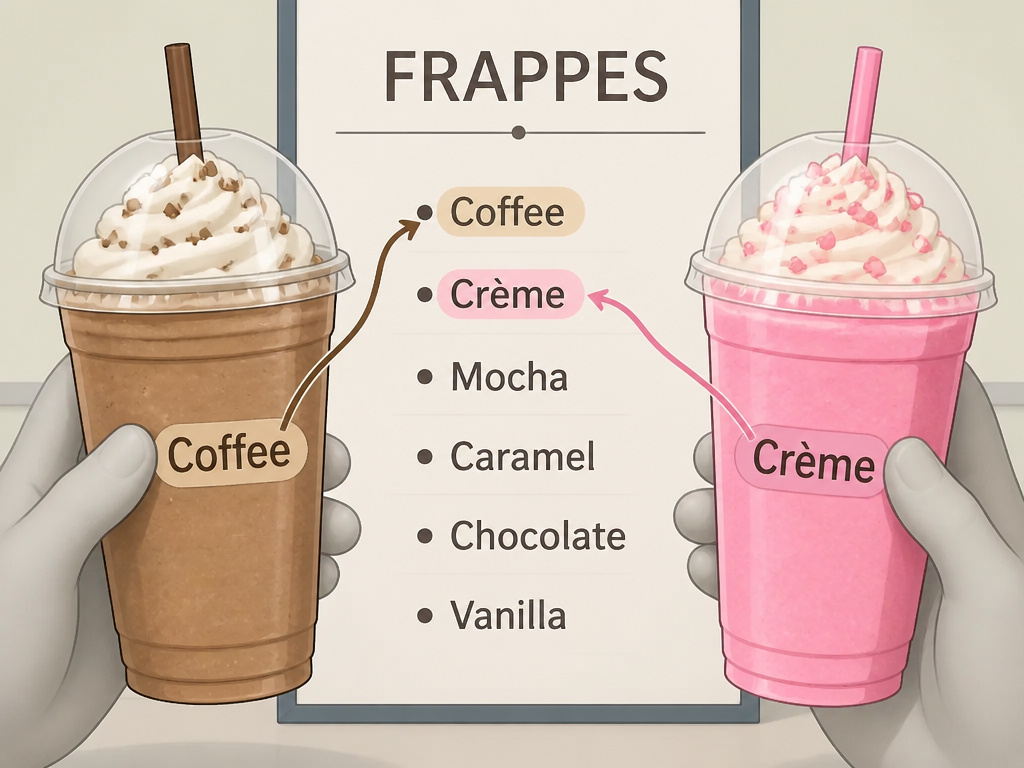
You don’t need a chemistry set. A few visual and verbal cues tell you everything.
First, decode the name. The word “crème” (or “creme”) is your zero-caffeine signal. It’s the industry term for the non-coffee base. “Vanilla Bean Crème Frappuccino.” “Strawberries & Creme Frappé.” If you see “crème,” you are holding a fancy, caffeinated milkshake.
Second, look for the coffee callout. Menus often highlight “coffee” in the name if it’s present. “Coffee Frappuccino.” “Mocha Coffee Frappé.” This is marketing being helpful, they know some people want the buzz.
Third, check the color. This is less reliable but a hint. Coffee-based frappes are usually shades of brown, beige, or dark tan from chocolate or coffee. Crème-based frappes are often white, pink, or bright green, colored by syrups and fruit.
Finally, when in doubt, ask or look it up. Baristas know the base formulas. Major chains also publish detailed nutritional information and ingredient lists online. A 30-second search for “McDonald’s Caramel Frappé ingredients” will show you “coffee frappe base” right in the list.
The 4-Second Menu Scan:
- Spot the word “Crème”? → No coffee.
- Spot the word “Coffee” in the name? → Has coffee.
- See only a flavor name like “Caramel”? → Assume it has coffee until proven otherwise at major chains.
- At an independent cafe? → Always ask.
What About Caffeine Content?
If your frappe does contain coffee, how much caffeine are you actually getting? It’s less than you might think.
A standard brewing method like drip coffee preparation delivers a predictable punch. Frappes are different. The caffeine comes from a pre-made syrup, instant coffee, or a shot of espresso blended in. The quantity is fixed and often lower per ounce than hot coffee.
- Starbucks Tall (12oz) Coffee Frappuccino: ~75 mg caffeine.
- McDonald’s Small (12oz) Caramel Frappé: ~75 mg caffeine.
- Home-made Greek Frappé (2 tsp instant): ~60-80 mg caffeine.
For comparison, a standard espresso shot caffeine is about 64 mg, and a 12oz brewed coffee can have 180-200 mg. The frappe’s caffeine is diluted by ice, milk, and sweeteners. If you need a serious kick, adding a shot of espresso to your frappe is a common and effective customization.
The cappuccino caffeine content model is a useful parallel. Both drinks use milk to temper the coffee’s intensity, but the frappe adds ice and sweetness as further dilutants. You’re drinking a dessert with a side of caffeine, not a caffeine delivery vehicle.
Building Your Own: The Control Method
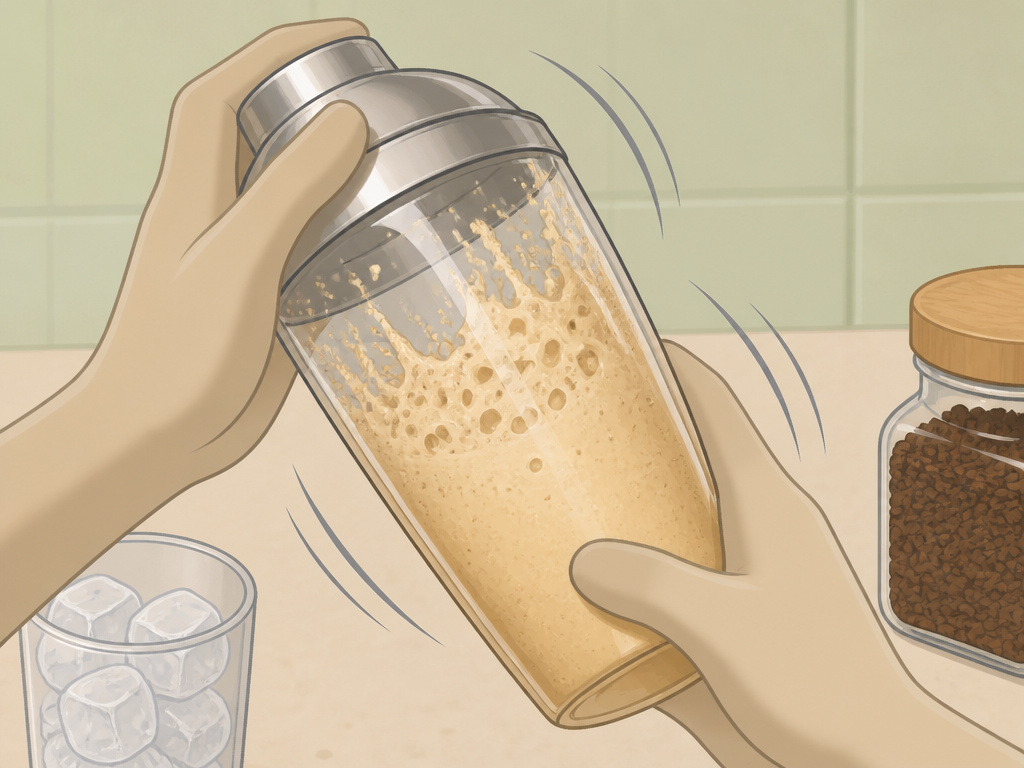
The only way to be 100% certain about your frappe’s contents is to make it yourself. This also lets you tailor it to dietary needs, like using dairy-free milk options or alternative sweeteners.
For a True Greek Frappé:
- Add 2 teaspoons of instant coffee, 2 teaspoons of sugar, and 2 tablespoons of cold water to a shaker.
- Shake vigorously for 15-20 seconds until a thick, pale foam forms.
- Pour over a glass full of ice. Add cold water or milk to fill.
- Drink with a straw to mix the foam.
For a Homemade “Frappuccino-Style” Drink:
- Brew a strong shot of espresso or 1/4 cup of strong coffee. Let it cool.
- In a blender, combine the coffee, 1 cup of ice, 1/2 cup of milk, and 1-2 tablespoons of syrup (chocolate, caramel, vanilla).
- Blend until smooth. Pour into a glass.
- Top with whipped cream if desired.
The homemade route demystifies the process. You see the coffee go in. You control the coffee sweeteners, whether it’s classic sugar, brown sugar flavor, or even a pinch of salt to cut bitterness. You can experiment with flavoring coffee with spices like cinnamon or trendy fatty coffee additions like coconut oil. You become the barista, and the question “does this have coffee?” has a definitive answer: yes, because you put it there.
Frequently Asked Questions
Does a McDonald’s frappe have coffee?
Yes, the core McCafé Frappé flavors like Caramel, Mocha, and Chocolate Chip all contain a “coffee frappe base.” Their smoothies and shakes do not. Always check the specific product’s ingredients online.
What is in a frappe if there’s no coffee?
coffee-free “crème” frappe is made from a sweetened crème or milk base, flavor syrups, ice, and often topped with whipped cream. It’s essentially a flavored milkshake or smoothie with the texture of a blended coffee drink.
Is a frappe stronger than coffee?
No. Ounce for ounce, a frappe is almost always weaker in caffeine than a standard cup of brewed coffee methods. The caffeine content is diluted by ice, milk, and sweeteners. A 12oz frappe typically has 75mg or less of caffeine, while a 12oz drip coffee can have over 200mg.
Why is it called a frappe?
The name comes from the French verb frapper, meaning “to chill” or “to ice.” It was applied to the Greek invention in 1957 because the drink is shaken with ice. The term was later adopted by commercial chains to describe any blended, icy beverage, stretching its original meaning.
The Bottom Line
The word “frappe” is a promise of texture, not ingredients. It promises something blended, icy, and spoonable. The original 1957 Greek version fulfills that promise with instant coffee as its soul. The modern commercial version sometimes uses coffee, sometimes doesn’t.
Your defense against confusion is a three-word checklist: Origin, Name, Ingredients. Know if you’re ordering a historical drink or a modern one. Read the full name on the menu for “coffee” or “crème.” When curiosity strikes, look up the official ingredients. With that habit, you’ll never be surprised by a caffeine-free coffee drink again. You’ll just enjoy the foam.
