
Can You Drink Coffee With High Blood Pressure? A Guide
You can drink coffee with high blood pressure if your personal systolic pressure increase stays under 10 mmHg after consumption. The American Heart Association notes this acute pressor effect is more pronounced in non-habitual drinkers, but tolerance develops. The real risk isn’t a daily cup for most people; it’s not knowing your individual response.
Most people get this wrong because they treat hypertension as a yes/no switch for caffeine. They either quit coffee entirely on principle or ignore it completely, missing the middle ground where personal biology decides. The advice “talk to your doctor” is correct but useless without the specific data they need to give you an answer.
This guide covers the exact numbers from the Mayo Clinic and AHA that define a sensitive response, how to run a simple at-home test with your own monitor, and why your genes might make you a fast or slow caffeine metabolizer. We’ll also compare the caffeine content in espresso vs coffee and look at lower-caffeine alternatives like the health benefits of tea.
Key Takeaways
- A systolic blood pressure increase of more than 5–10 points within an hour of drinking coffee signals caffeine sensitivity, per the Mayo Clinic.
- Long-term studies, including a systematic review like the UCL hypertension meta-analysis, show no consistent link between habitual coffee drinking and the development of hypertension.
- Your CYP1A2 enzyme genetics dictate whether you’re a fast or slow caffeine metabolizer, which changes your cardiovascular risk profile.
- Testing your personal response is a 30-minute process with a home monitor; guessing is what gets people into trouble.
- If you’re sensitive, switching to half-caff or fully decaffeinated coffee avoids the pressor effect while keeping the ritual.
The Acute Spike vs. The Long-Term Risk
Caffeine causes a short-term, measurable jump in blood pressure. The mechanism is straightforward: it blocks adenosine receptors, which normally help blood vessels relax, and it prompts the release of more adrenaline. Your heart beats a little faster, and your vessels constrict a little more. The Mayo Clinic caffeine FAQ calls this a “short, but dramatic increase,” and advises checking your pressure within 30 minutes of drinking coffee to see it in action.
The magnitude of that spike is what matters. Research summarized in an American Heart Association scientific statement puts the typical acute pressor response at “less than 10 mmHg for systolic and 5 mmHg for diastolic blood pressure.” That’s the baseline for a non-habitual consumer.
Common mistake: Assuming the morning coffee spike is harmless if you “feel fine”, the increase is often silent, and a sustained 10-point systolic lift moves you a full category in hypertension staging.
The long-term picture is different. Habitual consumption builds tolerance to this acute effect for most people. A 2021 review from Harvard Health Publishing highlights that long-term studies show no link between coffee and an increased risk of high blood pressure or heart disease. This is the critical disconnect. The immediate reaction (spike) and the chronic outcome (sustained hypertension) are separate questions. Your daily habit probably isn’t causing your high numbers, but that third cup today could still push a sensitive system into a risky zone for a few hours.
TL;DR: Coffee causes a short-term blood pressure spike of under 10 mmHg for most people, but habitual drinking doesn’t lead to chronic hypertension. The danger is in not knowing which group you’re in.
How to Test Your Personal Caffeine Sensitivity
You need a blood pressure monitor and 60 minutes. The test is simple, but the timing is non-negotiable.
First, take a baseline reading. Do this in the morning, before any caffeine. Sit quietly for five minutes. Rest your arm on a table. Record the numbers. Now drink your standard coffee, the same amount and type you normally would. Don’t change anything for the test.
Set a timer for 30 minutes. When it goes off, take your pressure again, using the same relaxed posture. Record those numbers. Take a final reading at the 60-minute mark.
| Time Point | What to Record | Why It Matters |
|---|---|---|
| Baseline (0 min) | Systolic / Diastolic before coffee | Establishes your normal resting pressure. |
| Peak Reaction (30 min) | Systolic / Diastolic after coffee | Captures the maximum acute pressor effect. |
| Recovery Check (60 min) | Systolic / Diastolic after coffee | Shows how quickly your body normalizes. |
Look at the systolic number. If it rose by 5–10 points or less, your response is within the typical range noted in the BMC cardiovascular review. If it shot up by 15 or 20 points, you are caffeine-sensitive. That’s the data to take to your doctor. “My pressure goes from 130/85 to 150/95 after a cup” is actionable. “I think coffee affects me” is not.
I ran this test after a period of poor sleep when my normal two cups made me feel jittery. The monitor showed a 22-point systolic jump at 30 minutes. I switched to a single cup of a lighter roast, and the spike dropped to 8 points. The ritual stayed, the risk plummeted.
Measure your blood pressure 30 minutes after your normal coffee. If the systolic reading climbs more than 10 points above your baseline, you’re likely caffeine-sensitive and should discuss alternatives with your doctor.
TL;DR: Check your pressure before and 30 minutes after your coffee. A systolic increase over 10 mmHg means you’re sensitive. Use that number, not a guess, to guide your choices.
When Genetics Play a Role
Not everyone processes caffeine the same way. The speed is largely dictated by your CYP1A2 enzyme, which is coded by your genes. Fast metabolizers break down caffeine quickly, minimizing its time in the bloodstream. Slow metabolizers let it linger, amplifying and prolonging its effects, including the blood pressure rise.
This isn’t theoretical. The American Heart Association statement specifically notes that “genetic polymorphisms in adenosine receptor genes or cytochrome P450 1A2 (CYP1A2) enzyme, which metabolizes caffeine, may influence individual responses.” If you’re a slow metabolizer, that morning coffee isn’t just a quick pick-me-up; it’s a several-hour cardiovascular stimulus.
You can’t change your genes, but you can change your dose. If you suspect sensitivity, perhaps you feel wired for hours or get palpitations, the practical move is to treat yourself as a slow metabolizer. This means strictly moderating intake or switching to decaf. The health implications of caffeine from slower metabolism are significant enough to override the general “coffee is fine” advice.
Navigating Different Coffee Types and Preparations
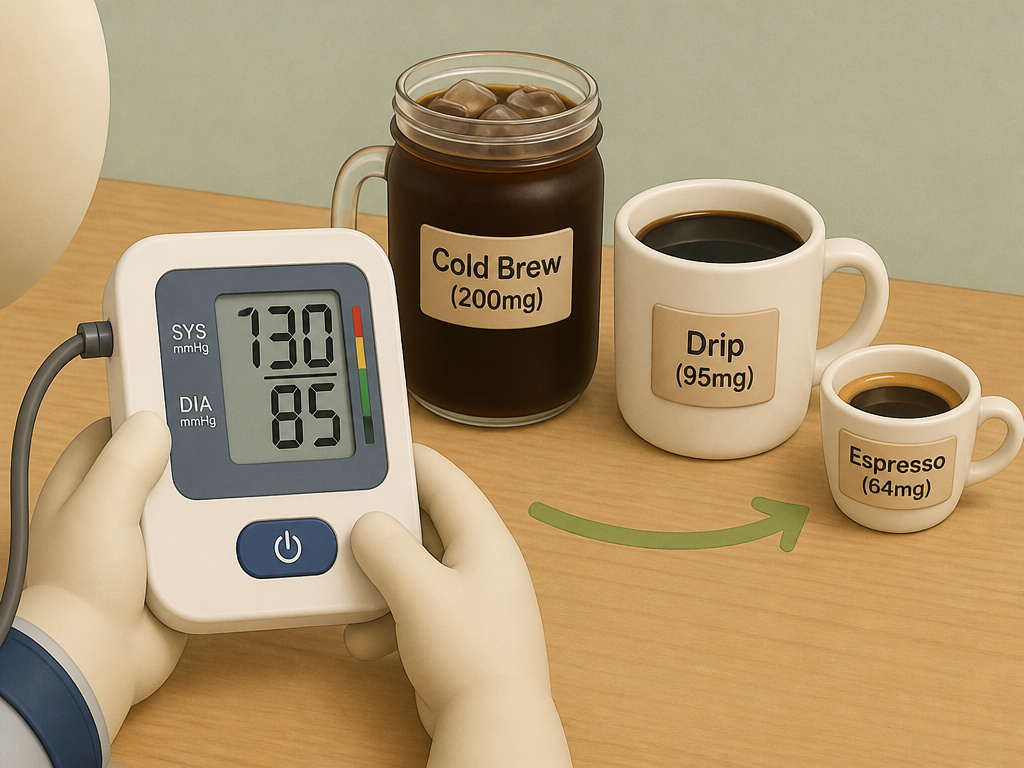
All coffee is not equal. An 8-ounce cup of brewed coffee contains about 95 mg of caffeine. A single shot of espresso has about 64 mg, but it’s consumed in a concentrated minute, which can feel more intense. Cold brew, often served in larger volumes, can pack 200 mg or more.
If you’re managing hypertension, you’re managing total caffeine load. This makes understanding the espresso caffeine content versus drip coffee crucial. You might handle one well but not the other.
| Beverage | Typical Serving Size | Approx. Caffeine | Best For Hypertension If… |
|---|---|---|---|
| Drip Brewed Coffee | 8 oz (240 ml) | 95 mg | You’ve tested and show low sensitivity. |
| Espresso | 1 shot (1 oz) | 64 mg | You want a controlled, smaller dose quickly. |
| Cold Brew | 8 oz (240 ml) | 200 mg | Avoid; the high, slow-release dose is risky. |
| Instant Coffee | 8 oz (240 ml) | 62 mg | A lower-caffeine option for slow metabolizers. |
| Decaf Coffee | 8 oz (240 ml) | 2–5 mg | The safest choice for known sensitivity. |
Dark roasts have slightly less caffeine than light roasts by weight, but the difference per cup is minor. Brew time and coffee-to-water ratio are bigger factors. A French press steeped for five minutes extracts more caffeine than a fast drip machine cycle.
The ritual matters. If you’re attached to the habit but not the stimulant, decaf is a full substitute. Modern Swiss Water Process decaffeination removes 99.9% of the caffeine without harsh chemicals, preserving most of the flavor compounds. It’s not your grandfather’s stale, bitter decaf.
Practical Strategies for the Coffee-Lover with Hypertension
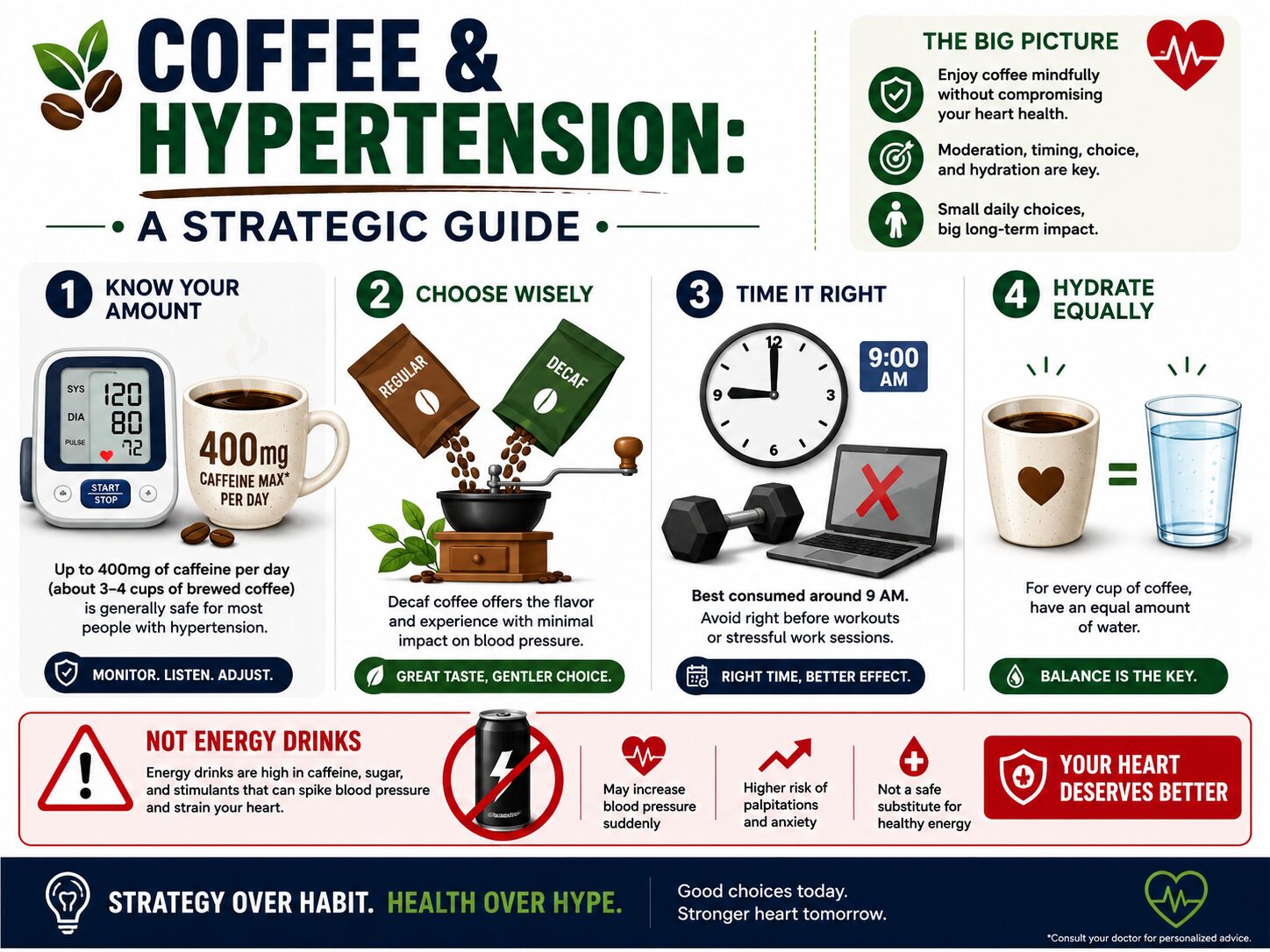
You don’t have to quit. You have to get strategic.
First, know your numbers from the sensitivity test. If your spike is mild, you can likely continue with moderation, defined by the USDA as up to 400 mg of caffeine daily, or about four 8-ounce cups of brewed coffee. Spread them out. Don’t drink them back-to-back.
Second, hybridize your brew. Mix half regular and half decaf beans in your grinder. You get the full flavor with half the caffeine. This “half-caff” approach is a perfect middle ground.
Third, time it right. Avoid coffee right before activities that naturally raise blood pressure, like exercise or stressful work meetings. The combined effects are additive.
Fourth, hydrate. Caffeine is a mild diuretic. For every cup of coffee, drink an equal glass of water. Dehydration stresses your cardiovascular system and can elevate blood pressure on its own.
Common mistake: Switching to energy drinks as a “coffee alternative”, they often contain more caffeine plus sugar, which itself is linked to higher blood pressure. The healthier caffeine sources are plain coffee or tea.
If you must reduce intake, taper. Going cold turkey can cause headaches and isn’t necessary. Reduce by half a cup per day over a week.
Lower-Caffeine and Caffeine-Free Alternatives
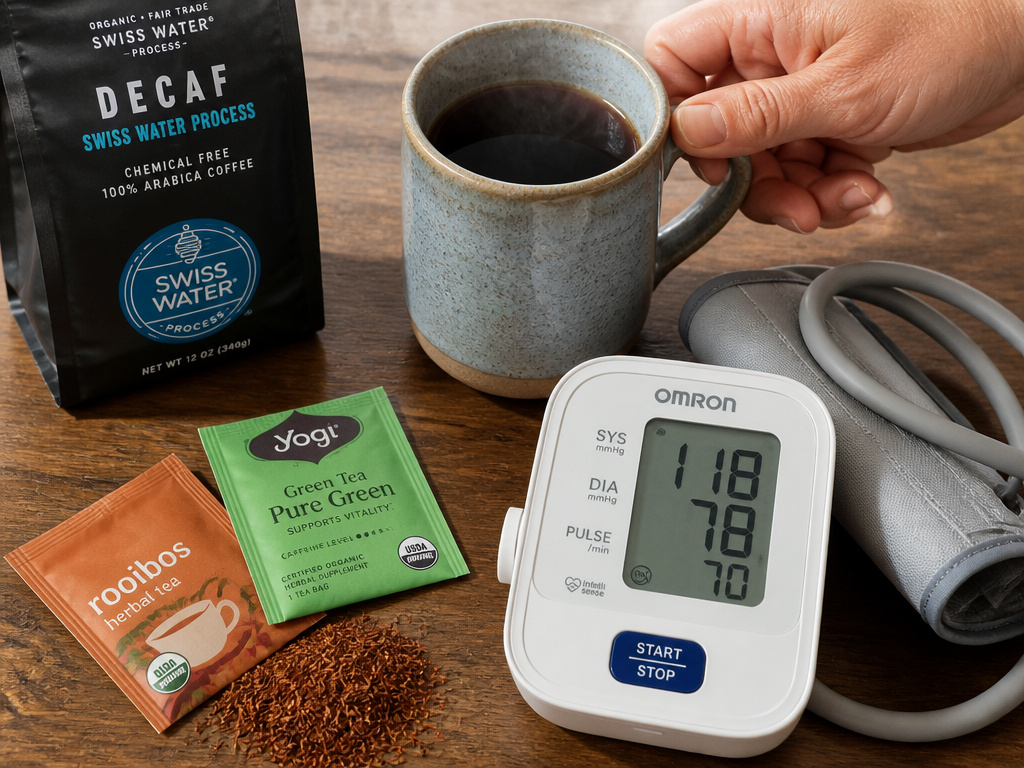
When coffee is off the table, you still have options that provide warmth, ritual, and flavor without the pressor effect.
Decaffeinated Coffee: As mentioned, modern decaf is excellent. Look for “Swiss Water Process” or “CO2 Process” on the label for the best flavor retention.
Black Tea: A standard 8-ounce cup has about 47 mg of caffeine, half that of coffee. It also contains L-theanine, which promotes calm focus. The caffeine in tea is released more slowly due to tannins, potentially leading to a gentler cardiovascular effect.
Green Tea: Even lower in caffeine (around 28 mg per cup) and rich in antioxidants like EGCG. The combination of a little caffeine with L-theanine can be especially good for alertness without jitters. The green tea benefits for heart health are well-documented.
Herbal Teas: Completely caffeine-free. Rooibos, chamomile, peppermint, and ginger tea are all flavorful choices. They contain no stimulants and some, like hibiscus tea, may have mild blood-pressure-lowering properties.
Chicory Root “Coffee”: A roasted, ground root that brews like coffee. It’s bitter, rich, and contains inulin, a prebiotic fiber. It has no caffeine.
The goal isn’t to find a perfect 1:1 replacement. It’s to find a satisfying substitute that doesn’t trigger your pressure. Sometimes, the ritual of a warm mug is 80% of the benefit.
Frequently Asked Questions
Does decaf coffee raise blood pressure?
No. Decaffeinated coffee contains only 2–5 mg of caffeine per cup, an amount too small to produce a measurable pressor effect. Any minimal spike would be psychosomatic or from another compound, not the caffeine.
How long does caffeine affect blood pressure?
The acute spike typically peaks 30–60 minutes after consumption and can last for 3–4 hours in slow metabolizers. For fast metabolizers, effects often subside within 90 minutes. This is why spacing out your cups is a key strategy.
Can I drink coffee while taking blood pressure medication?
You must consult your doctor. Caffeine can interfere with the metabolism of some drugs (like certain beta-blockers) and may affect how well your medication works. Never self-adjust your coffee intake based on medication without professional guidance, as it relates directly to your coffee and heart health.
Is tea better than coffee for high blood pressure?
Often, yes. Most teas have less caffeine than coffee, and compounds like L-theanine can promote relaxation. However, strong black tea can still contain a significant dose. The tea vs coffee decision comes down to your personal sensitivity test results.
What about energy drinks?
Avoid them. They combine high caffeine levels with large amounts of sugar, both of which can elevate blood pressure. The energy drinks vs coffee comparison consistently shows energy drinks pose a greater cardiovascular risk due to their ingredient cocktail.
The Bottom Line
Drinking coffee with high blood pressure isn’t a universal yes or no. It’s a personal equation solved with a $30 home monitor and 30 minutes of your time. The medical threshold is clear: if your systolic pressure jumps more than 5–10 points after a cup, you’re sensitive. That number, not generic advice, should guide you.
For most habitual drinkers, the long-term risk is negligible. The acute spike is real but manageable through moderation, timing, and knowing your limits. If you’re in the sensitive group, the world of half-caff, decaf, and tea is vast and flavorful. Your morning ritual doesn’t have to end. It just needs a data-driven edit.
{
“@context”: “https://schema.org”,
“@type”: “HowTo”,
“name”: “How to Safely Drink Coffee With High Blood Pressure”,
“totalTime”: “PT30M”,
“tool”: [
{
“@type”: “HowToTool”,
“name”: “Home blood pressure monitor”
},
{
“@type”: “HowToTool”,
“name”: “Notepad or tracking app”
}
],
“step”: [
{
“@type”: “HowToStep”,
“name”: “Establish a baseline reading”,
“text”: “Take your blood pressure while relaxed and before any caffeine intake for the day. Record both systolic and diastolic numbers.”
},
{
“@type”: “HowToStep”,
“name”: “Drink your standard coffee”,
“text”: “Consume your usual amount and type of coffee (e.g., one 8-ounce cup of brewed coffee). Do not change your routine for this test.”
},
{
“@type”: “HowToStep”,
“name”: “Measure again at 30 and 60 minutes”,
“text”: “Recheck your blood pressure 30 minutes after finishing the coffee, and again at the 60-minute mark. Record both readings.”
},
{
“@type”: “HowToStep”,
“name”: “Analyze the change”,
“text”: “Compare the post-coffee readings to your baseline. A rise of more than 5–10 mmHg in systolic pressure indicates caffeine sensitivity.”
},
{
“@type”: “HowToStep”,
“name”: “Adjust based on results”,
“text”: “If your increase is within the 5–10 mmHg range, moderate consumption is likely fine. If it exceeds that, discuss alternatives like half-caff or decaf with your doctor.”
}
]
}
{
“@context”: “https://schema.org”,
“@type”: “FAQPage”,
“mainEntity”: [
{
“@type”: “Question”,
“name”: “Does decaf coffee raise blood pressure?”,
“acceptedAnswer”: {
“@type”: “Answer”,
“text”: “No. Decaffeinated coffee contains only 2–5 mg of caffeine per cup, an amount too small to produce a measurable pressor effect. Any minimal spike would be psychosomatic or from another compound, not the caffeine.”
}
},
{
“@type”: “Question”,
“name”: “How long does caffeine affect blood pressure?”,
“acceptedAnswer”: {
“@type”: “Answer”,
“text”: “The acute spike typically peaks 30–60 minutes after consumption and can last for 3–4 hours in slow metabolizers. For fast metabolizers, effects often subside within 90 minutes. This is why spacing out your cups is a key strategy.”
}
},
{
“@type”: “Question”,
“name”: “Can I drink coffee while taking blood pressure medication?”,
“acceptedAnswer”: {
“@type”: “Answer”,
“text”: “You must consult your doctor. Caffeine can interfere with the metabolism of some drugs (like certain beta-blockers) and may affect how well your medication works. Never self-adjust your coffee intake based on medication without professional guidance, as it relates directly to your coffee and heart health.”
}
},
{
“@type”: “Question”,
“name”: “Is tea better than coffee for high blood pressure?”,
“acceptedAnswer”: {
“@type”: “Answer”,
“text”: “Often, yes. Most teas have less caffeine than coffee, and compounds like L-theanine can promote relaxation. However, strong black tea can still contain a significant dose. The tea vs coffee decision comes down to your personal sensitivity test results.”
}
},
{
“@type”: “Question”,
“name”: “What about energy drinks?”,
“acceptedAnswer”: {
“@type”: “Answer”,
“text”: “Avoid them. They combine high caffeine levels with large amounts of sugar, both of which can elevate blood pressure. The energy drinks vs coffee comparison consistently shows energy drinks pose a greater cardiovascular risk due to their ingredient cocktail.”
}
}
]
}
