
Drinking Decaf Coffee at Night: Effects on Sleep and Health
Drinking decaf coffee at night can affect sleep because it still contains 2–15mg of caffeine per cup. For most, this trace amount is harmless, but for those with high sensitivity or who drink multiple cups, it can delay sleep onset or reduce sleep quality, treating it as a low-caffeine drink.
Yes, you can drink decaf coffee at night, but the answer hinges on the FDA’s specific 2–15mg caffeine range and your individual sensitivity, not a simple yes or no. For most people, that trace caffeine won’t disrupt sleep, but for a subset with high sensitivity, or those drinking multiple cups, it can delay sleep onset or reduce sleep depth. The key is treating decaf as a low-caffeine beverage, not a caffeine-free one.
People get this wrong because they hear “decaf” and assume zero caffeine. They miss the fine print from regulators and the biological reality that sensitivity isn’t uniform. A cup that’s harmless for one person can be the reason another stares at the ceiling for an hour.
This guide breaks down the numbers from the FDA and sleep studies, explains the mechanism of caffeine sensitivity, and gives you a concrete method to test decaf’s effect on your own sleep. We’ll also cover the health pros and cons and suggest truly caffeine-free alternatives if decaf doesn’t work for you.
Key Takeaways
- Decaf coffee is not caffeine-free. The FDA states it contains 2–15mg of caffeine per 8-ounce cup.
- Your genetic sensitivity to caffeine is the deciding factor. The NIH confirms sensitivity varies dramatically between individuals.
- A 2019 randomized trial in Sleep Medicine found no significant sleep impact from decaf versus a placebo in a general adult group.
- If you’re sensitive, even 5mg can cause restless sleep. The solution is a personal sleep trial over three nights.
- For a guaranteed caffeine-free evening, switch to herbal teas like chamomile or rooibos, which contain zero caffeine.
The 2–15mg Caffeine Reality (What’s Actually in Your Cup)
Decaffeinated does not mean caffeine-free. That’s the first fact to sear into your brain. The U.S. Food and Drug Administration provides the anchor: decaffeinated coffee typically contains 2 to 15 milligrams of caffeine in an 8-ounce serving. Place that next to a regular cup of coffee, which packs 80 to 100mg or more.
The U.S. Food and Drug Administration states that decaffeinated coffee typically contains 2 to 15 milligrams of caffeine per 8-ounce serving. This regulatory range is based on standardized testing methods for beverages labeled as decaf.
The number varies based on the decaffeination process (Swiss Water, chemical solvents, CO2) and the coffee bean itself. A dark roast decaf might land at the lower end, while a light roast decaf could creep toward 15mg. If you drink a large 16-ounce mug, you’re now consuming 4–30mg, a amount that crosses the threshold for sensitive individuals.
TL;DR: The FDA defines decaf as containing 2–15mg of caffeine per cup. Always multiply that by your mug size.
Why Caffeine Sensitivity Varies Wildly (The Genetic Lottery)
The National Institutes of Health via MedlinePlus puts it plainly: some people are more sensitive to the effects of caffeine than others. This isn’t a minor footnote; it’s the core mechanism that makes the night-time decaf question personal.
Your liver metabolizes caffeine using an enzyme system coded by the CYP1A2 gene. Some people have a fast-metabolizing variant. They can drink a regular espresso after dinner and sleep like a log. Others have the slow variant. For them, caffeine lingers for hours, binding to adenosine receptors in the brain and blocking the sleep-signal molecule. Even the 5mg from a decaf can occupy enough receptors to blunt your sleep drive.
| Metabolizer Type | Caffeine Half-Life | Likely Impact of 10mg Decaf at 8 PM |
|---|---|---|
| Fast (CYP1A2 *1A) | ~3 hours | Negligible; cleared by 11 PM. |
| Slow (CYP1A2 *1F) | ~6 hours or more | 5mg still in system at 2 AM; can delay sleep onset. |
You can’t change your genes. But you can observe your reactions. Do you get jittery from a single can of soda? Does black tea after lunch keep you up? If yes, you’re likely in the sensitive group. Your approach to managing caffeine intake needs to be stricter, and decaf at night is a gamble.
What the Sleep Studies Actually Say
A 2019 randomized, double-blind, placebo-controlled trial published in Sleep Medicine gives the cleanest data. Researchers gave participants either decaffeinated coffee or a true placebo and measured sleep parameters. The result? No significant difference in sleep latency (time to fall asleep), total sleep time, or sleep efficiency between the two groups.
This study is often cited as proof decaf is sleep-safe. It is, for the average participant in a controlled trial. The catch is that “average” includes both fast and slow metabolizers. The effect on the sensitive subgroup gets washed out in the overall data. It’s a classic case of the “ecological fallacy.” The study’s conclusion, “decaffeinated coffee does not appear to have a significant impact on sleep parameters in healthy adults”, is true at the population level, but potentially false for you.
Common mistake: Citing the 2019 Sleep Medicine study as absolute proof decaf won’t affect your sleep, this ignores the individual sensitivity explicitly noted by the NIH.
The broader field of sleep hygiene, which includes timing considerations for any stimulant, errs on the side of caution. Its principle is to remove all potential sleep disruptors to build a robust, reliable routine. From that purist viewpoint, decaf is an unnecessary variable.
How to Run Your Own Decaf Sleep Trial (The 3-Night Test)

Theory is useless without a personal experiment. Here’s how to test decaf coffee’s effect on your sleep with data, not guesswork.
- Choose your decaf. Stick with one brand and type for the trial. The caffeine content comparison between products can be surprising.
- Establish a baseline. For two nights, have no caffeinated or decaf beverages after 2 PM. Go to bed at your usual time. Note how quickly you fall asleep and how rested you feel.
- Introduce the variable. On nights three, four, and five, drink one 8-ounce cup of your chosen decaf exactly 90 minutes before your bedtime.
- Track relentlessly. Use a notepad or app to record: time to fall asleep (estimate), number of nighttime awakenings, and a morning “rested score” from 1 to 5.
- Analyze the trend. Look at the three decaf nights versus the two baseline nights. Is sleep latency longer? Are you waking up more? If the data shows a clear negative shift, decaf is a culprit. If nothing changes, you’re probably in the clear.
This method removes the placebo effect. You’re not wondering “is this keeping me up?”, you’re checking the log.
Health Pros and Cons: More Than Just Sleep

The night-time question often overshadows decaf’s overall health profile. Understanding the full picture helps weigh the trade-offs.
The Pros:
- Antioxidants: Decaf retains most of coffee’s beneficial antioxidants, like chlorogenic acids, which are linked to reduced risk of type 2 diabetes and heart disease. Some studies show a drop of up to 50% due to the decaffeination process, but significant amounts remain.
- Liver Protection: Observational studies link decaf consumption with lower liver enzyme levels, suggesting a protective effect similar to regular coffee.
- Neurological Benefits: Cell studies indicate compounds in decaf may protect neurons, potentially lowering the risk of neurodegenerative diseases.
The Cons & Considerations:
- Acidity: The decaffeination process can sometimes elevate certain acids. If you manage GERD, the acid reflux management approach for coffee still applies to decaf for some people.
- Digestive Effects: Coffee, including decaf, stimulates gastrin release and colonic activity. For some, this leads to the digestive effects of coffee regardless of caffeine.
- The Missing Buzz: You forfeit caffeine’s benefits: improved mood, alertness, metabolic rate, and athletic performance. That’s the trade for nighttime permission.
For those seeking a middle ground, exploring low-caffeine alternatives like certain teas can offer a gentler stimulation profile.
Safer Evening Alternatives When Decaf Is a No-Go
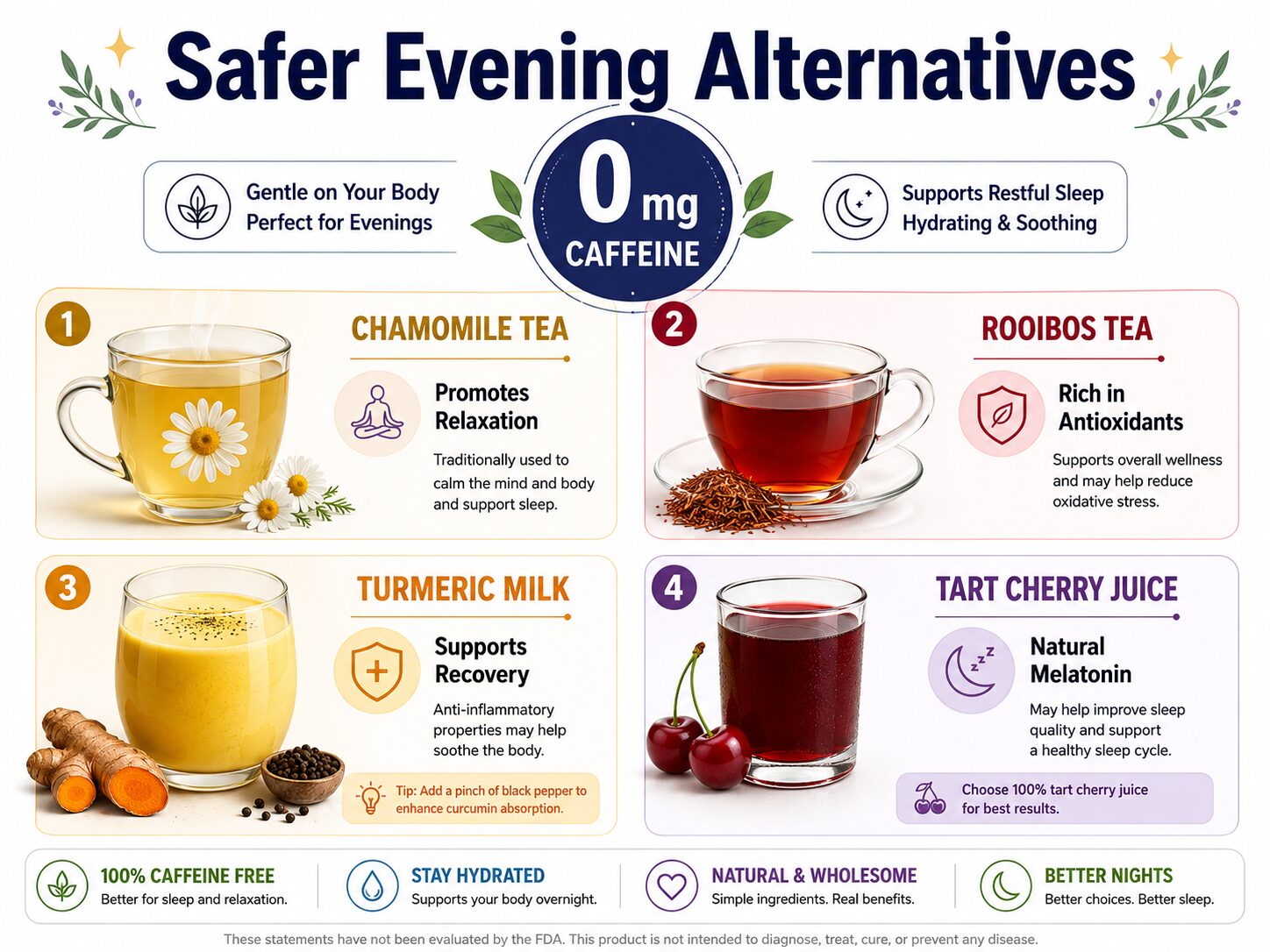
If your sleep trial fails, or you want to eliminate the variable entirely, these beverages contain zero caffeine and support sleep hygiene.
- Chamomile Tea: Contains apigenin, an antioxidant that binds to certain brain receptors to promote relaxation and drowsiness. The scent alone is a calming signal.
- Rooibos (Red Bush) Tea: Naturally caffeine-free, rich in antioxidants like aspalathin, and low in tannins (so it’s not bitter without sweetener). Its mild, sweet flavor mimics the comfort of a warm cup without any stimulant.
- Warm Milk with Turmeric & Black Pepper: The tryptophan in milk is a precursor to sleep-regulating serotonin and melatonin. Turmeric (curcumin) has anti-inflammatory properties, and black pepper boosts its absorption.
- Tart Cherry Juice: A natural source of melatonin. Drink a small glass about an hour before bed.
These are true zero-caffeine options. They also lack the caffeine impact on digestion that coffee can have, making them doubly gentle for the evening.
Frequently Asked Questions
Does decaf coffee have any caffeine?
Yes, absolutely. The FDA states decaffeinated coffee contains 2 to 15 milligrams of caffeine per 8-ounce cup. It is a low-caffeine beverage, not a caffeine-free one.
Can decaf coffee keep you awake at night?
It can, depending on your individual sensitivity to caffeine. For the majority, 2–15mg is too low to cause noticeable sleep disruption. But for people with a specific genetic makeup that slows caffeine metabolism, even that small amount can delay sleep onset or reduce sleep quality.
How many hours before bed should I stop drinking decaf coffee?
If you know you are caffeine-sensitive, stop all decaf consumption at least 4–6 hours before bedtime. If you are not sensitive, 1–2 hours is likely sufficient. The only way to know your personal cutoff is through the 3-night sleep trial described above.
Is decaf coffee bad for sleep hygiene?
From a strict sleep hygiene perspective, introducing any variable with stimulant potential is discouraged. The goal is to make your pre-sleep routine boring and predictable. If decaf is a cherished ritual and doesn’t affect your sleep data, it can be part of good hygiene. If it’s a variable, replace it with a caffeine-free alternative.
What has more caffeine at night: decaf coffee or black tea?
An 8-ounce cup of black tea contains about 40–70mg of caffeine, while decaf coffee contains 2–15mg. Therefore, black tea has significantly more caffeine and is much more likely to disrupt sleep. If choosing between the two for the evening, decaf coffee is the far safer bet from a caffeine-content standpoint.
Are the health benefits of decaf coffee the same as regular coffee?
Mostly, but not entirely. Decaf retains the majority of coffee’s antioxidants and is linked to similar reductions in diabetes and heart disease risk. It loses the specific benefits tied directly to caffeine, such as enhanced alertness, mood lift, and improved athletic performance.
The Bottom Line
Drinking decaf coffee at night is a personal experiment, not a universal rule. The FDA’s 2–15mg caffeine range is the starting point, and your genetic sensitivity is the finish line. For most, it’s a safe evening ritual. For a significant minority, it’s a stealthy sleep thief.
Do the three-night test. Track your sleep with cold data. If the numbers are good, enjoy your cup without guilt. If they’re not, switch to chamomile or rooibos and reclaim your sleep. The goal isn’t to give up something you love; it’s to love the sleep you get.
