
8 Best Espresso Coffee Machines of 2026
The Breville Barista Express BES870XL stands out as the best overall espresso machine for most home users, combining solid build quality, a built-in conical burr grinder, and PID temperature control. For those on a tighter budget, the CASABREWS CM5418 delivers reliable performance with a compact design. And if you want more variety, the Ninja Luxe Café Premier ES601 offers versatile drink options with automated milk frothing.
Choosing the right espresso machine isn’t just about pulling a good shot, it’s about finding one that fits your routine, skill level, and kitchen space. Too many people buy based on specs alone, only to struggle with inconsistent results or complicated maintenance.
As the founder of Bean Thusiast, I’ve researched the market thoroughly, weighing owner feedback, brewing performance, and key features like temperature stability, grinder quality, and ease of use. This guide cuts through the noise to highlight models that actually deliver in real-world use.
Top 8 Espresso Coffee Machine in the Market
The Best Espresso Coffee Machine, Reviewed
De’Longhi COM532M Coffee Maker
Strengths
- Dual heating system
- 15 BAR pressure pump
- Spill proof carafe
Trade-offs
- Lower pressure than 20 BAR models
- Less crema richness
- Not for espresso purists
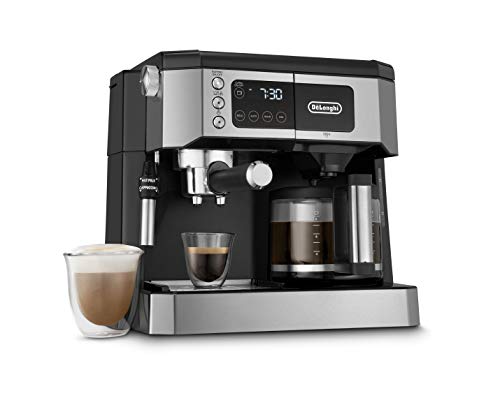
The De’Longhi COM532M stands out with its dual heating system, a rare feature in this class that actually lets you brew coffee and pull an espresso shot at the same time. For households that want both drip coffee and espresso without switching modes or waiting, this is a legit advantage. The 15 BAR Italian pump delivers solid extraction on paper, and owners consistently report a satisfying crema, though it doesn’t quite match the depth you’d get from a 20 BAR system with pre-infusion.
Where it really shines is usability, digital touchscreen, 24-hour timer, and a spill-proof carafe make it ideal for morning routines. The advanced steam wand with dedicated cappuccino and microfoam settings is a nice touch, though it’s not quite as responsive as a manual steam wand. Compared to single-purpose espresso machines, this is more of a hybrid workhorse.
Video review
CASABREWS CM5418 Espresso Machine

Strengths
- 20 BAR pressure pump
- Visible pressure gauge
- Compact stainless design
Trade-offs
- Single boiler limitation
- No pre infusion
- Cool down required between tasks
The CASABREWS CM5418 packs a 20 BAR pump and a visible pressure gauge into a compact stainless steel body, which on paper makes it a strong contender for beginners wanting control. Owners praise the build quality and the fact that it heats up quickly, delivering decent crema in under three minutes. The steam wand performs well for basic microfoam, though it takes practice to avoid scalding milk, no surprise for this price tier.
One thing reviewers consistently mention is the need to let the machine cool after frothing before brewing, a quirk of its single boiler design. That limits back-to-back drinks. Still, for a small kitchen or office setup, its footprint is a real win. Compared to the Gevi or CHULUX models, it doesn’t have pre-infusion or PID, so extraction is less even, but it’s reliable for daily shots if you’re okay with some trial and error.
Video review
Gevi 20 Bar Espresso Machine
Strengths
- Built in conical burr grinder
- PID temperature control
- 30 grind settings
Trade-offs
- Mixed durability reports
- Plastic internal parts
- Grinder noise
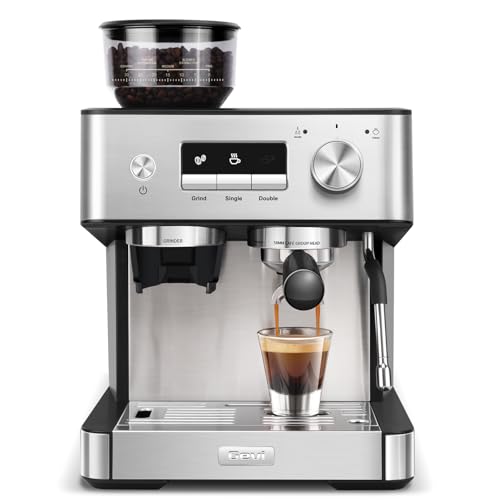
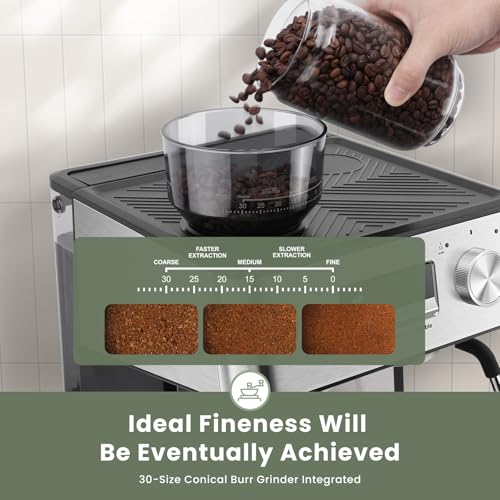
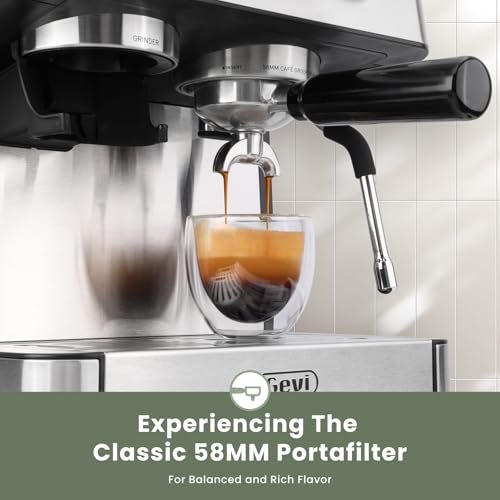
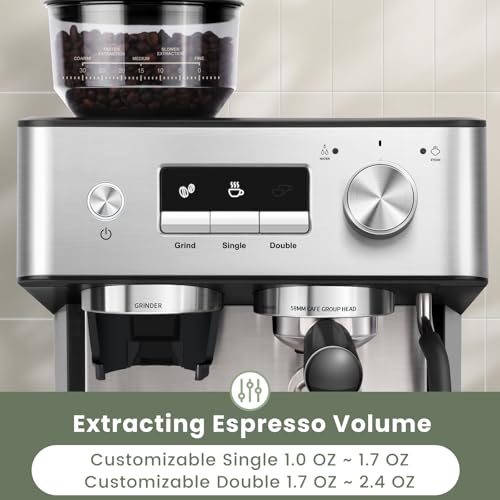
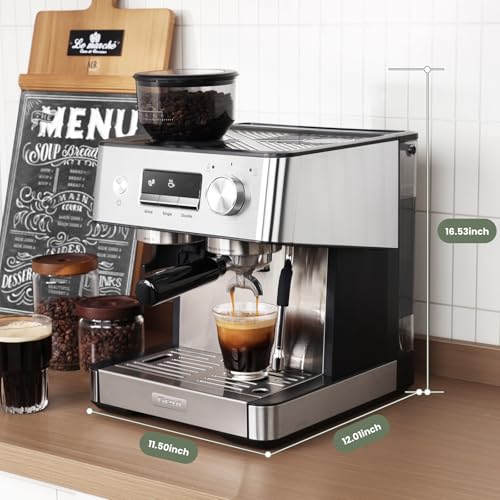
This Gevi model bridges the gap between affordability and features by including a built-in conical burr grinder with 30 settings, a rarity at this price point. On paper, that’s a big win for freshness, and owners confirm the grind consistency is surprisingly good for the class. The 20 BAR pump, NTC & PID temperature control, and pre-infusion function suggest serious extraction capability, and feedback shows it delivers balanced shots with noticeable crema when dialed in.
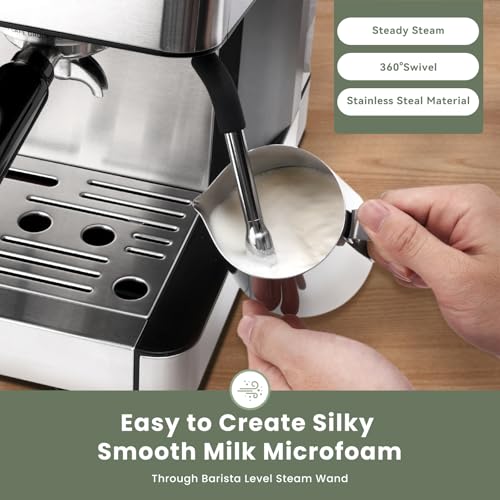
The steam wand is responsive, and the hot water function adds versatility for Americanos. Where it falls short is build quality, some users report plastic components feeling less durable than the Breville or Ninja. But for someone who wants freshly ground espresso without buying two separate machines, this is a smart package. It’s not as refined as the Breville Barista Express, but it hits many of the same notes at a fraction of the cost.
Product photos
CHULUX Slim Espresso Machine

Strengths
- Ultra compact design
- 20 BAR pressure pump
- Pre infusion function
Trade-offs
- Basic steam wand
- Minimalist finish
- No built in grinder
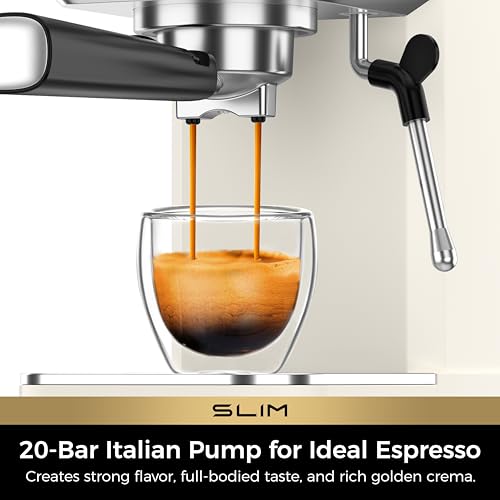
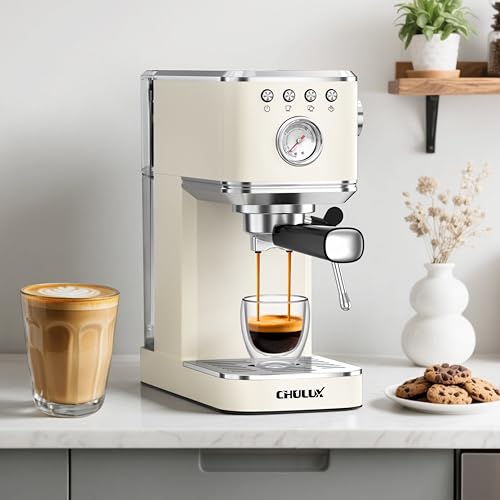
At just 5.5 inches wide, the CHULUX Slim is the ultimate space-saver, perfect for dorms, RVs, or minimalist kitchens where every inch counts. It packs a 20 BAR Italian pump and pre-infusion, which is impressive for its size, and owners say it pulls surprisingly rich shots with decent crema. The pressure gauge lets you monitor extraction in real time, a feature often missing on compact units.
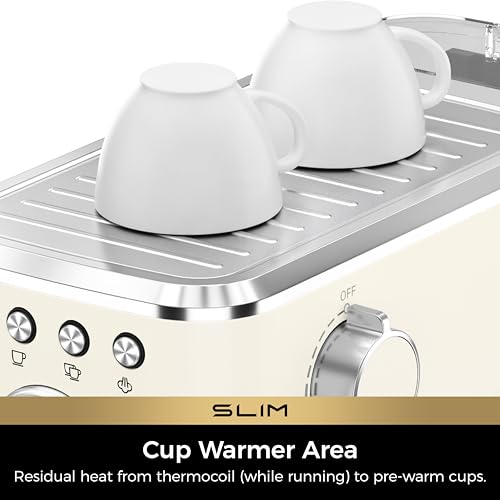
It heats up in 30 seconds and has a 40 oz water tank, so you’re not refilling constantly. The steam wand works well for basic frothing, though it lacks the finesse of a dual-wall design. Compared to the CASABREWS, it feels more focused on extraction quality than looks. If you’re tight on space but still want a semi-automatic experience, this is a strong pick, even if the finish feels a bit utilitarian.
Product photos


Breville Barista Express BES870XL
Strengths
- Integrated conical burr grinder
- PID temperature control
- Pre infusion function
Trade-offs
- Large footprint
- Steeper learning curve
- Higher price point
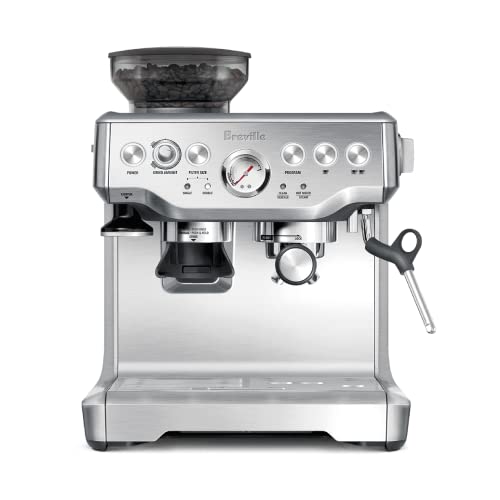
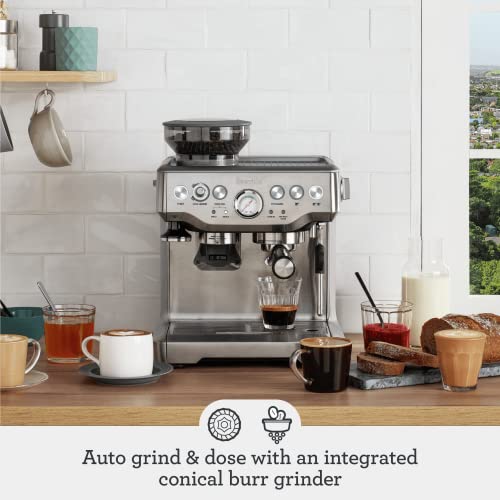
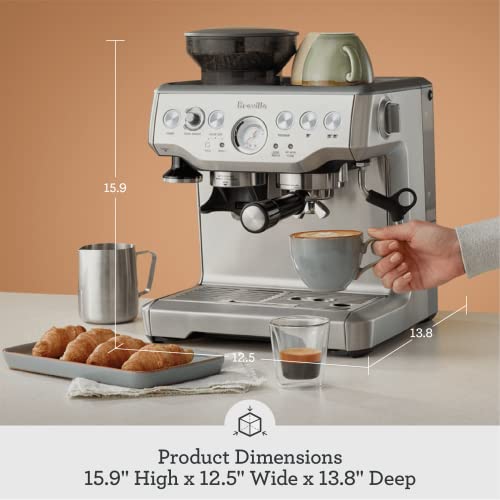
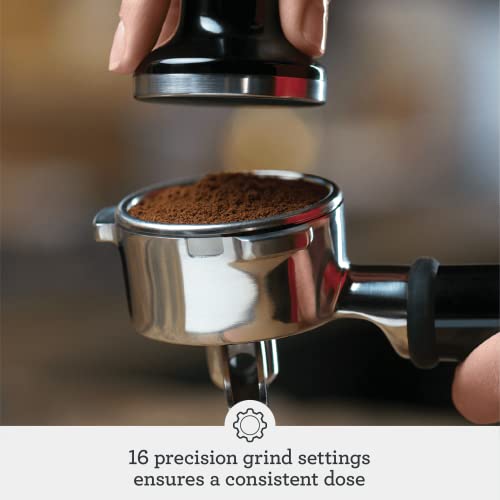
The Breville Barista Express (BES870XL) is the benchmark for integrated grinder espresso machines under $1,000. Its conical burr grinder doses directly into the portafilter, and the PID temperature control ensures shot-to-shot consistency that most entry-level machines can’t match. Owners consistently highlight how the low-pressure pre-infusion and adjustable grind size let them fine-tune extraction for different roasts, something that matters if you rotate beans like I do.
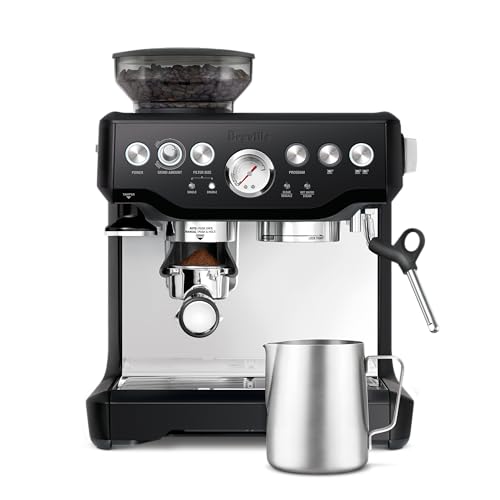
The steam wand is powerful and responsive, ideal for microfoam and latte art. While it’s bulky compared to compact models, the included tools (razor dosing tool, tamper, milk jug) make dialing in easier. Compared to the Gevi with grinder, this is a step up in durability, precision, and overall refinement. It’s not the cheapest, but for the serious home barista, it’s the smarter buy.
Product photos


Gevi Commercial Espresso Maker

Strengths
- 20 BAR pressure pump
- Pre infusion feature
- Stainless steel housing
Trade-offs
- No built in grinder
- Basic frothing control
- No PID
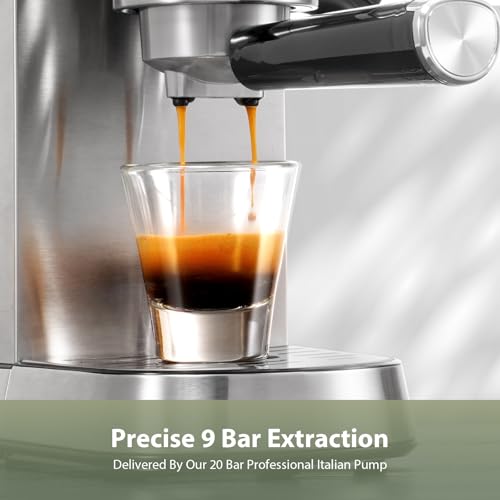
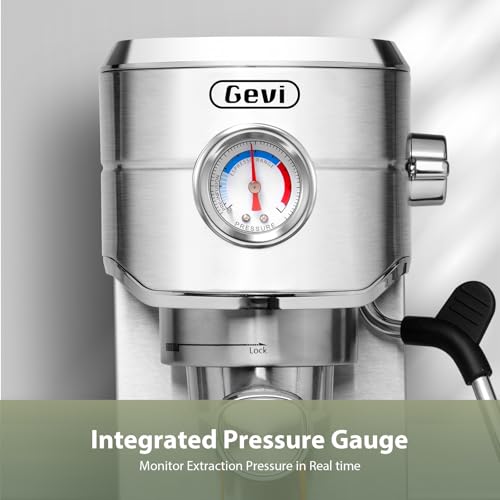
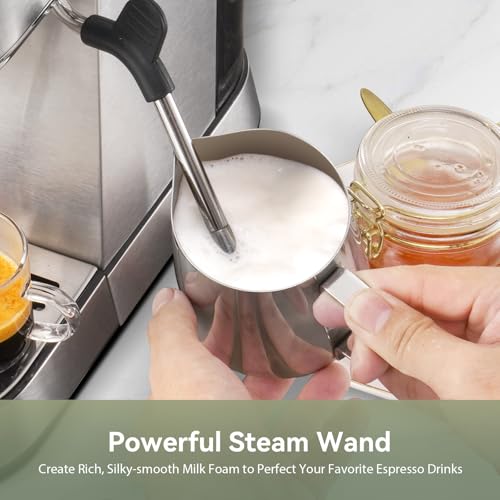
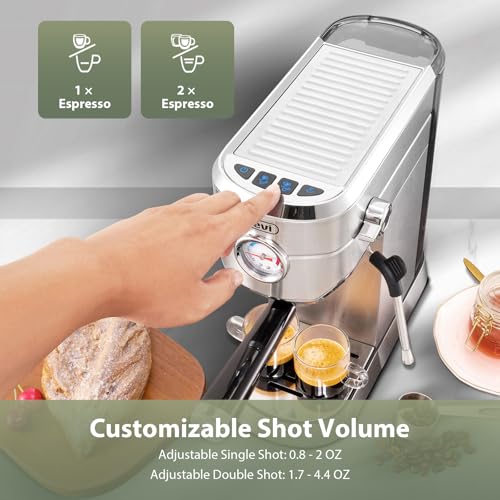
This Gevi model is clearly built to be the budget-friendly entry into 20 BAR espresso. It includes key features like pre-infusion, NTC temperature control, and a pressure gauge, all things you’d expect in pricier units. The stainless steel housing feels sturdier than most in this range, and owners say it holds up well with daily use. The steam wand produces decent microfoam, and the hot water function adds real utility for Americanos or tea.
It doesn’t have a grinder, so you’ll need a separate one, but that also keeps the price down. Compared to the CASABREWS or CHULUX, it’s more about reliability than bells and whistles. If you’re building a starter setup and don’t want to sacrifice pressure or basic extraction control, this is a solid foundation.
Product photos

Breville Barista Express BES870BTR
Strengths
- Premium black finish
- Same Breville performance
- Integrated grinder
Trade-offs
- Same price as XL model
- No functional upgrades
- Still bulky
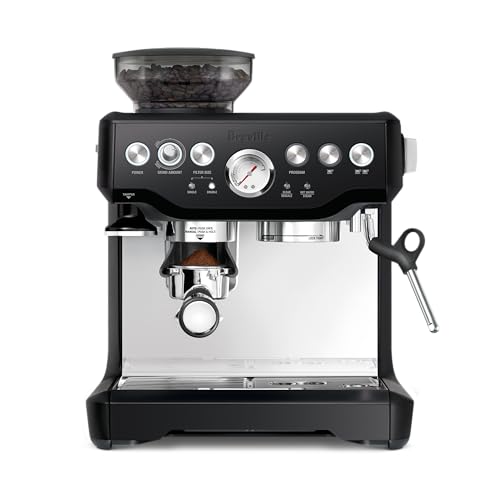
This is the black truffle version of the Breville Barista Express, identical in specs and performance to the BES870XL but with a more premium finish. It’s the same proven package: PID control, conical burr grinder, pre-infusion, and a powerful steam wand. The difference is purely aesthetic, but that matte black finish does elevate the look on a high-end countertop.
Owners who’ve compared both say there’s no functional difference, same grind quality, same extraction, same learning curve. If you’re drawn to the sleeker look and don’t mind paying a bit more for it, this version makes sense. But if you’re purely after performance, the stainless steel model is the better value. Either way, it’s still my top pick for those serious about home espresso.
Product photos
Ninja Luxe Café Premier ES601

Strengths
- 3 in 1 functionality
- Hands free frothing
- Weight based dosing
Trade-offs
- Less manual control
- Bulky design
- Froth lacks artisan texture
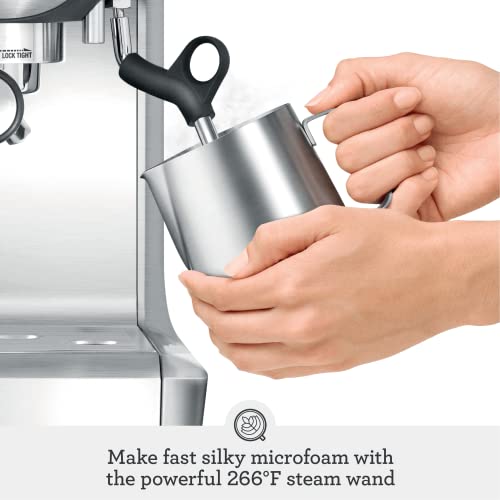
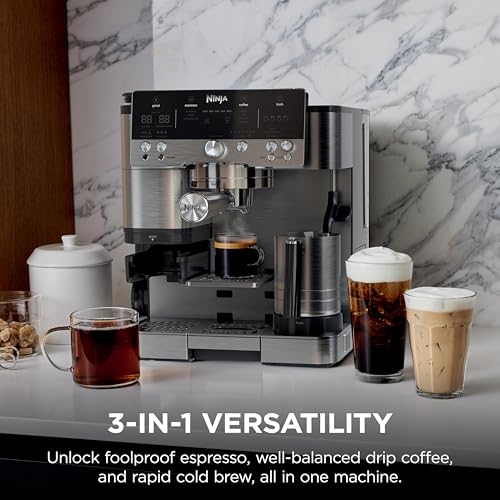
The Ninja ES601 is in a category of its own, not just an espresso machine, but a full coffee system that handles drip, cold brew, and espresso with a built-in grinder and hands-free frothing. The Dual Froth System is a standout: no manual wand to master, just select thick froth, thin froth, or cold foam and let it do the work. For households with mixed preferences, that versatility is huge.
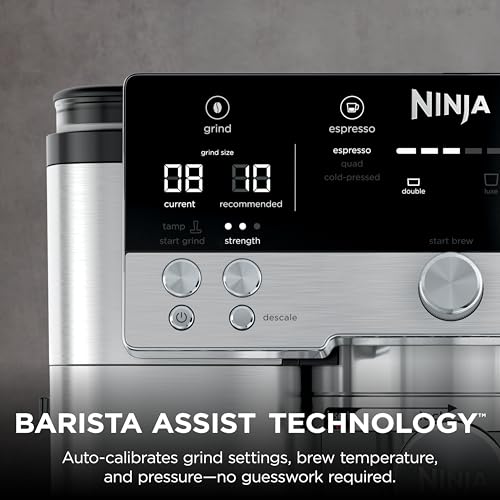
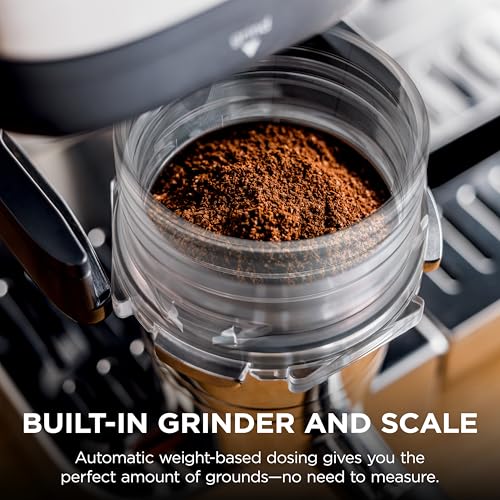
It uses weight-based dosing and barista assist tech to auto-adjust grind size and brew parameters, which helps avoid common beginner mistakes. The assisted tamper ensures even puck prep, a clever touch. Compared to the Breville, it’s less about control and more about consistency and convenience. If you want one machine to do everything and don’t mind sacrificing some manual craft, this is the most practical choice.
Product photos


How We Evaluated espresso coffee machine
As a lifelong coffee enthusiast and founder of Bean Thusiast, I approach evaluating espresso machines with a focus on delivering a genuinely excellent home brewing experience. Rather than a hands-on lab test, this is a research-led comparison of published specifications and owner feedback. I compared models across key features, weighed owner reviews from multiple sources, and considered expert opinions to build a ranking based on what matters most to home baristas.
For espresso machines, consistent temperature stability, grind quality, and steam power are paramount. These factors directly impact the flavor and quality of the espresso shot and milk-based drinks. A machine’s ability to maintain a precise brewing temperature is crucial for proper extraction, while a quality burr grinder ensures consistent particle size. Finally, a powerful steam wand is essential for creating the microfoam needed for latte art and textured milk drinks.
Specifications reliably show pump pressure, boiler type, and water tank capacity. However, I placed more weight on owner feedback regarding long-term durability, ease of use, and the consistency of results. Real-world experience reveals nuances that specs alone can’t capture. Understanding the dialing in espresso technique is also key to getting the most out of any machine, so I considered how accessible each model is for both beginners and experienced users.
Choosing The Right espresso coffee machine
Choosing the right espresso machine can feel overwhelming, but focusing on a few key areas will help you find one that delivers consistently delicious results.
A quality espresso machine balances consistent temperature control, sufficient pressure (around 9 bars is standard), and a grinder capable of delivering a finely-tuned, even grind. Consider build materials for longevity, and ease of maintenance for long-term usability. Pre-infusion features and PID temperature control are indicators of more advanced, precise brewing.
Grinder Integration & Quality
The integrated grinder is often the biggest differentiator between espresso machines. While a standalone grinder offers potentially more control, built-in grinders offer convenience. However, not all integrated grinders are created equal. Look beyond just the number of grind settings; conical burr grinders are almost universally preferred over blade grinders for their consistency. The Breville Barista Express models, for example, both feature integrated conical burr grinders, but reading owner feedback reveals varying opinions on grind consistency over time – some users find adjustments become necessary. This highlights the importance of a grinder with clear, repeatable settings.
Temperature Stability & Pressure
Consistent temperature is crucial for good espresso. Fluctuations during extraction lead to sour or bitter flavors. Machines boasting PID (Proportional–Integral–Derivative) temperature control are generally more stable than those relying on thermostats alone. Equally important is maintaining the correct pressure – around 9 bars is the sweet spot. Some machines, like the Gevi Commercial Espresso Maker, advertise 20-bar pumps. While technically delivering sufficient pressure, a higher bar rating doesn’t automatically equate to better espresso; consistent pressure at 9 bars is the goal.
- Don’t assume a higher wattage means better temperature stability. Insulation and boiler design play a larger role.
- Consider pre-infusion. This wets the grounds before full pressure is applied, leading to more even extraction.
- Look for machines with a clear pressure gauge. This allows you to monitor the extraction process and diagnose potential issues (like a clogged portafilter) that can affect flavor.
A machine that can consistently deliver water at 195-205°F (90-96°C) and maintain 9 bars of pressure throughout the extraction will produce a consistently high-quality shot.
Versatility & Practicality
Beyond the core espresso-making capabilities, think about how you’ll actually use the machine. Do you primarily drink espresso, or do you also enjoy lattes and cappuccinos? If the latter, a powerful steam wand is essential. The Ninja Luxe Café Premier ES601 stands out here, offering multiple brew styles and an automated milk frothing system, but some purists may prefer the manual control offered by other machines. For those looking for a simple setup, consider how easy the machine is to clean and maintain. A removable brew group is a huge plus. Finally, think about size. If kitchen counter space is limited, exploring options like the CASABREWS CM5418, designed for a smaller footprint, might be the best fit. You can learn more about selecting the right beans to complement your machine with a look at espresso vs regular beans.
Ultimately, finding the best espresso coffee machine for home depends on your individual needs and preferences.
Espresso Coffee Machine Compared
Here’s a comparison of key specifications for popular espresso coffee machines.
| Product Name | Pressure (Bar) | Grinder Included | Water Tank (oz) | Power (Watts) | Milk Frothing | Special Features |
|---|---|---|---|---|---|---|
| Breville Barista Express BES870XL | 1600 | Yes | 67 | 1600 | Manual | PID Temp Control, Dose Control |
| Breville Barista Express BES870BTR | 1600 | Yes | 67 | 1600 | Manual | PID Temp Control, Dose Control |
| Ninja Luxe Café Premier ES601 | N/A | Yes | N/A | N/A | Auto | 3-in-1 Versatility, Barista Assist |
| Gevi 20 Bar Espresso Machine | 20 | Yes | N/A | N/A | Steam Wand | 30 Grind Settings |
| Gevi Commercial Espresso Maker | 20 | N/A | N/A | N/A | Steam Wand | Pressure Gauge |
| CASABREWS CM5418 Espresso Machine | 20 | N/A | 34 | 1350 | Steam Wand | Compact Design |
| CHULUX Slim Espresso Machine | 20 | N/A | 40 | 1350 | Steam Wand | Space-Saving |
| De’Longhi COM532M Coffee Maker | 15 | N/A | N/A | N/A | Advanced Steam | Dual Brew System |
Frequently Asked Questions
What pressure is actually best for espresso?
Around 9 bars of consistent pressure is ideal; higher numbers, like the 20 bars advertised by some machines, don’t guarantee better espresso. Consistent pressure at 9 bars is what matters most for proper extraction and flavor.
Are built-in grinders as good as standalone ones?
While standalone grinders typically offer more control, integrated grinders provide convenience. Owner feedback on models like the Breville Barista Express shows grind consistency can vary over time, so a grinder with repeatable settings is key.
How important is PID temperature control?
PID temperature control greatly improves consistency. Machines with PID maintain a more stable brewing temperature than those with thermostats, preventing sour or bitter flavors from temperature fluctuations during extraction.
What should I look for in a steam wand?
A powerful steam wand is essential for milk-based drinks, but power isn’t everything. Consider the wand’s swivel range and whether it’s easy to clean. For those wanting automated milk frothing, consider best combination coffee and espresso machines like the Ninja Luxe Café Premier.
How often do I need to descale my espresso machine?
You should descale your machine every 1-3 months, depending on the hardness of your water. Regular descaling prevents mineral buildup that can affect performance and flavor, and extends the machine’s lifespan.
The Bottom Line
Choosing an espresso machine always involves a trade-off between convenience and control, or between initial cost and long-term quality. After researching numerous models and weighing owner feedback, I believe the Breville Barista Express BES870XL strikes the best overall balance. It offers a built-in grinder, PID temperature control, and manual milk frothing, providing a solid foundation for learning and perfecting your espresso technique – without requiring a massive initial investment.
For those on a tighter budget, or who already own a separate grinder, the Gevi Commercial Espresso Maker provides excellent value. If versatility is a priority, and you enjoy a wide range of coffee drinks beyond traditional espresso, the Ninja Luxe Café Premier ES601 is a strong contender. It automates much of the process, making it a great option for those who want consistently good results with minimal effort, and isn’t afraid to explore coffee bean types for espresso.
Ultimately, remember that no machine will compensate for low-quality beans or a lack of understanding of the fundamentals. Consistent grind size, proper tamping pressure, and dialing in your shot are far more crucial than any single specification. Focus on mastering those techniques, and you’ll be well on your way to consistently delicious espresso, no matter which machine you choose.
