
5 Best Battery Operated Coffee Makers of 2026
This post contains affiliate links. As an Amazon Associate, we earn from qualifying purchases.
The BougeRV 18V Coffee Maker is the best overall battery operated coffee maker, delivering reliable performance and versatile brewing options on a single charge. If you’re on a budget, the SENIX Dual AC/DC Coffee Maker offers solid value and dual power flexibility. For those already invested in power tool ecosystems, the Byutrcfuy Dewalt 20V model brings integrated grinding convenience.
Most people don’t realize how limited some battery operated coffee makers are until they’re stuck with a cold cup or a drained battery halfway through brewing. It’s not just about going cordless, it’s about getting a real, satisfying brew when you’re off-grid.
After researching the market and analyzing specs and owner experiences, I focused on models that balance battery efficiency, brewing quality, and durability. This guide cuts through the hype to show you which units actually deliver hot, consistent coffee without constant recharging or complicated maintenance.
Top 5 Battery Operated Coffee Maker in the Market
The Best Battery Operated Coffee Maker, Reviewed
BougeRV 18V Battery Coffee Maker

Strengths
- 8Ah battery (5–6 cups)
- K-Cup and ground compatible
- AC/DC flexible power
Trade-offs
- No built-in grinder
- Plastic housing feels less rugged
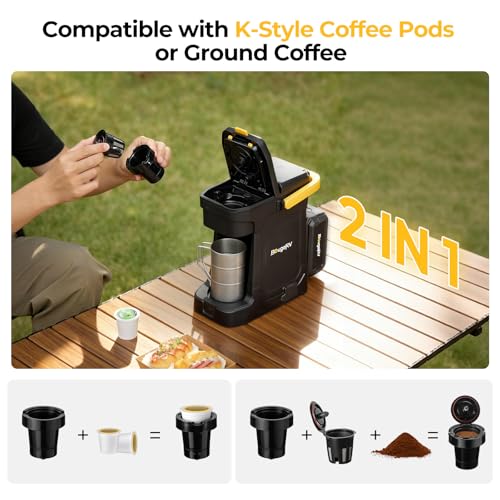
On paper, this is the most complete package in the category. The 8Ah removable battery delivers 5–6 cups per charge, more than most, and it supports both AC power and true cordless use, so it transitions smoothly from RV countertop to jobsite. It handles K-Cup pods, ground coffee, and loose powder, which is rare and practical. Reviewers note it’s especially popular with couples or small crews who want variety without fuss.
The compact design fits in tight spaces, and the wide cup clearance means no wrestling with travel mugs. It’s not barista-grade, but for a drip-style portable brewer, the consistency is solid. Compared to the SENIX model, it trades a slightly lower max temperature for longer runtime and broader pod compatibility. My pick for most buyers who want one device to cover home, travel, and outage prep.
Product photos


Byutrcfuy Dewalt 20V Coffee Maker

Strengths
- Dewalt 20V compatible
- Onboard coffee grinder
- Dual USB output
Trade-offs
- No AC power option
- Battery sold separately
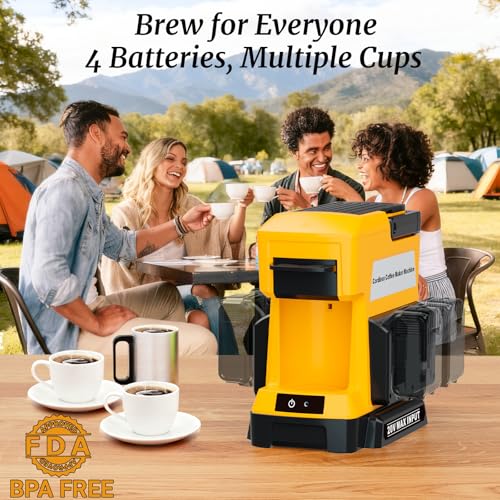
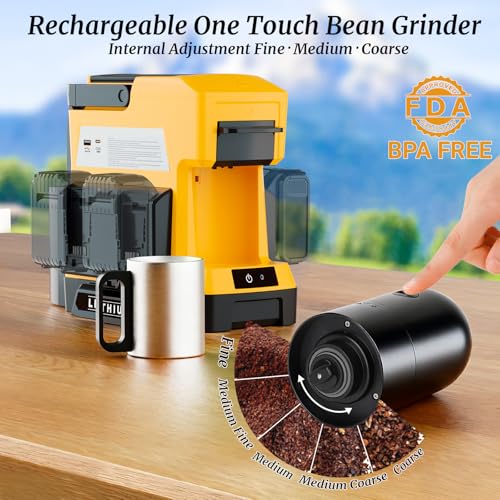
Built for the job site, this model uses Dewalt’s robust 20V MAX battery platform, which many tradespeople already carry. Like its Ryobi sibling, it offers one-touch brewing with a 400W heater and reusable filter, but it’s tuned for durability and multi-user scenarios. The ability to stack up to four batteries means you can keep brewing through a full shift, and the dual USB ports let you power tools or phones mid-brew, a small but meaningful perk when you’re off-grid.
It’s not flashy, but it’s functional: the included grinder ensures fresh flavor, and ESE pod support keeps things fast when time’s tight. Compared to the BougeRV, it lacks AC compatibility, so it’s purely battery-dependent. But for contractors or field crews, that’s not a flaw, it’s focus.
Product photos


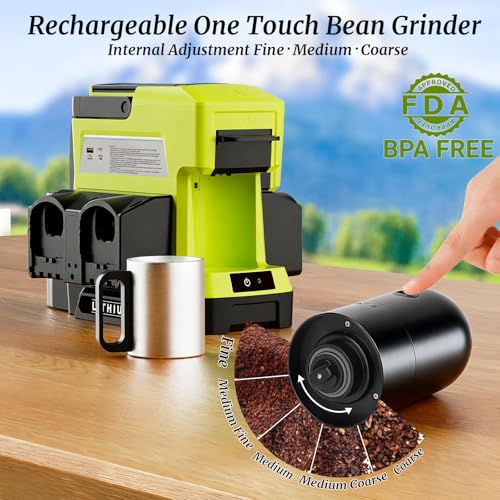
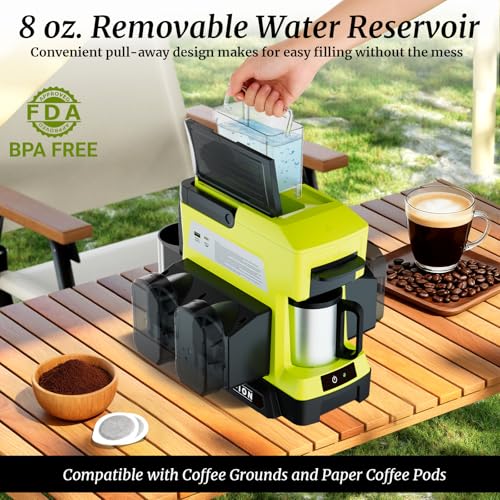
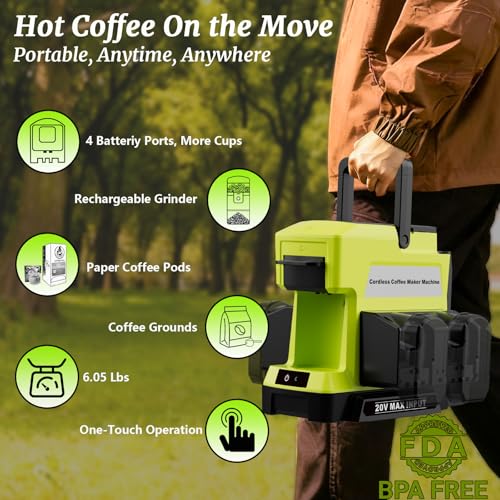
Byutrcfuy Ryobi 18V Coffee Maker

Strengths
- Ryobi 18V compatible
- Includes coffee grinder
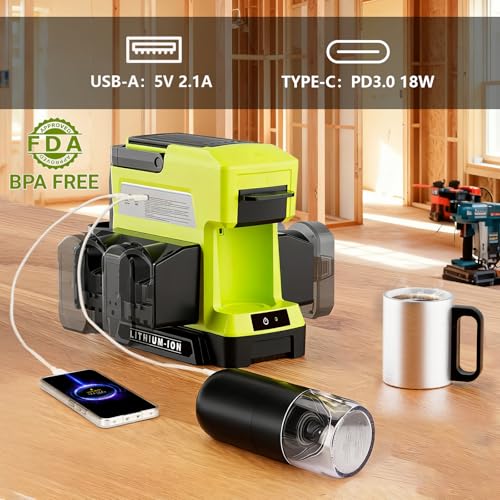
- Dual USB charging ports
Trade-offs
- Battery not included
- Short runtime per charge
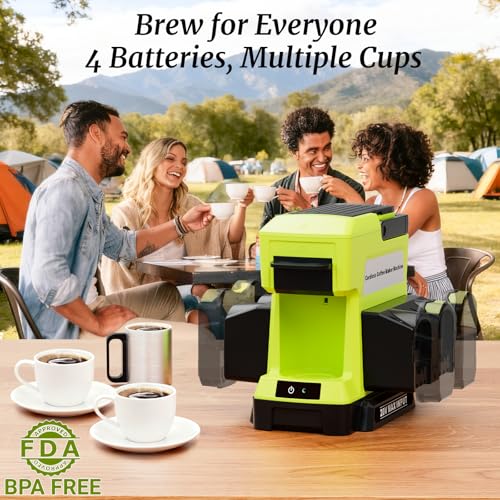
If you already own Ryobi 18V tools, this brewer is a no-brainer add-on, it runs directly off your existing batteries, eliminating the need for a proprietary power pack. The 400W heating system gets water to 195–205°F fast enough for a decent drip brew in a few minutes, and the reusable metal filter cuts down on waste. Owners appreciate the three brewing methods: fresh grounds via the included grinder, ESE pods, or coffee bags, which adds real flexibility in the field.
The dual USB outputs are a clever touch, letting you charge your phone or grinder while brewing, something campers and job site users actually use. That said, runtime is limited: a 4Ah battery yields only 2–3 cups, so sharing means carrying spares. It’s less of a standalone coffee machine and more of a power ecosystem play.
Product photos
Loezora Stainless Steel Espresso Maker

Strengths
- 20-bar pressure
- 7500mAh battery
- Stainless steel build
Trade-offs
- Heavier than drip models
- Requires fine grind precision
This is the only model here that delivers real espresso, not just strong drip, thanks to its 20-bar pump pressure and thermoblock heating. The 7500mAh battery is the largest on the list, supporting 6–8 shots per charge, and USB-C fast charging is a modern touch many overlook. But the real win is build quality: full 304 stainless steel construction with zero plastic in the water path means no off-flavors and better durability, especially in rugged conditions.
Owners praise the crema quality, which rivals home machines twice the price. It’s 3-in-1, working with Nespresso, Dolce Gusto, and fine grounds, so it adapts to different preferences. The downside? It’s heavier and pricier than drip models, and the learning curve for grind fineness and tamping matters more. If you demand espresso on the move, this is the closest you’ll get to authentic.
Video review
SENIX Dual AC/DC Coffee Maker

Strengths
- Heats cold water
- Dual AC/DC power
- ESE and grounds compatible
Trade-offs
- Slower on battery
- Limited to 4 cups max
This is one of the few portable brewers that actually heats cold water from scratch using its built-in 5000mAh battery, which is a big deal when you’re off-grid and don’t have access to a stove or kettle. The 208–212°F range hits the sweet spot for drip-style extraction, so owners consistently report a clean, balanced cup that tastes far better than what you’d expect from a travel unit. It’s not the fastest, battery mode takes 6–8 minutes per 6 oz cup, but the dual AC/DC flexibility makes it just as useful on a desk as it is in a camper.
What stands out is how self-contained it is. The included stainless steel mug, permanent filter, and cup-holder-friendly footprint mean you’re not chasing accessories. Compared to pod-only systems, this one gives real versatility with both grounds and ESE pods, though it won’t match the pressure of an espresso rig. For a true cordless drip experience, it’s a smart middle ground.
Video review
How We Picked These battery operated coffee maker
As the founder of Bean Thusiast, I approach coffee gear with a focus on real-world usability and flavor potential. Rather than a hands-on lab test of each unit, this selection is a research-led comparison of published specifications and owner feedback. I weighed features, power options, and build quality across several models, drawing on years of exploring brewing techniques and understanding what makes a truly convenient coffee experience. We prioritized models with consistent positive reviews and clear feature sets.
For battery-operated coffee makers, the most important factors are battery life/capacity and brewing flexibility. Long runtimes (or compatibility with multiple batteries) are critical for true portability, and the ability to use different coffee grounds – pods, ESEs, or loose grounds – significantly expands usability. Build quality also stood out; a durable machine is essential for outdoor adventures or job sites. These factors directly impact the convenience and overall value proposition.
Specifications reliably indicate brewing temperature and capacity, but owner reviews were invaluable for assessing real-world battery life claims and build quality durability. I looked for patterns in feedback regarding ease of cleaning, leakage issues, and the effectiveness of features like automatic shut-off. Proper coffee maker maintenance guide (https://beanthusiast.com/how-to-clean-coffee-maker/) is also important for these units, and owners often comment on how easy or difficult it is to keep them in good working order.
How To Pick The Right battery operated coffee maker
As someone who’s spent years chasing the perfect cup, I understand the appeal of a good, hot brew anywhere. But when it comes to battery-powered options, there’s a lot more to consider than just portability.
A quality battery operated coffee maker balances brewing speed, battery capacity for multiple cups, compatibility with common coffee types (grounds, pods, etc.), and build quality for outdoor durability. Look for models with temperature control for optimal extraction, automatic shut-off for safety, and a reasonably straightforward cleaning process. Pay attention to battery voltage and amp-hour ratings to estimate run time.
Battery Capacity & Brewing Volume
The biggest limitation of a battery operated coffee maker is, unsurprisingly, the battery. Don’t just look at the voltage (18V, 20V, etc.); focus on the amp-hour (Ah) rating. A higher Ah means longer run time. However, that run time is highly dependent on the wattage of the heating element. A 4Ah battery powering a 400W heater won’t brew nearly as many cups as a similar battery powering a 45W heater. Consider how many cups you realistically need on a single charge. If you’re primarily a solo camper, a smaller unit might suffice, but for a group, you’ll want something with substantial capacity or the ability to link multiple batteries.
Power Source Flexibility & Charging
While the appeal is cordless operation, a truly versatile unit offers multiple power options. The BougeRV and SENIX models both highlight this, offering AC adapter compatibility alongside battery power. This is particularly useful when you have access to an outlet – why drain the battery if you don’t need to? Also, consider charging speed. USB-C PD (Power Delivery) is becoming increasingly common and offers significantly faster charging times than older USB standards. A fast recharge can be critical on longer trips. I always suggest looking into portable battery coffee maker options if you want to be prepared for anything.
Brewing Method & Ease of Maintenance
Do you prefer the convenience of K-Cups, the richness of freshly ground coffee, or the simplicity of ESE pods? Some units, like the Byutrcfuy models, offer compatibility with all three. However, versatility often comes at a cost. Models that handle multiple brewing methods may not excel at any one in particular.
Here’s what I look for when deciding: * Pod Compatibility: A nice-to-have, but don’t sacrifice brew quality for it. * Ground Coffee Filter: A reusable metal filter is preferable to paper, reducing waste and ongoing costs. * Grinder Integration: Some units (like one of the Byutrcfuy models) include a built-in grinder. This is fantastic for freshness, but adds complexity and another component that could potentially fail.
Beyond brewing, remember that even battery operated coffee makers accumulate mineral buildup. Regular descaling battery-powered coffee makers is vital for maintaining performance and extending the life of your brewer.
A battery operated coffee maker is an investment in convenience. Treat it like one – regular cleaning and proper battery care will pay dividends in years of reliably brewed coffee.
Battery Operated Coffee Makers Compared
Here’s a comparison of key specifications for several battery operated coffee makers.
| Product Title | Battery Voltage | Battery Capacity | Brews Per Charge | Brewing Options | USB Charging | Heating System |
|---|---|---|---|---|---|---|
| BougeRV 18V Coffee Maker | 18V | 8Ah/144Wh | 5-6 (8oz) | K-Cup, Powder, Ground | Yes (USB-C) | Internal |
| Byutrcfuy Dewalt 20V Coffee Maker | 20V | N/A (Dewalt) | 2-3 (4Ah) | Grinder, E.S.E., Ground | Yes (USB-A & USB-C) | 400W |
| Byutrcfuy Ryobi 18V Coffee Maker | 18V | N/A (Ryobi) | 2-3 (4Ah) | Grinder, E.S.E., Ground | Yes (USB-A & USB-C) | 400W |
| Loezora Stainless Steel Espresso Maker | N/A | 7500mAh | 6-8 Shots | Nespresso, Dolce Gusto, Ground | Yes (USB-C) | 20Bar |
| SENIX Dual AC/DC Coffee Maker | N/A | 5000mAh | 4 Cups | Pods, Ground | N/A | Internal |
Frequently Asked Questions
What battery types are commonly compatible with these coffee makers?
Most models use Dewalt, Ryobi, or Makita batteries, offering broad compatibility for tool users. The BougeRV model uses an 18V battery, while others like Byutrcfuy are designed for 20V systems, providing flexibility if you already own these batteries for other tools.
How does brewing temperature affect the taste with these units?
Consistent brewing temperature, ideally between 195-205°F (90-96°C), is crucial for proper extraction. Owner feedback suggests some units struggle to reach optimal temperatures, potentially resulting in a weaker or more bitter brew, so look for models with temperature control if that’s a priority.
Can I use these coffee makers for more than just camping?
Absolutely. These are excellent coffee makers for outdoor use for tailgating, RV trips, or even job sites where standard outlets aren’t available. Their portability makes them useful anywhere you want a fresh brew without relying on mains power.
What’s the typical cleaning process for a battery-operated coffee maker?
Beyond regular rinsing, these units often require descaling to remove mineral buildup, just like conventional coffee makers. The Byutrcfuy models, with their grinder component, will require more thorough cleaning of the grinding chamber to prevent stale coffee oils from affecting the flavor.
Are there any battery operated espresso machines worth considering?
The Loezora Stainless Steel Espresso Maker offers a portable option for espresso lovers, utilizing a 20-bar pump and compatible with Nespresso and Dolce Gusto pods. However, it’s important to note this model focuses on shot-style brewing rather than full pots, and it’s a different brewing approach than the drip-style brewers.
The Bottom Line
Choosing a battery-operated coffee maker often comes down to balancing convenience with capacity. If you want a single, well-rounded unit that offers flexibility and solid performance, the BougeRV 18V Coffee Maker stands out as the best overall choice. It strikes a good balance between battery life, brewing options, and features like USB-C charging, making it a reliable companion for various adventures.
For those prioritizing specific needs, this category has excellent options. The Byutrcfuy Dewalt 20V Coffee Maker and Byutrcfuy Ryobi 18V Coffee Maker are ideal if you’re already invested in those tool ecosystems, offering the convenience of using existing batteries. And if you are looking for a compact espresso solution, the Loezora Stainless Steel Espresso Maker delivers on that front.
Ultimately, the “best” coffee maker isn’t about the highest wattage or the most features. It’s about consistent brewing temperature, ease of cleaning (especially learning how to descale drip coffee makers), and selecting a machine that fits your brewing habits. Focus on those fundamentals, and you’ll enjoy a great cup wherever you are.
