
How to Descale Coffee Maker | The One Step Most People Skip
To descale a coffee maker, you must dissolve mineral scale from its internal heating element and water lines using an acidic solution, followed by multiple thorough rinse cycles to remove all residue. The correct solution depends on your machine type: white vinegar is often okay for drip machines, but most espresso machines require a commercial citric-acid descaler to avoid damaging seals and aluminum components.
Most people get this wrong by using vinegar in machines that forbid it, or by skipping the final rinse cycles. The leftover acid etches metal and leaves a foul taste in every cup afterward.
This guide walks through the tools you need, the vinegar versus descaler debate, and specific steps for both simple drip machines and complex espresso automatics. We’ll also cover how to know when it’s time and what happens if you put it off.
Key Takeaways
- Vinegar damages espresso machines. De’Longhi and Breville manuals explicitly warn against it; the acid corrodes aluminum boilers and degrades rubber seals over time.
- The rinse is more important than the descale. Skipping the second and third water cycles leaves acidic residue that will slowly eat the heating element.
- Water hardness dictates frequency. If your tap water leaves white spots on glass, descale every 3 months. With soft water, you can stretch to 6.
- Automatic descale programs are not optional. When your Breville or De’Longhi machine flashes “DESCALE,” it’s calculating scale buildup; ignoring it leads to blocked lines and pump failure.
- Never run descaler through a coffee filter. It must go directly into the empty water reservoir and through the machine’s internal plumbing alone.
What Happens If You Don’t Descale?
Mineral deposits from water, primarily calcium and magnesium carbonate, accumulate on the internal heating element and narrow water pathways. This is limescale.
The first symptom is longer brew times. The heater is insulated by scale and must work harder to reach temperature. Your morning cup takes an extra minute. Next, the machine gets louder as the pump strains against restricted tubes. Finally, heat distribution becomes uneven. The scaled heater develops hot spots that can crack the metal or cause the thermal fuse to blow. At that point, the machine stops heating entirely.
Common mistake: Waiting for slower brewing as your only cue — by the time you notice, the scale is often thick enough to require multiple descaling cycles or professional service.
In espresso machines, scale blocks the solenoid valve, the OPV, and the steam wand. You’ll get weak, lukewarm shots and a steam wand that spits water instead of dry steam. Repairing those components costs more than the descaling solution ever would.
TL;DR: Scale acts as an insulator, causing longer brew times, pump strain, and eventual heater failure. In espresso machines, it blocks critical valves.
The Tools and Supplies You’ll Need
You don’t need many tools, but the choice of descaling agent is critical. Using the wrong one voids warranties and causes permanent damage.
| Item | Purpose | Notes |
|---|---|---|
| Commercial Descaler (e.g., Urnex Descal, Durgol) | Dissolves limescale safely for all machine types. | Citric acid-based; less corrosive than vinegar. The only choice for espresso machines. |
| White Distilled Vinegar | Descaling agent for drip machines that permit it. | Check your manual. Never use in machines with aluminum boilers. |
| Fresh Cold Water | Flushing agent for rinse cycles. | You’ll need 2-3 times the capacity of your reservoir. |
| Measuring Cup | Mixing solution accurately. | A standard 2-cup glass measure works. |
| Soft Cloth or Sponge | Wiping the reservoir and exterior. | Avoid abrasive scrubbers that scratch plastic. |
| Large Bowl or Jug | Catching the waste descaling solution. | Must hold at least a full reservoir of liquid. |
The debate between white vinegar and commercial descaler isn’t about cost. It’s about material compatibility. Vinegar is acetic acid. It’s more aggressive than citric acid.
In a Keurig K-Elite, the manual explicitly allows it. The plastic lines and stainless steel tank can handle it. In a De’Longhi Magnifica S ECAM22110B, the manual says “Do not use vinegar.” The reason is often an aluminum boiler or internal brass fittings that vinegar will corrode. The rubber seals and gaskets in an espresso machine also degrade faster in acetic acid.
I used a vinegar solution in a mid-range espresso machine years ago, following generic online advice. The machine ran fine for two months. Then the steam wand started leaking a brown, sludgy water. A technician found pitting in the aluminum boiler and swollen O-rings that no longer sealed. The repair bill exceeded the machine’s value.
Commercial descalers like Urnex Descal are formulated for coffee equipment. They’re effective at dissolving scale but gentler on metals and seals. They’re the universal safe bet.
Vinegar vs. Commercial Descaler: Which Should You Use?
Your machine’s manual is the final authority. If you’ve lost it, a quick search for your model number and “manual” often turns up a PDF. Brands like Breville and De’Longhi host them online.
For a drip coffee maker or single-serve pod machine like a Keurig, vinegar is usually acceptable. The Keurig K-Elite manual states you can use their solution or white vinegar. The process is straightforward and cheap.
For an espresso machine, especially one with an automatic descaling program, you must use the brand’s recommended solution or a compatible citric-acid descaler. The Breville Barista Express Impress BES876 uses a powder. The De’Longhi Magnifica S ECAM22110B requires its own liquid. These solutions are designed to work with the machine’s automated rinse cycles and will not harm internal components.
| Machine Type | Recommended Agent | Why It Matters |
|---|---|---|
| Drip / Pourover (e.g., Braun, Black & Decker) | White Vinegar or Commercial Descaler | Simple plumbing, often stainless steel or plastic heating elements. Vinegar is cost-effective. |
| Pod / Single-Serve (e.g., Keurig K-Elite) | White Vinegar or Keurig Descale Solution | Manual explicitly permits vinegar. Easy to rinse. |
| Semi-Automatic Espresso (e.g., Breville BES876) | Brand-Designed Descaler (e.g., Breville Powder) | Protects aluminum boiler, seals, and calibrates the machine’s descale indicator. |
| Super-Automatic Espresso (e.g., De’Longhi ECAM22110B) | Brand-Designed Liquid Descaler | Required to activate the automatic descaling cycle; vinegar can damage the flow meters. |
Common mistake: Using vinegar in an espresso machine because it’s cheaper — the acetic acid attacks aluminum and causes seals to swell, leading to leaks within a few months.
If you’re ever unsure, default to a commercial descaler. A bottle of Urnex Descal treats many machines and is safer than guessing wrong with vinegar. For machine-specific guidance, always consult the official Braun coffee maker manual or Black & Decker manual if you own those models.
How Often Should You Descale?

The standard “every 3-6 months” is a starting point. The real driver is your water’s hardness.
If you live in an area with hard water—where your showerhead gets crusty or your glasses spot—lean toward 3 months. The mineral load is high. If you use softened or filtered water, 6 months is often fine. Some advanced machines, like the Breville Barista Express Impress, have a water hardness setting. This tells the machine’s computer how quickly to expect scale buildup. When it calculates enough, the “DESCALE” light comes on. That’s your signal.
Ignoring that light is a choice with consequences. The machine isn’t guessing. It’s tracking water flow and heater performance. I once ignored the light on a test machine for two extra months out of curiosity. The first sign was a gurgling sound during extraction. Then, the steam wand output dropped to a sad wheeze. The descaling cycle that followed produced shocking chunks of white mineral debris. It took three cycles to clear.
Your nose is also a tool. If your coffee starts tasting flat, metallic, or oddly sour despite fresh beans, scale might be interfering with proper water temperature and flow. It’s a good time to check your calendar.
TL;DR: Base frequency on water hardness: every 3 months for hard water, 6 for soft. Never ignore your espresso machine’s “DESCALE” alert.
Step-by-Step: Descaling a Drip Coffee Maker
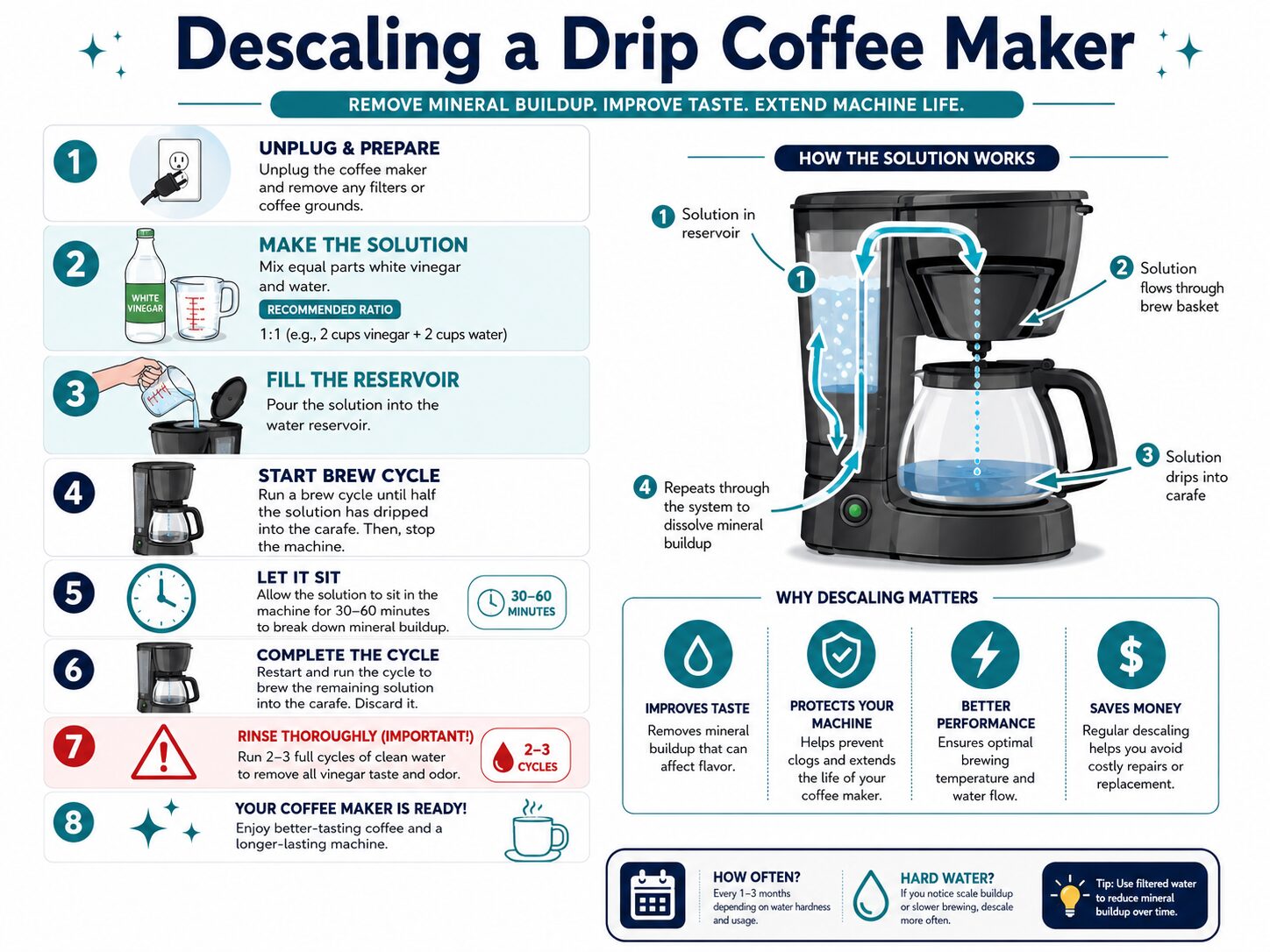
This process applies to basic drip machines from brands like Braun, Black & Decker, and OXO. Always remove any permanent filter or charcoal water filter before you start.
Before you start: Unplug the machine and let it cool completely. Descaling involves liquids near electrical components; working on a hot machine risks steam burns or short circuits.
- Empty and clean the reservoir. Remove any old water. Wipe out any visible film or sludge with a damp cloth. This ensures the descaling solution contacts scale directly.
- Mix your solution. For a full reservoir, use a 1:1 ratio of white vinegar to water. If using a commercial descaler like Urnex Descal, follow the package instructions—typically one packet or a capful per reservoir of water.
- Pour and run. Pour the solution into the empty reservoir. Place the empty carafe on the warmer. Start a full brew cycle. Let the solution run all the way through until the carafe is full.
- Let it soak. Turn the machine off. Let the vinegar or descaler solution sit in the carafe and the machine’s internal lines for 20-30 minutes. This dwell time is what dissolves the stuck-on mineral deposits.
- Dump and rinse the carafe. Discard the spent solution from the carafe. Rinse it thoroughly with fresh water.
- Run the first rinse cycle. Fill the reservoir with fresh, cold water. Run a full brew cycle, discarding the water from the carafe afterward. This flushes the bulk of the dissolved scale.
- Run the second and third rinse cycles. Repeat step 6 two more times. This is non-negotiable. Residual acid will damage the heater and taint your coffee.
- Final wipe and test. Wipe down the reservoir and exterior. Run one more brew cycle with fresh water, but this time, make a pot of coffee you intend to discard. This confirms no off-flavors remain in the system.
Skipping step 7 is the most common error. People think one rinse is enough. It isn’t. You need to flush the entire volume of the system multiple times to be sure. After the third cycle, smell the steam from the brewer. If you catch a whiff of vinegar or chemicals, run another.
Step-by-Step: Descaling an Espresso Machine

Espresso machines, especially super-automatics, have their own programmed routines. You must follow them. We’ll use the Breville Barista Express Impress BES876 and De’Longhi Magnifica S ECAM22110B as examples.
For the Breville Barista Express Impress:
1. The machine will display “DESCALE” on its LCD when it’s time. Ensure the water tank is full with fresh water and the drip tray is empty.
2. Fill the included descaling powder container with Breville’s descaling powder. Insert it into the powder holder.
3. Press and hold the “1 Cup” and “2 Cup” buttons simultaneously for 3 seconds. The descale cycle begins automatically.
4. The machine will pump the descaling solution through the group head and steam wand in stages. It will pause and prompt you to empty the drip tray.
5. Once the solution cycle is complete, it will prompt you to rinse. It will automatically run several rinse cycles through the group head. Follow the on-screen prompts until the cycle finishes and the machine returns to ready mode.
For the De’Longhi Magnifica S ECAM22110B:
1. Ensure the machine is on, the water tank (1.8L capacity) is full, and the drip tray and coffee grounds container are empty.
2. Pour the entire bottle of De’Longhi descaler liquid into the empty water tank. Do not dilute it.
3. Place a large container (at least 1L) under the coffee spout and the hot water/steam wand.
4. Press the “Descaling” button. The machine will enter its automatic cycle, running solution alternately from the spout and wand.
5. When the tank is empty, the machine will beep. Refill the tank with fresh water only.
6. Press the “Descaling” button again. The machine will now run rinse cycles. Continue refilling with fresh water and running rinse cycles until the “Descaling” light goes out. This typically takes 2-3 full tanks of water.
The key with automatics is patience. Do not interrupt the cycle. Do not switch the machine off. The process can take 20-30 minutes. The machine is flushing scale from internal valves and the heat exchanger that a manual process might miss.
The Critical Rinse Cycles (And How to Get Them Right)
Whether manual or automatic, the rinse phase is where the job is finished. Incomplete rinsing leaves active acid in the machine.
For drip machines, the rule is simple: run fresh water through for three full reservoir volumes. After the first cycle, the water might still look cloudy or have floating particles. That’s normal. The third cycle should run clear. If your machine has a “clean” or “rinse” button, use it. If not, just run a regular brew cycle.
For espresso machines, follow the machine’s prompts exactly. When it says “rinse,” add only fresh water. Do not add more descaler. The Breville and De’Longhi cycles are designed to rinse sufficiently. Trust the program.
I won’t recommend the bottomless portafilter for diagnosing a poor rinse. The visual feedback is honest, but it’s overkill. Instead, after the final rinse, pull a blank shot (no coffee) into a white cup. Let it cool. Taste it. If you detect any sourness, acidity, or chemical note, run two more rinse cycles. Your palate is the best sensor.
This thorough flushing is also your chance to clean other parts. While the rinse water runs, wipe down the steam wand with a damp cloth. Remove and rinse the water tank. Good maintenance of your Breville coffee machine filter or Bunn coffee maker filters happens here, while everything is already disassembled.
Troubleshooting Common Descaling Problems
Sometimes things don’t go smoothly. Here’s what to do.
Problem: The machine won’t start the descale cycle.
- Cause: The descale indicator might be a reminder, not a lock-out. Check that the water tank is full, the drip tray is seated correctly, and any accessory (like a descaling cartridge) is properly installed.
- Fix: Consult your Braun machine troubleshooting guide or the machine’s manual for a hard reset procedure.
Problem: The descaler solution isn’t flowing / machine is gurgling.
- Cause: Severe scale blockage. The deposits have narrowed or completely plugged the internal tubes.
- Fix: Stop the cycle. Let the solution sit in the machine for a full hour to dissolve the blockage. Then, try restarting the cycle. You may need to repeat the entire descaling process twice.
Problem: A bad taste persists after multiple rinses.
- Cause: Residual descaler or dissolved scale trapped in a dead-end line, often in the steam wand or a hot water dispenser.
- Fix: Manually activate the steam wand and hot water dispenser during the rinse cycles to flush those specific pathways. Run several ounces of clean water through each.
Problem: “DESCALE” light won’t turn off after completing the cycle.
- Cause: The machine’s internal counter wasn’t reset. Some machines require you to hold a button combination after the rinse to confirm completion.
- Fix: Again, the manual is key. For Breville, it’s often holding the “1 Cup” button. For others, it might be a power cycle. Look up the specific reset for your model.
Frequently Asked Questions
Can I use lemon juice instead of vinegar to descale my coffee maker?
No. Lemon juice is also acidic, but it contains sugars and organic compounds that can leave a sticky residue inside your machine. This residue can promote mold growth and is harder to rinse out than pure vinegar or descaler.
How do I know if my coffee maker needs descaling?
Look for longer brew times, weaker or cooler coffee, unusual noises from the pump, or a visible crust of white or off-white mineral deposits around the heater plate or inside the water reservoir. Many modern machines have a “Descale” or “Clean” indicator light that activates based on usage.
Is it safe to drink coffee right after descaling?
No. You must always run multiple rinse cycles with fresh water after descaling to flush all cleaning solution from the system. After the final rinse, brew and discard a full pot of plain water (or a blank shot from an espresso machine) as a final test to ensure no chemical taste remains.
What’s the difference between cleaning and descaling a coffee maker?
Cleaning removes coffee oils, residue, and stains from surfaces like the carafe, filter basket, and reservoir. Descaling is a chemical process that dissolves hard water mineral deposits (limescale) from the internal heating element and water pathways that you cannot see or scrub.
Can descaling damage my coffee maker?
Using the wrong descaling agent (like vinegar in an espresso machine with an aluminum boiler) or failing to rinse thoroughly can cause damage. Always use the solution recommended in your machine’s manual and complete all rinse cycles.
Why does my Keurig say ‘descaling’ but I just descaled it last month?
If you have extremely hard water, the mineral buildup can be rapid. Also, the Keurig’s reminder is often based on a simple brew-cycle counter, not actual scale detection. You can reset the reminder manually (see your manual), but if your water is hard, descaling monthly might be necessary.
Before You Go
Descaling isn’t optional maintenance. It’s the procedure that determines whether your machine lasts three years or ten. The choice between vinegar and commercial descaler hinges entirely on your machine’s internal materials—check the manual.
Remember the rinse. Two cycles is the minimum, three is safer. Leftover acid is a silent killer.
Finally, let your water be your guide. Hard water demands a 3-month schedule. Soft water buys you time. And when your espresso machine’s display lights up with that single, ominous word, listen to it. The alternative is a repair bill that could buy a new grinder, maybe even a proper burr coffee grinder to pair with your freshly cleaned machine.
{
“@context”: “https://schema.org”,
“@type”: “HowTo”,
“name”: “How to Descale a Coffee Maker”,
“totalTime”: “PT45M”,
“tool”: [
{
“@type”: “HowToTool”,
“name”: “Commercial descaling solution (e.g., Urnex Descal)”
},
{
“@type”: “HowToTool”,
“name”: “Measuring cup”
},
{
“@type”: “HowToTool”,
“name”: “Soft cloth or sponge”
}
],
“supply”: [
{
“@type”: “HowToSupply”,
“name”: “Fresh, cold water (2-3 full reservoirs)”
},
{
“@type”: “HowToSupply”,
“name”: “White vinegar (optional, for drip machines only)”
}
],
“step”: [
{
“@type”: “HowToStep”,
“name”: “Check your machine’s manual”,
“text”: “Confirm your machine’s specific descaling procedure and whether it permits vinegar or requires a proprietary solution.”
},
{
“@type”: “HowToStep”,
“name”: “Prepare the descaling solution”,
“text”: “Mix the commercial descaler with water per its instructions, or use a 1:1 vinegar-to-water ratio for approved drip machines.”
},
{
“@type”: “HowToStep”,
“name”: “Run the descaling cycle”,
“text”: “Pour the solution into the empty reservoir and start a brew cycle. For automatic machines, initiate the dedicated descale program.”
},
{
“@type”: “HowToStep”,
“name”: “Let it sit”,
“text”: “Allow the solution to sit in the machine’s internal lines and tank for 20-30 minutes to dissolve mineral deposits.”
},
{
“@type”: “HowToStep”,
“name”: “Complete the rinse cycles”,
“text”: “Run 2-3 full reservoirs of clean water through the machine to flush out all descaler and dissolved scale.”
},
{
“@type”: “HowToStep”,
“name”: “Wipe down and final check”,
“text”: “Wipe the reservoir and exterior, then run one final brew cycle with fresh water to ensure no chemical taste remains.”
}
]
}
{
“@context”: “https://schema.org”,
“@type”: “FAQPage”,
“mainEntity”: [
{
“@type”: “Question”,
“name”: “Can I use lemon juice instead of vinegar to descale my coffee maker?”,
“acceptedAnswer”: {
“@type”: “Answer”,
“text”: “No. Lemon juice is also acidic, but it contains sugars and organic compounds that can leave a sticky residue inside your machine. This residue can promote mold growth and is harder to rinse out than pure vinegar or descaler.”
}
},
{
“@type”: “Question”,
“name”: “How do I know if my coffee maker needs descaling?”,
“acceptedAnswer”: {
“@type”: “Answer”,
“text”: “Look for longer brew times, weaker or cooler coffee, unusual noises from the pump, or a visible crust of white or off-white mineral deposits around the heater plate or inside the water reservoir. Many modern machines have a \”Descale\” or \”Clean\” indicator light that activates based on usage.”
}
},
{
“@type”: “Question”,
“name”: “Is it safe to drink coffee right after descaling?”,
“acceptedAnswer”: {
“@type”: “Answer”,
“text”: “No. You must always run multiple rinse cycles with fresh water after descaling to flush all cleaning solution from the system. After the final rinse, brew and discard a full pot of plain water (or a blank shot from an espresso machine) as a final test to ensure no chemical taste remains.”
}
},
{
“@type”: “Question”,
“name”: “What’s the difference between cleaning and descaling a coffee maker?”,
“acceptedAnswer”: {
“@type”: “Answer”,
“text”: “Cleaning removes coffee oils, residue, and stains from surfaces like the carafe, filter basket, and reservoir. Descaling is a chemical process that dissolves hard water mineral deposits (limescale) from the internal heating element and water pathways that you cannot see or scrub.”
}
},
{
“@type”: “Question”,
“name”: “Can descaling damage my coffee maker?”,
“acceptedAnswer”: {
“@type”: “Answer”,
“text”: “Using the wrong descaling agent (like vinegar in an espresso machine with an aluminum boiler) or failing to rinse thoroughly can cause damage. Always use the solution recommended in your machine’s manual and complete all rinse cycles.”
}
},
{
“@type”: “Question”,
“name”: “Why does my Keurig say ‘descaling’ but I just descaled it last month?”,
“acceptedAnswer”: {
“@type”: “Answer”,
“text”: “If you have extremely hard water, the mineral buildup can be rapid. Also, the Keurig’s reminder is often based on a simple brew-cycle counter, not actual scale detection. You can reset the reminder manually (see your manual), but if your water is hard, descaling monthly might be necessary.”
}
}
]
}
