
Can You Use Powdered Sugar in Coffee? The Cornstarch Catch
Yes, you can use powdered sugar in coffee, but you must pre-dissolve it in a splash of hot liquid first. The cornstarch added to prevent caking will form gritty lumps if you dump it directly into your mug. This method works best in hot, well-stirred drinks like black coffee or lattes.
Yes, you can use powdered sugar in coffee. The cornstarch added to prevent caking is the only complication. You must pre-dissolve it in a splash of hot liquid first, or it will form stubborn, gritty lumps in your cup. This works best in hot, well-stirred drinks like black coffee, Americanos, or lattes.
Most people grab the sugar jar without thinking. They assume all white sugars are interchangeable. Powdered sugar looks finer, so it should dissolve faster, right? That logic misses the cornstarch. Dumping it straight into your mug is a fast track to a lumpy, textured drink you didn’t order.
This guide walks through what powdered sugar actually is, when to use it, and the exact method to avoid the clumping problem. We’ll compare it to other sweeteners and name the drinks where it shines, and the ones where it fails.
Key Takeaways
- Powdered sugar contains 3-5% cornstarch by weight to prevent caking. That starch turns into paste if you don’t pre-dissolve it.
- By volume, powdered sugar is about 30% less sweet than granulated sugar because it’s less dense. You need more to match the sweetness.
- It works brilliantly in cold, creamy drinks like iced lattes or shaken espresso, where the starch thickens the texture slightly.
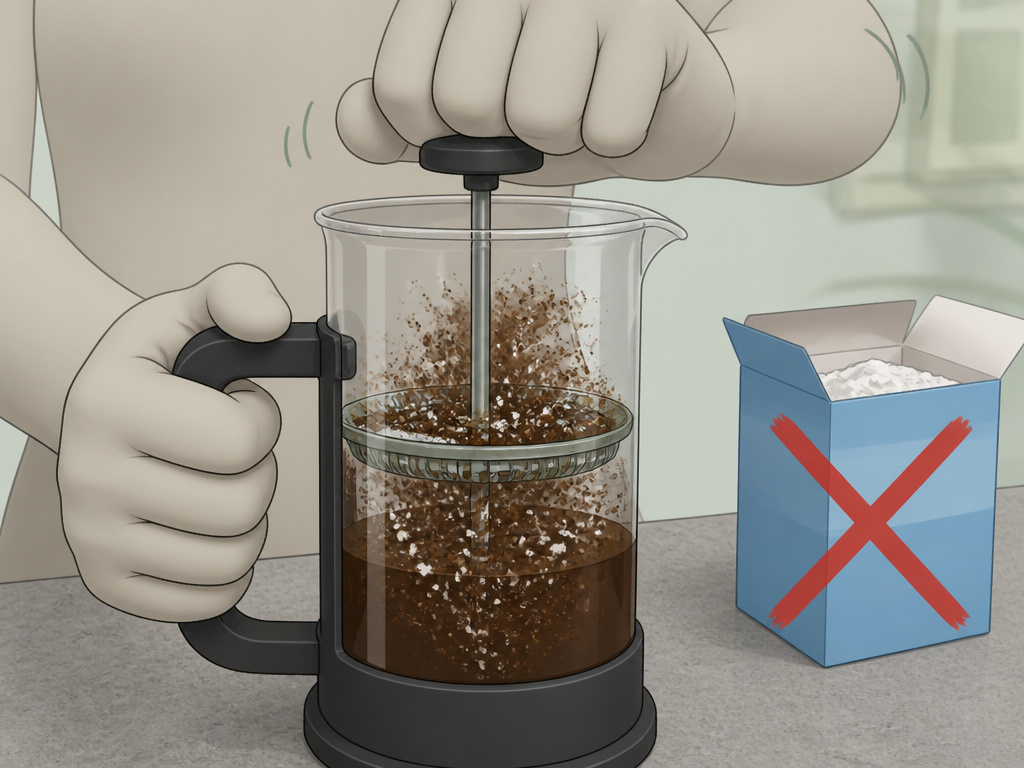
- Never add powdered sugar directly to a French press before plunging. The starch will clog the mesh filter and create a sludgy mess.
- For a quick homemade version, blend one cup of granulated sugar with one tablespoon of cornstarch for 60 seconds.
What Powdered Sugar Actually Is (And Why It’s Different)
Powdered sugar isn’t just ground-up table sugar. Industrial production involves milling granulated sugar to a super-fine powder and then adding an anti-caking agent, almost always cornstarch, at a ratio of about 3-5% by weight. The starch coats each microscopic grain, preventing the powder from absorbing ambient moisture and clumping into a solid brick in the bag.
The cornstarch is non-negotiable. It’s what gives confectioners’ sugar its characteristic ability to dust a cake without melting. In a hot liquid, that same property becomes a liability if the starch isn’t hydrated properly first.
This fundamental difference changes everything about using it in coffee. Granulated sugar is a pure sucrose crystal. It dissolves in hot water through a straightforward process. Powdered sugar introduces a hydrocolloid. When hit with hot liquid, the cornstarch granules swell and gelatinize. If they’re surrounded by enough water and agitated, they disperse smoothly. If they hit a large volume of liquid all at once without being broken up, they form gelatinous lumps.
The Wikipedia entry on powdered sugar confirms the standard composition and the reason for the cornstarch addition. It’s a functional ingredient, not an accident.
TL;DR: Powdered sugar has cornstarch added to keep it flowing; that starch needs to be pre-dissolved in hot liquid or it will lump in your coffee.
The Right Drinks for Powdered Sugar (And the Wrong Ones)
Not every coffee drink is a good candidate. The suitability hinges on temperature, agitation, and the presence of dairy or other fats.
| Drink Type | Works With Powdered Sugar? | Why It Works (Or Doesn’t) |
|---|---|---|
| Hot Black Coffee | Yes, with pre-mixing | High heat and stirring can fully dissolve the pre-mixed paste. |
| Americano | Yes, with pre-mixing | The extra hot water volume helps dilute the starch paste completely. |
| Latte / Cappuccino | Yes, best added to milk | Adding the sugar paste to the steaming pitcher integrates it seamlessly into the milk foam. |
| Iced Latte | Best use case | Cold temperature prevents lumping; starch slightly thickens the creamy texture. |
| French Press | No | Starch clogs the metal mesh filter, creating sludge and impeding the plunge. |
| Cold Brew (plain) | Tricky | Low temperature and minimal agitation make even pre-mixed paste hard to integrate fully. |
The standout winner is the iced latte. Here’s why. The drink is already cold, so the cornstarch doesn’t instantly gelatinize into visible lumps. The milk or cream provides fat, which coats the starch granules and helps keep them suspended. The shaking or stirring you give it provides more than enough agitation. The result is a drink that’s subtly silkier and more velvety than one sweetened with granulated syrup.
The absolute failure case is the French press. Adding powdered sugar, even pre-dissolved, to the grounds before adding water is a recipe for a clogged filter. The plunger will stick, and you’ll get a cup full of fine sludge. Even adding the paste to the brewed coffee in the carafe is risky, as residual starch can still gum up the mesh. Just don’t do it.
TL;DR: Use powdered sugar in iced, creamy drinks. Never use it in a French press.
How to Use Powdered Sugar in Coffee: The No-Clump Method
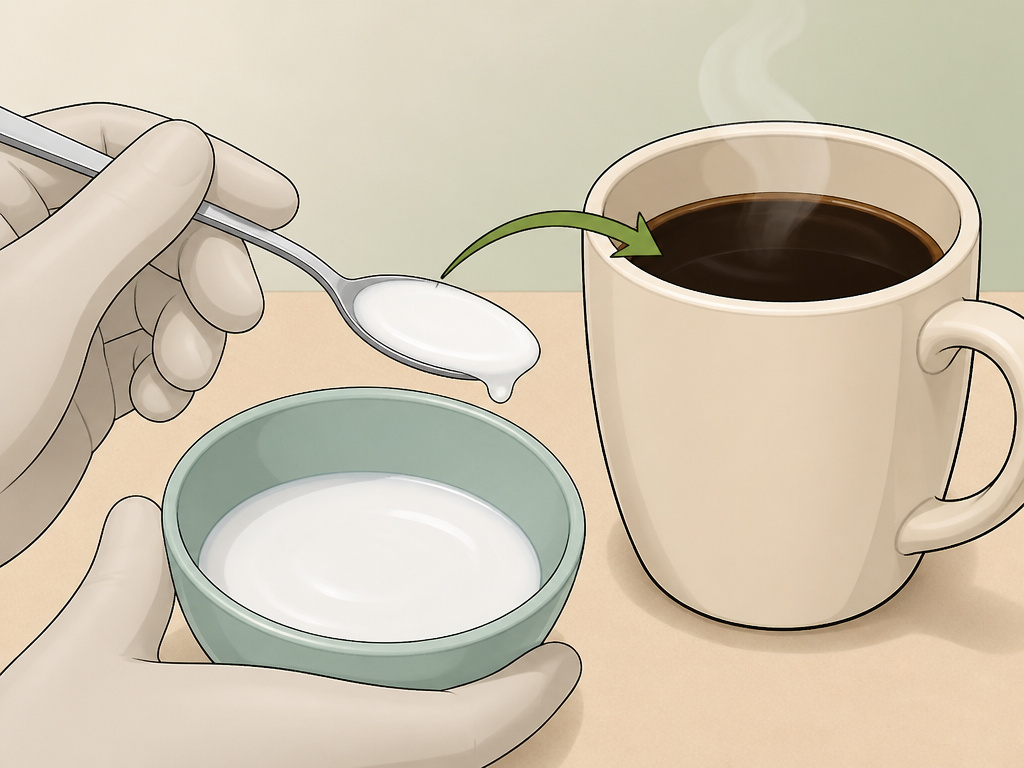 This isn’t a sprinkle-and-stir situation. Follow these steps to avoid a cup full of gelatinous surprises.
Before you start: The cornstarch in powdered sugar can form hot, sticky clumps if not handled correctly. Pouring boiling water directly onto a mound of dry powder will create a glue-like mass at the bottom of your cup that no amount of stirring will fix.
- Scoop your sugar into a separate vessel. Use a small cup, bowl, or even the teaspoon you’ll stir with. This gives you control over the initial hydration. Aim for about 1 1/2 teaspoons of powdered sugar for every teaspoon of granulated sugar you’d normally use.
- Add a tablespoon of hot liquid. This can be a splash of your just-brewed coffee or a bit of hot water from the kettle. The key is to have a small, manageable volume.
- Stir into a smooth paste. Work it vigorously with your spoon until every visible dry speck is gone. You’re creating a slurry. This hydrates the cornstarch fully before it meets the main batch of liquid.
- Pour the paste into your full cup. Now add your coffee or milk. Stir thoroughly again. The paste will dissolve evenly, leaving no trace.
Common mistake: Adding powdered sugar directly to a full cup of hot coffee, the outer layer of powder hydrates and seals dry powder inside, creating a gritty lump at the bottom that lasts for the entire drink.
What happens if you skip the pre-mix? You get what baristas call “shark teeth” – little stubborn nodules of half-dissolved sugar and gelatinized starch. They feel gritty on the tongue and look unappealing. They also don’t sweeten the drink evenly.
TL;DR: Always mix powdered sugar with a splash of hot liquid first to form a paste, then dilute it into your main drink.
Powdered Sugar vs. Other Sweeteners
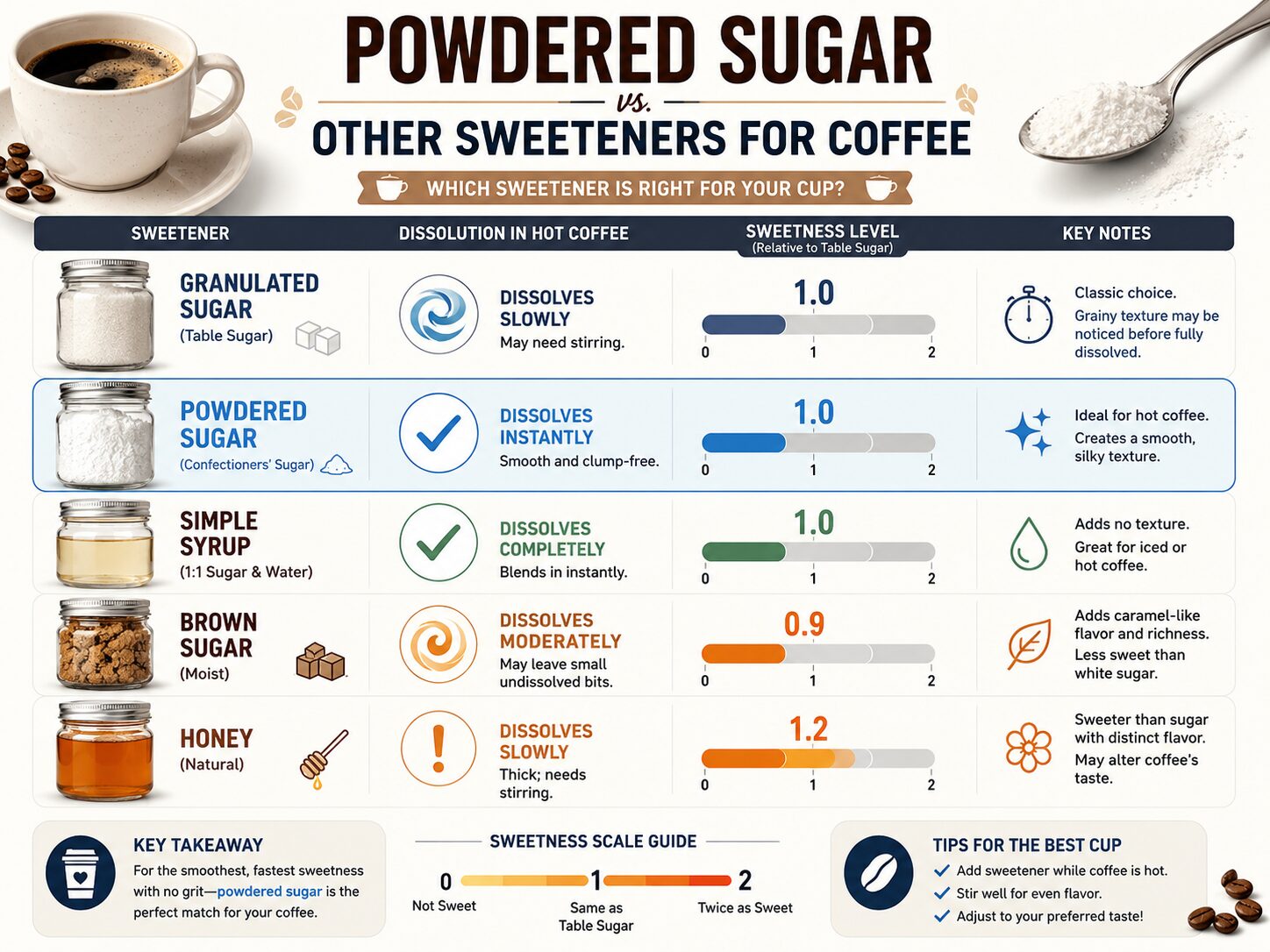 How does it stack up against the usual suspects? It’s not a direct swap.
| Sweetener | Sweetness (by volume) | Dissolution in Hot Coffee | Best For | Watch Out For |
|---|---|---|---|---|
| Granulated White Sugar | 1.0 (baseline) | Excellent with stirring | Any hot drink, simple syrup | Can sink to bottom if not stirred |
| Powdered Sugar | ~0.7 | Good with pre-mixing | Iced lattes, desserts, baking recipes | Lumping from cornstarch |
| Simple Syrup | ~0.8 | Instant | Cold drinks, cocktails, iced coffee | Dilutes the drink slightly |
| Brown sugar in coffee | ~0.9 | Good, but can leave molasses residue | Adding caramel-like depth to milk drinks | Can scorch if added to steaming pitcher |
| Honey | ~1.3 | Poor, sinks and separates | Tea, some wellness-focused drinks | Overwhelms delicate coffee flavors |
The volume-for-volume sweetness is the biggest practical difference. A teaspoon of powdered sugar weighs less and contains less actual sucrose than a teaspoon of granulated sugar. You need more to achieve the same perceived sweetness. This is crucial for baking, but in coffee, it just means an extra half-spoon.
Texture is the other differentiator. A drink sweetened with properly integrated powdered sugar will have a marginally thicker, silkier mouthfeel than one with granulated sugar. It’s subtle, but it’s there. This is why it pairs so well with the already creamy texture of an almond milk in coffee latte.
TL;DR: Powdered sugar is less sweet by volume than granulated and requires a pre-mix step. It adds a silky texture, especially in creamy drinks.
When Powdered Sugar Makes Sense (And When It Doesn’t)
 Your choice should depend on the drink, the equipment, and your tolerance for extra steps.
Reach for the powdered sugar when: * You’re making an iced latte or frappé. The cold temperature avoids lumping, and the slight thickening is a benefit. * You want to dust the top of a cappuccino or mocha for presentation. It melts into the foam beautifully. * You’re out of granulated sugar and simple syrup. The pre-mix method works in a pinch. * You enjoy the silky mouthfeel it imparts, similar to what a touch of coconut oil in coffee provides but without the oiliness.
Avoid powdered sugar when: * You’re using a French press. This is non-negotiable. * You’re in a hurry and just want to dump and stir. Granulated sugar or a pinch of salt is faster. * You’re drinking a very delicate, light-roast pour-over where any textural change might mask subtle floral or fruity notes. Stick with granulated. * You’re counting calories precisely. Because you need more by volume, the calorie content in coffee can creep up unexpectedly.
The first time I tried it in a French press, I learned the hard way. I was out of granulated sugar and figured the finer powder would dissolve faster. I added a spoonful to the grounds, poured in my water, and waited. When I went to plunge, the filter stuck after half an inch. I pushed harder, and a cloud of fine, sludgy grounds billowed up. The resulting cup was thick, gritty, and sweet in weird patches. I had to disassemble and deep-clean the press. Now I keep a small jar of simple syrup in the fridge for those moments.
TL;DR: Use powdered sugar for cold, creamy drinks and for presentation. Avoid it in French presses and delicate pour-overs.
Frequently Asked Questions
Does powdered sugar taste the same as regular sugar in coffee?
Yes and no. The sucrose itself tastes identical. However, because you typically need more powdered sugar by volume to achieve the same sweetness, and because the cornstarch can add a very slight starchy flavor if not fully dissolved, the overall profile can be marginally different. Most people won’t notice in a milky, flavored drink.
Will powdered sugar dissolve in iced coffee?
It will, but not instantly. You must pre-dissolve it in a small amount of hot water or hot coffee first to make a syrup. If you add the dry powder directly to cold liquid, the cornstarch will remain as a fine, chalky suspension that never fully integrates. It will sweeten the drink but leave a texture.
Can I make powdered sugar at home for coffee?
Absolutely. For a small batch, combine one cup of granulated sugar with one tablespoon of cornstarch in a high-speed blender. Blend on high for 60-90 seconds until the sugar is a fine powder. Let the dust settle before opening the lid. This homemade version will have the same clumping properties as store-bought, so the same pre-mix rule applies.
Is powdered sugar keto-friendly?
No. Powdered sugar is pure sugar with added cornstarch, both of which are carbohydrates. It has the same impact on blood sugar as granulated sugar. For a keto-friendly sweetener that dissolves well, look into powdered erythritol or allulose, which are often pre-mixed with a small amount of starch or fiber to prevent caking.
What’s the best way to store powdered sugar for coffee use?
In an airtight container in a cool, dry place. The cornstarch attracts moisture, which is the whole point. If it’s in a humid environment, it will form hard lumps even faster. If your sugar has hardened, you can break it up and sift it, but for coffee use, it’s often easier to just make a fresh small batch at home.
The Bottom Line
Powdered sugar can work in your coffee, but it demands respect for the cornstarch. The extra ten seconds to pre-mix it with a splash of hot liquid is the difference between a silky-sweet upgrade and a lumpy, gritty mistake. It finds its true home in iced, dairy-based drinks where it contributes to a luxurious texture.
For hot black coffee, granulated sugar or a drop of simple syrup is still the simpler, more reliable path. And if you’re exploring other ways to modify your cup’s profile, consider the brightening effect of cinnamon in coffee or the sustained energy from MCT oil in coffee. Sweetness is just one lever in a much bigger toolbox.
