
Adding Chia Seeds to Coffee: What You Need to Know First
Yes, you can put chia seeds in coffee, but you must pre-soak them first in a separate liquid like water or milk for at least 15 minutes. Adding dry chia seeds directly to hot coffee is ineffective for texture and carries a documented risk of esophageal obstruction, as the seeds can rapidly expand and form a gel block before reaching your stomach.
Most people think they can just sprinkle the seeds in and give it a stir. That’s how you end up with a cup that feels like you’re drinking tapioca that forgot to cook, or worse. The seeds don’t hydrate evenly in a hot, acidic environment. They clump. They sink. They form a sludge at the bottom that your spoon can stand up in.
This guide walks through the exact physics of chia gelation, the non-negotiable safety step, and how to actually make a chia coffee that’s drinkable instead of bizarre. We’ll also compare it to other popular additives so you know when to reach for the seeds and when to grab the MCT oil coffee recipes instead.
Key Takeaways
- Never add dry chia seeds to any liquid you plan to drink. A 2016 case study in the Journal of Emergency Medicine documented an esophageal obstruction requiring endoscopic removal after a man swallowed a tablespoon of dry seeds followed by water.
- Pre-soaking is mandatory, not a texture tip. Chia seeds absorb up to 27 times their weight in water, forming a mucilage gel. This process needs 15 minutes in a neutral liquid before meeting coffee.
- Hot coffee accelerates uneven gelation, causing immediate surface clumping. For the best texture, pre-soak in cool liquid and add the gel to slightly cooled coffee or cold brew.
- Chia seeds add fiber and omega-3s, but they change mouthfeel dramatically. If you want creaminess without gel, consider almond milk in coffee or coconut oil in coffee instead.
- The legal status of chia seeds as a novel food in the EU means approved products have undergone safety assessment, reinforcing that preparation method matters.
How Chia Seeds Transform in Liquid (The 27x Rule)
Forget the nutrition label for a second. The only thing that matters when adding chia to a beverage is their physical behavior. Dry chia seeds are tiny, hard, and hydrophobic. When they contact water, the outer layer of the seed, a polysaccharide-rich mucilage, swells rapidly.
A 2014 study in Food Hydrocolloids quantified this. The researchers found that chia seed mucilage can absorb up to 27 times its weight in water. That’s the number that defines your experience.
The gel-forming capacity of chia (Salvia hispanica L.) seed mucilage is a function of hydration time and water-to-seed ratio, with absorption capacities exceeding 25 times the seed’s dry weight under optimal conditions.
This isn’t a gentle thickening. It’s a phase change. The seeds become suspended in a viscous, transparent gel. In a controlled setting like a bowl of water, this creates a uniform pudding. In a cup of hot, acidic coffee, it creates chaos.
TL;DR: Chia seeds are mini hydrogel packets. They will pull water from their surroundings with extreme force, which is why you control the hydration environment separately.
The Critical Safety Rule: Why Pre-Soaking Isn’t Optional
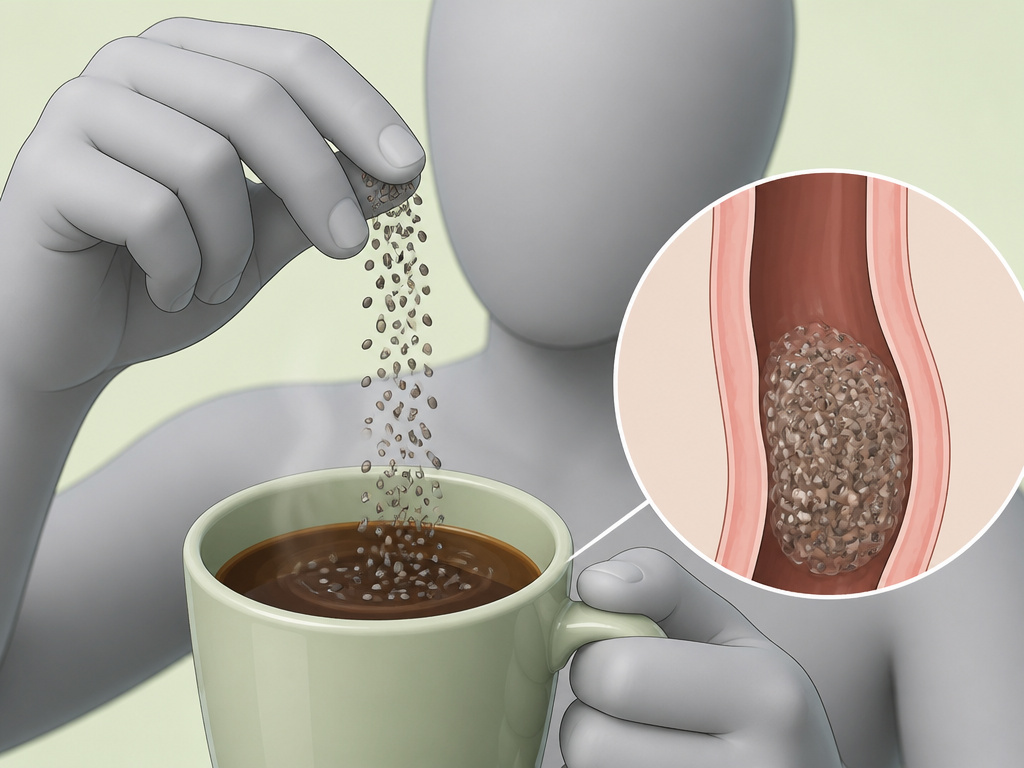
This is the section you read twice. Adding dry chia seeds to coffee and then drinking it is a documented physical hazard.
In 2016, the Journal of Emergency Medicine published a case report of a 39-year-old man who developed an acute esophageal obstruction. His meal? One tablespoon of dry chia seeds, followed immediately by a glass of water. The seeds hydrated rapidly in his esophagus, forming a cohesive gel bolus that he could not swallow or dislodge. It required endoscopic removal.
The mechanism is straightforward and terrifying. The esophagus is a moist tube. Dry seeds + moisture + time = gel. The gel expands and adheres. Your morning routine is not worth a trip to the ER.
Common mistake: Sprinkling dry chia seeds into coffee and drinking right away, the seeds can begin forming a gel plug in your esophagus within minutes, a risk confirmed by clinical case reports.
Therefore, the safety protocol is absolute:
1. Always pre-hydrate. Mix seeds with 3-4 parts cool water or milk.
2. Wait 15 minutes. Stir once halfway through to break up clumps.
3. Then, and only then, add the pre-formed gel to your beverage.
This rule applies to any liquid. It has nothing to do with coffee’ acidity or temperature. It’s a matter of basic physics and anatomical safety. If you want a fiber boost without this prep, consider a healthy sugar alternative that dissolves instantly.
Texture Showdown: Hot Coffee vs. Cold Brew
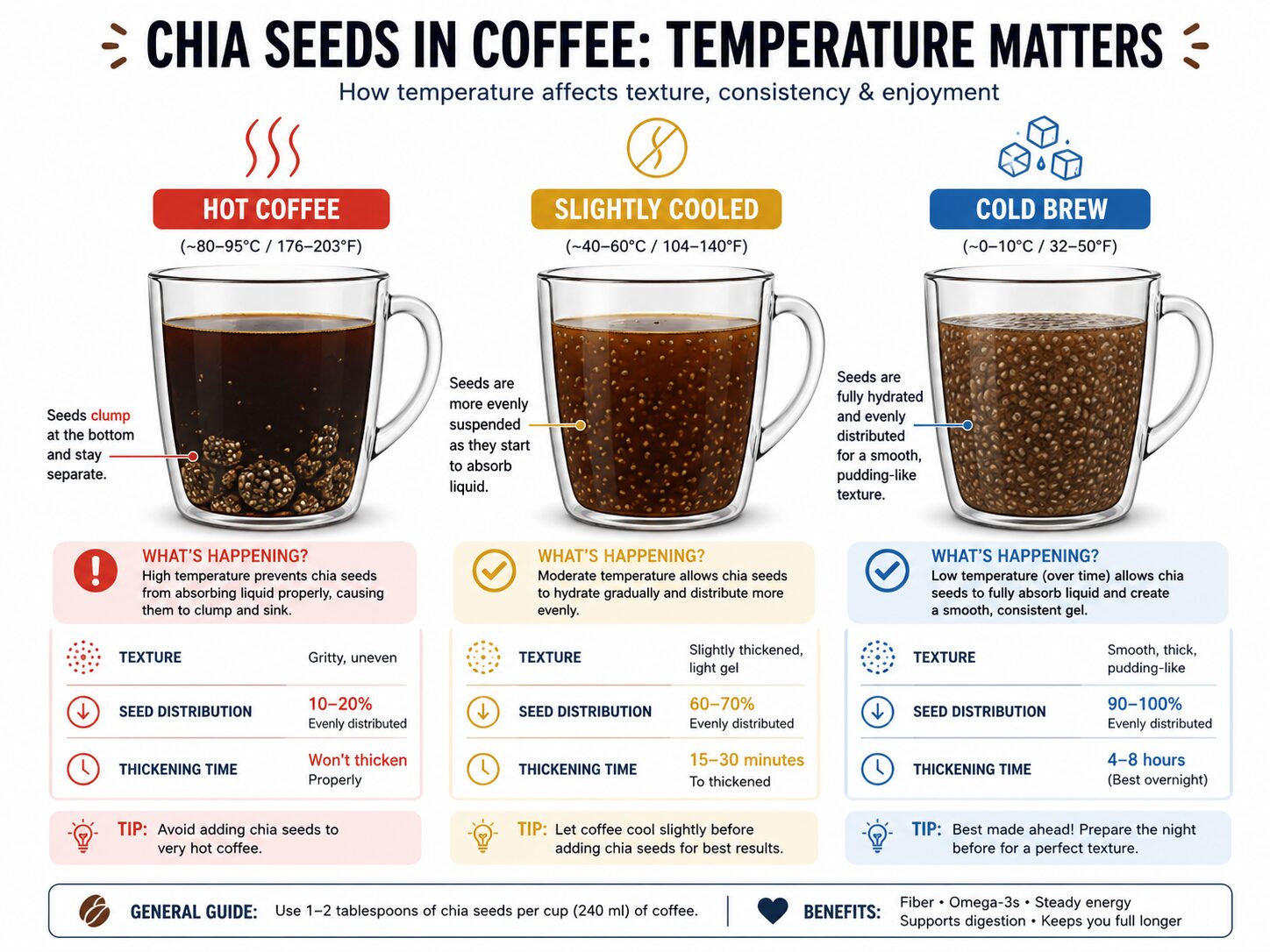
Once your seeds are safely pre-soaked, you still have a texture battle to fight. Coffee is not a neutral medium. Its heat and acidity interfere with the gel.
| Coffee Type | Effect on Chia Gel | Resulting Mouthfeel | Best For |
|---|---|---|---|
| Hot Coffee (Freshly Brewed) | Rapid, uneven hydration. Outer gel layer forms instantly, sealing dry centers. | Lumpy, gritty, with slippery gel blobs. Seeds sink fast. | Not recommended. |
| Hot Coffee (Slightly Cooled, 1-2 min) | Slower, more even integration. Gel disperses better. | Uniform viscosity, slight tapioca-like texture. | Those who must have hot chia coffee. |
| Cold Brew or Iced Coffee | Ideal. Cold liquid doesn’t shock the pre-soaked gel. | Smooth, consistent, pudding-like thickness. | The best possible chia coffee experience. |
Hot coffee wants to seize the gel. When you add your pre-soaked chia mixture to near-boiling water, the outer layer of the gel can actually tighten and contract, squeezing out moisture and creating those unpleasant rubbery blobs. It also makes the seeds sink to the bottom faster, giving you a stratified drink.
The fix is simple. Let your hot coffee rest for a minute off the boil. That small temperature drop makes a dramatic difference in integration. For the truly texture-averse, cold brew is the undisputed champion. The cold environment welcomes the gel, resulting in a smooth, uniformly thick beverage. It’s the difference between a science experiment and a treat.
If you’re exploring texture changes in your coffee, you might also be curious about how a pinch of salt trick can cut bitterness without altering body.
The Nutritional Exchange: What You Gain and What You Lose
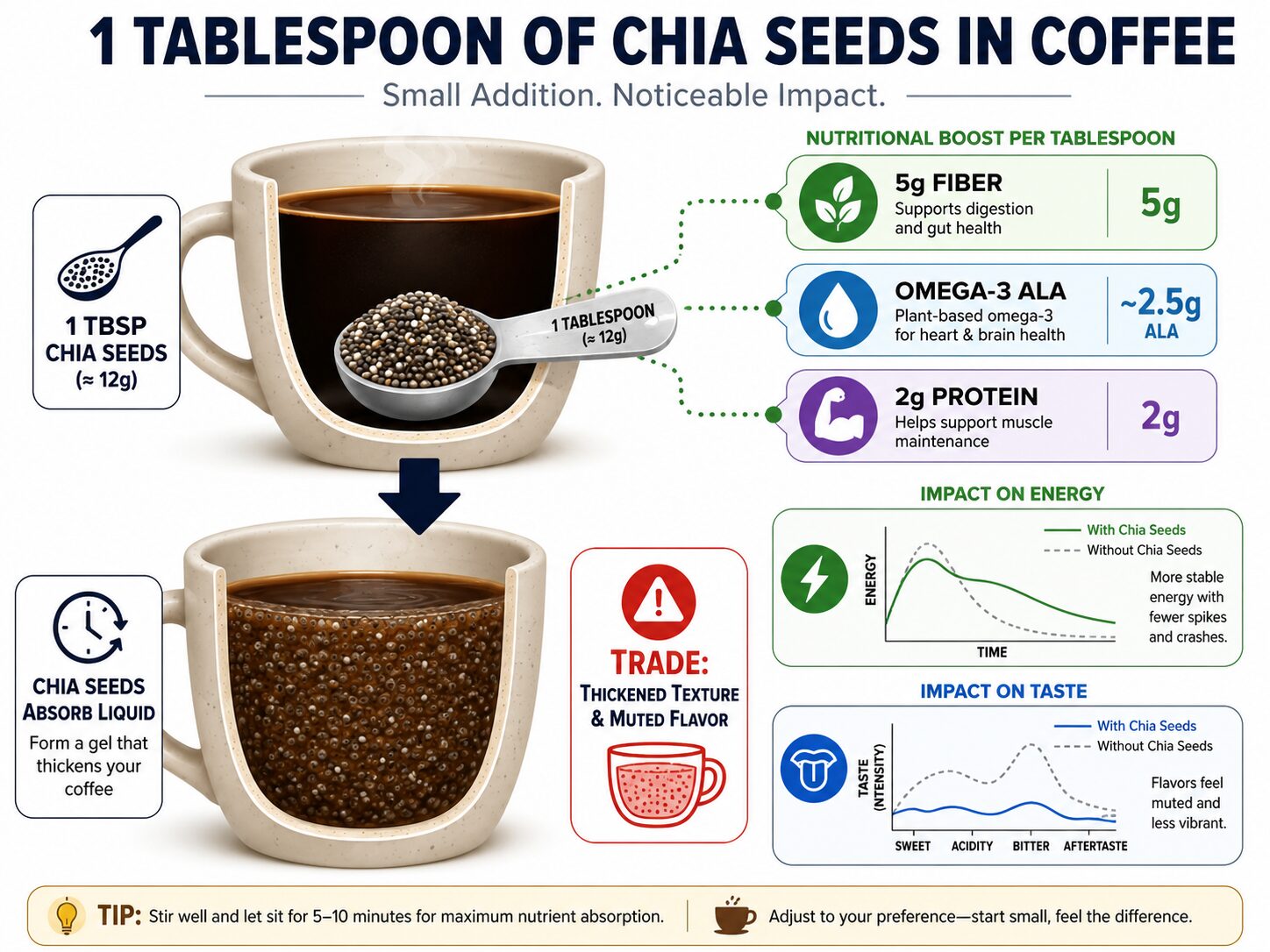
People add chia seeds for their nutritional halo. Let’s be specific about what you’re actually getting in your cup, and what you’re trading away.
A standard one-tablespoon serving mixed into your coffee adds:
* Fiber: About 5 grams, mostly soluble fiber from the mucilage.
* Omega-3 Fatty Acids: Alpha-linolenic acid (ALA), a plant-based omega-3.
* Protein: A minor amount, roughly 2 grams.
* Micronutrients: Small amounts of calcium, magnesium, and phosphorus.
The fiber is the headline. It can promote a feeling of fullness and slow the absorption of caffeine and sugars, which might smooth out your energy curve. This is a different strategy than using coconut oil in coffee for sustained energy from fats.
But there’s a trade. That soluble fiber is the gel. You are adding thickness and a distinct mouthfeel that many find odd in a hot drink. You are also subtly altering the flavor profile. Chia gel is very neutral, but it can mute the brighter, acidic notes of a light roast coffee, making it taste flatter.
I tried the “chia coffee” trend for two weeks as a fiber boost. The cold brew version was palatable, if odd. The hot version, even with pre-soaking, made my morning Ethiopian pour-over taste muddy. I lost the floral notes I paid for. Now I take my chia gel separately with lemon water and keep my coffee for antioxidant-rich coffee boosters like cinnamon that don’t change its fundamental character.
It’s a functional addition, not a flavor one. If your primary goal is managing coffee and digestion issues, the fiber can help. But if you’re chasing flavor, you’re better off with additives that complement, not cloak.
Chia Seeds vs. Other Popular Coffee Additives
Chia seeds occupy a weird niche. They’re not a sweetener, not a creamer, and not a flavoring. They’re a texture-and-fiber mod. This table shows where they fit, and don’t fit, compared to common additions.
| Additive | Primary Purpose | Texture Change | Best Paired With Chia? |
|---|---|---|---|
| MCT Oil / Coconut Oil | Sustained energy, ketosis support. | Adds richness, slight oiliness. | No. Creates a greasy, separated texture with chia gel. |
| Milk / Cream | Creaminess, reduce bitterness. | Smooth, adds body. | Yes. Use milk to pre-soak the seeds for a creamier gel. |
| Cinnamon / Cocoa | Flavor enhancement, antioxidants. | None (powder). | Yes. Adds flavor to the neutral chia gel. |
| Sugar / Syrup | Sweetness. | Dissolves, adds viscosity. | Yes. Sweetens the gel base effectively. |
| Protein Powder | Macronutrient boost. | Can make coffee chalky or clumpy. | Absolutely not. Combined with chia gel, it creates a cement-like sludge. |
The takeaway is one of exclusivity. Chia seeds don’t play well with other texture-modifying additives, especially oils or powders. Their gel network gets disrupted by fats and overwhelmed by dry particulates.
If you’re building a functional coffee, choose one lane:
* Energy/Fat Lane: Use MCT oil coffee recipes or coconut oil in coffee.
* Fiber/Fullness Lane: Use pre-soaked chia seeds.
* Flavor Lane: Use adding cinnamon to coffee or a brown sugar sweetener.
Mixing lanes leads to a failed experiment sitting in your sink. For more on balancing your brew, see our guide on calorie content of milk for weight-conscious choices.
Legal and Regulatory Context: Chia as a Novel Food
This might seem academic, but it underscores the seriousness of preparation. In the European Union, chia seeds were considered a “novel food” prior to 2009. This designation is for foods with no significant history of consumption in the EU before May 1997.
Their authorization for sale came with specific conditions about labeling and preparation advice, precisely because of their unique properties. The EU novel food authorization list includes such rulings, framing chia seeds as a food that requires consumer awareness. Regulatory bodies don’t do that for inert ingredients. They do it for ingredients that behave in potent, physical ways, like seeds that expand 27-fold.
This external validation matters. It tells you that the “pre-soak” advice isn’t a blogger’s whim; it’s a recognized, safety-informed best practice that follows from the seed’s fundamental material science. When you follow that step, you’re aligning with a consumption method that has passed formal safety assessments.
Frequently Asked Questions
Can I just stir chia seeds into my coffee really well?
No. Stirring cannot overcome the physics of gelation. The seeds will hydrate from the outside in, creating a clumpy layer around each seed that prevents the center from getting wet. You’ll get gritty seeds in slime, not a smooth gel.
Do chia seeds dissolve in coffee?
Chia seeds do not dissolve. They undergo hydration and gelation, meaning they swell and become suspended in a thick mucilage. The seed itself remains intact, just surrounded by gel.
Will chia seeds in coffee help me lose weight?
Chia seeds add fiber, which can promote satiety and help you feel full. This may reduce overall calorie intake if it leads you to snack less. However, adding them to coffee is not a magic weight-loss solution. The effect is minor and indirect compared to overall diet.
Can I make a big batch of chia coffee for the week?
You can pre-soak a larger batch of chia seeds and store the gel in the fridge for up to 5 days. However, add the gel to your fresh coffee daily. Pre-mixing coffee and chia gel and letting it sit for days will result in extreme separation, continued seed expansion, and off-flavors.
What’s the best way to hide the texture of chia in coffee?
You can’t hide it, but you can optimize it. Use a powerful blender to combine your pre-soaked chia gel, cold brew, and other ingredients like banana or cocoa powder into a smoothie-like consistency. For hot coffee, a high-speed immersion blender can help, but some texture remains.
Before You Go
Chia seeds in coffee is a technically possible but contextually tricky addition. The mandatory pre-soak is a safety step backed by medical literature, not just a texture hack. The resulting gel fundamentally changes your drink’s mouthfeel, favoring cold brew over hot.
Treat it as a functional, fiber-boosting modifier for when you want that specific benefit. If you’re after flavor, energy, or simple creaminess, other additives like natural coffee flavor enhancers or plant-based milk frothing are more straightforward. Understand the 27x absorption rule, respect the safety protocol, and you can experiment without surprise. Just know that your coffee will never be just coffee again.
{
“@context”: “https://schema.org”,
“@type”: “HowTo”,
“name”: “How to Safely Add Chia Seeds to Coffee”,
“totalTime”: “PT10M”,
“supply”: [
{
“@type”: “HowToSupply”,
“name”: “1 tablespoon of chia seeds”
},
{
“@type”: “HowToSupply”,
“name”: “1/4 cup of water or milk (for pre-soaking)”
}
],
“tool”: [
{
“@type”: “HowToTool”,
“name”: “Small bowl or jar”
},
{
“@type”: “HowToTool”,
“name”: “Spoon for stirring”
}
],
“step”: [
{
“@type”: “HowToStep”,
“name”: “Pre-soak the chia seeds”,
“text”: “Combine one tablespoon of chia seeds with a quarter cup of cool water or milk in a small bowl. Let it sit for 15 minutes, stirring once halfway through, until a thick gel forms.”
},
{
“@type”: “HowToStep”,
“name”: “Prepare your coffee”,
“text”: “Brew your coffee as usual. For best texture compatibility, let hot coffee cool slightly for a minute, or use cold brew.”
},
{
“@type”: “HowToStep”,
“name”: “Combine and stir”,
“text”: “Scoop the pre-soaked chia gel into your coffee mug. Stir vigorously for at least 30 seconds to fully incorporate the gel and prevent clumping.”
},
{
“@type”: “HowToStep”,
“name”: “Add final flavorings”,
“text”: “After the chia is fully mixed, add any milk, sweetener, or flavorings like cinnamon. Stir once more and drink immediately for the best texture.”
}
]
}
{
“@context”: “https://schema.org”,
“@type”: “FAQPage”,
“mainEntity”: [
{
“@type”: “Question”,
“name”: “Can I just stir chia seeds into my coffee really well?”,
“acceptedAnswer”: {
“@type”: “Answer”,
“text”: “No. Stirring cannot overcome the physics of gelation. The seeds will hydrate from the outside in, creating a clumpy layer around each seed that prevents the center from getting wet. You’ll get gritty seeds in slime, not a smooth gel.”
}
},
{
“@type”: “Question”,
“name”: “Do chia seeds dissolve in coffee?”,
“acceptedAnswer”: {
“@type”: “Answer”,
“text”: “Chia seeds do not dissolve. They undergo hydration and gelation, meaning they swell and become suspended in a thick mucilage. The seed itself remains intact, just surrounded by gel.”
}
},
{
“@type”: “Question”,
“name”: “Will chia seeds in coffee help me lose weight?”,
“acceptedAnswer”: {
“@type”: “Answer”,
“text”: “Chia seeds add fiber, which can promote satiety and help you feel full. This may reduce overall calorie intake if it leads you to snack less. However, adding them to coffee is not a magic weight-loss solution. The effect is minor and indirect compared to overall diet.”
}
},
{
“@type”: “Question”,
“name”: “Can I make a big batch of chia coffee for the week?”,
“acceptedAnswer”: {
“@type”: “Answer”,
“text”: “You can pre-soak a larger batch of chia seeds and store the gel in the fridge for up to 5 days. However, add the gel to your fresh coffee daily. Pre-mixing coffee and chia gel and letting it sit for days will result in extreme separation, continued seed expansion, and off-flavors.”
}
},
{
“@type”: “Question”,
“name”: “What’s the best way to hide the texture of chia in coffee?”,
“acceptedAnswer”: {
“@type”: “Answer”,
“text”: “You can’t hide it, but you can optimize it. Use a powerful blender to combine your pre-soaked chia gel, cold brew, and other ingredients like banana or cocoa powder into a smoothie-like consistency. For hot coffee, a high-speed immersion blender can help, but some texture remains.”
}
}
]
}
