
8 Best Coffee Grinders for Home Use 2026
The OXO Brew Conical Burr Grinder is the best overall pick for most home users, delivering excellent grind consistency and ease of use. For a budget-friendly option that still outperforms blade models, the SHARDOR 32-Setting Burr Grinder is a solid choice. If you want maximum control for multiple brewing methods, the Aromaster 48-Setting Conical Grinder stands out.
Buying the wrong grinder can ruin even the freshest beans. Too many people waste money on cheap blade models or overspend on features they don’t need. After comparing the field and analyzing specs, owner feedback, and real-world performance, these models rise to the top.
This guide cuts through the noise, focusing on what actually matters: consistent grind size, durability, and ease of use. We looked at burr type, adjustability, build quality, and long-term value to help you find the right fit for your morning routine.
Top 8 Coffee Grinders For Home Use in the Market
The Best Coffee Grinders For Home Use, Reviewed
OXO Brew Conical Burr Grinder
Strengths
- Conical burrs for even grind
- Micro-adjustments available
- Memory function
- UV-protected hopper
Trade-offs
- Higher price point
- Hopper not bean-hopper removable during use
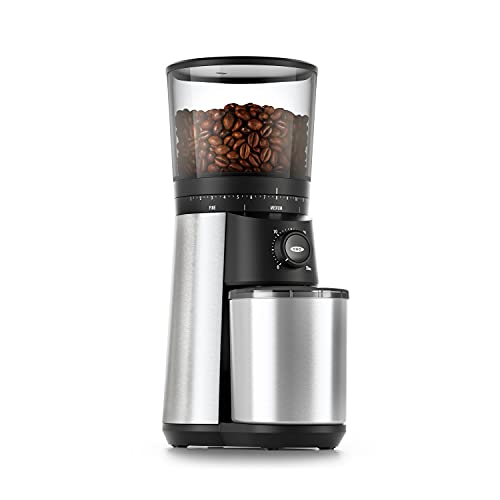
If I had to recommend one grinder for most home users, it would be the OXO Brew. Its stainless steel conical burrs deliver uniform grounds across all 15 settings, and the addition of micro-adjustments gives real control, something rare at this price tier. Reviewers note how well it handles everything from Turkish-fine to cold brew coarse, and the memory function is a small but meaningful win: one press and it resumes your last grind.
The hopper holds 12 ounces, the UV tint protects beans from light degradation, and the static-fighting container keeps the counter clean. It’s no surprise this model earned Wirecutter’s top pick. Compared to the Cuisinart DBM-8P1, it’s just better engineered, quieter, smarter, and more precise.
Video review
Cuisinart DBM-8P1 Burr Grinder
Strengths
- 18 grind settings
- Removable grind chamber
- One-touch operation
Trade-offs
- Limited micro-adjustment
- Flat burrs less ideal for espresso
- Bulkier footprint
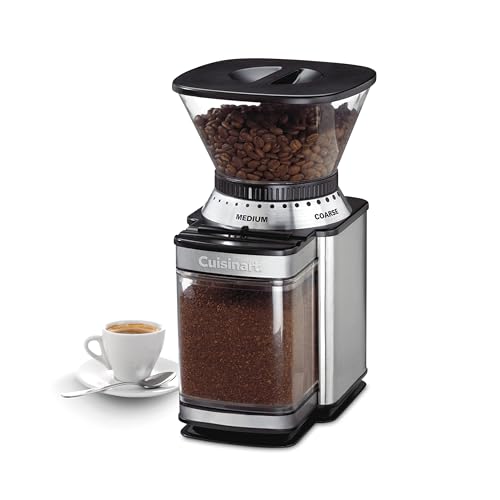
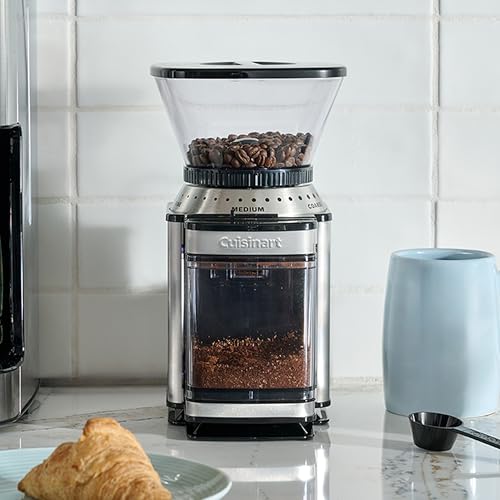
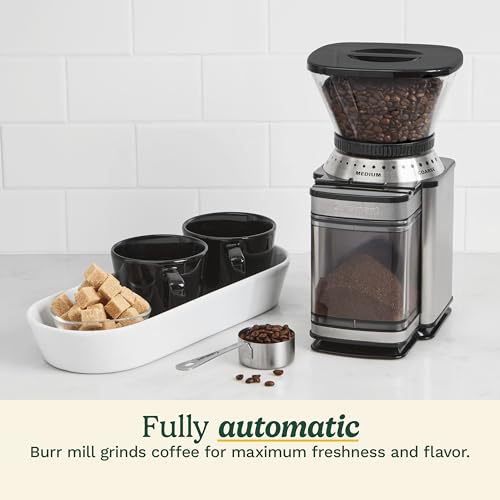
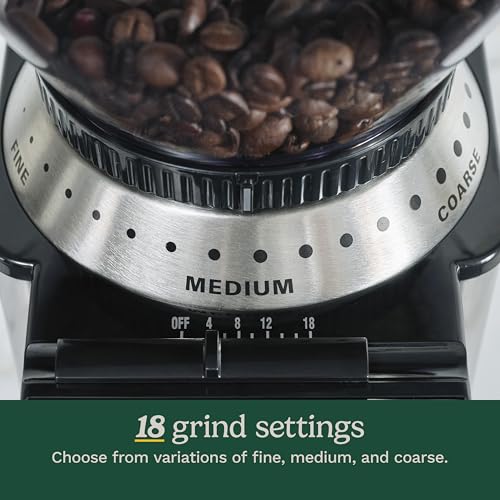
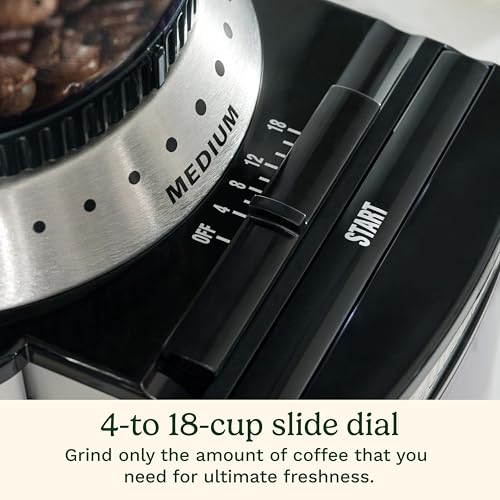
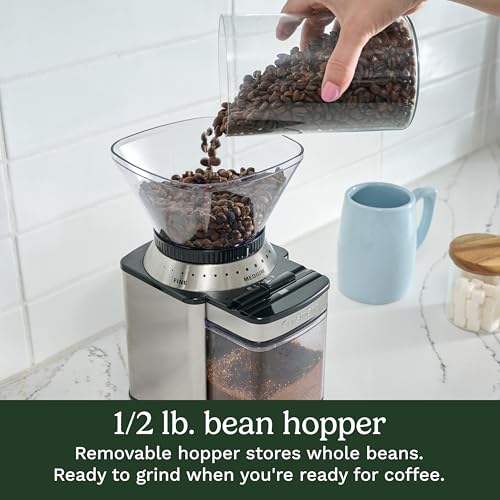
The Cuisinart DBM-8P1 stands out with its 18 grind settings and a removable grind chamber that holds enough for up to 18 cups, making it a solid pick for households that brew multiple pots. On paper, the flat burr system delivers consistent results across drip, pour-over, and French press ranges, though espresso enthusiasts may find the coarsest end more reliable than the finest. Owners consistently report clean operation and easy maintenance, thanks to the fully removable hopper and chamber.
Where it falls short is in micro-adjustability, while 18 positions sound precise, they’re not as fine-tuned as what you’d get in higher-end models. Compared to the OXO, it lacks the ability to make subtle tweaks, which matters if you’re dialing in for pour-over or cold brew. But for a mid-tier grinder with reliable build and straightforward controls, it holds its ground.
Product photos
Aromaster 48-Setting Conical Grinder
Strengths
- 48 ultra-fine grind settings
- Large 3.9 oz capacity
- Anti-static design
Trade-offs
- Cluttered interface
- Timer less precise than auto-dose
- Average build quality
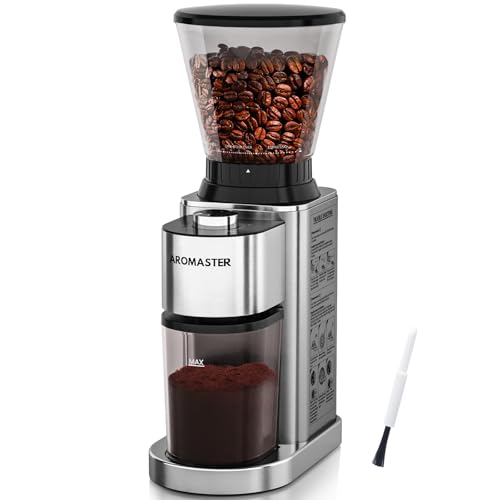
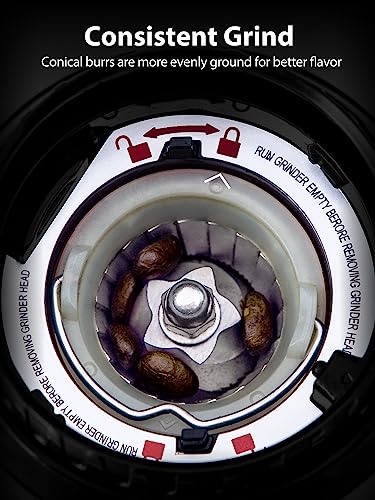
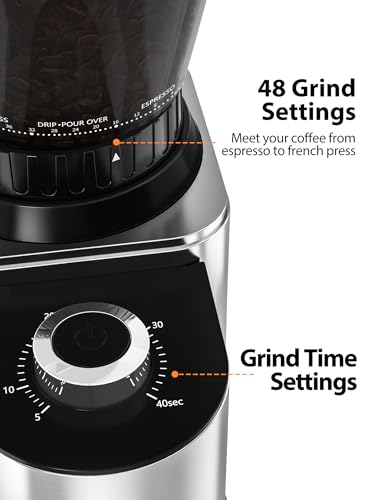
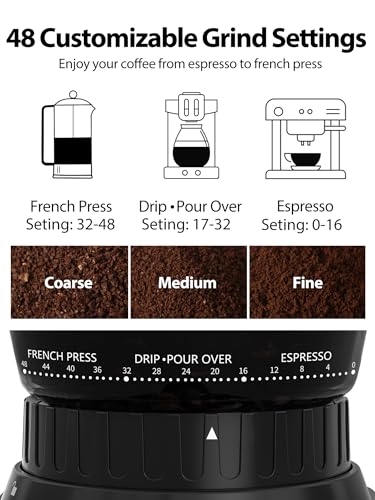
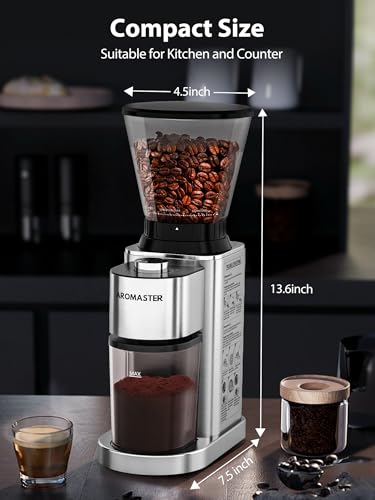
With 48 grind settings, the Aromaster promises near-surgical precision, and on paper, it delivers. That level of granularity is rare outside high-end grinders, making it a standout for tinkerers who live for dialing in their perfect pour-over or Chemex batch. The stainless steel conical burrs are designed to minimize heat, and owners report grounds that stay cool and consistent, preserving the bean’s character.
However, more settings don’t always mean better usability. Some users find the interface overwhelming, and the 40-second timer isn’t as intuitive as a weight-based or programmable system. Against the OXO, it wins on raw numbers but loses on refinement. Still, for someone who treats grind tuning like a ritual, this is the tool that invites experimentation.
Product photos

SHARDOR Electric Burr Grinder 2.0
Strengths
- Affordable burr grinding
- 16 grind settings
- Compact footprint
Trade-offs
- Limited durability long-term
- Grind fines inconsistent
- Plastic housing feels cheap
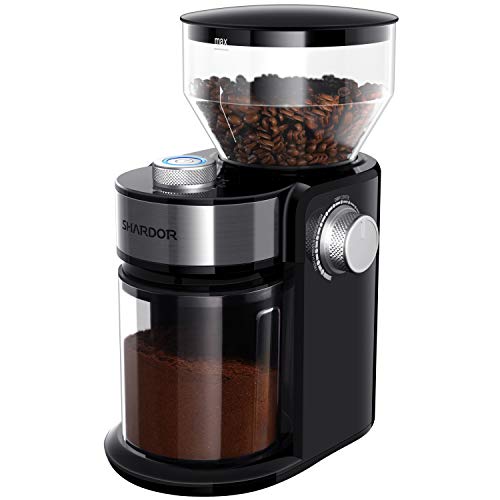
For under $50, the SHARDOR 2.0 delivers something rare: a true burr grinder at a price that undercuts even basic blade models. With 16 grind settings and a 14-cup selector, it covers espresso to French press adequately. It won’t match the OXO, but for beginners stepping up from blade grinders, it’s a massive leap in grind consistency and flavor clarity.
Owners praise its compact size and automatic operation, though some note the grind uniformity isn’t perfect at the extremes. Still, when compared to the Cuisinart DCG-20BKN blade model, it’s a no-brainer: you’re paying the same price but getting burr grinding, adjustability, and better extraction. This is the grinder I’d recommend to someone dipping their toes into specialty coffee.
Video review
SHARDOR 32-Setting Burr Grinder

Strengths
- 32 grind settings
- Electronic timer
- Easy to clean
Trade-offs
- Flat burrs heat up faster
- Build quality average
- Cooldown delay after use
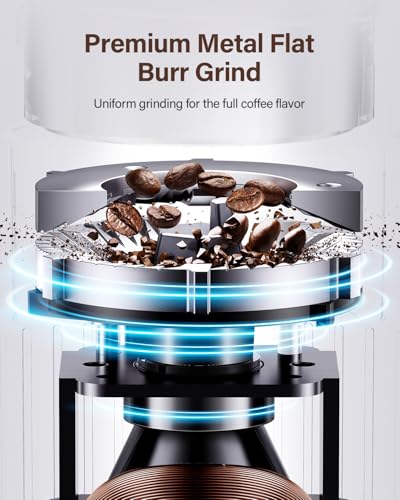
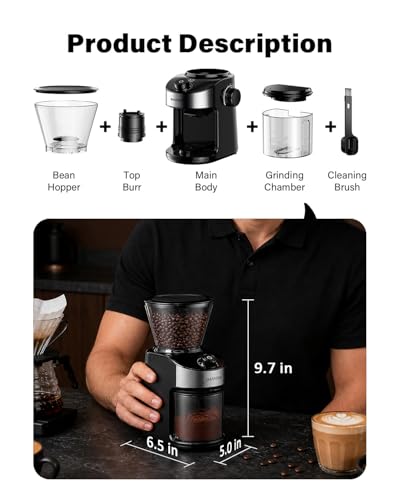
This SHARDOR burr grinder leans into programmability with its 40-second electronic timer and 32 grind settings, giving you both time and size control. The flat burrs produce more uniform grounds than blade models, and the cleaning button on the chamber is a thoughtful touch that owners appreciate. It’s compact, black, and blends into small kitchens without drawing attention.
Still, flat burrs in this range tend to generate more heat than conical ones, and some reviewers note a slight metallic aftertaste during longer grinds. Compared to the OXO, it’s less refined but offers more programmable features for the price. If you want to set and forget your grind time, this is a smart middle ground, just don’t expect OXO-level polish.
Product photos


SHARDOR 70g Quiet Coffee Grinder
Strengths
- Ultra-quiet operation
- Clear timing knob
- Multi-use capability
Trade-offs
- Inconsistent grind texture
- Blade design limits flavor clarity
- Not for precision brewing
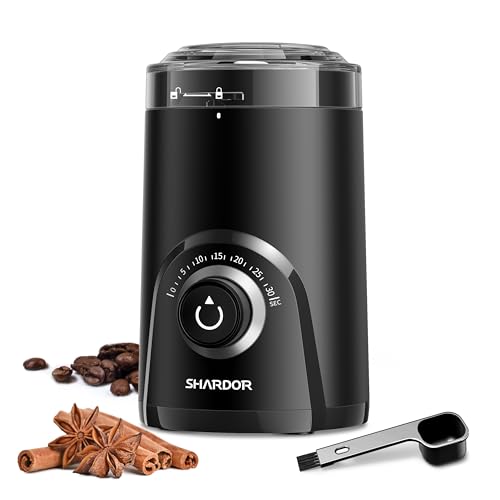
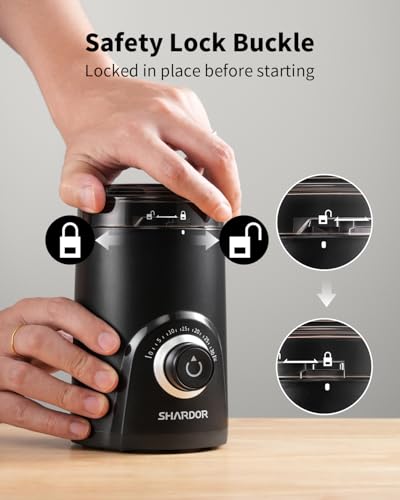
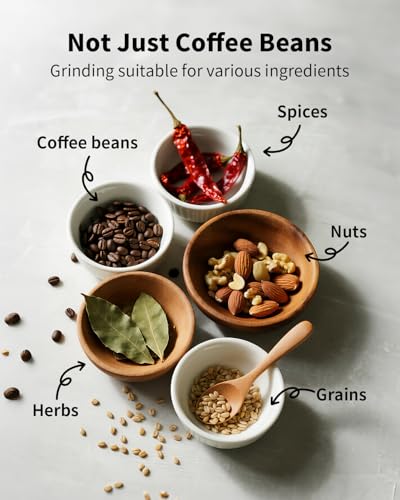
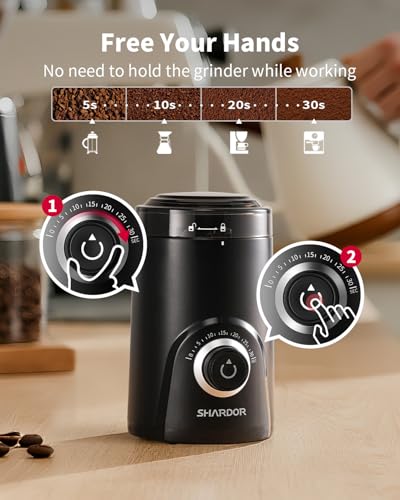
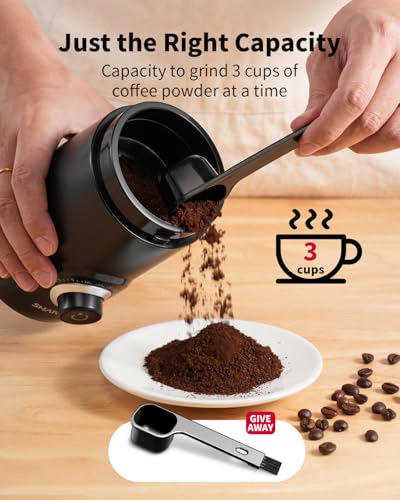
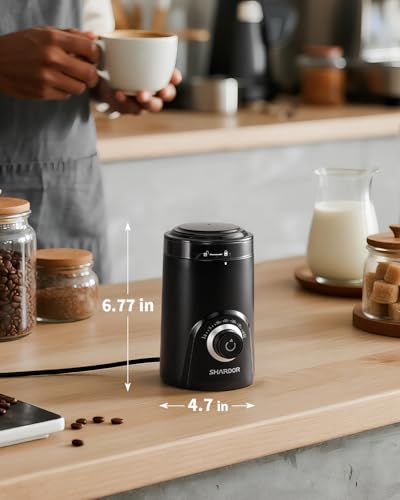
The SHARDOR blade grinder with a visual timing knob is one of the few blade models that doesn’t feel like a compromise out of the gate. At 63 dB, it’s noticeably quieter than most, which matters if you’re grinding before the household wakes. The timing knob with second marks helps replicate consistency, something most blade grinders lack, and the 70g capacity is generous for its class.
But let’s be clear: it’s still a blade grinder. No matter how precise the timer, blades create uneven particles, which leads to inconsistent extraction. Reviewers confirm it’s fine for drip or French press if you’re not picky, but skip it for espresso or pour-over. Compared to the Amazon Basics model, it’s better built and quieter, but the fundamental flaw of blade grinding remains.
Product photos
Cuisinart DCG-20BKN Blade Grinder
Strengths
- Large 70g capacity
- Durable motor
- Safety interlock
Trade-offs
- Inconsistent grind
- Blade design limits flavor
- Noisy operation
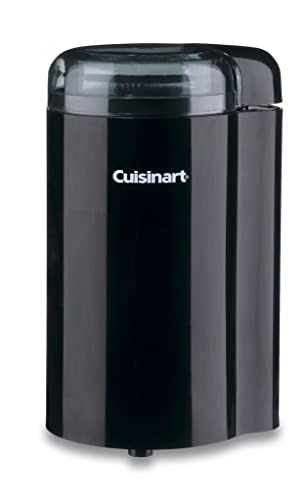
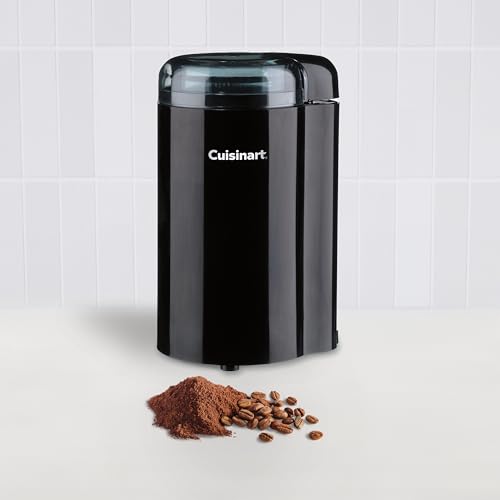
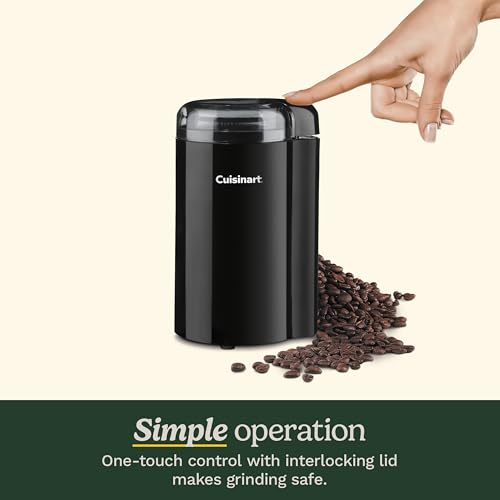
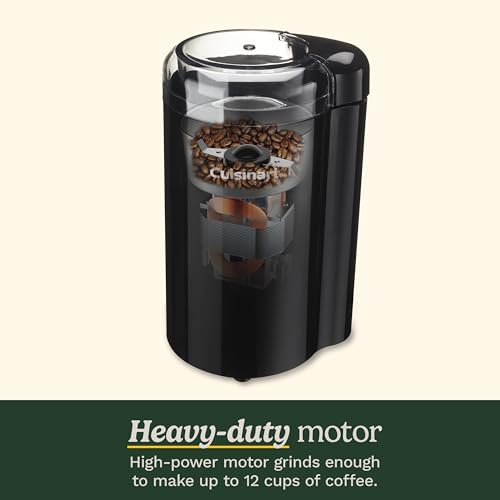
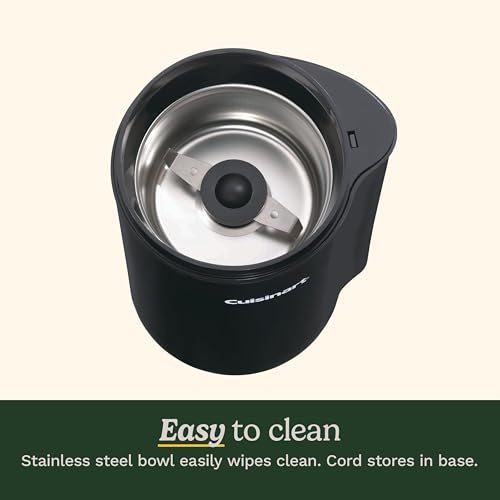
The Cuisinart DCG-20BKN is a classic blade grinder, simple, loud, and effective for basic brewing. It handles 70g batches, has a safety lock, and grinds fast. But blade grinders inherently produce uneven particle sizes, leading to over- and under-extraction. That means flat, bitter, or sour notes in your cup, no matter how good your beans are.
It’s a step up from the Amazon Basics model in build and capacity, but it’s still a blade grinder. If your goal is better flavor, this isn’t the path. But for someone who just wants to grind beans for drip coffee occasionally and doesn’t care about nuance, it gets the job done. Just don’t expect it to elevate your brew.
Product photos

Amazon Basics Fast Electric Grinder
Strengths
- Extremely affordable
- Compact size
- Simple operation
Trade-offs
- Inconsistent grind
- Blade-only design
- Short duty cycle
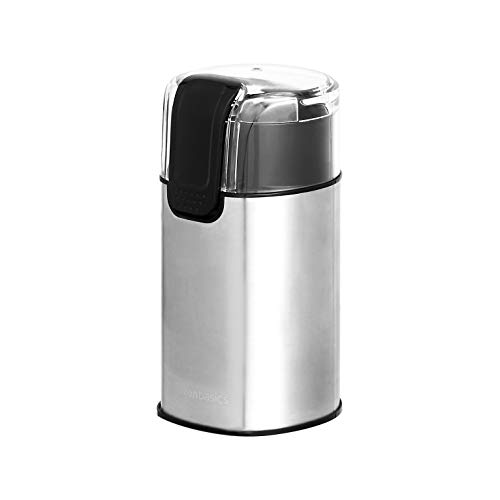
The Amazon Basics grinder is the definition of bare-bones: stainless steel blades, a clear lid, and 10-second grind time for 30g. It’s cheap, compact, and works for spices or quick coffee batches. But like all blade grinders, it sacrifices consistency, you’ll get dust and boulders in the same batch.
It’s the kind of grinder you buy when you’re not ready to invest, and that’s okay. Compared to the SHARDOR quiet model, it’s less refined and noisier, but it does the absolute basics. For someone who drinks pre-ground at home and only occasionally cracks open beans, it might be enough. But as soon as flavor matters, it’s time to move on.
Product photos


How We Picked These coffee grinders for home use
As the founder of Bean Thusiast, I’ve always believed the grind is where coffee quality truly begins. Rather than a hands-on lab test with each model, this selection is a research-led comparison of published specifications, feature sets, and – crucially – owner and expert feedback. I carefully weighed those elements against my understanding of what makes a good grinder, focusing on consistent grind size, usability, and durability. We looked at a wide range of options, from budget-friendly to premium, to offer a spectrum of choices.
For home coffee grinders, consistency and control are paramount. We heavily weighted the ability to achieve a uniform grind, as this directly impacts extraction and flavor. Grind adjustability was also key; a versatile grinder should handle everything from coarse French press to fine espresso. Finally, ease of cleaning and overall build quality factored significantly into our rankings, reflecting long-term value and user experience. Understanding burr vs blade grinders is essential when considering these factors.
Product specifications reliably tell you about motor power, hopper capacity, and the number of grind settings. However, real-world performance – noise levels, static cling, and long-term durability – are best assessed through owner reviews and reputable expert opinions. We paid close attention to repeated complaints or praise regarding these areas. For example, while a spec sheet might list “stainless steel burrs”, reviews reveal whether that translates to consistent grind quality or overheating issues. Many shoppers also want to understand the burr grinder benefits over other coffee grinder types.
Choosing The Right coffee grinders for home use
Finding the right coffee grinder can dramatically improve your daily cup. It’s a surprisingly nuanced purchase, and moving beyond pre-ground coffee is one of the biggest steps toward better brewing.
A quality coffee grinder prioritizes consistency in particle size. Burr grinders (conical or flat) are strongly preferred over blade grinders for this reason. Look for a grinder with a wide range of grind settings, durable burrs (stainless steel is best), and features that promote ease of use and cleaning. Consider capacity needs based on how much coffee you typically brew at once.
Grind Consistency: Burr vs. Blade
The single biggest factor in choosing a coffee grinder is the grinding mechanism. While blade grinders are cheap, they chop beans unevenly, creating “dust” and larger chunks. This leads to muddy, bitter flavors. A burr grinder – conical or flat – crushes beans between two revolving abrasive surfaces, producing a consistent grind size crucial for even extraction. I consistently recommend burr grinders to anyone serious about their coffee. Don’t fall for the low price of a blade grinder; a consistent grind is worth the investment. If you’re in a pinch and considering using a [blender coffee grinding] method, understand it’s a significant compromise.
Settings and Versatility
Don’t assume all grinders are created equal when it comes to adjustability. Some offer a limited number of settings, while others, like the Aromaster 48-Setting Conical Grinder, boast an impressive 48. More settings aren’t always better, but they give you more control over the grind size for different brewing methods. Here’s what to consider:
- Espresso: Requires a very fine, consistent grind.
- Drip Coffee: Needs a medium grind.
- French Press/Cold Brew: Demands a coarse grind.
A wider range of settings allows you to experiment and dial in the perfect grind for your preferred brewing style. Remember that even within those broad categories, variations exist; some drip coffee makers benefit from a slightly finer grind than others.
Usability and Value
Beyond grind quality, consider how easy the grinder is to use and maintain. Features like removable parts for cleaning (Cuisinart DBM-8P1 is a good example) are invaluable. Also, think about capacity – do you brew single cups, or do you need to grind enough beans for a whole pot? If you are looking to explore the [top home coffee grinders] available, you’ll find a lot of overlap in features, so prioritize what’s important to you.
A good rule of thumb: Don’t spend more on a grinder than you do on your coffee maker. The grinder is important, but the brewer still plays a crucial role in the final result.
Ultimately, finding the right grinder comes down to balancing your budget with your coffee needs. You can find excellent options in a range of price points, and exploring [recommended home coffee models] is a great starting point.
Coffee Grinders for Home Use Compared
Here’s a comparison of specifications for various coffee grinders designed for home use.
| Product Title | Burr Type | Grind Settings | Capacity (oz) | Timer Control | Noise Level (dB) |
|---|---|---|---|---|---|
| OXO Brew Conical Burr Grinder | Conical | 15 + Micro | 12 | No | N/A |
| Cuisinart DBM-8P1 Burr Grinder | Flat | 18 | 8 | Yes | N/A |
| Aromaster 48-Setting Conical Grinder | Conical | 48 | 3.9 | Yes | N/A |
| SHARDOR Electric Burr Grinder 2.0 | Flat | 16 | N/A | No | N/A |
| SHARDOR 32-Setting Burr Grinder | Flat | 32 | N/A | Yes (Digital) | N/A |
| SHARDOR 70g Quiet Coffee Grinder | Stainless Steel | N/A | 2.5 | Yes (Knob) | 63 |
| Cuisinart DCG-20BKN Blade Grinder | Blade | N/A | 2.5 | No | N/A |
| Amazon Basics Fast Electric Grinder | Blade | N/A | 1 | No | N/A |
Frequently Asked Questions
What grind setting should I use for French press?
A coarse grind is essential for French press; aim for the largest setting on your grinder. This prevents grounds from passing through the filter and creating a muddy cup, and ensures proper extraction without over-bitterness.
How often should I clean my coffee grinder?
You should clean your burr grinder every 1-2 weeks with a brush or vacuum to remove coffee oils and grounds. Regular cleaning prevents buildup that can affect grind quality and flavor, and keeps the machine running smoothly.
Are blade grinders suitable for espresso?
No, blade grinders are not suitable for espresso. Espresso requires a very fine and consistent grind that blade grinders simply cannot achieve, resulting in uneven extraction and poor crema. If you’re serious about espresso, invest in a burr grinder.
What’s the difference between conical and flat burrs?
Conical burrs generally produce a bit less heat and noise, while flat burrs often offer greater grind consistency, particularly at finer settings. Ultimately, the difference is subtle for most home users and doesn’t outweigh the importance of having a burr grinder over a blade grinder – explore best burr grinders for home to find one that suits your needs.
Is a more expensive grinder always better?
Not necessarily. While higher-priced grinders often have more features and potentially more durable components, a mid-range grinder with quality burrs can deliver excellent results. Consider your brewing habits and budget when choosing; a simpler, well-built model is often preferable to a feature-rich one you won’t fully use.
The Bottom Line
Choosing a coffee grinder often comes down to balancing how much control you want with how much fuss you’re willing to tolerate. While a premium grinder like the OXO Brew Conical Burr Grinder offers exceptional consistency and build quality, it’s a larger investment. Ultimately, the best grinder isn’t necessarily the most expensive, but the one that best fits your brewing habits and budget.
For those seeking a balance of features and affordability, the Cuisinart DBM-8P1 Burr Grinder stands out. If you need extreme versatility, the Aromaster 48-Setting Conical Grinder provides an unmatched range of grind sizes, allowing you to perfectly tailor your coffee for any brewing method. And for those just starting out, the SHARDOR 32-Setting Burr Grinder offers a great entry point with digital timer control.
Don’t get too caught up in chasing the latest specifications or features. Consistent burrs, whether conical or flat, and a grinder that allows for easy adjusting grind size are far more critical than any single number. Focus on finding a grinder you’ll enjoy using, and remember that fresh, consistently ground beans are the foundation of a truly great cup of coffee.
