
The Complete Guide on How to Use a Coffee Grinder Effectively
To use a coffee grinder, you must match the grind size to your brewing method and use a burr grinder for consistency. Set a Baratza Encore between 8-12 for espresso, 18-24 for pour over, and 28-38 for French press. Load whole beans into the hopper, grind directly into your brewer or a container, and clean the burrs weekly to prevent flavor contamination.
Most people buy a grinder, turn the dial once, and never touch it again. That’s why their coffee tastes muddy one day and sour the next. The grind size isn’t a set-and-forget setting. It’s the single most important variable you control before water ever touches the grounds.
This guide walks through the decision between burr and blade, how to dial in the perfect grind for any brewer, and the maintenance routine that keeps your machine from sabotaging your cup.
Key Takeaways
- Blade grinders smash beans into inconsistent dust and chunks; a conical or flat burr grinder is the only tool for repeatable coffee.
- Grind size directly controls extraction time. Too fine brews bitter; too coarse brews sour.
- Manufacturer setting charts are starting points. Your specific beans, water, and machine demand a final tweak.
- Clean the burrs every two weeks if you use light roasts, weekly if you use oily dark roasts. Neglect tastes like stale cardboard.
- Integrated grinders, like the one in a Breville Barista Express, have a hidden internal burr adjustment for ultra-fine tuning.
The Core Principle: Match Grind Size to Brew Method
Grind size dictates how fast water extracts flavor from the coffee. Get it wrong, and the balance of acids, sugars, and bitter compounds falls apart.
The particle size distribution from a burr grinder is predictable. A blade grinder produces a random mix of dust, medium granules, and whole bean fragments, guaranteeing simultaneous under- and over-extraction in the same brew.
TL;DR: Fine grinds for fast brews (espresso), coarse grinds for slow brews (French press). The wrong size makes coffee taste either bitter or sour.
Why Burr Beats Blade Every Time
The choice between burr vs blade grinders isn’t about preference. It’s about physics. A blade grinder is a propeller that chops beans until you stop it. The result is a wild mix of powder and boulders. A burr grinder crushes beans between two abrasive surfaces set a precise distance apart. Every particle passes through that gap, resulting in uniform size.
The Baratza Encore manual states it offers 40 precise grind settings. That granularity is impossible with a blade. Using a blade grinder or grinding with a blender for coffee is the most common mistake beginners make. The cup will always be uneven.
A Grind Size Reference Chart
Use this table to translate brewing method into a target grind texture and a starting point on a standard burr grinder like the Baratza Encore.
| Brew Method | Target Grind Texture | Baratza Encore Setting (0-40) | Extraction Time |
|---|---|---|---|
| Espresso | Fine, like table salt | 8–12 | 25–30 seconds |
| AeroPress | Fine to medium | 12–18 | 1.5–2.5 minutes |
| Pour Over | Medium, like sand | 18–24 | 3–4 minutes |
| Auto Drip | Medium-coarse | 20–26 | 5–6 minutes |
| French Press | Coarse, like breadcrumbs | 28–38 | 4–5 minutes |
Your actual perfect setting depends on your specific beans. Dense, light-roast Arabica beans often need a slightly finer grind than the chart suggests. Softer, dark-roast beans might need it coarser.
Your First Grind: A Step-by-Step for a Burr Grinder
Follow this sequence every time. Skipping the setup steps leads to wasted beans and frustration.
Before you start: Unplug the grinder before any adjustment or cleaning. The burrs are sharp and can cause injury if the motor is accidentally engaged. Ground coffee dust can be a respiratory irritant, work in a ventilated area.
-
Set the Grind Size. Find the adjustment dial, usually on the top or side. Refer to the chart above and turn the dial to your target number. If you’re using a new bag of blonde roast beans, start one click finer than your usual setting. Light roasts are harder and extract slower.
Consequence: Setting it too fine for a drip machine will clog the filter, cause overflow, and brew a bitter, over-extracted mess. You’ll know within the first minute of brewing. -
Weigh Your Beans. Use a kitchen scale. Dose by weight, not by scooping beans into the hopper. A standard starting dose is 15 grams of coffee for every 250 grams (ml) of water.
Consequence: Dosing by volume is inaccurate. Bean size and density vary wildly between a single-origin coffee and a dark blend. A volumetric scoop can be off by 2-3 grams, which is enough to make a strong cup taste weak and watery. -
Load the Hopper. Pour your weighed beans into the grinder’s hopper. The Baratza Encore hopper holds 8 ounces. You don’t need to fill it. Secure the lid to minimize static and contain noise.
-
Prepare the Catch. Place your grounds bin, portafilter, or brewer’s basket directly under the output chute. For espresso, hold the portafilter firmly. The force of the grounds can knock it over.
-
Grind. Turn the machine on. Let it run until the sound changes from a crushing crackle to a steady, empty hum. This ensures all beans have passed through the burrs.
Consequence: Stopping early leaves whole beans in the burr chamber. They’ll mix with your next grind, going stale and tainting the fresh batch. -
Check and Adjust. Look at the grounds. For pour over, they should look like granulated sand. If they look powdery, your grind is too fine. If you see distinct chunks, it’s too coarse. Make a one-click adjustment and note the result for next time.
Dialing It In: From Manufacturer Settings to Your Perfect Cup
The numbers in the manual are a map. Your taste is the destination. Dialing in is the process of connecting them.
Common mistake: Changing multiple variables at once, grind size, dose, and water temperature, when a shot tastes off. You’ll never know what fixed it. Change only the grind size first.
Start with the manufacturer’s recommended setting. The Breville Barista Express Impress manual suggests grind setting 15 for a single shot. Brew a cup. If it tastes sour and sharp, the water is passing through too quickly, under-extracting. Go one click finer. If it tastes bitter and harsh, the water is stuck, over-extracting. Go one click coarser.
This process is non-negotiable for espresso but just as valuable for drip. Your perfect setting for a coffee blend on a Tuesday might be one click coarser for a single-origin on a humid Friday. The burrs and beans are sensitive.
The Hidden Internal Adjustment
Some grinders, like the one in the Breville Barista Express Impress, have a secret. Beyond the 25 external dial settings, the top burr carrier itself has an internal adjustment with 10 positions. This is for when you’ve reached the finest external setting and your espresso still runs too fast.
You remove the hopper, lift out the top burr, and rotate its collar. It’s a powerful tool. It’s also easy to mis-set, causing the burrs to rub and wear prematurely. Only use it if the external dial has no more room.
The Non-Negotiable Maintenance Routine
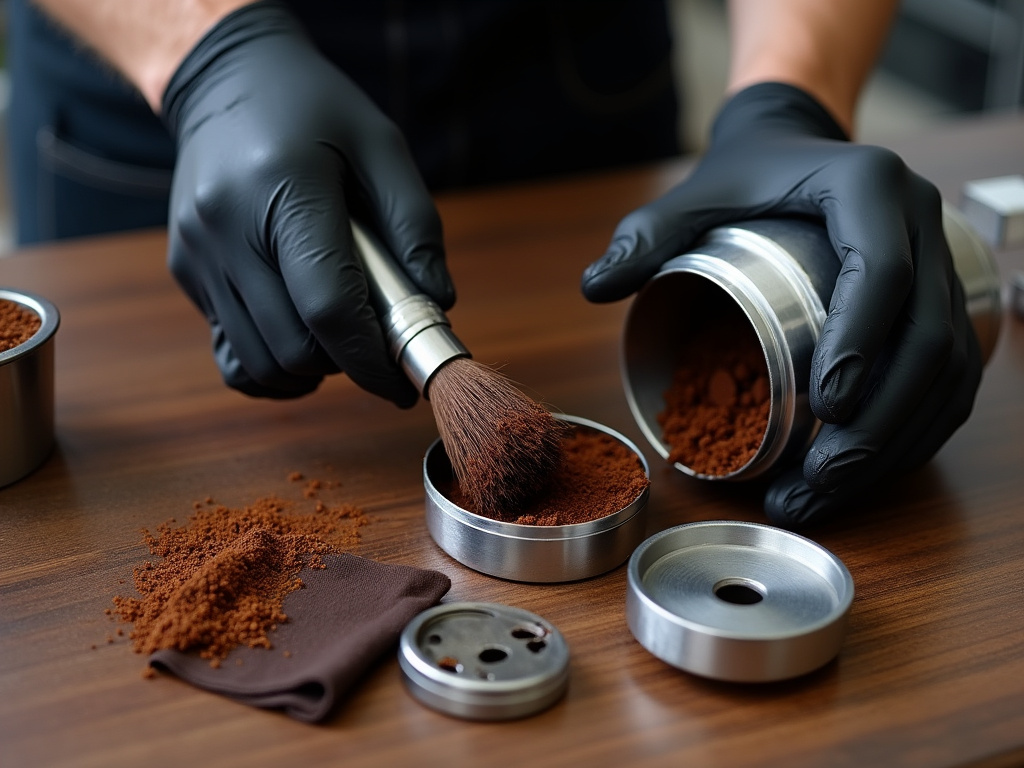
Coffee grinds are oily. That oil coats the burrs and the internal chambers, goes rancid, and makes every subsequent batch taste like stale cardboard. Cleaning is not optional.
| Task | Frequency | Tools Needed | Signs It’s Overdue |
|---|---|---|---|
| Brush out loose grounds | After every use | Small, dry brush | Visible dust in new grounds, stale aroma |
| Deep clean burrs & chamber | Every 2 weeks (light roast) / Weekly (dark roast) | Brush, dry cloth, grinder cleaning pellets (optional) | Inconsistent grind times, oily clumps in grounds, muted flavor |
| Check burr alignment | Every 6 months | Manufacturer manual | Increased noise, visible wobble, uneven wear on burr surfaces |
For a deep clean, unplug the grinder. Remove the hopper and top burr according to your manual. Use the brush to dislodge all packed-on grounds. Wipe the burrs with a dry cloth, never use water or cleaner. Reassemble.
If you use flavored beans, clean immediately after. Those vanilla or hazelnut oils cement themselves to the plastic and will ghost your next five batches of unflavored coffee.
What Not to Do: The Quickest Ways to Ruin Your Grinder
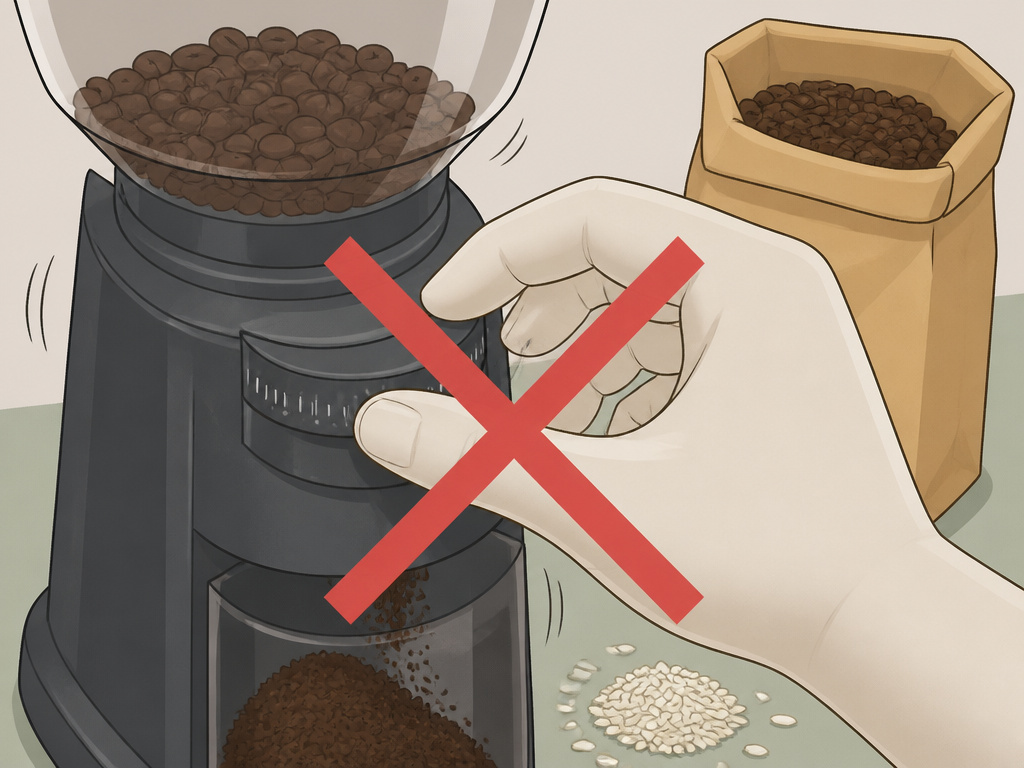
A few bad habits will shorten your grinder’s life from years to months.
Never run rice, bread, or grinding pellets through a burr grinder to “clean” it unless the manufacturer explicitly instructs you to. The hardness can fracture the burrs’ cutting edges. The Baratza manual specifies dry coffee beans only.
Don’t adjust the grind while it’s running. The torque can strip the plastic adjustment threads on consumer models. Always turn the motor off.
Don’t leave beans in the hopper long-term. Especially not in sunlight. The beans go stale, and their oils seep down into the burrs. Grind what you need, then store the rest in an airtight container.
Don’t ignore strange sounds. A new rattling or grinding noise often means a rock or hardened chunk of coffee is lodged between the burrs. Stop immediately. Forcing it can score the burr surfaces permanently.
Frequently Asked Questions
Can I grind spices in my coffee grinder?
No. The oils from spices like cinnamon or cloves are tenacious and will permanently flavor your coffee. If you must, dedicate a separate, cheap blade grinder to spices. The residue from cinnamon in coffee grinding will ghost your grinder for weeks.
How fine should I grind for a Moka pot?
Grind slightly coarser than espresso, but finer than drip. Aim for a texture like very fine sand. If the coffee spurts or bubbles violently at the end, the grind is too fine and is creating back pressure.
Why is my grinder producing clumpy, static-y grounds?
Static is common in dry climates or with very light roasts. A single drop of water on a spoon handle, stirred into the whole beans before grinding, neutralizes the charge. This is called the “Ross Droplet Technique.” It works.
Does pre-grinding coffee save time?
It saves 30 seconds and sacrifices most of the flavor. Ground coffee stales rapidly as surface area increases. Whole beans stay fresh for weeks; ground coffee goes flat in minutes. The convenience isn’t worth it.
Should I add anything to the beans before grinding?
Some people add a pinch of salt to reduce perceived bitterness, a practice covered in our look at adding salt to grounds. Others add flavorings like coconut oil coffee additives for texture. Do this only if you are prepared to clean your grinder thoroughly immediately after.
The Bottom Line
Using a coffee grinder correctly means respecting it as a precision tool, not an appliance. Start with a burr grinder. Match the grind size to your brewer with intention. Clean it before you think you need to. Your first few batches might be slightly off. That’s normal. Dialing in is a skill. The reward is a cup where you taste the fruit, the chocolate, or the nutty notes, not the bitterness of a forgotten chore. Now, go grind.
