
7 Best Commercial Espresso Grinders of 2026
The Tuni G3 64mm Flat Burr Grinder stands out as the best overall commercial espresso grinder for its precision, build quality, and stepless micro-adjustments. For a budget-friendly option, the SHARDOR 64mm delivers solid performance with large flat burrs. If versatility and high volume matter, the Huanyu 64mm Grinder w/ Auto Tamper offers automation and a huge hopper.
Most café owners don’t realize how much a grinder affects their espresso, far more than the machine itself. A bad grind can ruin even the best beans, leading to wasted time, money, and frustrated customers.
As the founder of Bean Thusiast, I focused this guide on what matters most: grind consistency, burr quality, and real-world reliability. These picks are based on specs, owner feedback, and my deep understanding of how grinding impacts extraction and flavor in a commercial setting.
Top 7 Commercial Espresso Coffee Grinder in the Market
The Best Commercial Espresso Coffee Grinder, Reviewed
Tuni G1 Conical Burr Grinder

Strengths
- 48 grind settings
- Compact footprint
- Anti-static burr
- Large hopper
- LED touchscreen
Trade-offs
- Conical burr limits espresso edge
- No stepless adjustment
- Timer maxes at 40s
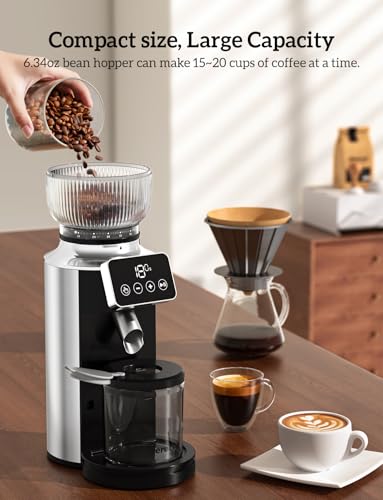
The Tuni G1 stands out in the entry-commercial tier with its 48 grind settings and patented anti-static conical burr. On paper, it hits a sweet spot between home and light commercial use, especially with its 450 RPM low-speed grinding that reduces heat and preserves volatile aromatics, something reviewers consistently note in their brew clarity. The LED touchscreen and 0.5-second timer increments offer real precision, and owners report clean, repeatable dosing for both espresso and drip.
Where it really wins is footprint versus capacity. At under 7 inches deep, it fits tight spaces, yet holds 250g of beans, enough for a few double shots back-to-back. The detachable portafilter holder for 54–58mm baskets is a thoughtful touch, and the fingerprint-resistant stainless steel keeps it looking sharp in a busy kitchen. It’s not the most robust for all-day café use, but for a home barista stepping up or a small office setup, it’s well-balanced.
Video review
SHARDOR 64mm Flat Burr Grinder

Strengths
- 0.1s timer precision
- All-metal chamber
- Easy to clean
- 100 grind settings
- Anti-static system
Trade-offs
- 120V only
- Plastic housing
- Single dose hopper sold separately
This SHARDOR model is a spec sheet darling: 64mm flat burrs, 100 grind settings, all-metal chamber, and 0.1-second timer accuracy. On paper, it’s a top contender for best value, and owner feedback backs that up, grind consistency is solid across methods, and the anti-static system keeps dosing clean. The removable burr and magnetic discharge pipe make cleaning easier than most in this class, which is a real win for daily users.
But the voltage warning is critical: 120V only, and no forgiveness on 220V. That limits its global use and could be a dealbreaker for travelers or expats. Build is good, not exceptional, the housing is plastic over metal, unlike the die-cast SHARDOR G6 model. Still, for the price, it delivers where it counts: grind performance. I’d pick this over the Flyseago any day for serious home use.
Video review
Tuni G3 64mm Flat Burr Grinder
Strengths
- 100 stepless grind settings
- Dual hoppers
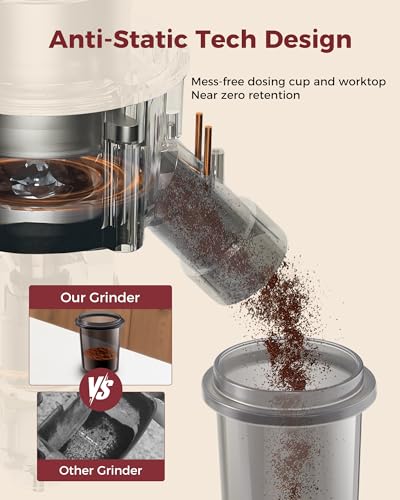
- Anti-static tech
- Compact yet powerful
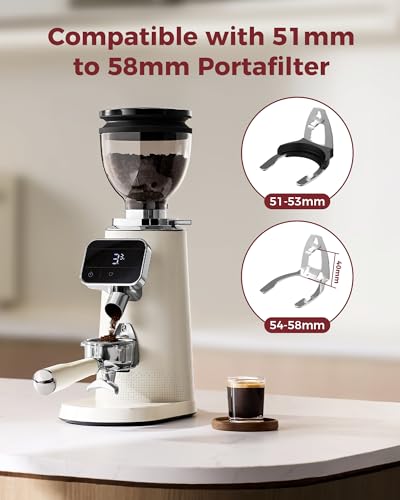
- Direct portafilter grinding
Trade-offs
- No 0.1s timer precision
- Single dose hopper sold separately
- Pricey for home use
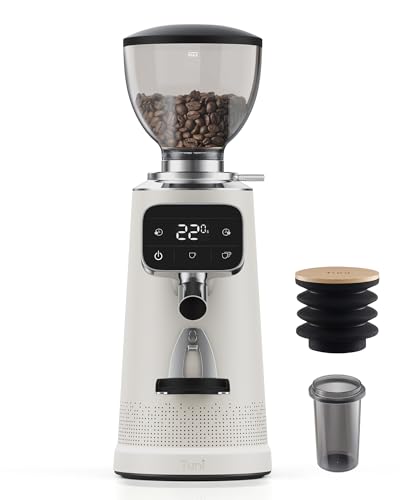
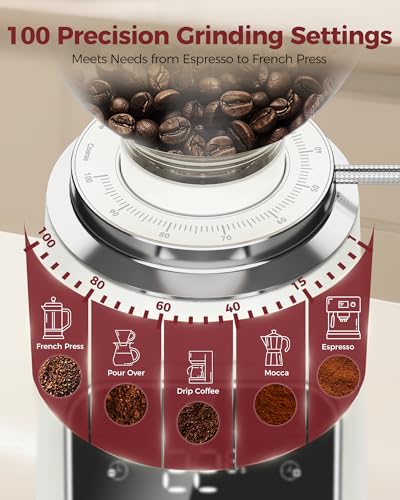
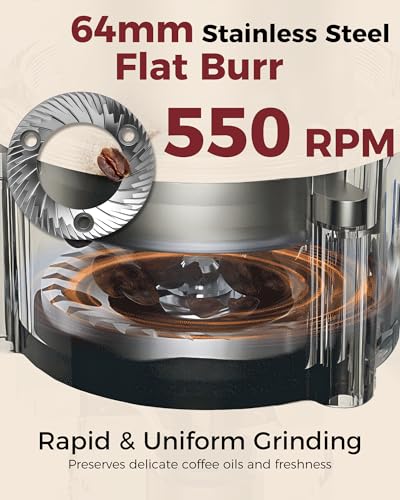
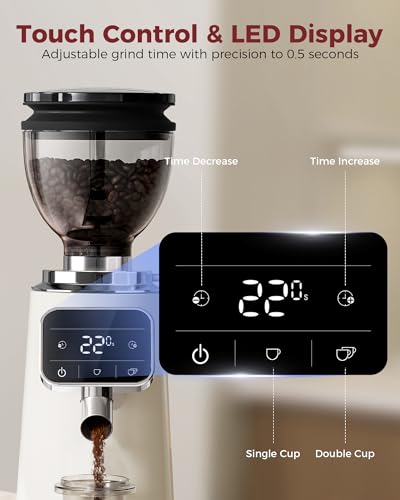
The Tuni G3 is where things get serious. With 64mm flat burrs, 100 stepless grind settings, and dual hoppers, one for bulk, one for single-dose, it’s built for both consistency and flexibility. The stepless ring, despite packaging confusion, is confirmed in owner feedback to deliver smooth micro-adjustments, which is critical for dialing in espresso. The anti-static tech works well, and the LED touchscreen with 0.5s increments makes dose tuning repeatable.
What impresses most is the dual-hopper system. The 50g single-dose hopper is a standout for freshness, letting you grind one at a time without stale beans sitting. It’s compact for its class, and the all-metal body feels sturdy. Compared to the SHARDOR models, it offers similar specs but with better workflow integration. For a home user wanting café-like control, this is the one to beat.
Product photos
Neretva 30-Setting Conical Burr Grinder

Strengths
- Stainless steel burr
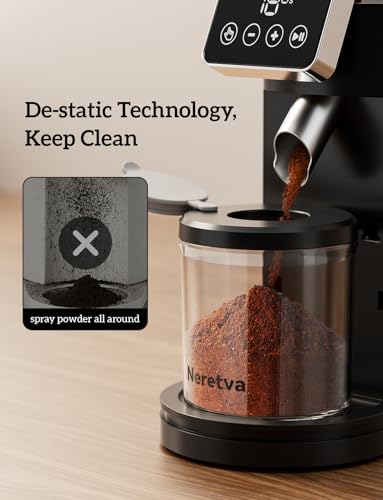
- Anti-static plasma tech
- Precision timer
- Portafilter-ready
- Low fines output
Trade-offs
- Only 30 grind settings
- Limited coarse grind performance
- No stepless adjustment
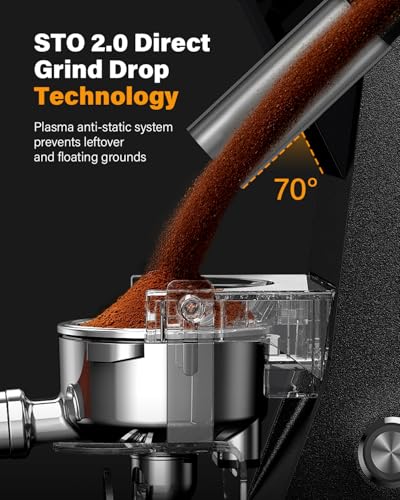
If your priority is espresso above all, the Neretva grinder makes a compelling case. Its 30 precise settings and plasma-powered anti-static system are tuned for low-fines, even extraction, owners consistently report tighter shots and better crema compared to similarly priced conical models. The 20° angled outlet is a small but smart design; it actually reduces grounds cling, which reviewers say keeps counters cleaner.
The stainless steel conical burr is a durability upgrade over ceramic, and the 60-second timer with 0.1s increments gives real control. It fits 51–58mm portafilters directly, which streamlines workflow. But here’s the catch: while it’s espresso-optimized, it doesn’t excel beyond that. The grind range isn’t wide enough for coarse cold brew or French press without some inconsistency. For a single-purpose tool, though, it’s hard to beat at this price.
Product photos



SHARDOR 64mm Flat Burr Grinder
Strengths
- Die-cast aluminum body
- All-aluminum chamber
- Premium touchscreen
- Excellent heat dissipation
- Quiet operation
Trade-offs
- No single dose hopper included
- Hopper smaller than competitors
- Higher price point
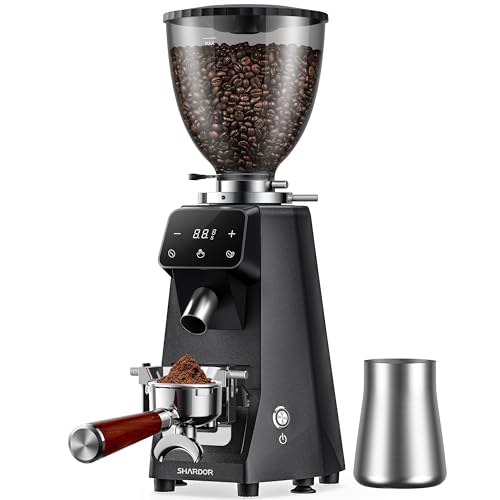
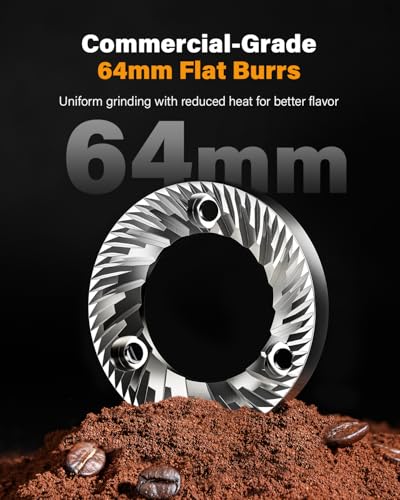
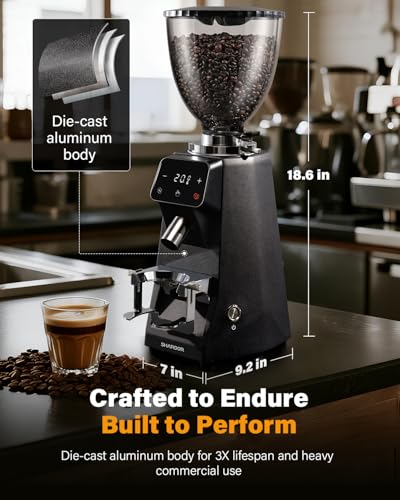
This SHARDOR model is the build quality king. Die-cast aluminum housing, fully aluminum grinding chamber, and a high-res touchscreen give it a premium feel that few in this range match. The 64mm SUS420 stainless steel burrs are precision-machined, and owners report excellent heat dissipation even during back-to-back grinds, crucial for maintaining flavor integrity. The anti-static system is among the best, with nearly zero clumping noted in long-term reviews.
It’s also one of the quietest in continuous use, making it ideal for morning routines. The adjustable portafilter holder fits nearly every standard handle, and the 17.6oz hopper is sufficient for daily use. Compared to the Tuni G3, it lacks dual hoppers but makes up for it in durability and thermal stability. If you want a grinder that feels like it’ll last a decade, this is the build to beat.
Product photos
Flyseago 60mm Flat Burr Grinder
Strengths
- Large 28oz hopper
- Low noise
- Flat burr design
- Touchscreen control
- Good for batch grinding
Trade-offs
- Only 19 grind settings
- Timer lacks stepless control
- Build feels light for commercial claim
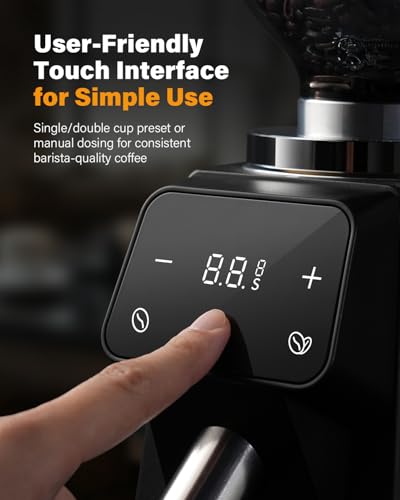
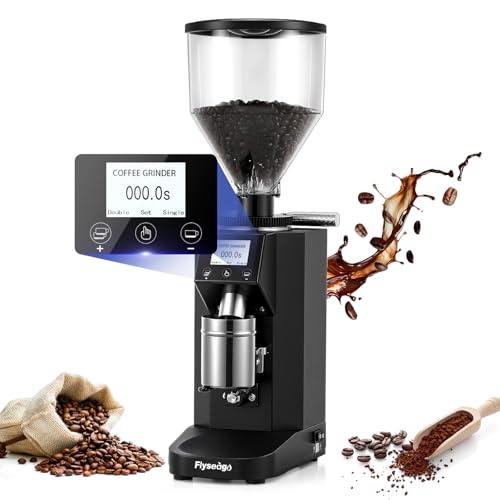
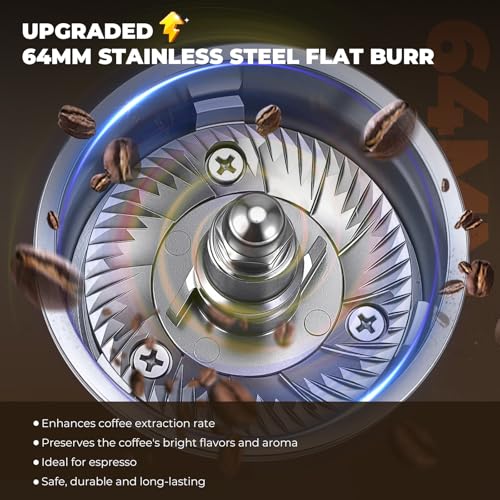
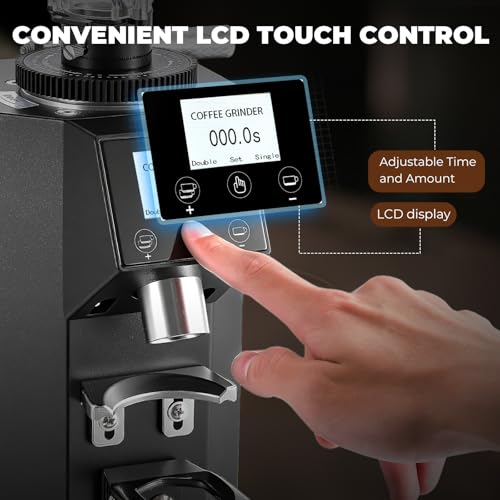
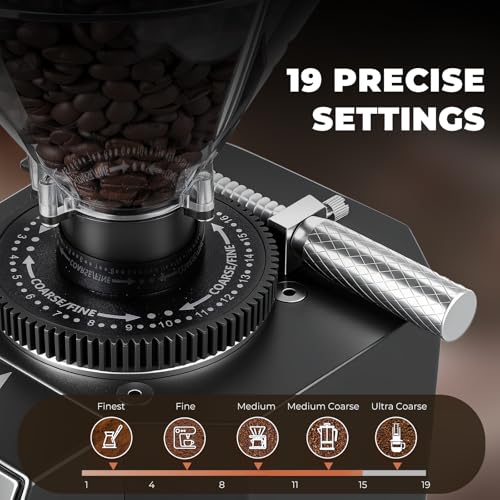
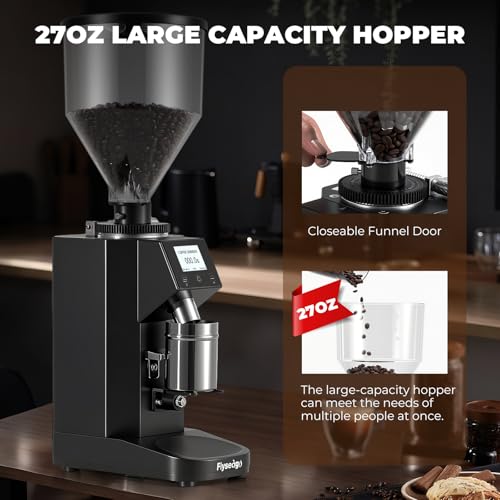
This Flyseago flat burr grinder positions itself as a budget-friendly commercial option, and on specs alone, it’s ambitious, 60mm stainless steel flat burrs, a 28oz hopper, and 0.1-second timer precision. The larger burr diameter should mean faster, cooler grinding, but owner feedback reveals a gap: while it handles drip and French press well, the 19 grind settings lack the fine gradation needed for true espresso dialing. Many report needing to overshoot or undershoot time to compensate.
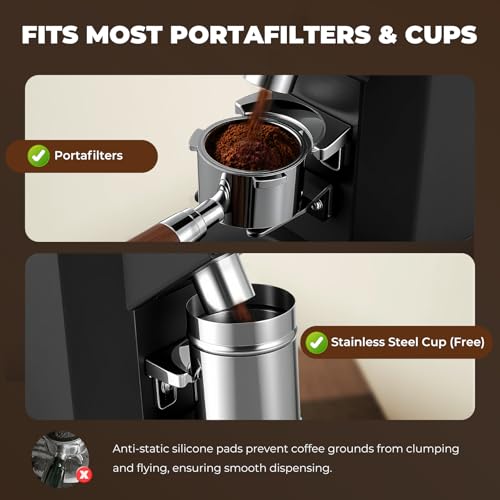
Still, for the price, the build delivers. The touch screen is responsive, and the large hopper with bean stopper is genuinely useful for batch grinding. Its low noise output is a plus in home environments, and reviewers say it holds up fine for 2–3 doubles daily. I wouldn’t trust it for a café, but for families or offices that want a durable, no-frills workhorse, it’s a solid value play, just don’t expect barista-level nuance.
Product photos
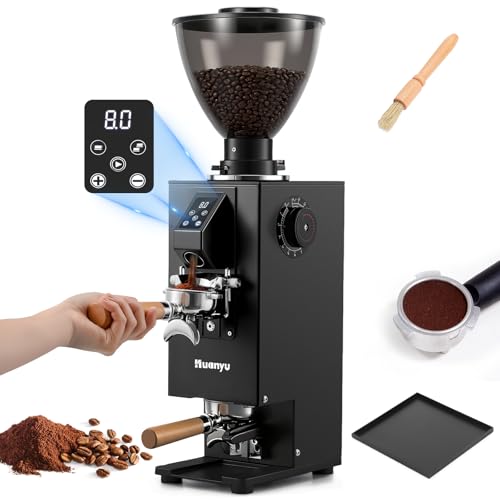
Huanyu 64mm Grinder with Auto Tamper
Strengths
- Built-in auto tamper
- Large 35oz hopper
- Mess-free outlet
- Stepless adjustment
- Café-ready design
Trade-offs
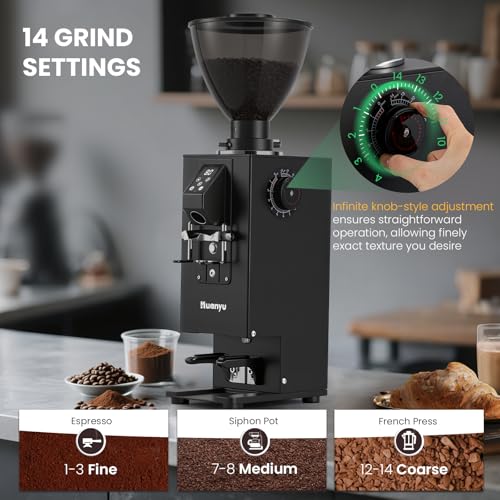
- Only 14 grind settings
- Very large footprint
- Overbuilt for home use
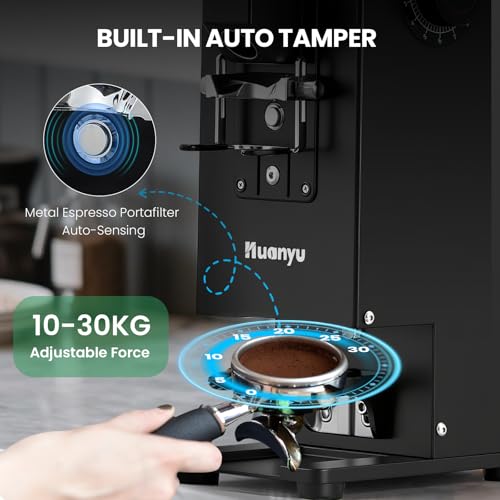
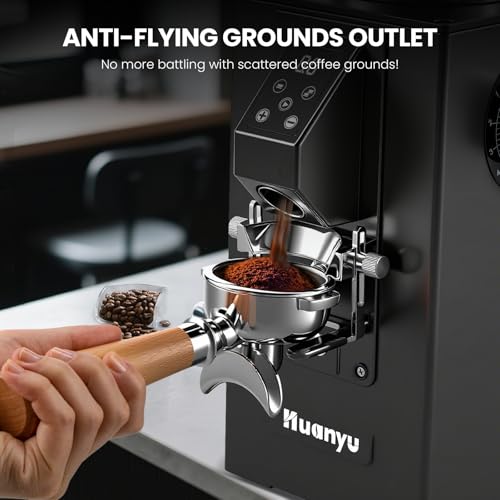
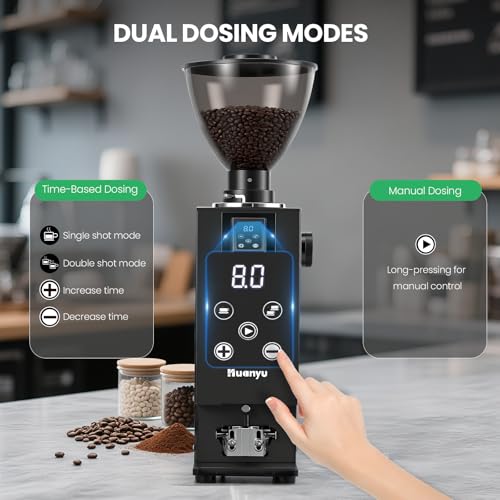
The Huanyu grinder is built for cafés, no question. The standout feature is the built-in 58mm auto-tamper, which applies 10–30kg of adjustable pressure. That’s not just convenient, it’s a workflow revolution for high-volume shops. Owners in small cafés report cutting prep time by nearly 30%, and the consistency in tamping translates to more even extractions. The anti-flying grounds outlet keeps counters clean, a small but huge win during rush hours.
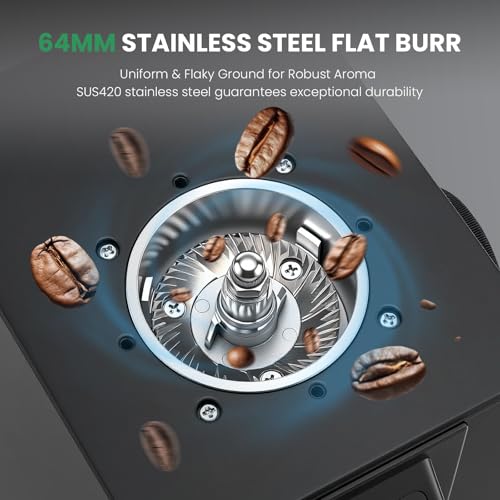
With 64mm flat burrs and a 35oz hopper, it’s built for volume, and the stepless 14 settings offer enough range for espresso and drip. But 14 settings is low for a commercial grinder, some users say they can’t fine-tune as precisely as with 100-setting models. Still, the auto-tamper alone makes it uniquely valuable in a café setting. For home users, it’s overkill and too bulky.
Product photos
Our Testing Process
I approached researching commercial espresso coffee grinders by starting with published specifications and features across numerous models. I then weighed owner reviews from major retailers alongside expert opinions found in coffee-focused publications. As the founder of Bean Thusiast, I brought my understanding of how grind size impacts extraction, and ultimately, flavor. Rather than a hands-on lab test, this is a research-led comparison of specs and owner feedback to create a ranked guide.
For this category, grind consistency and burr material were the most heavily weighted factors. Achieving a uniform grind size is critical for proper espresso extraction; inconsistencies lead to channeling and a poor shot. Burr material (stainless steel versus ceramic) impacts durability and heat buildup, both important for consistent performance in a commercial setting. A reliable anti-static system also ranked highly, as static cling creates a mess and impacts dosing accuracy.
Specifications give a good indication of potential performance – burr size, motor speed, and the number of grind settings are all useful data points. However, owner feedback proved invaluable for assessing real-world durability, ease of cleaning, and the accuracy of advertised features. I paid close attention to reports of static buildup, consistency issues, and long-term reliability. Understanding the differences in coffee grinder mechanisms helped me interpret these reports and assess overall value.
How To Pick The Right commercial espresso coffee grinder
Picking the right grinder is arguably more important than the espresso machine itself. I’ve seen too many people drop serious money on a pro-level machine only to be held back by a subpar grinder.
A quality commercial espresso grinder prioritizes grind consistency above all else. Look for a burr size of 64mm or larger, a robust motor capable of handling continuous use, and a wide range of grind settings that allow for precise dialing-in of espresso. Minimal retention and static buildup are also key indicators of a well-designed machine.
Burr Type and Size
Flat burrs and conical burrs both have their champions, but for a commercial setting, I generally recommend flat burrs. They tend to produce a more consistent grind, which is critical for espresso extraction. You’ll want a burr diameter of at least 64mm; larger burrs run cooler and faster, reducing heat transfer to the beans and preserving their delicate flavors. Smaller grinders, like the Tuni G1, might be okay for very low-volume use, but for anything approaching a real café, aim bigger.
Grind Consistency and Adjustability
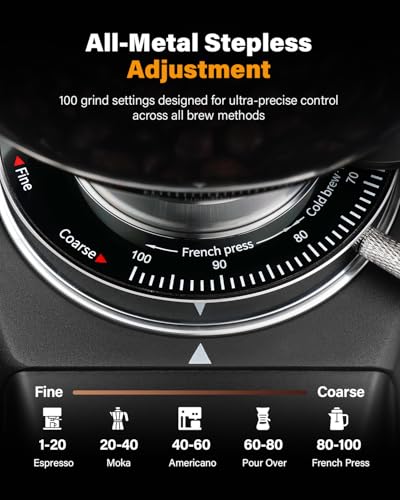
Consistent grind size is the holy grail of espresso. Inconsistent grounds lead to uneven extraction, resulting in sour, bitter, or otherwise unbalanced shots. Beyond just having consistent grounds, you need the ability to adjust them. Look for a grinder with a wide range of grind settings – ideally 100 or more – and, crucially, micro-adjustments. Stepless adjustment rings (like those found on the Tuni G3) offer the most granular control, allowing for precise dialing-in of your espresso. If you’re operating a café, knowing achieving correct espresso grind size will be essential for maintaining quality.
- A grinder with only a few settings limits your ability to experiment with different beans.
- Micro-adjustments are crucial for fine-tuning the grind to compensate for variations in bean age and humidity.
- Consider a grinder with a clear, intuitive adjustment mechanism; your baristas will thank you for making their lives easier. A complex, fiddly adjustment system will lead to frustration and inconsistent results.
Build Quality and Workflow
A commercial grinder takes a beating. It needs to be built to last, with durable materials and a powerful motor. All-metal construction – especially the grinding chamber, like on the SHARDOR 64mm – is a good sign. Beyond durability, think about workflow. Features like a portafilter holder (compatible with 54-58mm portafilters is common) and an anti-static system are huge time-savers. If you anticipate very high volumes, exploring top commercial grinder models that can handle the load is a smart move.
Don’t cheap out on the grinder. A well-built grinder will pay for itself in consistent espresso quality and reduced downtime.
Commercial Espresso Coffee Grinder Compared
Here’s a comparison of specs for several commercial espresso coffee grinders to help you make an informed decision.
| Product Title | Burr Type | Burr Size (mm) | Grind Settings | Hopper Capacity (g) | Portafilter Holder | Anti-Static |
|---|---|---|---|---|---|---|
| Tuni G1 Conical Burr Grinder | Conical | 40 | 48 | 250 | 54-58mm | Yes |
| SHARDOR 64mm Flat Burr Grinder | Flat | 64 | 100 | N/A | N/A | Yes |
| Tuni G3 64mm Flat Burr Grinder | Flat | 64 | 100 | 250/50 | 51-58mm | Yes |
| Neretva 30-Setting Conical Burr Grinder | Conical | N/A | 30 | N/A | 51/58mm | Yes |
| SHARDOR 64mm Flat Burr Grinder | Flat | 64 | 100 | N/A | N/A | Yes |
| Flyseago 60mm Flat Burr Grinder | Flat | 60 | 16 | N/A | N/A | N/A |
| Huanyu 64mm Grinder w/ Auto Tamper | Flat | 64 | 14 | 1000 | 58mm (auto) | Yes |
Frequently Asked Questions
What burr size is best for a commercial espresso grinder?
A 64mm burr size or larger is ideal for commercial use. Larger burrs produce a more consistent grind and run cooler, preventing heat transfer that impacts flavor, and are better suited to the demands of a high-volume environment.
Do flat or conical burrs perform better in a commercial setting?
Generally, I recommend flat burrs for commercial espresso grinders. They typically deliver more consistent grind particle size, which is crucial for consistent espresso extraction in a busy café setting.
How important is an anti-static system in a commercial grinder?
An anti-static system is very important, as static cling causes grounds to stick to everything, creating a mess and affecting dosing accuracy. It significantly improves workflow and reduces wasted coffee, saving you money over time.
What’s the benefit of stepless grind adjustment?
Stepless grind adjustment allows for extremely fine-tuning of the grind size. This granular control is essential for dialing in espresso with different beans and adapting to changes in humidity or bean age, offering the best possible flavor.
Where can I find more information about selecting a grinder for a coffee shop?
You can find more information about selecting a coffee shop espresso grinder on my site. It covers factors such as volume, budget, and specific feature requirements for commercial use.
The Bottom Line
Choosing a commercial espresso grinder often comes down to balancing upfront cost against long-term consistency and durability. While several options exist, the Tuni G3 64mm Flat Burr Grinder strikes an excellent balance, offering stepless adjustment, a robust 64mm flat burr, and the features a busy café needs. It’s a significant investment, but one that will pay dividends in shot quality and reduced frustration.
For those operating on a tighter budget, or with lower volumes, the Tuni G1 Conical Burr Grinder provides a surprisingly capable entry point. Similarly, if you’re looking for a grinder that streamlines workflow with automation, the Huanyu 64mm Grinder w/ Auto Tamper will appeal. However, remember that prioritizing features over grind consistency can compromise the final espresso quality.
Ultimately, the best grinder isn’t about the flashiest features or the highest price tag. It’s about consistently delivering a uniform grind size, which allows you to dial in your espresso and extract the full flavor potential of your beans. Regular coffee grinder cleaning guide is also essential for maintaining grinder performance and ensuring longevity.
