
7 Best Manual Coffee Grinders for Espresso 2026
The TIMEMORE C5 Pro stands out as the best manual coffee grinder for espresso, delivering consistent, fine grinds with its stainless steel burrs and precise adjustment. For a budget-friendly option, the Rsoilch ceramic grinder offers solid performance, while the CEVING 60g brings extra capacity for those brewing multiple shots.
Most people shopping for a manual espresso grinder quickly realize it’s not just about saving counter space or going cord-free, it’s about pulling a shot that rivals what you’d get from a machine. The grind has to be fine, even, and repeatable, or your espresso will be sour, bitter, or both.
I researched the top models by comparing specs, analyzing owner feedback, and looking at real-world performance in forums and reviews. This guide cuts through the noise to highlight grinders that actually deliver on consistency, build quality, and adjustability, so you can make informed choices without wasting money on a pretty paperweight.
Top 7 Manual Coffee Grinder For Espresso in the Market
The Best Manual Coffee Grinder For Espresso, Reviewed
KINGrinder K6 Hand Coffee Grinder

Strengths
- Precise 16μm clicks
- Full metal build
- Easy to clean
Trade-offs
- Internal adjustment less intuitive
- No foldable handle
- Heavier than travel-focused models
The KINGrinder K6 stands out with its internal stepped adjustment system, 16 microns per click, 60 clicks per rotation. On paper, that’s tighter control than many grinders in this range, which matters when dialing in for espresso. Owners report consistent performance across pour over and espresso, though some note the learning curve with internal numbering. The full aluminum body and dual-bearing design promise durability and smooth grinding, and reviewers consistently praise its build quality for the price.
Where it really gains traction is value. For a grinder that claims to handle espresso with stainless steel conical burrs and a solid metal chassis, it punches above its weight. Compared to pricier TIMEMORE models, it doesn’t have the same refinement in micro-adjustments, but it gets surprisingly close. The 25–35g capacity fits most single or double shots, and the tool-free disassembly makes cleaning straightforward.
Video review
Rsoilch Ceramic Burr Coffee Grinder

Strengths
- Cool grinding with ceramic burrs
- Wide grind range
- Affordable build
Trade-offs
- Ceramic burrs less durable for espresso
- Adjustment less precise
- Fewer user reviews for long-term reliability
Ceramic burrs are a smart choice for heat-sensitive grinding, and the Rsoilch grinder leans into that with a conical ceramic set that owners say stays cool even during extended sessions. That’s a win for flavor preservation, especially with delicate single-origin beans. The 40 adjustable settings offer a wide range, and while they’re not click-adjusted with measurable increments, feedback suggests it’s capable of hitting espresso fineness with some trial and error.
But here’s the catch: ceramic burrs, while cool-running, are more brittle and less durable than steel, especially under high torque. For espresso, which demands high compression and consistent force, that can be a liability over time. Compared to steel-burr competitors in this list, it’s less suited for daily espresso grinding. It works well for French press or pour over, but longevity may be a concern if pushed hard.
Video review
NANSPATH Manual Ceramic Burr Grinder
Strengths
- Ultra-light and compact
- Ceramic burrs for heat control
- Detachable handle
Trade-offs
- Ceramic burrs less durable
- Smaller capacity
- Not ideal for daily heavy use
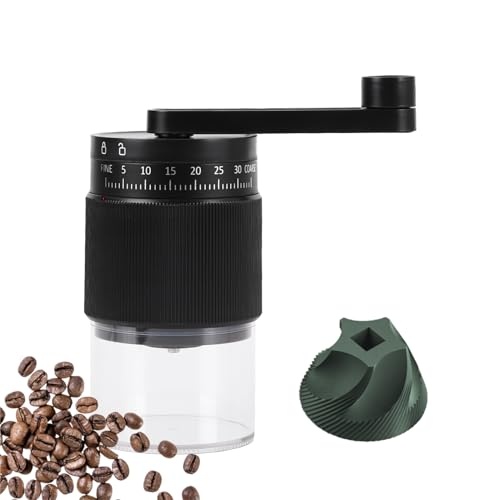
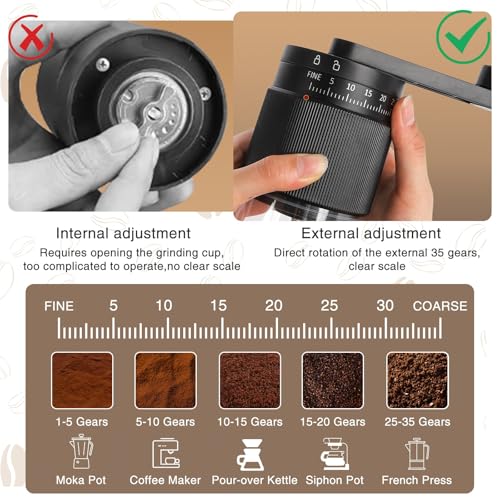
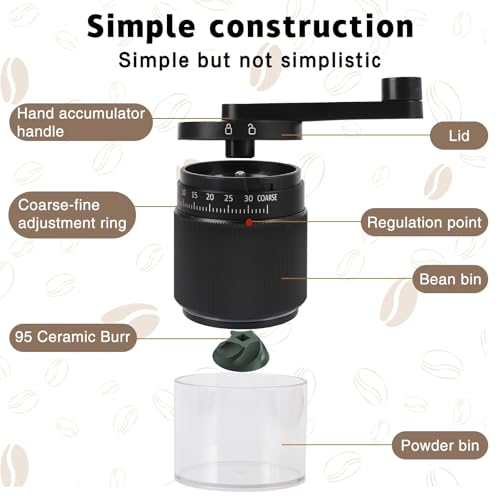
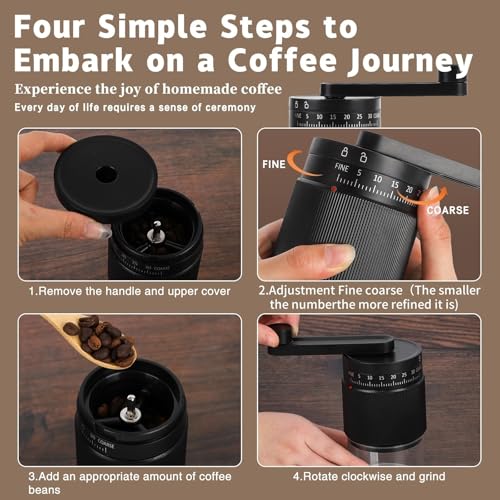
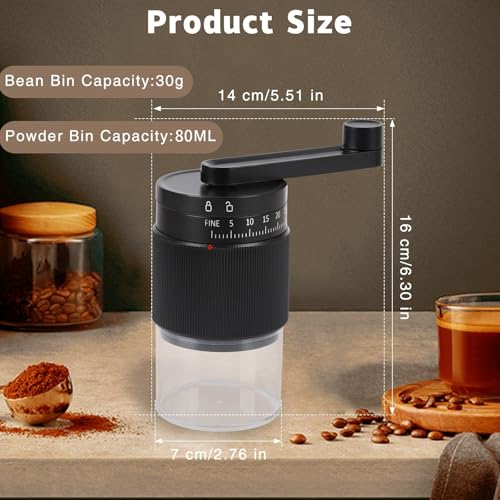
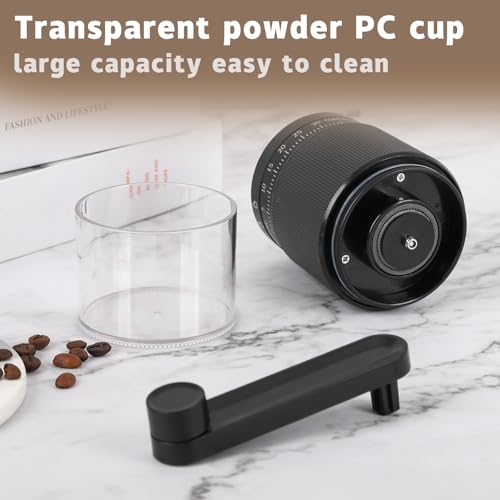
At just 235g, the NANSPATH grinder is one of the lightest on this list, and its detachable handle makes it absurdly portable. For travelers or office users who want espresso-level fineness on the go, this is a standout. The 95-grade ceramic burrs stay cool and preserve aroma, and the top-mounted external knob offers 46+ settings without needing to open the grinder, huge for quick changes between brewing methods.
But ceramic burrs again raise durability concerns, especially under the strain of fine espresso grinding. Owners report decent performance for light use, but long-term feedback suggests steel burrs hold up better. Still, for its size and weight, it’s impressively capable. Compared to the CEVING 60g model, it’s less about capacity and more about convenience.
Product photos
TIMEMORE C5 Pro Manual Grinder
Strengths
- High grind precision
- 48 adjustment levels
- Stable double-bearing design
Trade-offs
- Internal adjustment slower to dial
- Slightly bulky for tight spaces
- Pricier than entry-level options
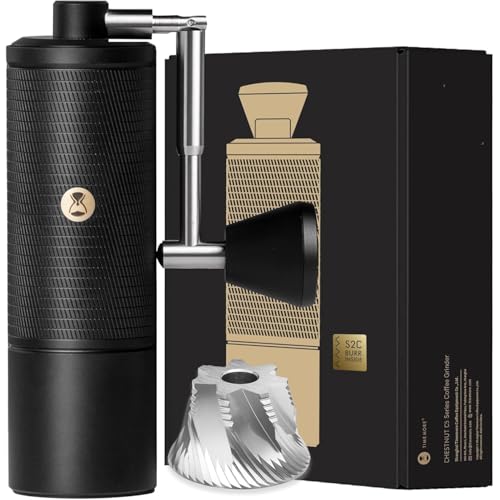
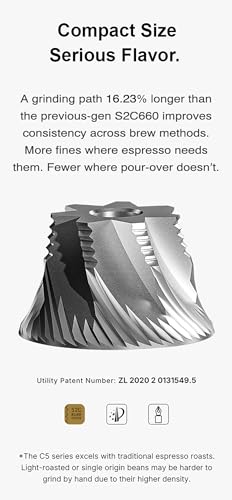
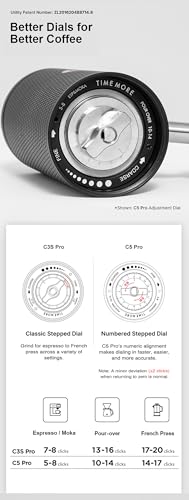
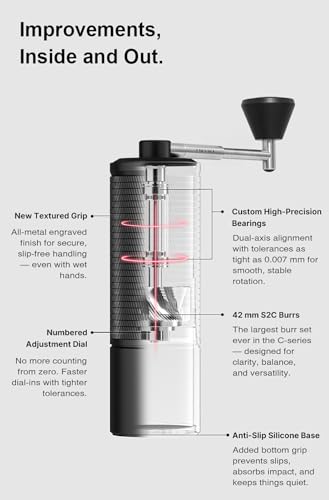
The TIMEMORE C5 Pro is built for people who care about precision. With 48 grind settings and a 0.031mm adjustment per click, it gives you the kind of control that matters when tweaking for espresso. The patented S2C-042-III stainless steel burrs are a step up from earlier S2C versions, and reviewers note a visible improvement in grind uniformity, fewer boulders, less fines clumping. This is the kind of grinder where small changes make a real difference in your shot.
It’s heavier than the C3S Pro, but that extra mass comes from the CNC-machined stainless steel body and double-bearing system, which reduce wobble and improve consistency. Paired with the foldable handle, it’s still travel-friendly, though not as compact as ultra-light models. Compared to the S3, it lacks external adjustment, so dialing in takes longer, but the internal mechanism is more protected from debris.
Product photos
TIMEMORE S3 Manual Coffee Grinder

Strengths
- Ultra-fine external adjustment
- High-precision bearings
- Excellent burr performance
Trade-offs
- Higher price point
- Slightly heavier than C3S
- Adjustment ring sensitive to debris
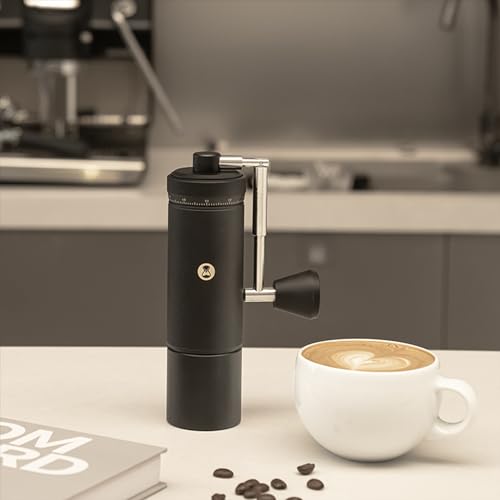
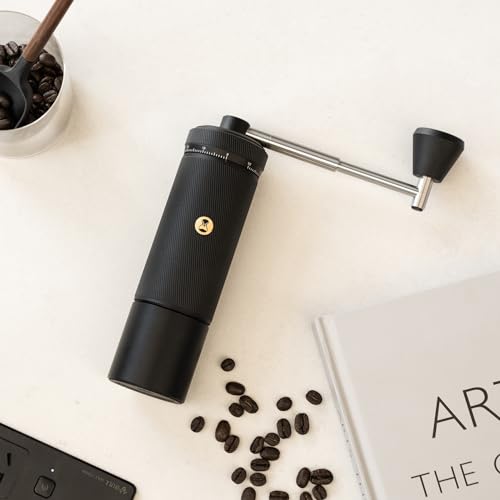
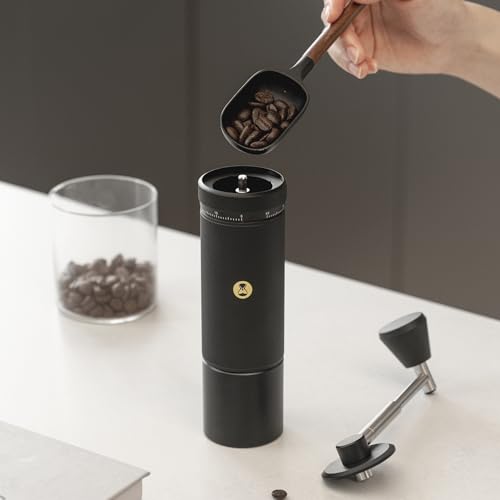
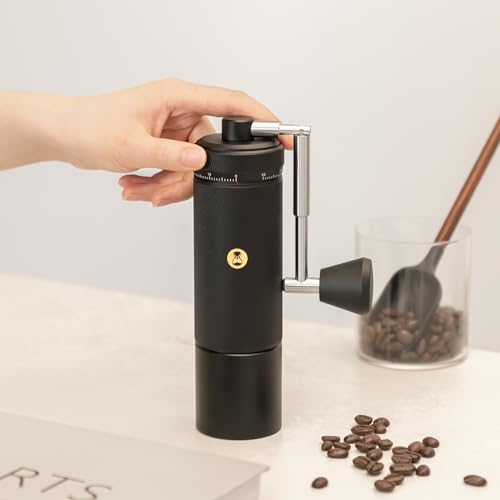
The TIMEMORE S3 is the most refined grinder on this list, and it shows in the details. The external digital adjustment system, 0.015mm per grid, is a standout for espresso. No more counting clicks or disassembling to tweak; you can make micro-adjustments on the fly, which owners love. The S2C890 steel burrs deliver exceptional uniformity, and the customized 5μm-tolerance bearings reduce wobble, translating to more consistent particle size. This is the kind of grinder that makes dialing in feel effortless.
It’s also built like a tool, not a toy. The unibody metal construction and spring-assisted foldable handle add to its premium feel. Yes, it’s one of the pricier options, but when compared to the C5 Pro or KINGrinder K6, the S3 justifies the cost with usability and precision. If you’re serious about manual espresso, this is where I’d put my money.
Product photos

CEVING 60g Stainless Steel Grinder

Strengths
- 60g large capacity
- External adjustment ring
- Durable stainless steel burrs
Trade-offs
- Bulkier than compact models
- Adjustment not ultra-fine
- Slightly higher static in grind
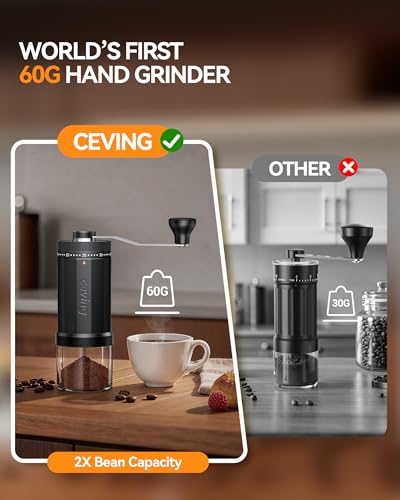
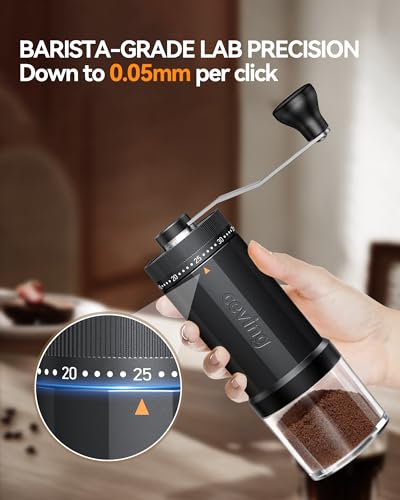
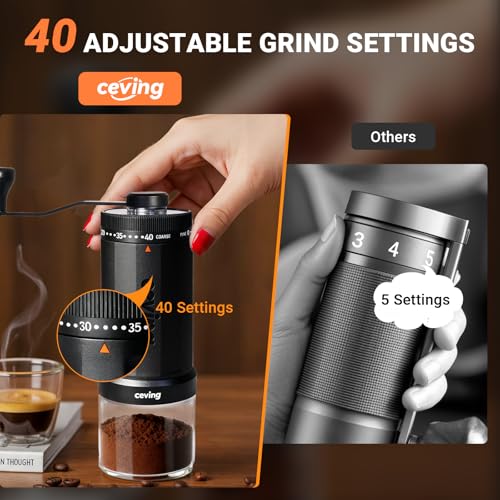
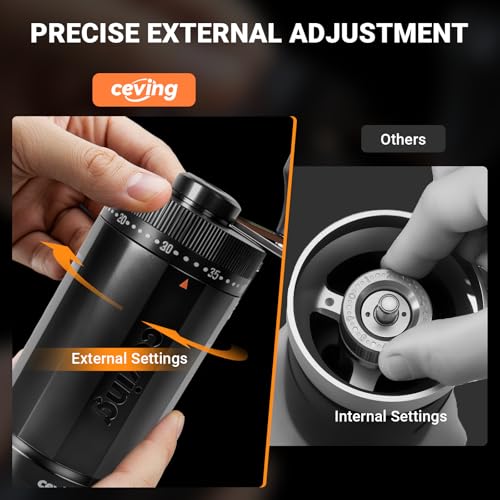
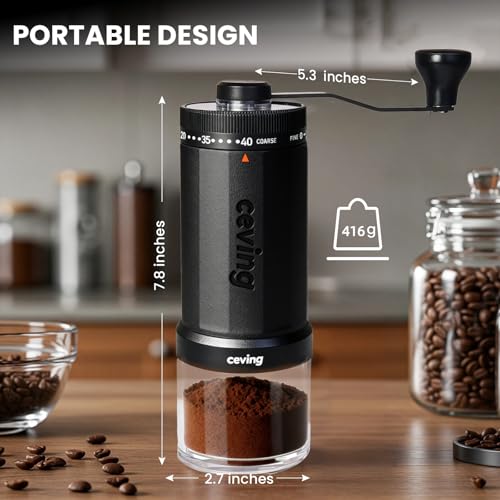
The CEVING 60g grinder solves a real problem: having to grind twice for multiple cups. With a 60g hopper, it’s ideal for families or travelers who want to prep multiple servings at once. The external 40-setting ring is user-friendly, no counting clicks, and the 0.05mm per click adjustment is precise enough for espresso, though not as fine as the TIMEMORE S3. Owners appreciate the stainless steel burrs for durability and speed, and the 416g weight keeps it portable despite the size.
Where it shines is practicality. The external dial, large capacity, and solid build make it a strong all-rounder. It’s not the most precise, but for someone who wants to grind a lot without sacrificing freshness, it’s unmatched. Compared to the NANSPATH or C3S Pro, it’s bulkier, but that’s the trade-off for capacity.
Product photos
TIMEMORE Chestnut C3S Pro Grinder

Strengths
- Smooth grinding action
- Foldable handle
- Durable aluminum body
Trade-offs
- Fewer grind steps than high-end models
- Burr performance slightly behind S2C-042-III
- Adjustment nut can loosen over time
If you’re looking for a budget-friendly grinder that still feels premium, the TIMEMORE C3S Pro is a smart pick. It inherits the S2C conical burr design from higher-end models, which owners say delivers surprisingly even particle distribution, critical for espresso. The 36 grind settings aren’t as fine-tuned as some, but they’re sufficient for dialing in with patience. What stands out is the labor-saving performance: the built-in bearing lets the handle keep spinning, reducing fatigue, a small but meaningful detail during long grinds.
It’s not the most precise option here, but it’s one of the most balanced. The foldable handle and aluminum alloy body make it portable without sacrificing durability. When compared to the C5 Pro or S3, it lacks the ultra-fine adjustability, but for most daily users, especially those not chasing absolute espresso perfection, it’s more than capable.
Product photos


How We Evaluated manual coffee grinder for espresso
We approached this guide by researching the specifications and features of numerous manual coffee grinders, focusing on those marketed for espresso use. I then weighed those details against owner reviews from sites like Amazon and coffee-focused forums, and expert opinions from trusted coffee review websites. This wasn’t about long-term, hands-on testing with each grinder; rather, it was a research-led comparison of published data and user experiences to identify patterns and strengths.
For manual espresso grinders, consistency and adjustability are paramount. I prioritized grinders with clearly defined and repeatable grind settings, and those built with durable burr materials. The ability to achieve a very fine, consistent grind is critical for proper espresso extraction, and a robust build quality ensures longevity – especially given the extra force needed for finer settings. Ultimately, a grinder’s performance directly impacts the final flavor in your cup.
Specifications reliably indicate build materials and the number of grind settings, but owner feedback proved invaluable in assessing real-world usability. Reports on ease of adjustment, static buildup, and grind consistency were heavily considered. Understanding the difference between a burr vs blade grinders is crucial, and user experiences shed light on how well each grinder delivers a consistent espresso grind, even with varying bean types and roast levels. Reputation also played a role; established brands with a history of quality were given extra consideration.
What To Look For In manual coffee grinder for espresso
Finding the right manual grinder for espresso isn’t just about the price; it’s about dialing in a tool that consistently delivers the fine, uniform grounds necessary for a quality shot.
A truly excellent manual coffee grinder for espresso prioritizes grind consistency above all else. Look for models with quality burrs (ceramic or steel), a precise adjustment mechanism (offering micro-adjustments are ideal), and a stable body to minimize shifting during grinding. Hopper capacity is less critical than the ability to achieve and repeat a very fine grind setting.
Burr Material: Steel vs. Ceramic
The burr material is arguably the most significant factor in your grinder’s performance. While both steel and ceramic burrs can produce excellent results, they have distinct characteristics. Steel burrs, particularly those found in higher-end models like the TIMEMORE C5 Pro, tend to grind faster and generate less static. This makes them a good choice for someone grinding larger quantities or who dislikes dealing with coffee grounds clinging to the grinder. Ceramic burrs, often seen in more budget-friendly options such as the Rsoilch, retain very little heat during grinding, which can help preserve delicate coffee aromas. However, they can be more brittle and may require more careful handling.
Grind Adjustment Precision
Espresso demands a very specific grind size, and even slight variations can drastically affect your shot. This is where grind adjustment precision becomes crucial. Avoid grinders with only a few broad settings. Instead, prioritize those offering a large number of clicks or, even better, a stepless adjustment system. Many grinders, like the NANSPATH, boast 35+ grind settings, but the key is how much each adjustment changes the grind size. A finer adjustment – like the 0.015mm/grid on the TIMEMORE S3 – gives you much greater control. Learning about adjusting grind coarseness is also essential.
- A wider range of settings is nice, but not essential if the adjustments are coarse.
- Stepless adjustment offers the ultimate control, but can be more complex to learn.
- Micro-adjustments (less than 0.1mm per click) are vital for consistent espresso, allowing you to fine-tune your grind to perfection and achieve optimal extraction.
Portability and Capacity
While espresso is often associated with home brewing, a manual grinder’s portability can be a huge benefit. If you travel frequently or enjoy camping, a compact and lightweight grinder like the CEVING 60g is a great option. However, consider the trade-offs. Larger capacity grinders, like the CEVING, can grind more coffee in a single session, which is convenient if you’re brewing for multiple people.
A good rule of thumb: don’t sacrifice grind quality for portability. Prioritize a grinder that produces consistent results, even if it means sacrificing some convenience.
If you’re looking for more options, check out our top manual coffee grinders guide for a broader overview. Understanding how to use your grinder correctly is also key, so explore our resources on using manual coffee grinders.
Manual Coffee Grinder for Espresso Compared
Here’s a comparison of specifications for various manual coffee grinders designed for espresso preparation.
| Product Title | Burr Type | Capacity (g) | Grind Settings | Adjustment Type | Material |
|---|---|---|---|---|---|
| KINGrinder K6 | Stainless Steel | 25-35 | 60+ | Internal | Aluminum/Steel |
| Rsoilch Ceramic Burr Grinder | Ceramic | N/A | 40 | N/A | N/A |
| NANSPATH Manual Ceramic Burr Grinder | Ceramic | 30 | 46+ | External | N/A |
| TIMEMORE C5 Pro | Stainless Steel | 30 | 48 | External | Stainless Steel |
| TIMEMORE S3 | Steel | N/A | N/A | External | Stainless Steel |
| CEVING 60g Stainless Steel Grinder | Stainless Steel | 60 | 40 | External | Stainless Steel |
| TIMEMORE Chestnut C3S Pro | Steel | N/A | 36 | External | Aluminum Alloy |
Frequently Asked Questions
What grind size should I aim for when making espresso with a manual grinder?
You’ll want an extremely fine grind, finer than for drip coffee, but achieving this requires patience. Most espresso grinders offer enough adjustment to get into the correct range, and a good starting point is to begin with the finest setting and work slightly coarser until you achieve a proper extraction.
How much does grind consistency vary between steel and ceramic burrs in manual grinders?
Steel burrs generally produce a more consistent grind particle size distribution, which is important for espresso, though high-quality ceramic burrs are very close. While ceramic burrs may retain less heat, the consistency advantage of steel burrs is often prioritized by espresso enthusiasts.
Is it possible to get espresso-quality results from a relatively inexpensive manual grinder?
Yes, you can, but it requires more effort and acceptance of limitations. Grinders like the Rsoilch can produce acceptable espresso, but you may need to be very precise with your technique and accept some inconsistencies in the grind. Exploring best manual burr grinders can help.
How important is the grinder’s build quality and stability?
Build quality is very important, as the force needed to grind for espresso can stress a flimsy grinder. A stable grinder body minimizes shifting during the grind, helping to maintain consistency, and a durable construction ensures the grinder will last through frequent use.
What’s the typical learning curve for dialing in espresso with a manual grinder?
Expect a learning curve of several shots, and potentially a week or more, to truly dial in your grind. Achieving consistent results with a manual grinder takes practice, but the control offered by these grinders allows for a very personalized brewing experience; exploring different hand-operated burr grinders is a good starting point.
The Bottom Line
Ultimately, choosing a manual grinder for espresso involves a trade-off between outright convenience and the level of control you desire. If you’re willing to invest a bit more for precision and speed, the TIMEMORE C5 Pro stands out as the strongest overall choice. It offers a fantastic balance of build quality, grind consistency, and adjustment options that will help you dial in your espresso with confidence.
For those on a tighter budget, or who are newer to manual grinding, the NANSPATH Manual Ceramic Burr Grinder provides excellent value. If portability is your primary concern, the CEVING 60g Stainless Steel Grinder delivers a generous capacity in a relatively compact package, though be mindful of maintaining a consistent espresso grind size when on the move.
Don’t get too caught up in chasing the highest number of grind settings or the most exotic materials. The fundamentals – burr quality, adjustment precision, and a stable grinding experience – matter far more than any single specification. A consistent grind, achieved with a grinder you find comfortable to use, will always yield a better cup of espresso.
