
7 Best Manual Burr Coffee Grinders of 2026
The TIMEMORE C5 Pro Stainless is the overall best manual burr coffee grinder for its precise 48-click adjustment and durable stainless steel burrs, while the KINGrinder K6 stands out as a solid budget-friendly option that’s also highly portable. For those who want maximum versatility and large-capacity grinding, the CEVING 60g Stainless Steel model delivers strong performance at a mid-range price.
Most people don’t realize how much their grinder affects the taste of their coffee. A poor grinder creates uneven particles, leading to bitter or weak brews no matter how good your beans are. I’ve seen it too many times, a carefully sourced single-origin ruined by a subpar grind.
This guide cuts through the noise. Based on specs, owner feedback, and years of studying coffee gear, I’ve focused on consistency, build quality, and usability. These picks meet real-world needs, whether you’re brewing solo, traveling, or serving a crowd.
Top 7 Manual Burr Coffee Grinder in the Market
The Best Manual Burr Coffee Grinder, Reviewed
CEVING 60g Stainless Steel Burr Grinder

Strengths
- 60g capacity
- 40 external click settings
- Stainless steel burrs
Trade-offs
- Slight static issue
- Heavier than some
- Click ring may wear
This is the complete package, the same 60g capacity and 40 external clicks as the ceramic version, but now with stainless steel burrs that are tougher and more consistent over time. Owners consistently report faster grinding and better longevity, especially with dense beans. The 0.05mm per click adjustment is genuinely useful, letting you fine-tune for espresso or go coarse for French press without guesswork.
At 416g, it’s still portable enough for travel, and the external dial makes switching brew methods intuitive. Compared to the C3S Pro or K6, this one offers a better balance of capacity, precision, and durability. For most people, this isn’t just the best CEVING model, it’s the best overall pick in this list.
Video review
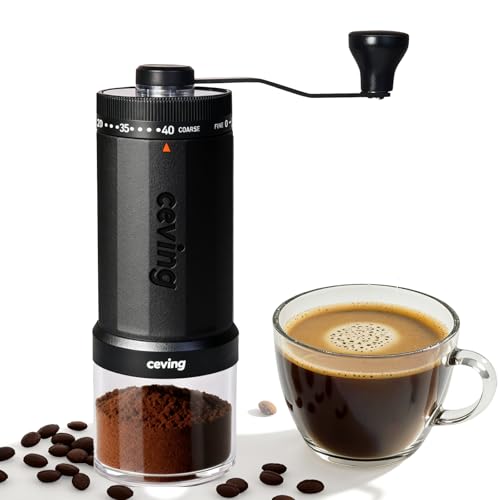
CEVING 60g Ceramic Burr Grinder
Strengths
- 60g capacity
- External 40-click adjustment
- Ceramic burrs preserve flavor
Trade-offs
- Ceramic burrs less durable
- Slightly bulkier design
- Potential static cling
The 60g capacity here is a standout on paper, especially for those brewing for more than one or making cold brew. Being able to grind that much in a single pass without refilling cuts effort in half compared to most manual grinders. The 40 external click settings are a huge win, no more fumbling with internal rings, and owners love how repeatable their settings feel.
But here’s the catch: ceramic burrs, while great at minimizing heat and preserving flavor, don’t hold up as well over time with frequent use, especially with harder beans. Some reviewers note chipping or dulling after months of daily grinding. If you’re a lighter user or value flavor purity over longevity, this could be your pick. For heavy daily use, I’d lean toward stainless steel.
Video review
KINGrinder K6 Hand Coffee Grinder

Strengths
- 60 ultra-fine clicks
- Stainless steel burrs
- Dual bearing system
Trade-offs
- Internal adjustment only
- Small hopper
- No external indicators
With 60 internal clicks at 16µ per step, the K6 offers some of the most precise grind control in its class, this is serious gear for tinkerers. The stainless steel burrs and dual-bearing design deliver on consistency, and owners praise how smooth the grind feels, even at finer settings. It’s clearly engineered with input from serious coffee enthusiasts, including that YouTuber nod in the specs.
But that precision comes with a learning curve. Without external numbering, you’re relying on memory or tick counting, which isn’t ideal mid-morning. Still, for the weight-to-performance ratio, it punches above its class. At 25–35g capacity, it’s not for crowds, but for the solo traveler or minimalist camper who wants barista-level control, it’s hard to beat.
Product photos


TIMEMORE Chestnut C3S Pro Grinder

Strengths
- High-quality S2C burrs
- Foldable handle
- Efficient grinding
Trade-offs
- No external markings
- 36 settings less than some
- Hopper capacity modest
The C3S Pro is where portability meets performance. Its full aluminum alloy body feels premium and sheds heat better than plastic-bodied grinders, which matters during longer grinds. The real star is the S2C660 patent conical burr, owners report minimal fines and boulders, which translates to cleaner extractions, especially for pour over. With 36 grind settings and a foldable handle, it’s built for the road but doesn’t feel like a travel compromise.
I appreciate the labor-saving bearing system, it keeps momentum going, reducing hand fatigue. Compared to the JavaPresse or basic models, this one feels like a true step up in grind quality. It’s not the largest capacity, but for most single brewers, it’s plenty. If you want one grinder that does home and travel well, this is a strong contender.
Product photos


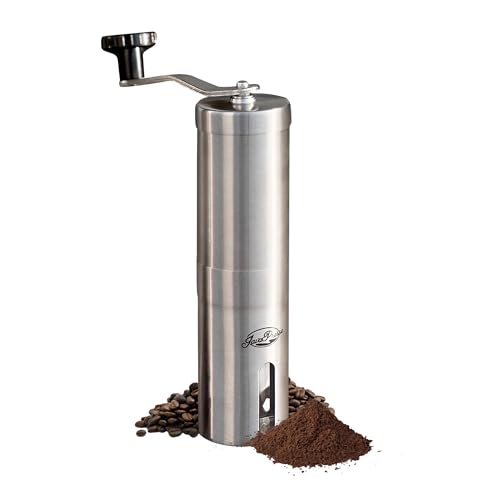
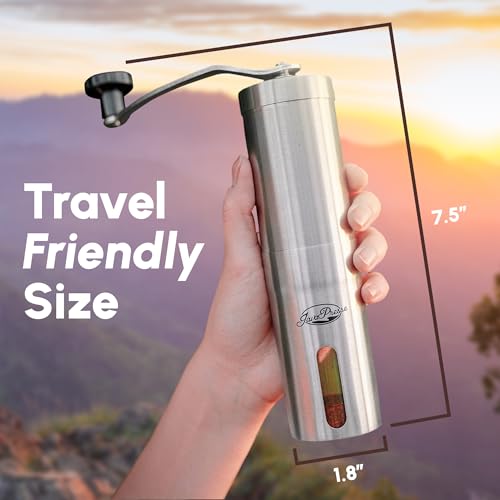
JavaPresse Manual Stainless Steel Grinder
Strengths
- Affordable
- Ceramic burr
- Lightweight and portable
Trade-offs
- No click settings
- Limited precision
- Basic build
This is the budget gateway into decent manual grinding, and it does its job. The ceramic burr delivers a noticeably better grind than blade grinders, and owners say it holds up well for occasional use. It’s lightweight, quiet, and simple, great for camping or a second grinder at the cabin.
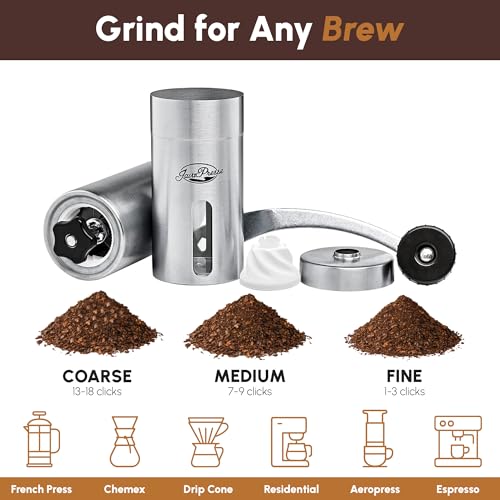
But “18 settings” is vague, and there’s no click system, so repeatability is hit-or-miss. Compared to the TIMEMORE or CEVING models, it feels like a step back in control. Still, for the price, it’s a solid intro. I appreciate that JavaPresse supports farmers, but that doesn’t make the grinder itself more precise. If you’re just starting out or need a backup, it works. For serious brewing, look higher.
Product photos



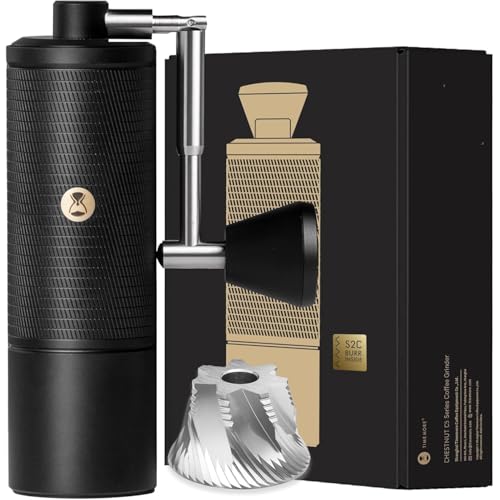
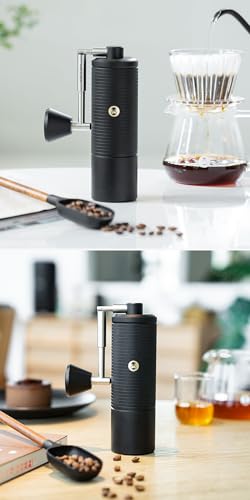
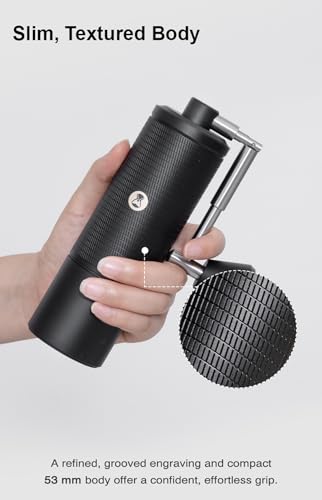
TIMEMORE C5 Pro Stainless Grinder
Strengths
- Ultra-fine 48-click adjustment
- Double bearing stability
- High grind consistency
Trade-offs
- Internal adjustment
- Moderate capacity
- Higher price point
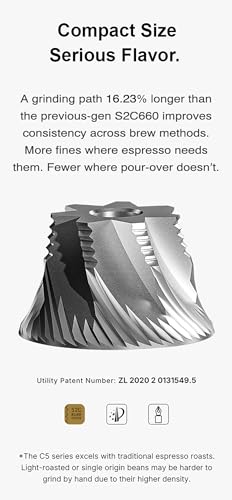
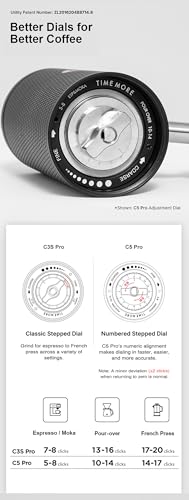
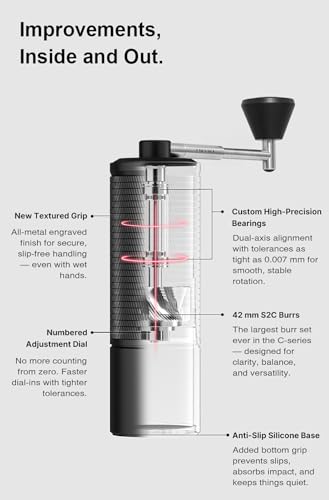
If grind consistency is your top priority, the C5 Pro deserves your attention. The S2C-042-III stainless steel burrs with 0.031mm per click adjustment are among the most precise in any manual grinder. Combined with double bearing positioning, this thing grinds with remarkable uniformity, owners report fewer boulders and fines, which is gold for pour over and espresso.
It’s not the lightest or largest, but at 30g capacity and 663g weight, it’s a fair trade-off. The folding handle helps with portability, though I’d still pick the C3S Pro for backpacking. Where this shines is at home, where you can dial in and nail extraction day after day. For the detail-oriented brewer, this is the tool.
Product photos
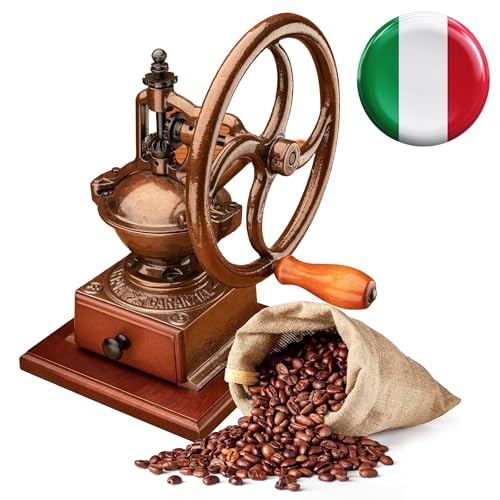
Classic Cuisine Cast Iron Grinder
Strengths
- Heavy-duty build
- Large bean capacity
- Stable base
Trade-offs
- Very heavy
- No external grind indicator
- Bulky footprint
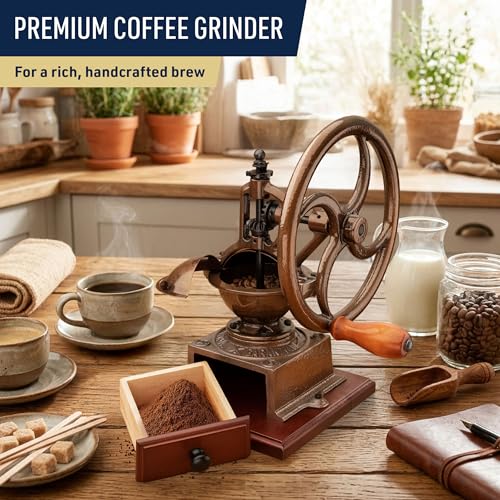
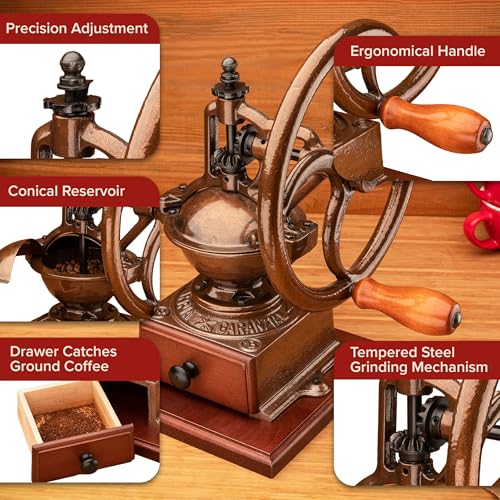
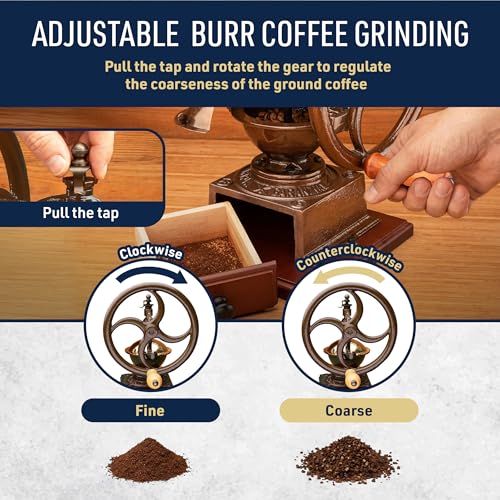
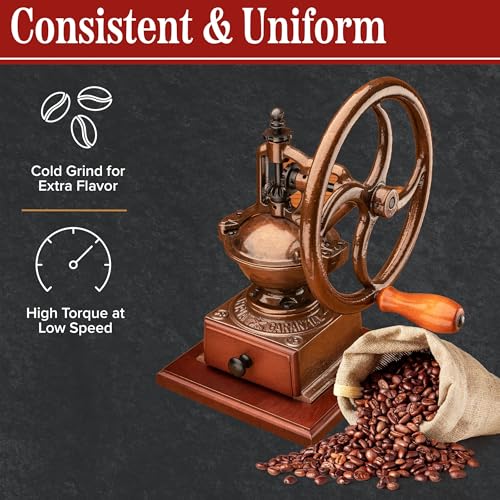
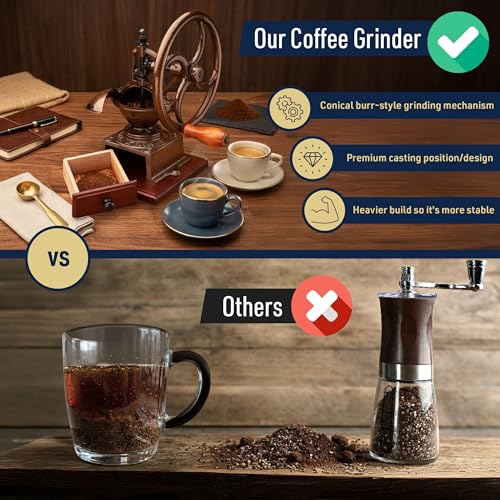
This grinder looks like it belongs on a vintage espresso bar in a 1940s Italian cafe, and that’s part of its appeal. The heavy cast iron body gives it serious stability, so it doesn’t wobble during grinding, which is a real issue with lighter models. On paper, the tempered steel conical burrs should deliver solid consistency, and owners consistently report that it handles fine grinds for espresso well, though not with the precision of higher-end modern grinders.
It’s undeniably built to last, and the 125g hopper is generous for a manual model. But that weight (14.22lbs!) means it’s not going anywhere, this is strictly a countertop piece. If you value tradition, durability, and a statement piece over portability or micro-adjustments, this one earns respect. Still, for the same heft, I’d want external grind markings or more than just hand-crank feedback to dial in.
Product photos
How We Picked These manual burr coffee grinder
As a long-time coffee enthusiast, I wanted to identify the top manual burr grinders available today. Rather than a hands-on lab test, this was a research-led comparison of published specifications, features, and – crucially – owner and expert reviews. I focused on understanding how each grinder performs across a range of needs, from travel to large batches, and considered build quality and adjustability. My aim was to pinpoint grinders offering the best balance of performance and value.
For manual burr grinders, consistency and capacity are paramount. I weighted grind consistency very heavily, as this directly impacts extraction and ultimately, the flavor of your coffee. Capacity followed closely behind; a larger capacity means fewer grinds for bigger brews, which is a significant convenience factor. Finally, the quality of the burrs themselves, material and design, was critical, influencing both grind quality and the grinder’s longevity.
Specifications clearly indicate burr material (ceramic versus stainless steel) and adjustment increments, telling you the potential for precision. However, I relied on owner feedback to assess real-world usability and durability. Reviews helped me understand how easy each grinder is to adjust and clean, and how well they hold up to regular use. Understanding the flavor impact of grinder type is also crucial, and the consensus points to burr grinders delivering a superior, more nuanced cup.
What To Look For In manual burr coffee grinder
Choosing the right manual burr grinder can dramatically improve your daily coffee ritual.
A quality manual burr grinder prioritizes consistent particle size, minimizing fines and maximizing flavor extraction. Key features to evaluate include burr material (ceramic vs. steel), grind adjustment precision, build quality for durability, and overall capacity to suit your brewing needs. Look for grinders with easily adjustable settings and robust construction for long-term performance.
Burr Material: Ceramic or Steel?
The burr material is arguably the most important factor. While both ceramic and stainless steel burrs can produce excellent results, they have distinct characteristics. Stainless steel burrs, like those found in the TIMEMORE C5 Pro, are very durable and remain relatively cool during grinding. Ceramic burrs, as seen in the CEVING 60g Ceramic Burr Grinder, are known for retaining less heat, which can help preserve delicate coffee oils and flavors. However, ceramic burrs can be more brittle and susceptible to damage if a stone chip gets caught in the grind. I generally recommend stainless steel for its longevity, especially if you’re prone to accidentally introducing pebbles into your beans.
Grind Adjustment Precision
Don’t underestimate the importance of precise grind adjustment. A wider range of settings is useful, but how those settings are adjusted matters more. Many grinders offer stepped adjustments, while others have stepless. Stepped adjustments, like those on the KINGrinder K6, are simpler to use but offer less granular control. A finer adjustment – like the 0.031mm per click on the TIMEMORE C5 Pro – lets you dial in the perfect grind for different brew methods. If you plan to experiment with espresso, a highly adjustable grinder is essential. Finding top manual coffee grinders with this level of control will elevate your brewing process.
Capacity and Portability
Consider how much coffee you typically grind at once, and where you’ll be grinding it. A larger capacity, such as the 60g hopper on the CEVING 60g Stainless Steel Burr Grinder, is convenient for families or those who brew multiple cups. However, a larger grinder will naturally be less portable. If you’re a frequent traveler or camper, a compact and lightweight model like the KINGrinder K6 is a better choice. Here’s a quick guide to capacity considerations:
- Single Person: 20-30g capacity is usually sufficient.
- Two People: 30-40g is a good starting point.
- Family/Large Batch: 50g+ will save you time and effort.
A clean grinder is a happy grinder. Regular maintenance not only extends its lifespan but also ensures the best possible flavor from your beans.
Finally, remember that regular cleaning manual coffee grinder is crucial for maintaining performance and preventing stale coffee buildup.
Manual Burr Coffee Grinders Compared
Here’s a comparison of key specifications for several manual burr coffee grinders to help you make an informed decision.
| Product Name | Burr Material | Capacity (g) | Grind Settings | Dimensions (in) | Weight (g) |
|---|---|---|---|---|---|
| CEVING 60g Stainless Steel | Stainless Steel | 60 | 40 | 2.7×7.8×5.3 | 416 |
| CEVING 60g Ceramic | Ceramic | 60 | 40 | 2.7×7.8×5.3 | 346 |
| KINGrinder K6 | Stainless Steel | 25-35 | N/A | N/A | N/A |
| TIMEMORE Chestnut C3S Pro | Stainless Steel | N/A | 36 | N/A | N/A |
| JavaPresse Manual Stainless | Ceramic | N/A | 18+ | N/A | N/A |
| TIMEMORE C5 Pro Stainless | Stainless Steel | 30 | 48 | 159x53x163.5 | 663 |
| Classic Cuisine Cast Iron | Tempered Steel | 125 | Adjustable | 12.2×9.06×13.78 | 6450 |
Frequently Asked Questions
What grind size should I use for French press?
A coarse grind is best for French press; aim for a setting on your grinder that produces particles resembling breadcrumbs. This prevents grounds from passing through the filter and creating a muddy cup.
Will a manual grinder work for espresso?
Yes, but you’ll want to invest in one of the manual grinders for espresso designed for the task. Espresso requires a very fine and consistent grind, so look for a grinder with stepless adjustment and high precision.
How often should I clean my manual burr grinder?
I recommend cleaning your grinder every one to two weeks with regular use. This prevents coffee oils from building up and affecting the flavor of your brew; a deeper clean every month or so is also a good practice.
What’s the difference between ceramic and stainless steel burrs in terms of lifespan?
Stainless steel burrs generally last much longer than ceramic burrs. While ceramic is hard, it’s also brittle and prone to chipping, whereas stainless steel is more resistant to damage from accidental impacts.
How much does grind setting affect the taste of my coffee?
Grind setting is incredibly important; even small adjustments can significantly impact extraction and flavor. A too-fine grind can lead to over-extraction and bitterness, while a too-coarse grind results in under-extraction and sourness.
The Bottom Line
Choosing a manual burr grinder often comes down to balancing control with convenience. If you want the most precise adjustments and are willing to spend a bit more, the TIMEMORE C5 Pro Stainless is the standout performer, offering an impressive 48 grind settings and a durable stainless steel build. It’s a commitment to dialing in your brew, but one that delivers noticeable results.
For those seeking a balance of affordability and capability, the CEVING 60g Stainless Steel Burr Grinder provides excellent value. Similarly, if portability is a key concern – for camping or travel – the KINGrinder K6’s compact size makes it an easy choice. These options deliver consistent grinds without breaking the bank or adding bulk to your gear.
Ultimately, the best manual burr grinder is the one that fits your routine. Don’t get too caught up in chasing the highest number of grind settings or the most exotic burr material. Focus instead on build quality, ease of use, and finding a grinder that allows you to consistently achieve a consistent coffee grind mechanism – that’s where the real flavor improvements lie.
