
Calories in Coffee: Understanding the 0-5 Calorie Baseline
This post contains affiliate links. As an Amazon Associate, we earn from qualifying purchases.
Black coffee contains 0-5 calories per cup, with a standard 8-ounce serving at 2.4 calories. The calorie baseline is nearly zero for plain, unsweetened coffee. Calories only increase significantly when you add milk, sugar, cream, or flavored syrups to your drink.
A plain cup of black coffee contains between 0 and 5 calories. The exact number depends on your brewing method and serving size, but the USDA FoodData Central lists a standard 8-ounce cup at 2.4 calories. Espresso shots and Americanos fall in the same 0-5 calorie range.
The calorie confusion starts after you pour the coffee. Most people think of their morning latte or sweetened iced coffee as just “coffee,” but the milk, sugar, and syrups are where the real calorie load hides. A 16-ounce caramel macchiato can hit 250 calories before you’ve eaten a single bite of breakfast.
This guide breaks down the calorie math from primary sources like the USDA and manufacturer nutrition labels. You’ll see exactly where the calories come from, which brewing methods add a fraction more, and how to keep your daily cup in line with any weight loss plan.
Key Takeaways
- Black coffee’s calorie count is negligible, ranging from 0.6 calories for a 1-ounce espresso shot to 5 calories for a 14-ounce Dunkin’ brew.
- Milk and sugar are the primary calorie drivers. Switching from whole milk to unsweetened almond milk in a 16-ounce latte cuts about 120 calories.
- Brewing method has a minor caloric impact. A French press or cold brew might extract a fraction more soluble solids, but the difference is under 5 calories per serving.
- Weight loss from switching to black coffee adds up slowly. Cutting 250 daily calories from a sugary drink could lead to about a 2-pound weight loss over a month.
- Calorie-free flavor boosters like a pinch of salt or cinnamon let you enhance taste without impacting your count.
How Many Calories Are in Black Coffee?
The USDA’s FoodData Central is the gold standard for nutritional information, and their data is clear. A one-cup serving of brewed coffee, prepared with tap water, contains 2.4 calories. Their entry for espresso is even lower, at 0.6 calories per fluid ounce.
According to the USDA’s FoodData Central, an 8-ounce cup of brewed coffee contains 2.4 calories. A 1-ounce shot of espresso contains 0.6 calories. These figures are for coffee prepared with water and no additives.
Major coffee chains confirm this baseline. Starbucks lists its Espresso Roast brewed coffee at 0 calories per 10-ounce serving. Dunkin’ reports 5 calories for a medium Original Blend. The slight variance comes from the coffee bean’s trace amounts of oils, proteins, and micronutrients that dissolve during brewing.
The type of bean, roast level, and grind size influence flavor, not calories. A dark French roast and a light Ethiopian pour-over will have statistically identical calorie counts if brewed with the same water-to-coffee ratio. The difference is in the dissolved solids, which contribute a negligible amount.
TL;DR: An 8-ounce black coffee has about 2.5 calories. A shot of espresso has less than 1. The bean type doesn’t change this number in any meaningful way.
The Calorie Math of Your Coffee Additives
Black coffee is a non-issue. The caloric payload arrives with everything you add to it. This is where people tracking calories for weight loss get surprised.
A single teaspoon of granulated sugar packs 16 calories. Two teaspoons in your daily cup is 32 calories, which adds up to over 11,000 calories a year. Flavored syrups are worse, a standard pump of vanilla or caramel syrup adds about 20 calories, and many cafe drinks get three or four pumps.
Dairy and plant-based milks are the other major variable. The difference between choices is massive.
| Additive (per 8 fl oz) | Calories | Best For | Watch Out For |
|---|---|---|---|
| Whole Milk | ~150 | Creamy texture, frothing | Highest calorie dairy option |
| 2% Milk | ~120 | Balanced flavor, lower calorie | Still significant calorie load |
| Unsweetened Almond Milk | ~30 | Very low calorie, nutty flavor | Can separate in very hot coffee |
| Half-and-Half (2 tbsp) | ~40 | Richness without watering down coffee | Easy to over-pour, calories add up fast |
| Heavy Cream (2 tbsp) | ~100 | Keto diets, extreme richness | Extremely high in saturated fat |
Common mistake: Switching from sugar to “sugar-free” syrup but keeping whole milk, you save 60 calories from the sugar but keep 150 from the milk. The swap feels healthy but leaves most of the calorie burden intact.
Whipped cream is a silent calorie bomb. A dollop on a mocha or seasonal drink can add 50 to 100 calories instantly. Chocolate shavings, caramel drizzle, and cookie crumbles function the same way, they’re pure sugar and fat.
If your goal is managing calories in milk, the move is to measure. A “splash” of whole milk can easily be two ounces, adding nearly 40 calories. Use a measuring spoon for sugar or a scale for milk until you can eyeball a consistent portion.
TL;DR: Sugar and milk are where 95% of coffee calories live. Switching from whole milk to a low-calorie milk alternative like unsweetened almond milk is the single biggest cut you can make.
Brewing Method’s Tiny Calorie Impact
Brewing technique changes extraction, which changes the minuscule amount of dissolved solids in your cup. The difference is measurable in a lab but irrelevant for daily calorie counting.
Espresso, by forcing hot water through tightly packed grounds under high pressure, pulls a concentrated shot. The USDA figure of 0.6 calories per ounce reflects this. An Americano, espresso diluted with hot water, simply spreads those same calories over a larger volume. A 12-ounce Americano still clocks in under 5 calories.
I pulled shots on a home machine for a year before I weighed the output. A 2-ounce double shot weighed about 60 grams. The scale never moved more than 0.1 grams between shots, which translates to a calorie variance too small for any diet app to care about.
French press and cold brew methods, which involve longer steeping times, extract a slightly higher percentage of the coffee bean’s soluble material. A PubMed coffee composition study on brewing methods confirms that immersion brewing can yield more dissolved solids than percolation. We’re talking about a difference of maybe 1 or 2 calories per cup compared to drip coffee.
Pod systems like Nespresso or Keurig are just delivery mechanisms for ground coffee. The calorie content of the brew is identical to any other method using the same coffee-to-water ratio. The pod’s material doesn’t add calories.
The real caloric impact of brewing method is indirect. A French press or espresso machine gives you control, so you’re less likely to reach for sugar to mask bitterness. A bad batch of drip coffee might drive you to add two sugars instead of one.
What About Decaf, Instant, and Flavored Coffees?
Decaffeination removes caffeine, not calories. The USDA lists decaf brewed coffee at 2.4 calories per cup, the same as regular. The process strips caffeine molecules, leaving the bean’s cellular structure and oils intact.
Instant coffee is dehydrated brewed coffee. The USDA entry for instant coffee prepared with water shows 4.7 calories per cup. The slight increase over brewed coffee is due to the manufacturing process, which can concentrate some solids. It’s still a trivial number.
Flavored coffee beans are a trickier category. Beans roasted with natural flavor oils, like vanilla or hazelnut, add no measurable calories. The flavor compounds are volatile and calorie-free. However, “flavored” coffee that’s actually pre-mixed with sugary powders or creamers is a different product entirely. Read the label.
Pre-made bottled or canned coffee drinks are not black coffee. They are desserts. A 12-ounce bottle of Starbucks Frappuccino can contain 200 calories and 30 grams of sugar. These should be tracked as you would a soda or milkshake, not a cup of coffee.
TL;DR: Decaf and instant coffee have nearly identical calorie counts to regular brewed coffee. Flavored beans add aroma, not calories. Bottled coffee drinks are sugar bombs in disguise.
Realistic Weight Loss Expectations
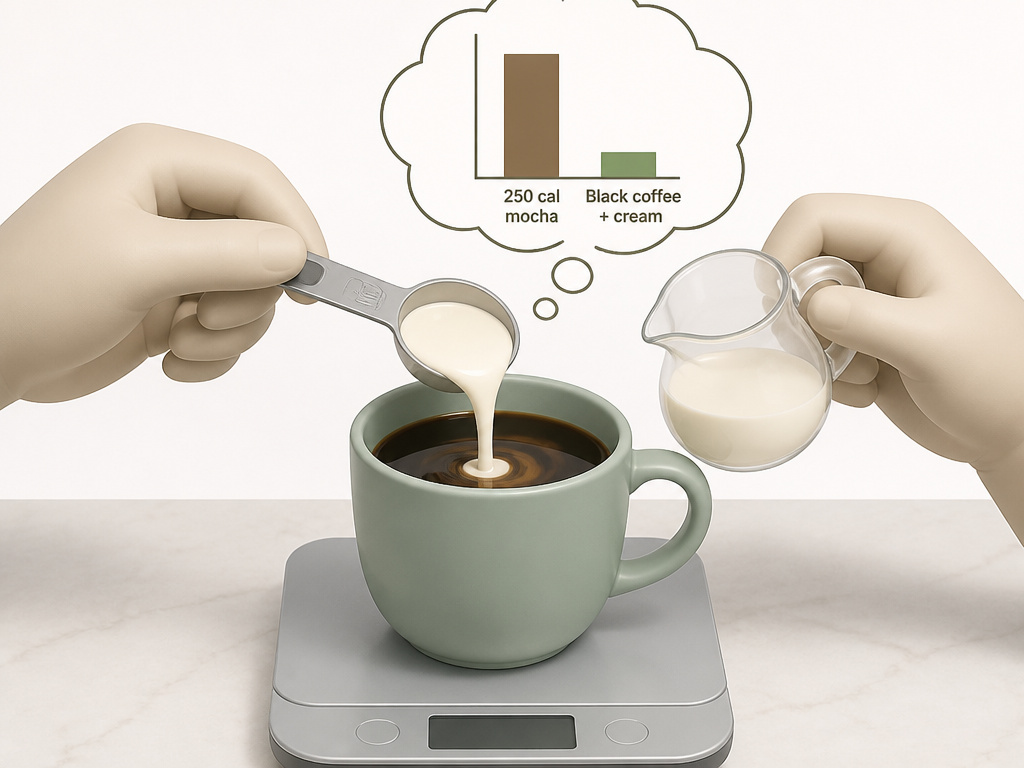
Switching from a daily 250-calorie mocha to black coffee saves 250 calories a day. That’s a 1750-calorie weekly deficit, which translates to about half a pound of body weight per week. Over a month, that’s roughly two pounds.
The math is simple, but the habit is hard. The sweetness and texture of a latte are psychological rewards. Going straight to black coffee is a shock.
A stepped approach works better. First, switch from whole milk to 2% milk. Then to almond milk. Then cut the number of syrup pumps in half. Then switch to a zero-calorie flavor enhancer like a tiny pinch of salt to curb bitterness. Finally, try your drink with just the milk alternative. After a few weeks, black coffee tastes clean, not bitter.
Common mistake: Quitting sugary coffee cold turkey on Monday, by Wednesday the craving wins, and you order a large mocha with extra whip, consuming more calories than if you’d tapered slowly.
Tracking matters. If you don’t measure your milk, you’ll underestimate. A “glug” of half-and-half can be two tablespoons, adding 80 calories you didn’t count. Weighing your additions for a week sets a accurate baseline.
The other benefit is financial. A daily $6 latte costs over $2,000 a year. Switching to black coffee brewed at home cuts that cost by 90%. The weight loss is a side effect of saving money.
How to Build a Low-Calorie Coffee Habit
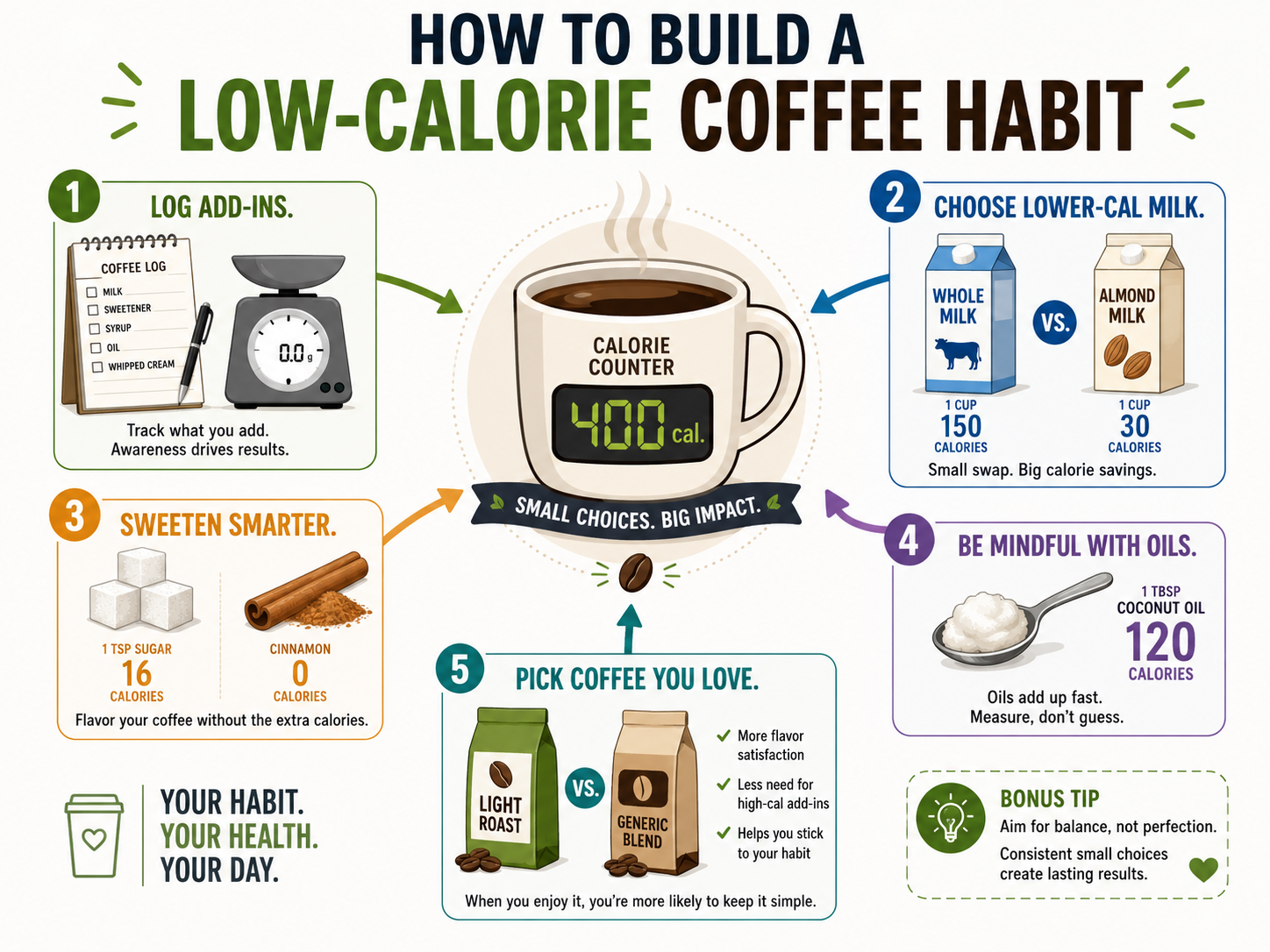
Your tools are a scale, measuring spoons, and a willingness to experiment. Start by knowing your enemy.
- Identify your current calorie load. For one week, log every addition to your coffee. Use precise measures. You’ll likely find one or two ingredients responsible for 80% of the calories.
- Pick one swap. The biggest lever is usually the milk. Swap whole milk for unsweetened almond or oat milk. This alone can cut 100+ calories from a 16-ounce drink. The texture is different, but the nutty flavor works with coffee.
- Attack the sugar. If you use two sugars, try one. If you use flavored syrup, try a low-calorie spice like cinnamon or nutmeg shaken into the grounds before brewing. They add flavor without calories.
- Re-evaluate “healthy” add-ins. Bulletproof coffee, with its tablespoon of butter or coconut oil, is a high-fat, high-calorie meal replacement, not a low-calorie drink. A tablespoon of coconut oil calories adds about 120 calories. So does a tablespoon of MCT oil calories. If weight loss is the goal, these are counterproductive.
- Upgrade your beans. Better coffee tastes better black. A light roast Ethiopian has natural fruity notes that don’t need sugar. A well-pulled espresso has a creamy sweetness from the crema. When the coffee itself is good, you stop wanting to cover it up.
The goal isn’t punishment. It’s noticing that a 400-calorie morning drink is the calorie equivalent of a large banana muffin. Would you eat a muffin every day and wonder why the scale isn’t moving?
Frequently Asked Questions
Does black coffee have any calories at all?
Yes, but a trivial amount. The USDA’s data shows 2.4 calories in an 8-ounce cup of brewed coffee. For practical diet tracking, most people round this to zero.
Does espresso have more calories than drip coffee?
No. Ounce for ounce, espresso is more concentrated, but a standard 1-ounce shot contains only 0.6 calories. A 12-ounce Americano made with two shots and hot water still contains under 5 calories total.
Do different roasts (light vs. dark) have different calories?
No. The roasting process breaks down carbohydrates and oils, but the total caloric content of the dissolved solids in the cup remains statistically identical. The calories in black coffee from light and dark roasts are the same.
Does adding cinnamon or salt to coffee add calories?
No. These are calorie-free flavor enhancers. A pinch of salt can reduce perceived bitterness. Cinnamon adds aroma and a sweet perception without sugar.
How many calories are in an iced coffee?
It depends entirely on what’s in it. A plain black iced coffee has the same 0-5 calories as hot coffee. A commercial iced coffee with milk and sweetener can range from 100 to 250 calories. Always check nutrition information or ask what’s added.
The Bottom Line
Black coffee is essentially a zero-calorie beverage. The entire conversation about calories in coffee is really a conversation about what you put in it. Milk, sugar, syrups, and oils turn a 5-calorie drink into a 500-calorie dessert.
The path to a low-calorie coffee habit is substitution, not deprivation. Swap whole milk for almond milk. Use cinnamon instead of sugar. Measure your additions so you know the real count. Better beans need less help.
Cutting 250 calories a day from your coffee can lead to steady weight loss over months. It’s a small, sustainable change that adds up faster than you think, especially when compared to the sugary drink calories in most energy drinks and sodas. Start with one swap this week.
