
How to Make Iced Coffee Without a Machine: Cold Brew & More
To make iced coffee without a machine, you have three proven paths: cold brew steeping, flash-chilling hot coffee directly over ice, or whipping instant coffee into a foam. Each method hinges on a specific coffee-to-water ratio and grind size to control strength and avoid bitterness.
Most people grab whatever coffee they have, dump it in water, and wait. The result is weak, watery, or harsh, a far cry from the smooth, rich iced coffee you’re after. The difference isn’t patience. It’s precision.
You can nail it with gear you already own. Here are the exact specs, the common trip-ups, and the one method that works when you’re in a real hurry.
Key Takeaways
- Cold brew uses a coarse grind and a long steep (12+ hours) for a smooth, low-acid concentrate. Stumptown’s official 1:2 coffee-to-water ratio is the gold standard.
- Japanese iced coffee, or flash-chilling, brews hot coffee directly onto ice. Blue Bottle’s method uses a 1:16 ratio with a medium-fine grind and a 2:30–3:00 minute brew time for maximum aroma.
- A French press is the easiest tool for cold brew, it combines steeping and straining in one vessel.
- Instant coffee can make a legit iced drink if you whip it with sugar and water into a thick foam before adding it to milk and ice.
- Storing cold brew concentrate in a sealed container in the fridge extends its life to two weeks. Dilute it with water or milk just before serving.
The Two Main Philosophies: Cold Brew vs. Flash-Chilled
Your choice here defines everything about your drink’s flavor profile. Cold brew extracts slowly with cold water, muting acidity and highlighting chocolatey, nutty notes. Flash-chilling captures the bright, fruity aromatics of hot extraction by instantly locking them in ice.
Cold brew coffee steeps coarse grounds in cold water for 12–24 hours, producing a concentrate with about 67% less acidity than hot-brewed coffee. This method requires no heat and relies entirely on time for extraction.
The flash-chill method, often called Japanese iced coffee, isn’t just hot coffee poured over ice. It’s a calibrated pour-over where half your brewing water is replaced by ice in the serving carafe. The hot coffee hits the ice and drops below flavor-degrading temperatures in seconds.
TL;DR: Cold brew for smooth, low-acid sips. Flash-chill for bright, aromatic clarity. They’re different drinks from the same beans.
The Cold Brew Method: Low and Slow
This is the set-it-and-forget-it champion. The process is simple: combine coffee and water, wait, strain. The devil is in the ratios and the wait.
You need a coarse grind. Think breadcrumb texture. A fine grind will over-extract and turn bitter, even in cold water, and it will sludge up your filter. If you only have a blade grinder, pulse in short bursts and shake the grinder between pulses to even things out.
The ratio is non-negotiable. Stumptown Coffee Roasters, a specialty coffee leader, officially recommends a 1:2 coffee-to-water ratio by weight for their concentrate. That means for every 1 gram of coffee, you use 2 grams of water. For a practical batch: 100 grams of coffee to 200 grams (about 1 cup) of water. This makes a strong concentrate you’ll dilute later.
| Factor | Spec | Why It Matters |
|---|---|---|
| Grind Size | Coarse (breadcrumbs) | Fine grinds over-extract and clog filters, creating bitterness and sediment. |
| Coffee:Water Ratio | 1:2 by weight (Stumptown standard) | A weaker ratio (like 1:4) yields a ready-to-drink but flat brew; 1:2 creates a versatile concentrate. |
| Steep Time | 12 hrs at room temp, or 16–20 hrs in fridge | Less than 10 hours tastes weak and under-extracted. Beyond 24 hours can introduce stale, woody notes. |
| Best Tool | French press or mason jar + filter | A French press has a built-in metal filter for easy straining. A mason jar needs a separate paper filter or cheesecloth. |
Combine your coarse grounds and cold water in your jar or French press. Stir gently to make sure all grounds are wet. Don’t heat the water. Cover it and leave it on the counter for 12 hours. If your kitchen is very warm, or if you prefer a slightly mellower extraction, put it in the fridge for 16 to 20 hours.
Straining is the final gate. If you used a French press, just press the plunger down slowly and pour. For a mason jar, set a fine-mesh sieve or a funnel lined with a paper coffee filter over another container. Pour the mixture through. This can take a few minutes, don’t rush it or push on the grounds.
Common mistake: Using a medium or fine grind for cold brew, the increased surface area leads to over-extraction of bitter compounds, and the sludge will clog your filter every time.
Your yield is a potent concentrate. Stumptown advises it will keep in a sealed container in the refrigerator for up to two weeks. To serve, dilute it roughly 1:1 with cold water, milk, or a dairy alternative like almond milk. Pour it over a glass full of ice.
The Flash-Chill Method: Hot Over Ice
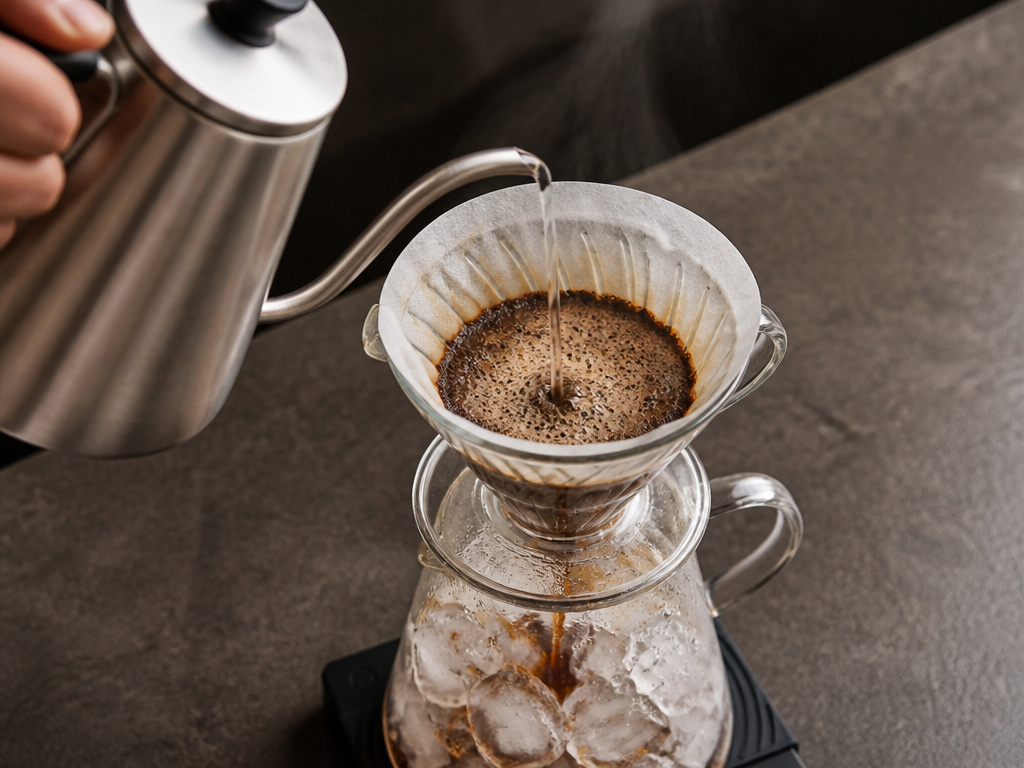
This is for when you want iced coffee that tastes like the best version of hot coffee. The technique comes from specialty cafes like Blue Bottle. It brews a stronger hot coffee directly onto ice, so it chills instantly and preserves the volatile aromatics that normally evaporate as hot coffee cools.
You’ll need a way to brew hot water, a kettle, a pot on the stove, even a microwave. And you need a pour-over setup: a cone and a filter. A Hario V60 or a Melitta dripper is perfect.
The math is precise. Blue Bottle’s recipe is built on a 1:16 coffee-to-water ratio, but half your water is ice. For a single serving: weigh 30 grams of coffee. Grind it to a medium-fine consistency, similar to table salt. Place 240 grams of ice in your serving carafe or glass. Now, your total hot water weight is 240 grams (30g coffee x 16 = 480g total water; 480g – 240g ice = 240g hot water).
Bloom the coffee first. Pour just enough hot water (about 60 grams) to saturate all the grounds. Wait 30 seconds. This lets the coffee degas. Then pour the remaining 180 grams of hot water in slow, steady circles, aiming to finish all pouring by the 1:30 mark. Your total brew time, from first pour to last drip, should land between 2:30 and 3:00 minutes.
If it drips through much faster, your grind is too coarse and the coffee will be weak. If it takes longer than 3:30, your grind is too fine and it will over-extract, turning bitter. This method is less forgiving than cold brew, which is why a consistent burr grinder is a huge advantage here.
The hot coffee melts about half the ice, leaving you with a perfectly chilled, full-strength brew. Give it a gentle swirl and pour it into a fresh glass with new ice. This method produces a drink meant for immediate consumption, not storage.
I tried flash-chilling with a blade-ground coffee once. The inconsistent grind meant some parts over-extracted and some under-extracted. The cup was simultaneously bitter and sour, a confusing mess. Switching to a burr grind fixed it on the next attempt.
TL;DR: Weigh everything. Use half ice, half hot water. Grind medium-fine and hit the 2:30–3:00 minute brew window.
The Instant Coffee Shortcut
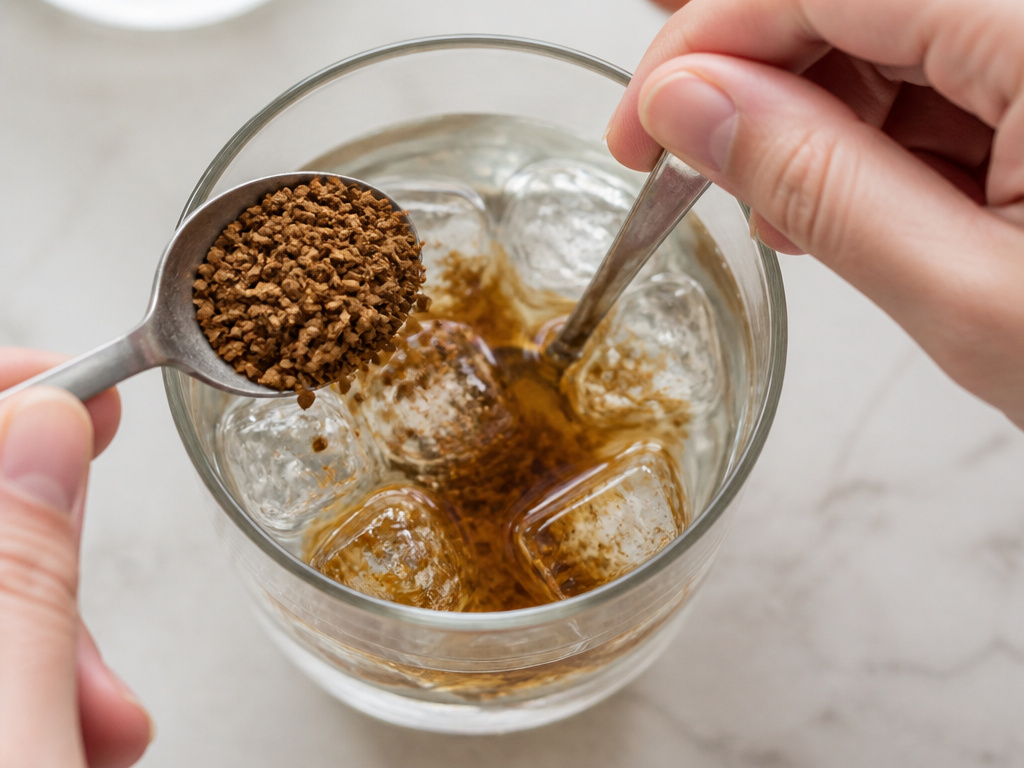
You might think instant coffee is the enemy of good iced coffee. It can be. But there’s a viral method that transforms cheap instant crystals into a luxurious foam, creating a surprisingly delicious and texturally interesting drink.
This isn’t about dissolving granules in water. It’s about emulsification. The technique, popularized on social media, uses mechanical agitation to whip instant coffee, sugar, and a little water into a thick, pale foam.
The formula is simple: equal parts instant coffee and sugar, and twice as much cold water. Start with a tablespoon of instant coffee and a tablespoon of white sugar in a jar or bottle with a tight seal. Add two tablespoons of cold water. Now shake it, hard, for a solid 30 seconds.
You’re not just mixing. You’re incorporating air and forcing the coffee solids and sugar to form a stable foam. It will lighten in color and triple in volume, reaching a consistency like loose whipped cream.
Pour this foam over a glass full of ice. Then top it with cold water or milk. As you drink, the foam slowly integrates, sweetening and flavoring the milk. It’s a completely different experience from gritty, dissolved instant coffee. For sweetness without refined sugar, you could experiment with a natural option like brown sugar, though it may not dissolve as readily in the cold shake.
This method is spectacularly fast. From cabinet to cup in under two minutes. It’s also the most forgiving on grind quality, because there is no grind.
Equipment You Already Own (And One Thing to Buy)
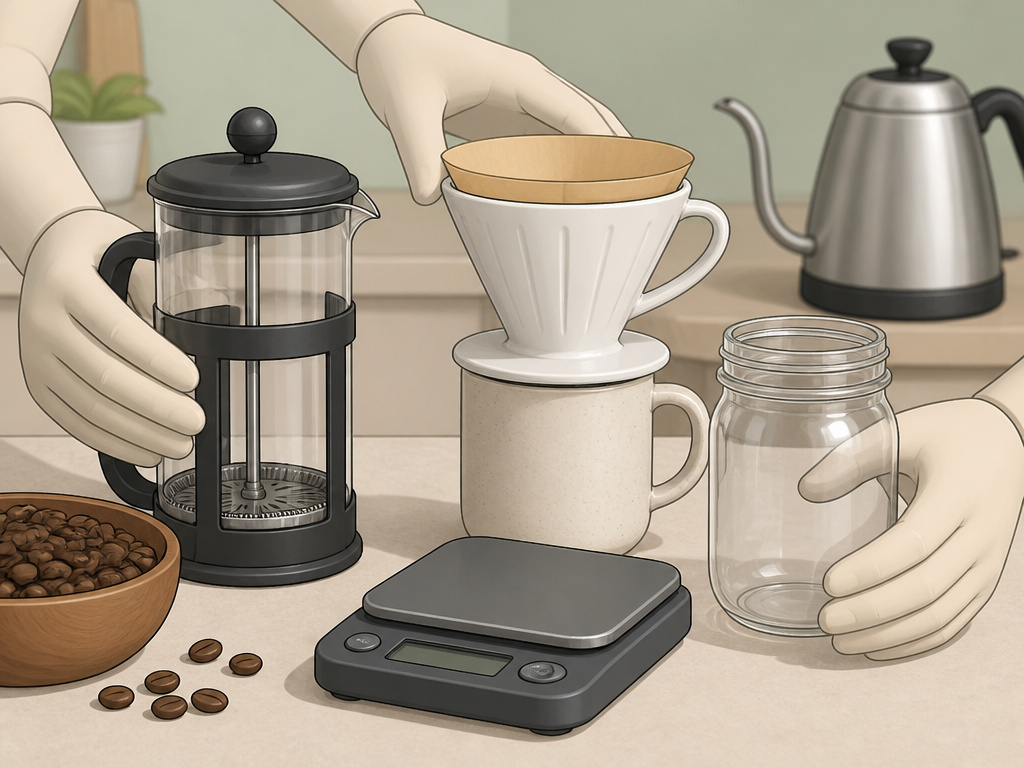
You don’t need a dedicated machine. Your kitchen is already stocked.
A French press is the cold brew workhorse. It immerses the grounds and has a built-in metal filter for easy separation. Cleanup is straightforward: just compost the grounds and wash the beaker.
A pour-over cone (plastic, ceramic, or metal) and some filters are all you need for the flash-chill method. If you’re environmentally conscious, look into biodegradable filters. A kettle for hot water is essential here, but any pot you can boil water in works.
Mason jars or any large, sealable container are perfect for steeping cold brew. For straining without a French press, you’ll need a fine-mesh sieve, cheesecloth, or a paper filter.
The one tool worth buying if you’re serious is a kitchen scale. Measuring by weight is accurate and consistent. A tablespoon of one coffee can weigh significantly more than a tablespoon of another due to density and grind. A $20 digital scale removes all guesswork from your ratios.
| Method | Core Tool | Alternative Tool | Key Limitation |
|---|---|---|---|
| Cold Brew | French Press | Mason Jar + Filter | Metal filter lets through more sediment; paper filters can clog. |
| Flash-Chill | Pour-Over Cone | Large Measuring Cup + Spoon | Without a cone, achieving an even, controlled pour is nearly impossible. |
| Instant Foam | Lidded Jar or Bottle | Bowl + Whisk | Whisking by hand takes longer and may not achieve the same stable foam. |
Troubleshooting Your Iced Coffee
Something taste off? The fix is usually in the ratio, the grind, or the time.
Your cold brew tastes weak or sour. This is under-extraction. Your grind is too coarse, your steep time was too short, or your ratio used too much water. Next time, grind slightly finer, steep for the full 12 hours at room temperature, and double-check your 1:2 ratio by weight.
Your flash-chill coffee is bitter. This is over-extraction. Your grind is too fine, your water was too hot (use water just off the boil, around 205°F), or your pour was too slow, extending the brew time past 3:30. Grind coarser and aim to complete your pour by 1:30.
Your instant foam is runny or falls flat. You didn’t shake hard enough or long enough. The agitation is what creates the emulsion. Use a jar with a very tight seal and shake it like you mean it for a full 30 seconds. The mixture should be thick and pale.
All your methods taste flat or stale. Your coffee beans are old. Coffee is best used within 3–4 weeks of its roast date. Pre-ground coffee loses its vibrancy even faster. If you’re buying bags with no roast date, you’re fighting a losing battle. For a quick fix to mask staleness in a pinch, a pinch of salt can reduce the perception of bitterness.
Frequently Asked Questions
Can I use regular pre-ground coffee for cold brew?
Yes, but aim for a grind labeled “coarse” or “French press.” Standard drip grind is a bit too fine and will make a slightly more bitter, sediment-heavy brew. It will still work, but straining will take longer.
How long does homemade iced coffee last in the fridge?
Cold brew concentrate lasts up to two weeks in a sealed container. Flash-chilled coffee or diluted cold brew is best consumed within 24 hours, as the melted ice continues to dilute it and flavors degrade.
Does cold brew have more caffeine than hot coffee?
It depends on your dilution. Cold brew concentrate, at a 1:2 ratio, is extremely potent. When diluted 1:1 with water, its caffeine content is roughly comparable to a standard cup of hot drip coffee. For a detailed look, our guide on caffeine in iced drinks breaks it down.
What’s the best coffee bean for iced coffee?
For cold brew, choose a medium or dark roast with chocolate, nut, or caramel notes. For flash-chilling, a light or medium roast with fruity or floral highlights will shine through the rapid cooling process. The method matters more than the bean.
Can I make a large batch of flash-chill coffee?
It’s tricky. The method relies on the hot coffee instantly chilling upon contact with a specific mass of ice. Scaling it up requires precise calculations for ice and water, and a pour-over device large enough to handle the volume. For batch brewing, cold brew is the more practical choice.
The Bottom Line
Skip the expensive coffee shop line and the single-use machine. Your best iced coffee is already in your kitchen. For effortless, smooth results that last two weeks, master the 1:2 cold brew ratio in a French press. For a bright, aromatic cup that tastes like a specialty cafe, practice the flash-chill pour-over with a scale and timer. And for a shockingly good drink in under two minutes, shake that instant coffee into a foam.
Each method serves a different mood and timeline. Your choice between a brewed coffee method and an instant one just got a lot clearer. Now you know the numbers, the tools, and the mistakes to avoid. The only thing left is to make it.
