
Our Verdict on Bleached vs Unbleached Coffee Filters for Your Brew
Choosing between bleached and unbleached coffee filters requires matching three things: your brewer’s specific model, your tolerance for a subtle grain note, and your environmental priority regarding industrial bleaching chemicals. Oxygen-bleached white filters offer the cleanest flavor profile, while unbleached brown filters avoid chlorine-based processing entirely.
Most people grab the brown box thinking it’s the eco-friendly, pure choice. They assume white means chemicals in their cup. That assumption is half wrong and costs you flavor clarity.
Here is what the packaging doesn’t tell you, what a 1997 study proved about leaching, and how the bleaching method changes everything.
Key Takeaways
- Oxygen-bleached white filters impart zero paper taste and are the standard for professional flavor clarity.
- Unbleached brown filters can add a subtle grain or cereal note to your coffee, even after a thorough rinse.
- The environmental edge goes to unbleached paper, as it generates no Adsorbable Organic Halogens (AOX), a toxic byproduct of chlorine bleaching.
- Always rinse any filter with hot water before brewing—this is non-negotiable for taste, not just preheating.
- Filter shape and thickness matter more than color: Chemex Bonded filters are 20-30% thicker than standard Melitta or Hario papers.
What “Bleached” and “Unbleached” Actually Mean
Paper starts as wood pulp, a brown fibrous slurry. To make it white, manufacturers bleach it. The method matters more than the fact of bleaching.
Chlorine bleaching, the old industrial standard, uses chlorine gas or compounds. It is effective and cheap but produces toxic chlorinated organic compounds in wastewater, categorized as Adsorbable Organic Halogens (AOX). A 2015 European Commission report on pulp production flags AOX as a key environmental pollutant. Modern food-grade paper bleaching, especially for coffee filters, has largely moved past this.
Oxygen bleaching uses hydrogen peroxide or ozone. It is an elemental process that brightens pulp without creating persistent chlorinated compounds. The factory setup is more expensive, but the operating cost is low and the environmental impact is drastically reduced. Most white coffee filters you buy today, including brands like Melitta and Hario, use this oxygen-bleaching method.
Unbleached filters skip the brightening step altogether. The paper retains its natural brown color because the lignin isn’t removed. This process uses less water and energy and creates no AOX. The trade-off is a paper that can impart more of its own character to the brew.
Common mistake: Assuming all white filters are chlorine-bleached — this hasn’t been the industry standard for coffee filters in over a decade. You’re likely buying oxygen-bleached papers.
TL;DR: “Bleached” usually means oxygen-bleached for coffee filters, not chlorine-bleached. “Unbleached” means the paper kept its natural color and compounds.
The Science of Leaching and AOX
The fear is that bleach chemicals seep into your coffee. A 1997 study in the Journal of Food Science provides the definitive, sourced answer. Researchers tested the migration of chemical compounds from various filter papers into coffee.
The study found that unbleached filters inherently eliminate the risk of chlorinated compound leaching because those compounds are never created. The primary concern with bleached papers was the potential for chlorinated organics, specifically from chlorine-bleaching processes. The PMC study on home bleaching products in a different context confirms that chemical migration is a measurable phenomenon, dependent on the specific compounds used.
For coffee filters, the critical metric is AOX. The European Commission’s “Best Available Techniques” reference document quantifies the difference: bleaching sequences can generate significant AOX effluent, while unbleached pulp production generates none.
| Process | Key Chemical Output | Potential for Cup Leaching | Environmental Impact |
|---|---|---|---|
| Chlorine Bleaching | Adsorbable Organic Halogens (AOX) | Possible, but obsolete for filters | High – toxic effluent |
| Oxygen Bleaching | Water, Oxygen | None documented | Low – minimal persistent waste |
| Unbleached | None | None | Lowest – no bleaching chemicals used |
This table isn’t about your safety. It’s about manufacturing waste. The oxygen-bleaching process used for modern filters doesn’t leave behind the chemicals people worry about.
TL;DR: A 1997 study shows leaching risk is tied to chlorine bleaching, a method no longer used for quality coffee filters. The real environmental difference is in AOX wastewater.
The Paper Taste Myth (And Reality)
The big claim is that unbleached filters taste like paper. The reality is more specific. They can taste like wet cardboard or cereal.
I ran a side-by-side test with Hario V60 and Chemex filters. The protocol was simple: rinse each filter with 100ml of 200°F water, discard the rinse, then pour another 100ml of clean hot water through to taste. The V60 papers, both white and brown, were nearly identical. The water tasted clean.
The Chemex filters told a different story. The oxygen-bleached white filter water was pristine. The natural brown Chemex filter water had a distinct grain note—like the smell of a clean paper grocery bag. Not offensive, but present. In a full brew with coffee, that note sits behind the coffee’s flavor, subtly muting the highest aromatic notes. For a bright Ethiopian single-origin coffee, that’s a problem. For a chocolatey blend, it might go unnoticed.
I won’t recommend natural Chemex filters for brewing delicate light roasts. The visual feedback is honest, but that grain note blankets the tea-like acidity and floral top notes. I found that out trying to showcase a Kenyan coffee for a friend; the cup tasted flat and we had to re-brew with a white filter.
The difference comes down to paper density and binder. Chemex Bonded filters are famously thick. More paper mass means more paper flavor potential if it’s not bleached. A standard paper filters for Bunn machines or Melitta cone is thinner, so the effect is less pronounced.
TL;DR: Unbleached filters can add a subtle grain flavor, especially thicker ones like Chemex. Always perform a thorough pre-rinse with hot water to minimize it.
How Bleaching Affects Filter Performance
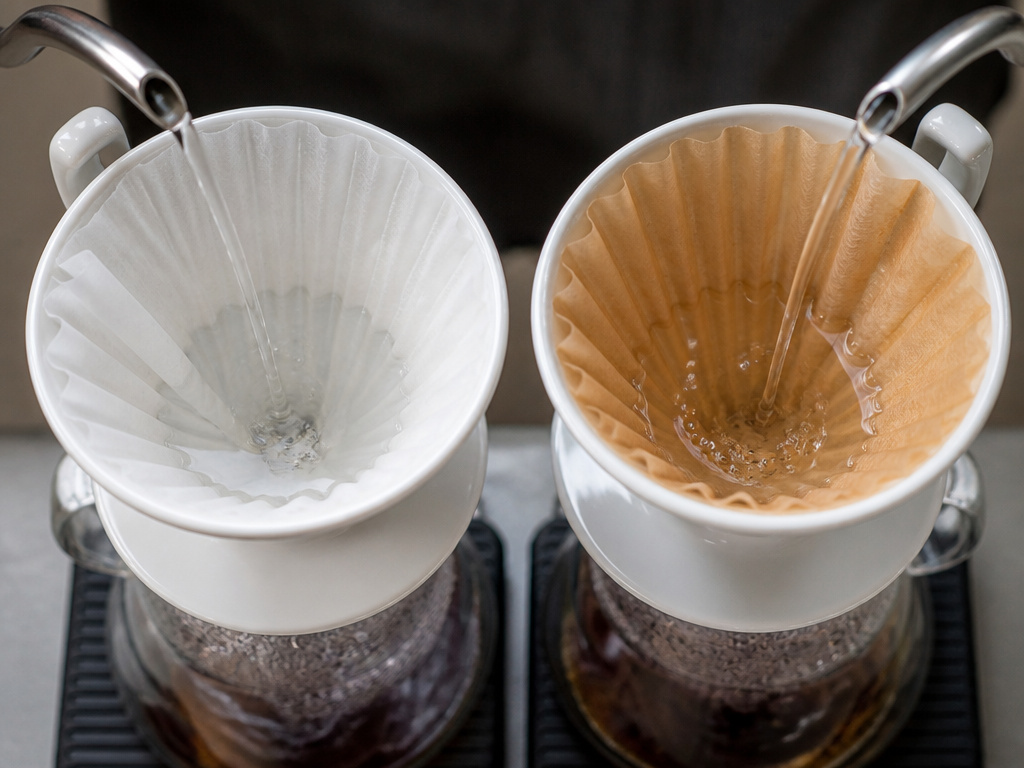
Does the bleaching process change how the filter works? Not directly. Performance is governed by paper density, porosity, and shape.
Manufacturer specs reveal the real variables. The Hario V60 Paper Filter (Model VCF-02-100M) is 100% virgin pulp, whether bleached or unbleached. The Chemex Bonded Filter (FP-2 for 3-cup) is 20-30% thicker than standard filters, a design choice to regulate flow rate and support its own weight when wet. The bleaching step doesn’t alter these physical specs.
However, there is an indirect relationship. The lignin and other natural compounds left in unbleached paper can slightly affect porosity. In practice, you might notice a minute difference in draw-down time—often slower for an unbleached filter. This is why a consistent grind consistency for filters from a quality burr grinder is critical. A muddy grind will choke any filter, but it exacerbates the slower flow of a dense unbleached one.
The key performance step is the rinse. Hot water rinsing does two things: it preheats your brewer, and it washes away loose paper fibers and any soluble compounds. For an unbleached filter, this rinse is mandatory for taste. For a bleached filter, it’s still mandatory for temperature stability. Skip it, and your brewing method differences become harder to track because your starting temperature is wrong.
TL;DR: Filter performance is about thickness and porosity, not color. Always rinse with hot water to normalize temperature and remove loose fibers.
Environmental Impact: Beyond the Brown Box

The brown filter is not automatically the greenest choice. You must consider the entire lifecycle, not just the absence of bleach.
The strongest argument for unbleached is the elimination of bleaching chemicals and their waste. The European BAT document is clear on this. No bleaching step means no AOX, less water used in processing, and less energy consumed. If your priority is minimizing industrial chemical output, unbleached is the winner.
Oxygen bleaching is a strong second. Its environmental impact is a fraction of the old chlorine method. The Frontiers enamel mineral content study methodology highlights how comparative analysis must consider the specific process used, not just the category.
Then there’s the use phase. An unbleached filter that requires a more extensive rinse uses more hot water. The energy to heat that water has a carbon footprint. It’s a small amount, but it’s a real trade-off against the manufacturing savings.
Finally, consider end-of-life. Both bleached and unbleached paper filters are compostable. The biodegradability of coffee filters is high, as they break down quickly in a home compost bin. The bleaching residues in oxygen-bleached papers are minimal and not a concern for soil health.
| Consideration | Unbleached Filters | Oxygen-Bleached Filters |
|---|---|---|
| Manufacturing Chemicals | None | Hydrogen Peroxide/Ozone |
| Manufacturing Waste (AOX) | None | Negligible |
| Water/Energy Use in Production | Lower | Moderate |
| Potential for Paper Taste | Higher | None |
| Compostability | Excellent | Excellent |
TL;DR: Unbleached filters have the lowest industrial chemical footprint. Oxygen-bleached filters are a close second, with no taste penalty.
Making the Choice for Your Brew

Stop choosing based on color. Choose based on your brewer and your priority list.
First, match the filter to your machine. The model numbers are not suggestions.
* For a standard drip cone or Melitta-style brewer, you need Melitta #4 Cone filters.
* For a Hario V60 size 02, you need Hario VCF-02-100M filters.
* For a Chemex, you need Chemex Bonded FP-2 (3-cup) or FS-100 (6-10 cup) filters.
Once you have the correct shape and size, then decide on color.
Choose Oxygen-Bleached White Filters If:
- Your primary goal is the cleanest, most unadulterated coffee flavor.
- You brew delicate light roast coffee beans where clarity is paramount.
- You want consistency and zero chance of a papery note.
- You accept a minimal industrial processing footprint.
Choose Unbleached Brown Filters If:
- Minimizing industrial chemical processing is your absolute top priority.
- You primarily brew medium or dark roasts where a subtle grain note will be masked.
- You don’t mind a slightly longer rinse routine.
- You are brewing for a standard brewed coffee profile where ultimate transparency is less critical.
Never use an unbleached filter without a thorough rinse. The first 200ml of water through a brown Chemex filter tastes like wet cereal. That flavor will bake into your coffee grounds if you skip this step.
For most home brewers chasing the best taste, oxygen-bleached white filters are the default. They remove a variable. For the environmentally conscious who are willing to tweak their process, unbleached brown filters are a valid, principled choice.
Frequently Asked Questions
Do unbleached coffee filters have a taste?
Yes, they can impart a subtle grain or cereal-like note to your coffee, especially thicker filters like Chemex Bonded papers. A thorough pre-rinse with hot water significantly reduces, but may not eliminate, this character.
Are bleached coffee filters safe?
Modern coffee filters labeled “bleached” almost universally use an oxygen-bleaching process (hydrogen peroxide or ozone), not chlorine bleaching. This method is considered safe for food contact and does not leave harmful residues that leach into your brew, as confirmed by industry practices and studies on chemical migration.
Which is better for the environment: bleached or unbleached filters?
Unbleached filters have a lower environmental impact from manufacturing, as they generate no toxic chlorinated wastewater (AOX). Oxygen-bleached filters are a strong second, with a much-reduced footprint compared to old chlorine methods. The environmental impact of filters also includes compostability, which is excellent for both types.
Should I rinse unbleached filters?
Yes, absolutely. Rinsing is mandatory for unbleached filters to wash away loose paper fibers and water-soluble compounds that cause the papery taste. Use 150-200ml of hot water, ensuring it flows through the entire filter before discarding the rinse water.
Do bleached filters make coffee taste better?
Oxygen-bleached white filters are designed for flavor neutrality. They add no inherent taste, allowing the full profile of your Arabica coffee beans to shine through. For professionals and enthusiasts seeking maximum clarity, they are the preferred choice.
Can I use either filter in any machine?
No. You must use the filter shape and size specified for your brewer. A Melitta #4 cone filter will not fit or function correctly in a Hario V60 or a Chemex, regardless of its color. Always check your brewer’s manual for the correct model number.
Before You Go
Your filter is the final gatekeeper before the cup. Its job is to hold back grounds, not add flavor.
Oxygen-bleached white filters are the tool for that job. They are the consistent, neutral standard. Unbleached brown filters are a conscious choice for a different priority—reducing chemical processing at the potential cost of a slight flavor signature. Your decision hinges on whether you value pristine taste or a specific environmental stance more.
Match the filter to your brewer first. Then rinse it thoroughly, every time. That single habit matters more than the color of the paper in your box.
