
Guide: How to Make Iced Coffee with Your Keurig Coffee Maker
To make iced coffee with a Keurig, brew a small, concentrated cup of hot coffee into a heat-safe mug, then pour it over a full glass of ice. Never brew directly onto ice in a glass carafe or thin glass, as the extreme temperature change can shatter it. Models with a dedicated “Iced” button automate this concentrated brew for you.
Most people grab a glass, dump in ice, and hit brew. That method works until the day it doesn’t, and the failure isn’t a weak drink, it’s a cracked glass and a counter covered in hot coffee and shards. Keurig’s own support page warns against it for a specific physical reason they don’t fully explain.
This guide walks through the official, safe method and the workarounds for every Keurig model. You will get the strength right, avoid the thermal shock that breaks glass, and learn which pods and add-ins turn a simple iced coffee into something worth sipping slowly.
Key Takeaways
- Keurig explicitly warns against brewing directly over ice into glass due to thermal shock, the rapid temperature change can crack or shatter the vessel.
- Machines with an “Iced” button (like the K-Elite or K-Slim + ICED) brew a stronger, smaller shot (typically 6oz) designed to be poured over ice.
- For models without that button, manually select the smallest brew size (6oz or 8oz) to create a concentrated coffee base that can withstand dilution.
- Using a reusable K-Cup filter with a fine grind of dark roast coffee gives you the most control over strength and flavor for iced drinks.
- Always brew into a heat-safe mug or plastic tumbler first, then pour over ice in your serving glass. This is the single step that prevents mess and potential injury.
The Official Keurig Method (And Why It Says No to Ice)
Keurig’s support documentation is unambiguous. The instruction is to not brew directly over ice. The reason is not about taste, it’s about material science and a recalled history.
Before you start: The brewer dispenses water near boiling temperature (192°F). Introducing this to a mass of 32°F ice creates a thermal gradient that thin glass cannot handle. Stress fractures can form instantly or after a few cycles, leading to sudden failure. Use a heat-safe intermediary mug.
The official method is a two-vessel process. You brew hot coffee into a sturdy mug, then you pour that coffee over ice in your drinking glass. This simple pause allows the coffee’s temperature to drop slightly and the thermal transfer to happen in the air, not against the glass wall.
This caution traces back to a documented safety mindset. In 2014, Keurig recalled millions of MINI Plus brewers (models K10 and B31) because they could spray hot water during operation. While not the same as a glass breaking, that incident underscores the manufacturer’s established focus on hot-liquid safety and predictable performance.
TL;DR: Brew hot into mug, then pour over ice. Skipping the mug risks glass fracture via thermal shock.
What If Your Keurig Doesn’t Have an “Iced” Button?
Most older or basic Keurig models lack a dedicated button. This doesn’t mean you can’t make good iced coffee. It means you manually replicate what the “Iced” button does: brew a smaller, stronger cup.
The “Iced” button on a Keurig K-Elite or K-Slim + ICED isn’t magic. It programs the machine to run the same amount of water through the pod over a shorter time, or to use a finer internal pressure profile, resulting in a more concentrated extraction. You can approximate this.
First, always select the smallest brew size on your machine’s menu. This is typically 6oz, sometimes 8oz. The 10oz and 12oz sizes will produce coffee that is too weak once diluted.
| Brew Size | Best For | Risk If Used for Iced |
|---|---|---|
| 6oz | Iced coffee, strong espresso-style drinks | Can be too intense if not diluted enough |
| 8oz | A balanced iced coffee, larger servings | May taste slightly weak with a full glass of ice |
| 10oz / 12oz | Standard hot coffee | Will taste watery and flat when poured over ice |
Second, choose your pod for the job. A dark roast K-Cup inherently has a bolder, less acidic flavor profile that stands up to ice melting better than a light roast. If you use a reusable filter, grind your beans slightly finer than you would for a standard cup. The finer particles increase surface area, boosting extraction in that short brew cycle.
Common mistake: Using the 12oz setting with a light roast pod, the resulting drink tastes like faintly brown ice water by the time you’re halfway through.
The process is simple. Brew your small, strong cup into a mug. While it brews, fill your serving glass to the brim with ice. The mass of cold ice is what stops the melt, if you use four cubes, they’ll vanish in seconds. Pour the hot coffee over the ice, listen to the crackle, and stir immediately.
The Community Workaround: Brewing Directly Over Ice (And the Risk)

Search any coffee forum and you’ll find Keurig owners who swear by brewing directly over ice. They often use a plastic tumbler or a thick, insulated metal cup like a Yeti. This method contradicts the manufacturer’s warning but is rooted in a practical understanding of materials.
The risk Keurig cites is specific to glass. Plastic and metal have different thermal expansion coefficients. They can handle the rapid temperature change without structural failure. The community workaround changes the vessel, not the thermodynamics.
If you go this route, you must manage two new variables: splash and overflow. As the hot coffee hits the ice, it can splatter. As the ice melts rapidly, the liquid volume in the cup can exceed its capacity and spill over the rim.
Here is a safe sequence if you choose to ignore the manual:
1. Use a plastic or metal cup, never glass.
2. Fill it only 2/3 full with ice.
3. Place it on the drip tray and start the brew cycle.
4. Stand back slightly for the first few seconds to avoid splash.
5. Have a towel ready.
The appeal is one less dish to wash. The trade-off is accepting a liability that Keurig’s warranty won’t cover if something goes wrong. I tried this with a stainless steel tumbler for a month. It worked fine until a particularly vigorous brew cycle caused a splash that hit my hand. It was a minor burn, but it underlined why the two-vessel method exists.
I won’t recommend the bottomless portafilter for first-time grinder calibration. The visual feedback is honest, but new users overcorrect on every shot and chase ghosts. Found that out training my first apprentice.
TL;DR: If you brew directly over ice, only use plastic or metal cups and leave room for splash. The convenience isn’t worth a glass-related injury.
Pro Moves for Better Flavor
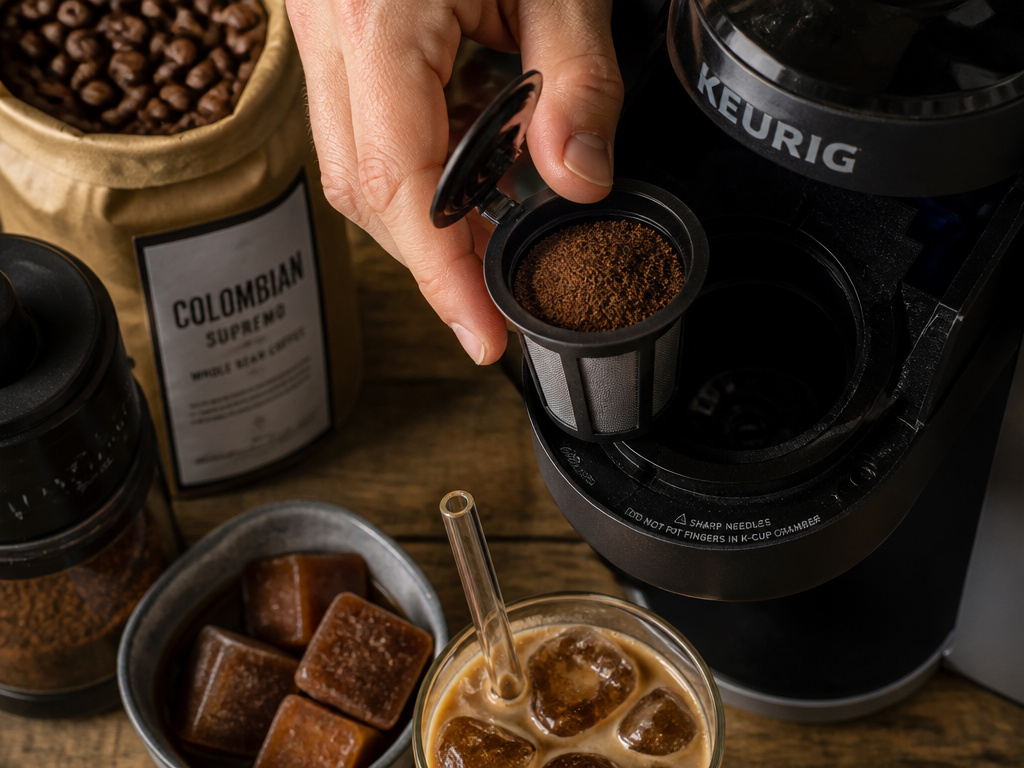
Strength is just the first battle. Iced coffee from a single-serve pod can taste one-dimensional. A few adjustments bridge the gap between passable and great.
Start with your coffee base. As mentioned, dark roasts win. But within that, look for pods labeled “Espresso Roast” or “Extra Bold.” These are blended and roasted for a more concentrated flavor profile. The Starbucks Espresso Roast K-Cup or the Green Mountain Coffee Nantucket Blend are reliable choices.
The real lever is your reusable K-Cup filter. This little mesh basket lets you use any ground coffee. For iced coffee, grind fresh beans to a consistency slightly finer than table salt. Dose it full, about 2 tablespoons or 12 grams. This gives you the intensity needed to punch through dilution.
Now, address dilution itself. The enemy isn’t ice; it’s warm, watery melt. The solution is to make coffee ice cubes. Brew a strong cup, let it cool, and freeze it in an ice tray. Using these instead of water ice means your drink stays strong as it chills. It is the single best upgrade for home iced coffee.
Finally, integrate your additions thoughtfully. Pouring cold milk into hot coffee over ice can sometimes cause curdling if the dairy is old or very acidic. Add the milk after the coffee has cooled slightly from contact with the ice, or use a stable non-dairy creamer like oat or almond milk. For sweetening, a liquid syrup incorporates instantly. A simple brown sugar syrup (one part brown sugar to one part hot water, stirred) adds a caramel depth that granulated sugar can’t match.
| Flavor Boost | How To Use | Why It Works for Iced |
|---|---|---|
| Coffee Ice Cubes | Replace regular ice cubes | Prevents watery dilution as drink sits |
| Liquid Sweetener | Simple syrup, maple syrup, flavored syrup | Dissolves instantly in cold liquid |
| Pinch of Salt | Add a tiny amount to grounds or finished cup | Cuts perceived bitterness amplified by chilling |
| Spice Infusion | Add cinnamon or nutmeg to grounds in reusable filter | Adds complexity without sweetness |
A pinch of salt is a barista trick that works wonders in iced coffee. The sodium ions block some of the bitterness receptors on your tongue. It doesn’t make the coffee taste salty; it makes it taste smoother and more balanced, especially with darker roasts.
Choosing the Right Keurig Model for Iced Coffee
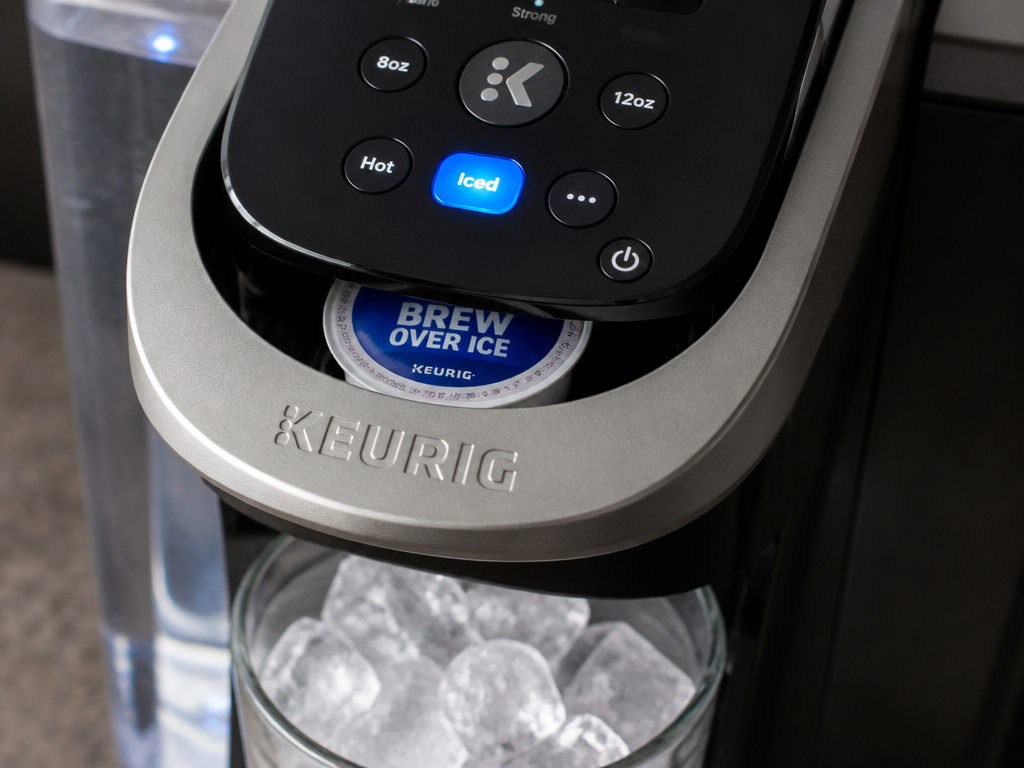
If you’re in the market for a machine and iced coffee is a priority, your choice is simple. Get a model with a dedicated “Iced” button. This isn’t a gimmick, it’s a calibrated setting that removes guesswork.
The Keurig K-Elite (Model K-Elite) is the standard-bearer. Its “Iced” button delivers a stronger 6oz brew. It also has a built-in hot water spout for tea, which is irrelevant for coffee but speaks to its versatility. The K-Slim + ICED (Model K-Slim + ICED) is the space-saving option with the same dedicated button.
The higher-end K-Supreme Plus SMART offers “Brew Over Ice” settings alongside its multi-temperature controls. This is for the enthusiast who also wants to experiment with brew temperatures for different hot coffees.
For everyone else, the vast majority with a K-Classic, K-Select, or older model, the manual method is your path. The difference between a machine with the button and without isn’t quality; it’s convenience. The button ensures consistency. Without it, you must be diligent about always selecting the 6oz setting and using the right pods.
If your iced coffee consistently tastes weak, the problem is almost always the brew size, not the pod. Lock in the small setting before you spend money on new coffee.
Frequently Asked Questions
Can I use any K-Cup for iced coffee?
You can, but dark roast or “extra bold” labeled pods will produce a much better result. Light roasts and breakfast blends are too delicate and will taste washed out once diluted. A blonde roast is the worst choice here, its subtle notes vanish against the ice.
How much caffeine is in Keurig iced coffee?
The caffeine in iced coffee from a Keurig is identical to the hot version of the same pod and brew size. A standard 8oz K-Cup brewed coffee has between 75-150mg of caffeine. Because the “Iced” button uses a smaller size, you might get slightly less volume but a similar total caffeine punch. It is not as concentrated as a true espresso shot.
Why does my iced coffee taste bitter?
Bitterness in iced coffee is often exacerbated by the chilling process, which can mute sweetness and amplify harsh notes. First, ensure you’re not over-extracting by using too fine a grind in a reusable filter or the smallest brew size on an old, scaled machine. Second, try the salt trick. Third, consider adding a fat source like a dash of MCT oil or coconut oil, the fat molecules bind to some bitter compounds, smoothing the mouthfeel.
Can I make a large batch of Keurig iced coffee?
Yes, but not directly. The best method is to brew multiple concentrated cups (using the 6oz setting) into a large heat-proof pitcher or measuring cup. Let this concentrate cool for 10-15 minutes, then pour it over a full pitcher of ice. Stir vigorously to chill it quickly. Store any leftovers in the refrigerator without ice; add fresh ice to each serving.
Is it cheaper to use a reusable K-Cup?
Overwhelmingly, yes. A bag of whole bean coffee costs less per cup than a packaged K-Cup. The upfront cost of the reusable filter pays itself off in a few weeks. You also gain complete control over grind size and coffee origin, which is the key to a truly great iced coffee that doesn’t taste like a compromise.
The Bottom Line
Making iced coffee with a Keurig is about respecting physics and managing dilution. The machine’s warning against brewing onto ice is a real safety guideline, not corporate overcaution. Use a mug as your intermediary.
Your two controls are brew size and coffee choice. Small and strong beats large and weak every time. If your machine has an “Iced” button, use it. If it doesn’t, make the 6oz setting your default for cold drinks.
Finally, treat the Keurig as a convenient hot water dispenser that makes decent coffee. The final quality of your iced drink depends more on your additions, coffee ice cubes, good syrup, the right milk, than on the machine itself. With those tweaks, a fast, single-serve iced coffee goes from a summer shortcut to a ritual worth keeping year-round.
