
How to Make Coffee Less Acidic | 5 Proven Methods That Work
To make coffee less acidic, you must control extraction by choosing a dark roast bean, using a coarser grind, lowering your brew water temperature, and considering the cold brew method. A 2018 study in Food Chemistry found brewing at 60°C instead of 95°C reduced titratable acidity by 15-20%.
Most advice tells you to just pick a dark roast and move on. That helps, but it’s only one lever in a machine with four or five. The real problem is chlorogenic acid, and how fast you pull it out of the grounds with heat and time. Pull it out slowly, or break it down first in the roaster, and the cup changes.
This guide walks through the actionable controls, from bean selection to your water’s mineral content. You’ll get the specific temperatures, grind sizes, and timing windows that shift a sharp, bright cup into a smooth, rounded one.
Key Takeaways
- Dark roast beans have fewer chlorogenic acids, the main source of perceived acidity, because the longer roast breaks them down.
- A coarse grind setting on a burr grinder extracts acidic compounds 10-12% slower than a fine grind, giving you a buffer against sourness.
- Brewing with water between 85°C and 90°C (185°F–194°F), not the standard 95°C (203°F), can cut extracted acidity by 15-20%.
- Cold brew is the most effective method for low acidity, as the cold water never extracts certain harsh acids that hot water grabs in seconds.
- Your local water hardness acts as a natural buffer; very soft water can make even a dark roast taste sharper.
The Science Behind Coffee Acidity
Coffee acidity isn’t about pH in the way lemon juice is. It’s a perceived sensation of brightness or sharpness on your tongue, driven by specific organic acids. The main culprit is a family of compounds called chlorogenic acids. During roasting, these large molecules break down. The longer and darker the roast, the more they fracture into other substances that taste less sharp.
Chlorogenic acids are the primary precursors to quinic and caffeic acids, which contribute directly to the perceived acidity in your cup. A 2023 systematic review in Nutrients confirmed that darker roasts have significantly lower levels of these compounds.
A light roast preserves most of the bean’s original chlorogenic acids. That’s why a bright Ethiopian Yirgacheffe has such a pronounced, wine-like tang. A French or Italian dark roast breaks so many of those acids down that the cup tastes heavier, with more bitter and roasted notes upfront. Your first move is always bean selection.
TL;DR: The sharp taste comes from chlorogenic acids. A dark roast destroys more of them than a light roast does.
Choose Your Beans Wisely
Start with the bean itself. Your choice of origin, species, and roast level sets the ceiling for how acidic your final brew can possibly be.
For the lowest possible acidity, you want a dark roast. Terms like French Roast, Italian Roast, or Espresso Roast on the bag are reliable indicators. The beans will look oily and be very dark brown, almost black. Avoid labels like Light Roast, City Roast, or Blonde Roast. A blonde roast coffee is practically designed for high acidity.
The species matters too. Coffea arabica beans are naturally more acidic than Coffea canephora (Robusta). However, a dark-roasted Arabica coffee bean will still be far less acidic than a light-roasted one. If you see a bag of dark roast Robusta, that’s the lowest-acid combination available, though the flavor trades acidity for a stronger, more bitter profile.
Common mistake: Choosing a single-origin light roast for its “complexity” when you want a low-acid cup — you are buying the exact chemical profile you’re trying to avoid. The fruity notes come from the acids.
Here’s a quick guide to set your expectations:
| Bean Type | Roast Level | Acidity Profile | Best For |
|---|---|---|---|
| Brazilian Santos (Arabica) | Dark | Very Low | Smoothest, chocolatey daily drinker |
| Sumatra (Arabica) | Medium-Dark | Low | Earthy, full-bodied cups with minimal sharpness |
| Ethiopian Yirgacheffe | Light | Very High | Experiencing bright, tea-like, fruity acidity |
| Robusta Blend | Dark | Lowest | Strong, bold espresso with a thick crema |
Your water can’t add acids the beans never had. Pick the right bag first.
Master Your Brewing Method
This is where you take control. You can soften a moderately acidic bean, or you can ruin a low-acid dark roast. The brewing method and its parameters dictate how many of the remaining acids end up in your cup.
The Cold Brew Guarantee
If you need a guarantee, cold brew is it. Steeping coarse grounds in cold water for 18-24 hours creates a concentrate with profoundly lower acidity. The cold water simply doesn’t have the energy to extract certain harsh acids that hot water pulls out in the first minute. The result is inherently smoother and sweeter.
The process is simple but demands patience. Use 100 grams of coarsely ground coffee per liter of water. Stir gently, cover, and refrigerate. Strain it after a full day. This PMC study on coffee acids notes that cold brewing’s lower temperature and longer time fundamentally alter the chemical composition compared to hot methods. You can dilute the concentrate with water or milk and it keeps for a week.
Tweaking Hot Brew Parameters
For hot coffee, you have three main levers: grind size, water temperature, and contact time.
First, grind size. A coarse grind exposes less surface area. Water moves through it more slowly and extracts compounds at a reduced rate. A 2019 study in the Journal of Food Science and Technology found a coarse French press grind extracted 10-12% less chlorogenic acid than a fine espresso grind over the same period. This is why a consistent burr coffee grinder is non-negotiable. Blade grinders create a mix of dust and boulders that leads to uneven, often over-acidic extraction.
Second, water temperature. This is the most effective hot-brew adjustment. The Food Chemistry study from 2018 gives us the number: brewing at 60°C instead of 95°C reduced titratable acidity by 15-20%. You don’t need to go that low. Aiming for 85–90°C (185–194°F) makes a noticeable difference without tasting under-extracted. Use a temperature-controlled kettle.
I used to brew everything at a rolling 96°C, chasing “optimal extraction.” My morning cup was consistently sharp, even with dark roasts. Dropping to 88°C felt wrong, like I was breaking a rule. The first sip was a revelation — all the body and flavor, but the biting edge was just gone. Now my kettle never passes 90.
Third, contact time. In pour-over or drip, a faster flow rate means less time for acid extraction. A finer grind can increase time, so you’re balancing variables. For immersion methods like French press, a shorter steep (3 minutes instead of 4) can help, but you risk weak strength. The Specialty Coffee Association’s Brewing Control Chart targets an extraction yield between 18-22% for balance. Under-extracting (below 18%) to avoid acidity can leave you with a sour, weak cup. It’s a tightrope.
TL;DR: Cold brew is the nuclear option for low acidity. For hot coffee, coarser grinds and cooler water (85–90°C) are your best tools.
Adjust Your Water and Additives
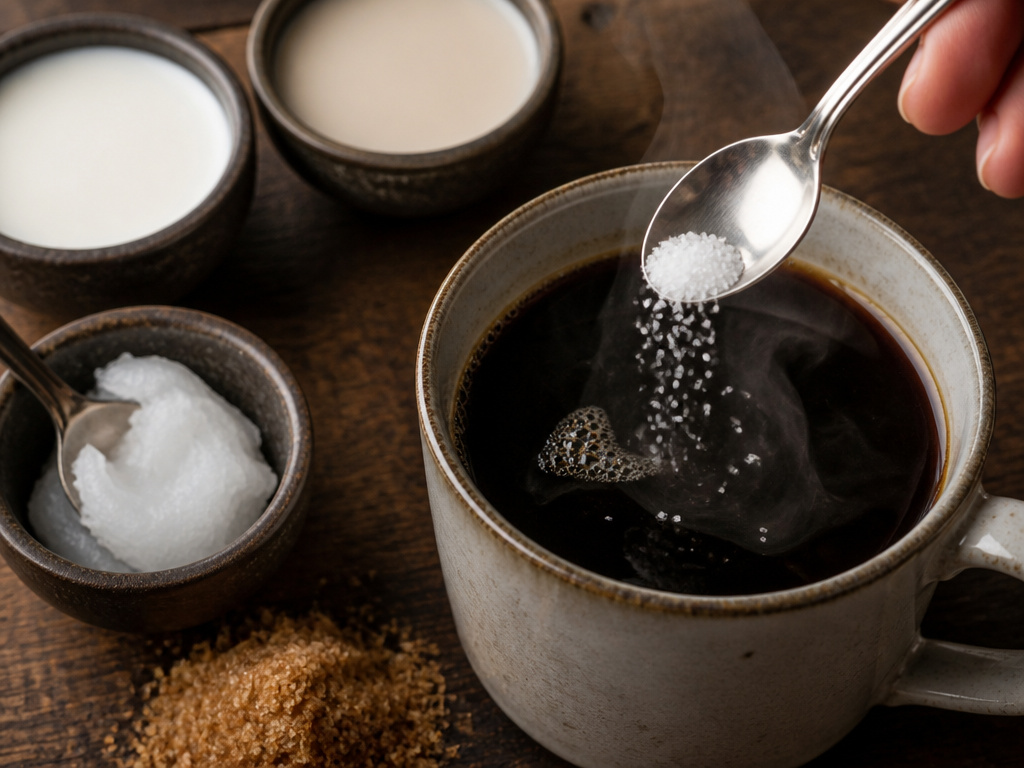
Your water isn’t a neutral solvent. Its mineral content changes the game, and what you add to the cup can mask or neutralize acids directly.
The Water Hardness Wild Card
The mineral content in your tap water, specifically calcium and magnesium, acts as a buffer. It can bind with acidic compounds, softening their impact on your palate. The 2023 Nutrients review pointed out that harder water can lead to a less acidic taste, while very soft or distilled water might accentuate it.
If you use a filter pitcher or buy distilled water, your coffee might taste brighter. If you have hard tap water, it might naturally taste smoother. This is the edge case that breaks standard advice. If you’re following every step but your coffee is still too sharp, test with a different water source. A filter impact on brew from paper can also trap oils and fine particles, slightly altering perceived acidity.
Post-Brew Neutralizers
After brewing, you have direct options to counteract acidity.
Dairy milk is a classic buffer. The proteins and fats coat your tongue and neutralize acidic sensations. For a stronger effect, try a fat-forward addition like coconut oil in coffee. The fat molecules bind with acidic compounds. Almond milk in coffee is a popular low-acid milk option, though its effect is milder than dairy.
The oldest trick is a pinch of salt. Sodium ions interfere with your tongue’s ability to register bitter and acidic tastes. Adding salt to coffee isn’t about making it salty; it’s about blocking the receptors for sourness. Start with two or three grains on the tip of a spoon, stir, and taste. It’s shockingly effective.
Sweeteners can distract from acidity, but they don’t neutralize it. Brown sugar sweetener adds molasses notes that can complement a dark roast, masking the sharpness with sweetness.
| Additive | Mechanism | Effect on Acidity | Best Used With |
|---|---|---|---|
| Whole Milk | Protein/fat coating, chemical buffering | High reduction | Any medium or dark roast |
| Pinch of Salt | Blocks taste receptors | Moderate to high reduction | Over-extracted or bitter cups |
| Almond Milk | Mild buffering, dilution | Low to moderate reduction | Light roasts, iced coffee |
| Coconut Oil (1 tsp) | Fat binds acidic compounds | Moderate reduction | Blended drinks, bulletproof style |
| Brown Sugar (1 tsp) | Masks with sweetness | Perceived reduction only | Dark roasts needing flavor depth |
Common mistake: Using skim milk — the lack of fat reduces its buffering power significantly. You need the whole molecules for the full effect.
What to Avoid
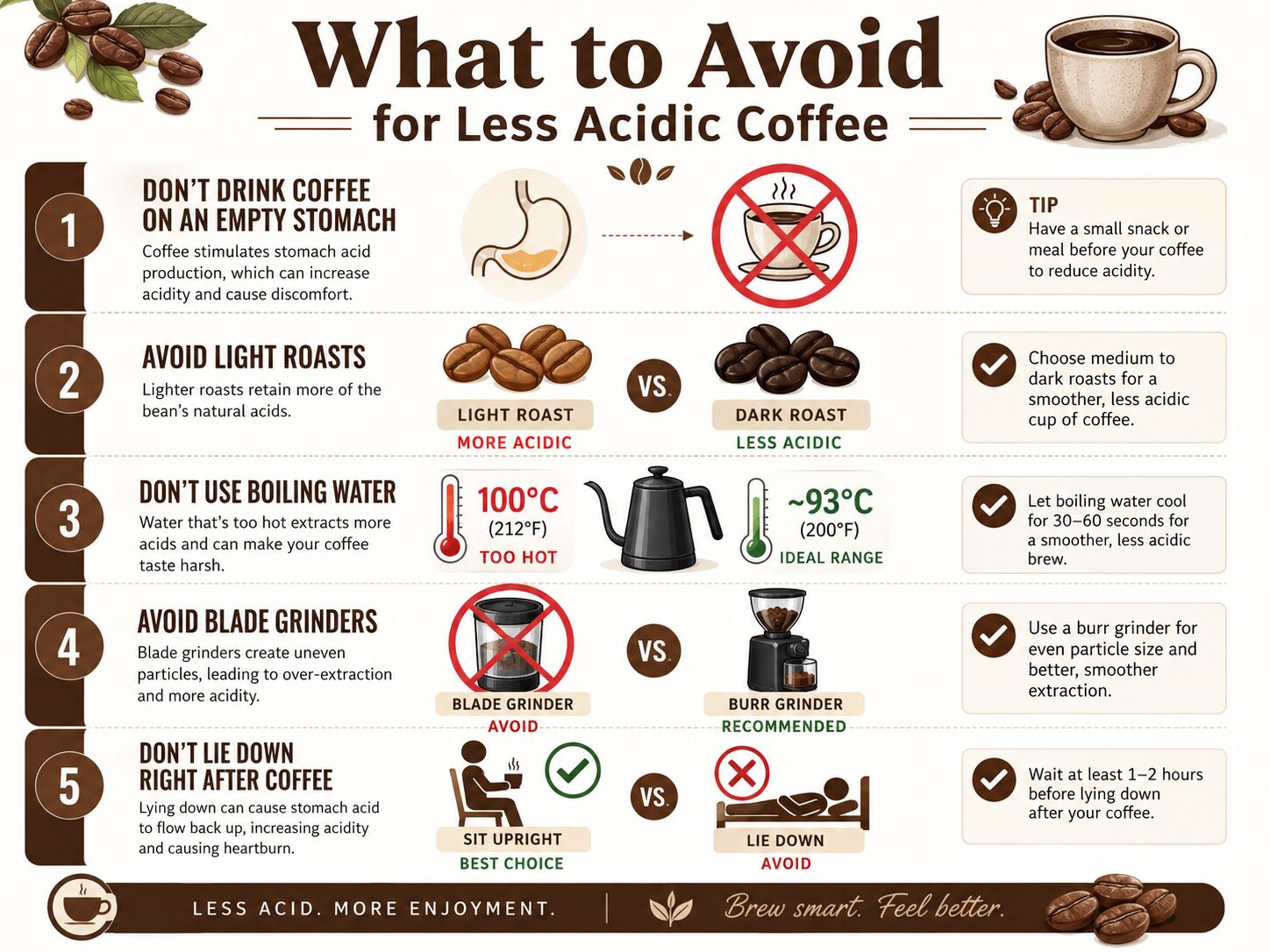
Knowing what not to do is half the battle. Certain habits will guarantee a more acidic cup, no matter your beans or method.
Never brew on an empty stomach first thing in the morning, as mentioned in one YouTube transcript. The coffee’s acids hit an unprotected stomach lining, amplifying discomfort. Always have a small bite first.
Avoid light roast beans if acidity is a concern. This seems obvious, but in the quest for “fruity” or “complex” flavors, it’s the most common error. A roasting degree and coffee pH study clearly shows the correlation.
Don’t use boiling water. That initial blast of 100°C water is excellent for extracting every last bit of chlorogenic acid. Let the kettle sit for 30 seconds after it boils.
Don’t use a blade grinder. The inconsistent particle size means fines over-extract (sour) while boulders under-extract (weak). You get both problems. Invest in a burr grinder.
Finally, don’t lie down immediately after drinking coffee. Gravity helps keep stomach contents down. Reclining too soon can increase reflux chances, making acidity feel worse.
Frequently Asked Questions
Does adding milk reduce coffee acidity?
Yes, dairy milk reduces perceived acidity. The proteins (casein) and fats act as buffers, neutralizing acidic compounds and coating your tongue. Whole milk is more effective than skim milk due to its higher fat content.
Is cold brew really less acidic?
Yes, cold brew is significantly less acidic. Brewing with cold water over 18-24 hours extracts a different chemical profile, leaving many of the harsh acids associated with hot brewing behind. Studies confirm its titratable acidity is much lower.
What is the best low acid coffee bean?
The best low acid coffee beans are dark roast Robusta beans, followed by dark roast Arabica beans from regions like Brazil or Sumatra. The dark roasting process breaks down chlorogenic acids, the primary source of sharpness.
How does roast level affect acidity?
Roast level directly affects acidity. Light roasts preserve most of the bean’s natural chlorogenic acids, resulting in a brighter, more acidic cup. Dark roasts break down a large portion of these acids during the longer roasting process, leading to a smoother, less acidic taste.
Can water type change coffee acidity?
Yes, water type can change perceived acidity. Hard water, rich in minerals like calcium and magnesium, can buffer acidic compounds and produce a smoother cup. Very soft or distilled water lacks these buffers and can make acidity taste more pronounced.
Does grinding finer make coffee more acidic?
Yes, grinding finer generally makes coffee more acidic. A fine grind increases surface area, allowing water to extract acidic compounds like chlorogenic acids faster and more completely. A coarser grind slows this extraction, reducing acidity.
Before You Go
Making coffee less acidic is a systematic process. Start with a dark roast bean—that’s your foundation. Grind it coarser than you think you need. Then, don’t pour boiling water over it; aim for 85–90°C. If you want a guarantee, commit to the cold brew method.
Remember the variables you can’t see. Your water’s hardness is a silent partner in every cup. A pinch of salt or a splash of whole milk can rescue a brew that’s already in the mug.
The goal isn’t to remove all character, just the sharp edge that causes discomfort. You can have a flavorful, satisfying cup that doesn’t fight back.
{
“@context”: “https://schema.org”,
“@type”: “HowTo”,
“name”: “How to Make Coffee Less Acidic”,
“totalTime”: “PT15M”,
“tool”: [
{
“@type”: “HowToTool”,
“name”: “Burr coffee grinder”
},
{
“@type”: “HowToTool”,
“name”: “Gooseneck kettle with temperature control”
},
{
“@type”: “HowToTool”,
“name”: “Scale for measuring coffee and water”
}
],
“step”: [
{
“@type”: “HowToStep”,
“name”: “Select a dark roast bean”,
“text”: “Choose coffee beans labeled as dark roast, as the longer roasting process breaks down more chlorogenic acids, the primary source of perceived acidity.”
},
{
“@type”: “HowToStep”,
“name”: “Grind coarser than usual”,
“text”: “Set your burr grinder to a coarser setting, similar to what you’d use for a French press. This slows the extraction of acidic compounds.”
},
{
“@type”: “HowToStep”,
“name”: “Lower your brew water temperature”,
“text”: “Heat your water to between 85°C and 90°C (185°F to 194°F) instead of the typical 95°C (203°F). This reduces acid extraction by approximately 15-20%.”
},
{
“@type”: “HowToStep”,
“name”: “Brew with the cold method for maximum reduction”,
“text”: “For the least acidic result, use the cold brew method. Steep coarse grounds in cold water in the refrigerator for 18 to 24 hours, then strain.”
}
]
}
{
“@context”: “https://schema.org”,
“@type”: “FAQPage”,
“mainEntity”: [
{
“@type”: “Question”,
“name”: “Does adding milk reduce coffee acidity?”,
“acceptedAnswer”: {
“@type”: “Answer”,
“text”: “Yes, dairy milk reduces perceived acidity. The proteins (casein) and fats act as buffers, neutralizing acidic compounds and coating your tongue. Whole milk is more effective than skim milk due to its higher fat content.”
}
},
{
“@type”: “Question”,
“name”: “Is cold brew really less acidic?”,
“acceptedAnswer”: {
“@type”: “Answer”,
“text”: “Yes, cold brew is significantly less acidic. Brewing with cold water over 18-24 hours extracts a different chemical profile, leaving many of the harsh acids associated with hot brewing behind. Studies confirm its titratable acidity is much lower.”
}
},
{
“@type”: “Question”,
“name”: “What is the best low acid coffee bean?”,
“acceptedAnswer”: {
“@type”: “Answer”,
“text”: “The best low acid coffee beans are dark roast Robusta beans, followed by dark roast Arabica beans from regions like Brazil or Sumatra. The dark roasting process breaks down chlorogenic acids, the primary source of sharpness.”
}
},
{
“@type”: “Question”,
“name”: “How does roast level affect acidity?”,
“acceptedAnswer”: {
“@type”: “Answer”,
“text”: “Roast level directly affects acidity. Light roasts preserve most of the bean’s natural chlorogenic acids, resulting in a brighter, more acidic cup. Dark roasts break down a large portion of these acids during the longer roasting process, leading to a smoother, less acidic taste.”
}
},
{
“@type”: “Question”,
“name”: “Can water type change coffee acidity?”,
“acceptedAnswer”: {
“@type”: “Answer”,
“text”: “Yes, water type can change perceived acidity. Hard water, rich in minerals like calcium and magnesium, can buffer acidic compounds and produce a smoother cup. Very soft or distilled water lacks these buffers and can make acidity taste more pronounced.”
}
},
{
“@type”: “Question”,
“name”: “Does grinding finer make coffee more acidic?”,
“acceptedAnswer”: {
“@type”: “Answer”,
“text”: “Yes, grinding finer generally makes coffee more acidic. A fine grind increases surface area, allowing water to extract acidic compounds like chlorogenic acids faster and more completely. A coarser grind slows this extraction, reducing acidity.”
}
}
]
}
