
Cups of Coffee in a Gallon: The Correct Measurement Guide
A US liquid gallon equals 16 standard 8-ounce measuring cups. However, for coffee, a “cup” is only 5 to 6 ounces. Therefore, one gallon of water yields 21 to 26 cups of coffee, explaining why a “12-cup” brewer needs less than a full gallon.
A US liquid gallon holds 16 standard 8-fluid-ounce measuring cups. But if you’re filling a coffee carafe, that same gallon yields between 21 and 26 “cups” because the industry uses a smaller 5 to 6-ounce measure. That mismatch is why a “12-cup” coffee maker doesn’t need a full gallon of water to brew a full pot.
Most guides stop at the basic math. They don’t tell you that using the wrong definition burns your coffee budget or leaves your church social with half a pot. The difference between 16 cups and 25 cups is a bag of beans.
This guide walks through the numbers, explains why your brewer lies on the box, and shows you how to scale any recipe from a single mug to a full gallon batch.
Key Takeaways
- A US gallon is 128 fluid ounces. Divided by an 8-ounce measuring cup, that’s 16 cups.
- Coffee machine “cups” are typically 5 or 6 ounces. A gallon makes 25.6 or 21.3 of those.
- Your brewer’s “cup” setting is a marketing convention, not a standard measure.
- To scale recipes, work in fluid ounces or milliliters, not “cups.”
- For a full gallon batch following the Specialty Coffee Association standard, use about 55 grams of coffee.
The Straight Math: 16 Cups Per Gallon
The math starts with fixed numbers. A US liquid gallon is defined as 3.78541 liters, which breaks down to 128 US fluid ounces. The standard US customary cup, used in cooking and baking, is 8 fluid ounces. You divide 128 by 8.
The answer is 16. That’s it.
A US liquid gallon contains 128 fluid ounces. One US customary cup is 8 fluid ounces. Therefore, one gallon equals 16 standard cups. This is the official conversion per the National Institute of Standards and Technology (NIST).
This is the number you’d use for any culinary purpose, like scaling a soup recipe or mixing a large batch of iced tea. It’s clean, it’s precise, and it’s universally understood in an American kitchen.
But walk over to your coffee station and everything changes. The carafe on your machine likely says “12 cups.” If you pour 12 of your standard 8-ounce measuring cups of water into it, you’ll have an overflow disaster. The carafe probably holds about 60 ounces total.
The “cup” on that machine isn’t 8 ounces. It’s smaller.
TL;DR: One gallon equals sixteen 8-ounce cups. Coffee makers use a different “cup.”
Why Your Coffee Maker Lies
Open the manual for a BUNN VP17-1SS commercial brewer or a Keurig K-Duo Plus. You’ll see “12-cup” capacity. Now find the carafe’s total volume in ounces or milliliters. The BUNN’s carafe holds about 60 ounces. Do the division: 60 ounces divided by 12 “cups” equals 5 ounces per cup.
That’s the open secret. The coffee industry standardized on a smaller “cup” measure decades ago. It’s a convention, not a deception, but it causes real confusion.
The origin is murky. Some trace it to the modest size of a typical porcelain coffee cup in mid-20th century America. Others say it was a marketing move to make home brewers sound more capacious. A “12-cup” machine sounds more substantial than a “60-ounce” one.
The problem is consistency. There isn’t one.
* Some brands use a 5-ounce “cup.”
* Others, particularly European models, might use a 6-ounce (177 mL) “cup.”
* A few high-end machines now adhere to the 8-ounce standard.
You must check your own machine’s manual. Assume nothing.
Common mistake: Filling your brewer using standard 8-ounce measuring cups — you’ll overfill the reservoir and likely trigger an overflow error or brew weak, underwhelming coffee.
| Brewer “Cup” Size | Fluid Ounces | Cups Per Gallon (128 fl oz) |
|---|---|---|
| Standard Measuring Cup | 8 fl oz | 16 |
| Common Coffee Brewer Cup | 5 fl oz | 25.6 |
| Alternative Coffee Brewer Cup | 6 fl oz | 21.33 |
The table shows the stakes. Planning a gallon of coffee for a 5-ounce cup crowd means brewing nearly 26 servings. That changes your coffee brewing methods and how much coffee you need to buy.
From a Single Cup to a Full Gallon Batch
Scaling a recipe requires abandoning the word “cup” altogether. Work in ounces, milliliters, or grams. Weight is the most precise method, especially for coffee grounds.
Let’s say your daily ritual is a single 10-ounce mug of standard drip coffee. You use 18 grams of coffee for that. To scale up to a gallon (128 ounces), you first find your ratio.
128 ounces / 10 ounces = 12.8. You need to multiply your coffee dose by 12.8.
18 grams x 12.8 = 230.4 grams of coffee for a gallon.
That’s over half a pound of beans. Suddenly, that gallon doesn’t seem so casual.
For commercial or church-basement purposes, the Specialty Coffee Association (SCA) provides a benchmark. Their Golden Cup Standard suggests a brewing ratio of 55 grams of coffee per liter of water. Since a gallon is 3.785 liters, the math is straightforward.
55 grams/liter x 3.785 liters/gallon ≈ 208 grams of coffee per gallon.
That’s your professional starting point. It produces a balanced, extraction-focused brew suitable for catering or large gatherings. Your coffee brewing supplies, like a large commercial filter basket, become critical at this volume.
TL;DR: Scale using weight, not volume “cups.” For a SCA-standard gallon, start with 208 grams of coffee.
The Real-World Gallon: Coffee for a Crowd
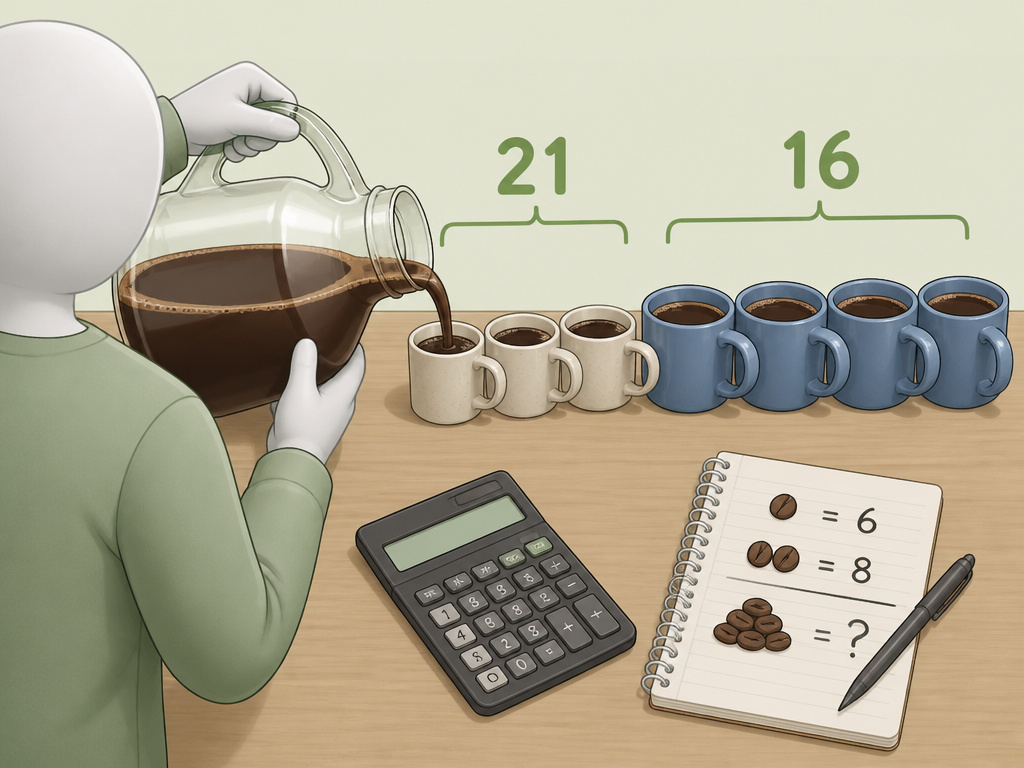
You’re not making a gallon for yourself. You’re making it for a crowd. The math now shifts from volume to servings. If your crowd expects a 6-ounce serving, a gallon yields about 21 drinks. If they’re used to a larger 8-ounce mug, it’s only 16.
This is where cost and logistics hit.
- Choose your serving size. Are these small cups at a meeting or large mugs at a weekend gathering?
- Calculate total coffee needed. Using the SCA’s 208-grams-per-gallon figure, you’ll need about a 12-ounce bag of coffee beans per gallon brewed.
- Consider your equipment. Most home brewers max out at a 12-cup (60-ounce) carafe. To make a full gallon, you’re brewing two full batches back-to-back. This affects timing, warming plate endurance, and coffee flavor degradation.
- Plan for waste and refills. Not everyone drinks one cup. Factor in a 10-15% buffer.
I learned the buffer lesson the hard way at a family reunion. I calculated 20 people, one 6-ounce cup each. One gallon should cover it. I forgot about refills. By the time the late arrivals showed up, the pot was empty and the only thing bitter was the mood. Now I brew a gallon and a half for groups that size.
For large-scale coffee preparation, a dedicated commercial urn or a large batch brewer like the Wilbur Curtis G4 is a better tool. They’re built for holding temperature over hours and for the sheer volume of grounds required.
TL;DR: A gallon serves 16-21 people for a single round. Always brew extra.
Frequently Asked Questions
My coffee maker says “cups,” but the manual only lists ounces. How do I find its true cup size?
Look for the carafe’s total capacity in ounces or milliliters. If it’s a “12-cup” machine with a 60-ounce carafe, divide 60 by 12. The answer, 5, is the ounces per “cup” your manufacturer uses. If it’s a 72-ounce carafe, it’s likely using 6-ounce cups.
Is a “coffee cup” the same worldwide?
No. While the US industry often uses 5-6 fluid ounces, other countries differ. In Australia, a standard coffee serving like a flat white is often 6.8 fl oz (200 mL). In Italy, an espresso is about 1 ounce. Always check the context.
How much caffeine is in a gallon of coffee?
This depends entirely on your brewed coffee caffeine concentration. Using a moderate coffee brewing ratio, a gallon of drip coffee could contain roughly 1,920 mg of caffeine. That’s based on an average of 120 mg per 8-ounce serving. It’s a massive dose, underscosing why monitoring your caffeine intake matters even in social settings.
Can I use a gallon to measure coffee for cold brew?
Absolutely, and it’s an excellent method. For cold brew, a common ratio is 1 pound of coffee (roughly 450 grams) to 1 gallon of water. This produces a concentrated brew you dilute later. The large volume and long steep time make the gallon measurement ideal.
Does the type of coffee affect how many cups I get from a gallon?
No. The volume of water is fixed. However, the coffee’s density and grind size affect how much grounds by volume you need to hit your target weight. A light roast is less dense than a dark roast, so a cup of light roast beans weighs less.
The Bottom Line
Forget the simple answer. Yes, a gallon is 16 measuring cups. But your coffee world doesn’t use that measure.
The useful answer is that a gallon fills between 21 and 26 coffee machine “cups,” and it requires between 200 and 230 grams of coffee to brew it properly. Scaling up means ditching the vague term “cup” and working in ounces, milliliters, and grams. Check your brewer’s manual, do the real math, and always brew a little extra. Your guests will notice the difference between a calculated batch and a guess, even if they just think the coffee drinks taste better.
{
“@context”: “https://schema.org”,
“@type”: “HowTo”,
“name”: “How to Calculate Cups of Coffee in a Gallon”,
“totalTime”: “PT5M”,
“tool”: [
{
“@type”: “HowToTool”,
“name”: “Standard US liquid gallon container”
},
{
“@type”: “HowToTool”,
“name”: “US customary 8-fluid-ounce measuring cup”
},
{
“@type”: “HowToTool”,
“name”: “Kitchen scale (optional)”
}
],
“step”: [
{
“@type”: “HowToStep”,
“name”: “Define your ‘cup'”,
“text”: “Decide if you are using a standard 8-fluid-ounce measuring cup or the smaller ‘coffee cup’ (5-6 fl oz) used by brewer manufacturers.”
},
{
“@type”: “HowToStep”,
“name”: “Divide gallon volume by cup size”,
“text”: “A US liquid gallon contains 128 fluid ounces. Divide 128 by your chosen cup size in ounces.”
},
{
“@type”: “HowToStep”,
“name”: “Calculate for a standard cup”,
“text”: “Using an 8 fl oz cup: 128 / 8 = 16 cups per gallon.”
},
{
“@type”: “HowToStep”,
“name”: “Calculate for a coffee machine cup”,
“text”: “Using a 5 fl oz coffee cup: 128 / 5 = 25.6 cups per gallon. Using a 6 fl oz cup: 128 / 6 = 21.33 cups.”
},
{
“@type”: “HowToStep”,
“name”: “Scale your coffee recipe”,
“text”: “Use the calculated number of cups to scale your coffee grounds. For the SCA Golden Cup ratio, use 55 grams of coffee per gallon of water.”
}
]
}
{
“@context”: “https://schema.org”,
“@type”: “FAQPage”,
“mainEntity”: [
{
“@type”: “Question”,
“name”: “My coffee maker says \”cups,\” but the manual only lists ounces. How do I find its true cup size?”,
“acceptedAnswer”: {
“@type”: “Answer”,
“text”: “Look for the carafe’s total capacity in ounces or milliliters. If it’s a \”12-cup\” machine with a 60-ounce carafe, divide 60 by 12. The answer, 5, is the ounces per \”cup\” your manufacturer uses. If it’s a 72-ounce carafe, it’s likely using 6-ounce cups.”
}
},
{
“@type”: “Question”,
“name”: “Is a \”coffee cup\” the same worldwide?”,
“acceptedAnswer”: {
“@type”: “Answer”,
“text”: “No. While the US industry often uses 5-6 fluid ounces, other countries differ. In Australia, a standard coffee serving like a flat white is often 6.8 fl oz (200 mL). In Italy, an espresso is about 1 ounce. Always check the context.”
}
},
{
“@type”: “Question”,
“name”: “How much caffeine is in a gallon of coffee?”,
“acceptedAnswer”: {
“@type”: “Answer”,
“text”: “This depends entirely on your brewed coffee caffeine concentration. Using a moderate coffee brewing ratio, a gallon of drip coffee could contain roughly 1,920 mg of caffeine. That’s based on an average of 120 mg per 8-ounce serving. It’s a massive dose, underscosing why monitoring your caffeine intake matters even in social settings.”
}
},
{
“@type”: “Question”,
“name”: “Can I use a gallon to measure coffee for cold brew?”,
“acceptedAnswer”: {
“@type”: “Answer”,
“text”: “Absolutely, and it’s an excellent method. For cold brew, a common ratio is 1 pound of coffee (roughly 450 grams) to 1 gallon of water. This produces a concentrated brew you dilute later. The large volume and long steep time make the gallon measurement ideal.”
}
},
{
“@type”: “Question”,
“name”: “Does the type of coffee affect how many cups I get from a gallon?”,
“acceptedAnswer”: {
“@type”: “Answer”,
“text”: “No. The volume of water is fixed. However, the coffee’s density and grind size affect how much grounds by volume you need to hit your target weight. A light roast is less dense than a dark roast, so a cup of light roast beans weighs less.”
}
}
]
}
