
How Long After Drinking Coffee Can I Breastfeed? Wait Times
This post contains affiliate links. As an Amazon Associate, we earn from qualifying purchases.
Wait about 5 hours after drinking coffee before breastfeeding to allow caffeine levels in your milk to drop significantly. This is based on caffeine’s half-life in breast milk, which is 4.9 hours according to the NIH LactMed database. For older infants over 6 months, a 2-3 hour wait may be enough, but newborns and preemies need the full window due to their much slower caffeine metabolism.
Most advice stops at “wait a couple hours” or “have your coffee right after nursing.” That’s the consensus, and it’s fine for a robust six-month-old. It falls apart completely for a three-week-old who hasn’t developed the liver enzymes to process stimulants. The difference between a calm baby and a frantic, sleepless one isn’t the coffee, it’s the timing mismatch between the adult half-life and the infant’s.
This guide breaks down the exact pharmacokinetics: how caffeine transfers, when it peaks, and how long it lingers based on your baby’s age. We’ll translate the NIH and CDC data into a practical feeding schedule, highlight the signs of infant sensitivity, and show you how to enjoy your ritual without the next-day regret.
Key Takeaways
- Caffeine concentration in breast milk peaks 1 hour after you drink it, making post-feeding the ideal time to consume.
- The half-life of caffeine in breast milk is 4.9 hours, meaning it takes about 5 hours for the concentration to drop by half.
- A newborn’s caffeine half-life can be 80 to 100 hours, while a 6-month-old’s is close to an adult’s at 2.6 hours.
- The American Academy of Pediatrics considers up to 300 mg of daily caffeine (about 3 cups of coffee) generally safe for breastfeeding.
- If your baby shows signs of sensitivity, jitteriness, extreme alertness, fussiness, extend the waiting period or reduce your intake.
The 5-Hour Rule vs. Infant Age
You’ll see the 5-hour rule everywhere. It comes from a single, well-sourced fact: caffeine has a half-life in breast milk of approximately 4.9 hours. After one half-life, the concentration is halved. After two, it’s quartered. The math is clean.
The problem is that rule assumes your baby processes caffeine at the same rate you do. They don’t. Not even close.
A newborn’s liver is immature. The enzymes that break down caffeine, primarily CYP1A2, are barely active. The NIH caffeine and lactation monograph states the half-life in a neonate is 80 to 100 hours. That means caffeine from a single cup of coffee you drank on Monday could still be circulating in your baby’s system on Thursday. By 3-5 months, that half-life shortens to about 14 hours. By 6 months, it’s down to 2.6 hours, essentially adult speed.
Caffeine passes into breast milk at a relative infant dose (RID) of 0.6% to 1.5% of the maternal dose. This means if you drink a 200 mg coffee, your baby receives the caffeine equivalent of a 1-3 mg dose, scaled to their tiny body weight.
TL;DR: Use the 5-hour rule as a maximum safe window, especially for newborns under 3 months. For infants over 6 months, a 2-3 hour wait is often perfectly adequate because they metabolize it nearly as fast as you do.
Why Peak Concentration Matters More Than You Think
Caffeine levels in your milk aren’t static. They spike. The LactMed data shows peak concentration occurs about 1 hour after you ingest it. This creates a strategic opportunity.
Drinking your coffee immediately after a feeding session gives you the longest possible buffer, the full 4.9-hour half-life window, before the next feed when concentrations are highest. Drink it right before a feed, and you’re delivering a near-peak dose directly to your baby.
That’s the mechanical reason behind the common advice to “nurse first, coffee second.” It’s not just folklore; it’s pharmacokinetic scheduling.
| Infant Age | Caffeine Half-Life (Hours) | Recommended Max Wait After Coffee | Rationale |
|---|---|---|---|
| Newborn (0-1 month) | 80 – 100 | 5+ hours (observe baby) | Immature liver, extreme sensitivity, slow clearance. |
| 1 – 5 months | ~14 | 3 – 4 hours | Metabolism accelerating but still slow. |
| 6+ months | ~2.6 | 2 – 3 hours | Adult-like metabolism; shorter wait is often fine. |
Calculating Your Actual Caffeine Intake
The 300 mg daily limit from the AAP is a ceiling, not a target. One “cup” is a notoriously vague measure. A standard 8-oz brewed coffee from a home drip machine contains about 100 mg of caffeine. A Starbucks Grande (16 oz) brewed coffee has around 330 mg, already over the daily limit in one serving.
You must add in all sources: tea, soda, chocolate, energy drinks, and even some medications. This total matters more than the timing of a single cup. If you’re near the 300 mg limit, even perfect timing might not prevent cumulative effects in a sensitive infant.
Common mistake: Counting only coffee, ignoring tea, soda, and chocolate. A 20-oz bottle of cola and a dark chocolate bar can add 80+ mg, pushing a moderate coffee drinker over the safe threshold without realizing it.
Here’s a quick audit list. Check these per day:
* Brewed coffee (8 oz): ~100 mg
* Espresso (1 shot): ~64 mg
* Black tea (8 oz): ~50 mg
* Green tea (8 oz): ~30 mg
* Cola (12 oz): ~35 mg
* Dark chocolate (1 oz): ~20 mg
If your total drifts toward 300 mg and your baby seems fussy, the first fix isn’t longer waiting periods, it’s cutting the total dose. Switching part of your intake to a lower-caffeine alternative like green tea can help manage the stimulant load while preserving your ritual.
Signs Your Baby Might Be Sensitive
Some infants are caffeine magnets. The 0.6-1.5% RID is an average; individual variation exists. You might have a baby who reacts noticeably to a single small cup, while another shows no effects even with higher maternal intake.
The symptoms are straightforward but easy to attribute to normal infant fussiness. Look for a cluster of these behaviors appearing 1-2 hours after a feed where you consumed caffeine:
* Hyper-alertness: Wide, staring eyes, refusing to close them even when obviously tired.
* Jitteriness: Tremors in the arms or legs, a shaky quality to movements.
* Fussiness that escalates: Not just typical grizzling, but intense, hard-to-console crying.
* Poor sleep patterns: Fighting naps, short sleep cycles, waking frequently despite being fed and changed.
I learned this the hard way with my first. A single afternoon latte, timed 3 hours before his evening feed, turned a baby who usually slept a 4-hour stretch into a wide-eyed, fussing bundle who wouldn’t sleep for more than 45 minutes at a time all night. It took two days for his system to clear it.
If you see this pattern, conduct a simple test. Eliminate all caffeine for 48 hours and note any change in baseline behavior. Then reintroduce a small amount (like half a cup) and watch closely. This isn’t medical advice, it’s basic cause-and-effect observation any parent can do. The CDC caffeine and breastfeeding guide explicitly notes that some babies are more sensitive and mothers may need to reduce intake.
Special Considerations: Premature Infants and Medical Conditions
The standard guidelines assume a healthy, term infant. If your baby was born premature, the rules change drastically. Their metabolic systems are even less developed than a term newborn’s. The 80-100 hour half-life applies, and may be even longer.
For preemies, many pediatricians recommend avoiding caffeine altogether during the initial months of breastfeeding, or keeping intake extremely minimal (under 100 mg daily). Always follow the specific guidance of your neonatologist or pediatrician, this is one area where general advice fails.
Maternal health matters too. Conditions that affect your own metabolism, like liver issues, can alter how quickly you clear caffeine, indirectly affecting milk concentrations. If you have any metabolic health concerns, discuss caffeine consumption while breastfeeding with your doctor.
Practical Timing Strategies and Alternatives
Let’s translate this into a daily plan. Your goal is to maximize the time between your caffeine intake and the next feed, while staying under the daily limit.
The Feed-First Method (Most Effective):
- Breastfeed your baby.
- Immediately after, prepare and enjoy your coffee.
- This starts the 4.9-hour half-life clock at the moment of peak milk concentration (1 hour later).
- By the next feeding, typically 2-4 hours later for a young infant, concentrations have already dropped significantly.
The “Watch the Clock” Method:
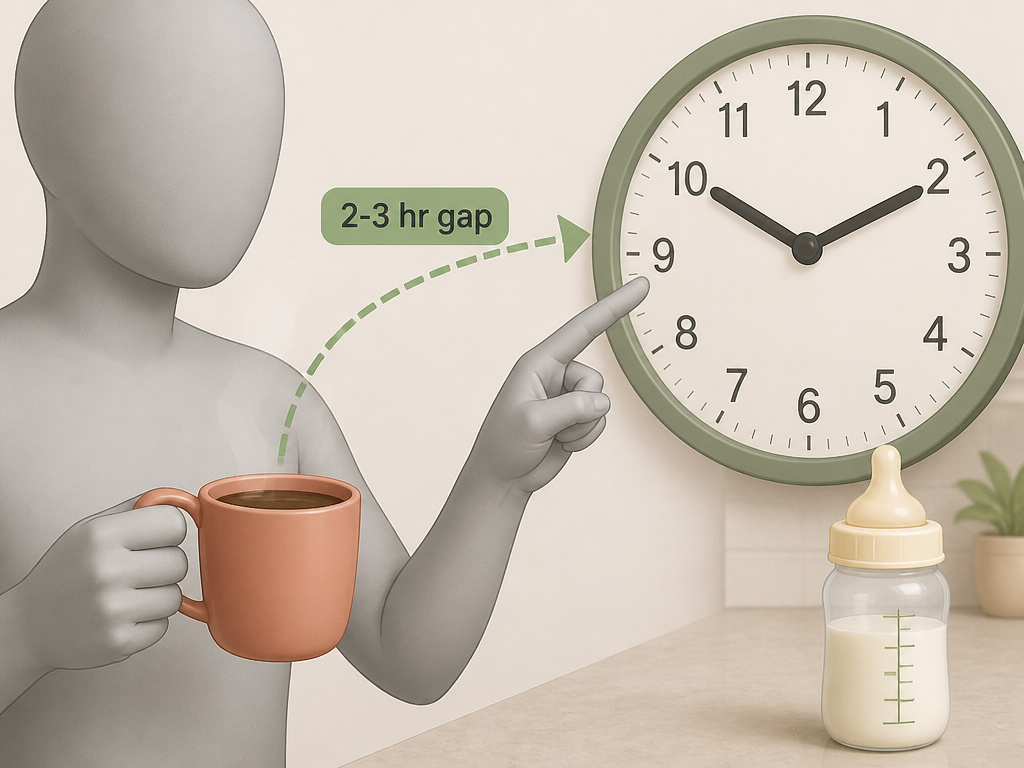
If you drink coffee at other times, simply note the time. For an infant over 6 months, aim for a 2-3 hour gap before the next feed. For a newborn, push for the full 5 hours if possible. Use expressed milk or a previously pumped bottle for the feed that falls within that window if needed.
Reducing the Need for Timing:
If the scheduling feels stressful, consider lowering the dose per serving. This is where exploring lower-caffeine alternatives pays off. A cup of black tea has about half the caffeine of coffee. Green tea has less, plus L-theanine which can smooth the stimulant edge. Decaf coffee has improved dramatically in quality, it’s not caffeine-free, but at 2-5 mg per cup, it’s negligible.
Switching one daily coffee for a green tea benefits session can cut your stimulant load in half, giving you more flexibility with timing and reducing the risk of infant sensitivity.
Frequently Asked Questions
Does the type of coffee affect how much caffeine gets into my milk?
Yes, but not dramatically. Brew method, roast level, and bean origin change caffeine content in your cup, which changes the dose entering your milk. A light roast typically has slightly more caffeine than a dark roast by volume. An espresso shot caffeine dose is concentrated but the serving size is small. The transfer percentage (RID) remains constant regardless of source.
My baby is 8 months old and eats solid food. Do I still need to wait?
Likely not as long. At 8 months, your baby’s metabolism is mature, and they are consuming other foods that dilute the effect. The 2-3 hour guideline is more than sufficient. Observation is still key, if they seem unusually wired after a feed, extend the wait.
Can I “pump and dump” after drinking coffee to clear the caffeine?
No. Pumping and discarding milk does not accelerate caffeine clearance from your bloodstream or your milk supply. Caffeine enters and leaves your milk passively as your blood levels rise and fall. Time is the only thing that lowers milk concentration. Pumping is only useful for maintaining supply if you are skipping a direct feed during the peak caffeine window.
Are some babies just more sensitive to caffeine in breast milk?
Absolutely. Sensitivity is a spectrum. Some babies react visibly to small amounts, others show no signs even with higher maternal intake. It depends on their individual genetics and metabolic maturity. If your baby is sensitive, the solution is reducing your total intake, not just perfecting the timing.
Does caffeine affect my milk supply?
There is no consistent evidence that moderate caffeine consumption (under 300 mg/day) negatively impacts milk production. However, dehydration can. Since caffeine is a mild diuretic, ensure you drink an extra glass of water for each caffeinated beverage to stay well-hydrated for lactation.
The Bottom Line
You don’t need to give up coffee while breastfeeding. You need to become a strategist about it. The core fact is the 4.9-hour half-life. Pair that with your baby’s age, the huge gap between a newborn’s 100-hour metabolism and a six-month-old’s 2.6-hour clearance, and you have your personalized waiting period.
Drink after feeding, not before. Count all your caffeine sources, not just coffee. Watch your baby, not the clock, for the real answer on sensitivity. When in doubt, lower the dose or switch to a gentler source like tea. The goal is a happy baby and a sane, caffeinated parent. That balance is entirely possible with the right timing.
