
Honey in Coffee vs Sugar: The Flavor and Health Comparison
Switching to honey in coffee instead of sugar requires matching three things: your coffee’s roast profile, the honey’s varietal flavor, and the drink’s temperature. Honey is 1.2 to 1.5 times sweeter than sucrose by weight, so you use less, and its average glycemic index of 58 is lower than table sugar’s 65, but it still causes a blood glucose spike.
Most people dump honey into their cup expecting a simple, healthy swap. The reality is more nuanced. A strong buckwheat honey will obliterate a delicate Ethiopian pour-over, and cold honey in iced coffee forms stubborn globs at the bottom of the glass. It’s not a direct substitute.
This guide walks through the flavor chemistry, the real health trade-offs backed by data, and the mechanical tricks to make honey work in everything from espresso to cold brew.
Key Takeaways
- Honey is not a 1:1 sugar swap. Its higher fructose content makes it taste sweeter, so start with half the amount and adjust.
- The honey varietal dictates the pairing. Light, floral honeys (acacia, orange blossom) complement light roasts; dark, robust honeys (buckwheat, manuka) can stand up to dark roasts.
- Temperature is a physical constraint. Honey’s viscosity plummets above 70°F (21°C). For cold drinks, pre-dissolve it in a splash of hot liquid to avoid clumping.
- The health advantage is relative, not absolute. While honey contains trace enzymes and antioxidants, heating it above 140°F (60°C) degrades most of them, and it still significantly raises blood sugar.
- It will change your coffee’s mouthfeel. Honey adds a subtle, silky viscosity that granulated sugar does not, which can either enhance or muddle the coffee’s body.
Is Honey Actually Healthier Than Sugar in Coffee?
The short answer is yes, but marginally and with major caveats. The health halo around honey comes from its trace nutrients, enzymes, amino acids, vitamins, and antioxidants like flavonoids and phenolic acids. Table sugar (sucrose) offers none of that. However, to get a nutritionally meaningful dose of those compounds from honey, you’d have to consume tablespoons at a time, which defeats the purpose of a modest sweetener.
Honey has an average glycemic index (GI) of 58, compared to table sugar’s GI of 65, according to data from the National Honey Board. This means it raises blood sugar slightly more slowly, but it is still a high-GI food that causes a significant spike.
The pivotal factor is what happens when you add it to hot coffee. Those prized enzymes, like glucose oxidase which produces hydrogen peroxide (giving honey some antibacterial properties), are heat-sensitive. Research indicates sustained temperatures above 140°F (60°C) begin to denature them. Your coffee is likely between 160°F and 200°F (71°C–93°C). By the time you stir, most of the enzymatic activity is gone.
TL;DR: Honey offers trace nutrients sugar lacks, but the heat of coffee destroys its enzymes. Its main advantage is a slightly lower glycemic impact, but it remains an added sugar.
The Flavor Chemistry: Why Pairing Matters
This is where the simple swap gets interesting. Sugar is a blank slate, sweetness without flavor. Honey is a complex ingredient. Its flavor profile is determined by the nectar source, which means choosing a honey is as important as choosing your coffee beans.
The dominant sugars are fructose and glucose, but the minor components, organic acids, esters, and pollen, create the unique taste. A clover honey is mild and grassy. An orange blossom honey is citrusy and perfumed. A buckwheat honey is molasses-like, almost malty.
| Coffee Roast Profile | Recommended Honey Varietal | Why It Works |
|---|---|---|
| Light Roast (Fruity, Tea-like) | Acacia, Orange Blossom, Tupelo | These light, floral honeys complement delicate fruity and floral notes without overpowering them. |
| Medium Roast (Balanced, Nutty) | Clover, Wildflower, Alfalfa | These versatile, middle-of-the-road honeys add sweetness that enhances the roast’s balance. |
| Dark Roast (Bold, Chocolatey) | Buckwheat, Manuka, Chestnut | These robust, mineral-rich honeys have the intensity to stand up to the roast’s bold bitterness. |
Pouring a powerfully earthy buckwheat honey into a light, citrusy Kenyan coffee is a clash. You lose the coffee. The rule is simple: pair light with light, dark with dark. Think of it like wine pairing.
I learned this the hard way with a prized bag of Yirgacheffe. I used a dark, almost bitter honey from a local farmer’s market. The coffee’s beautiful jasmine and bergamot notes vanished, replaced by a muddled, overly sweet brew. Now I keep a small bottle of acacia honey specifically for my light roasts.
How to Add Honey to Coffee Correctly (The Mechanical Part)
This isn’t just about stirring. Honey’s physical behavior changes with temperature, and getting it wrong leads to a poorly sweetened, messy drink.
Before you start: Use a clean, dry spoon. Introducing water to your honey jar encourages fermentation. If your honey has crystallized, gently warm the jar in a bowl of warm water, never microwave it, as that can create localized hot spots that degrade quality.
- Start with hot coffee. This is non-negotiable. Your coffee should be above 160°F (71°C). At this temperature, honey’s viscosity is low enough for it to dissolve readily. If your coffee has cooled, the honey will sink and stick to the bottom, requiring vigorous and prolonged stirring.
- Add the honey to the liquid first. Don’t put honey in an empty cup and pour coffee over it. The initial pour may not provide enough agitation to dissolve it fully. Add your coffee, then drizzle in the honey.
- Stir with purpose. A lazy swirl isn’t enough. Stir vigorously for a good 10-15 seconds, scraping the bottom and sides of the mug. The goal is full integration.
- For iced coffee or cold brew, pre-dissolve. This is the critical workaround. Honey thickens dramatically below 50°F (10°C). If you add it directly to a cold drink, it will form gummy strands or a sticky layer at the bottom.
- Take a tablespoon of your hot coffee or some hot water.
- Stir the desired amount of honey into this small, hot liquid until it’s fully dissolved into a syrup.
- Pour this honey syrup over your iced coffee and stir. It incorporates perfectly every time.
Skipping the pre-dissolve step for cold brew is the most common mistake. You’ll take a sip, think it’s not sweet enough, add more honey, stir again, and end up with an overly sweet top layer and a glob of undissolved honey at the bottom. It ruins the consistency.
Common mistake: Adding honey directly to cold brew, the honey’s high viscosity at low temperatures prevents dissolution, creating an unevenly sweet drink and wasted honey at the bottom of the glass.
The Blood Sugar Reality Check

Many people choose honey believing it’s a “low-glycemic” sweetener that won’t affect their blood sugar. The data from continuous glucose monitors (CGMs) tells a more honest story.
In a direct test documented by a CGM user, adding honey to milk coffee caused a 22 mg/dL blood glucose spike. The same coffee with white sugar caused a 24 mg/dL spike, and with brown sugar a 26 mg/dL spike. The difference is statistically negligible for most people. Honey’s slightly lower GI, driven by its higher fructose content, may smooth the curve slightly, but it is not a free pass.
Both honey and sugar are broken down into glucose and fructose in your body. The liver metabolizes fructose, and excess consumption is linked to fatty liver disease and insulin resistance. From a metabolic standpoint, they are more similar than they are different.
If your primary goal is blood sugar management, the best choice is to reduce or eliminate added sweeteners altogether. Using a pinch of salt can effectively reduce perceived bitterness without adding carbohydrates. For those seeking a metabolic boost without sugar, adding MCT oil or coconut oil provides energy from fats, not sugars.
TL;DR: Honey will spike your blood sugar almost as much as table sugar. For true glycemic control, focus on reducing sweetener quantity, not just swapping the type.
Choosing Your Honey: Raw, Pasteurized, and Flavored
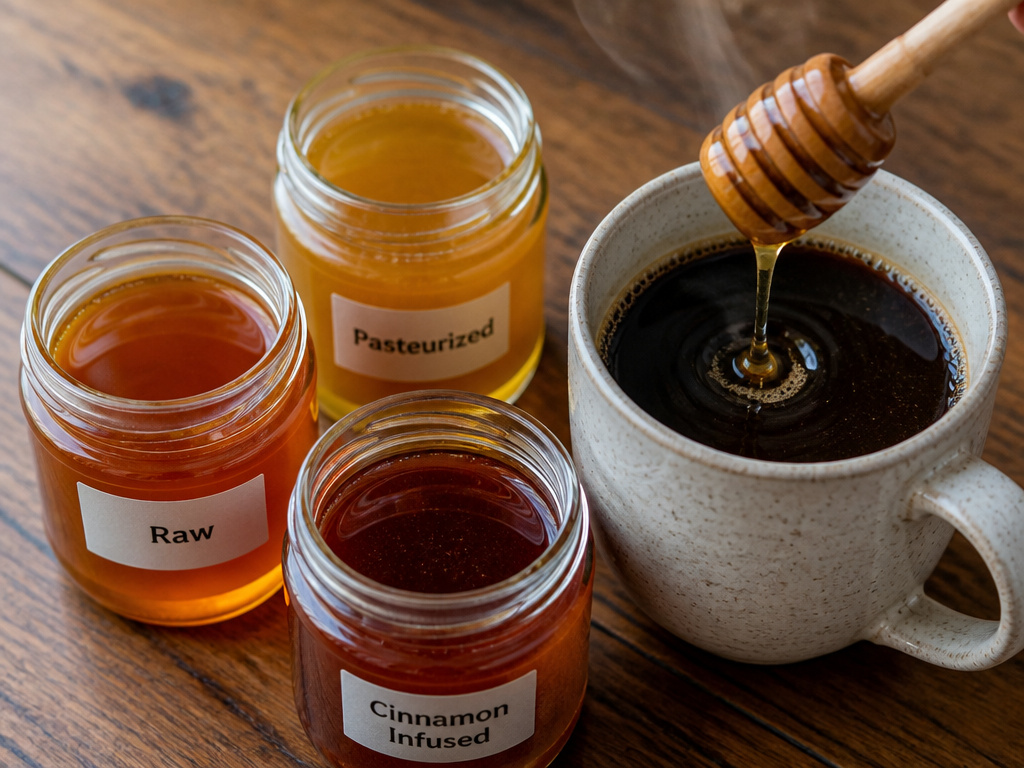
Not all honey on the shelf is equal. Your choice here impacts flavor, potential health benefits, and even how it behaves in your cup.
- Raw Honey: This is honey as it exists in the hive, strained but not heated. It contains pollen, propolis, and the full suite of heat-sensitive enzymes. It has the most complex flavor and potential health benefits. It may also crystallize faster. This is the best choice for flavor purists, but remember its enzymes will still be destroyed in hot coffee.
- Pasteurized (Commercial) Honey: This honey has been heated and filtered to kill yeast, prevent crystallization, and create a clear, shelf-stable product. The process strips away pollen and degrades enzymes and some delicate aromas. It’s often a blend from multiple global sources. It’s consistent and easy to pour, but flavor is neutralized.
- Flavored or Infused Honey: These are honeys blended with ingredients like vanilla, cinnamon, or chili. They can be a fun way to add a compound flavor to your coffee. For example, a cinnamon-infused honey can mimic the effect of adding cinnamon directly.
For coffee, I recommend a locally sourced, raw honey from a single floral source. You support local beekeepers and get a true taste of place. The flavor difference between a raw clover honey and the generic pasteurized bear-shaped bottle is profound.
Honey vs. Other Common Coffee Sweeteners

How does honey stack up against the alternatives? It’s not just about honey versus sugar.
| Sweetener | Sweetness (vs. Sugar) | Key Consideration for Coffee | Best Use Case |
|---|---|---|---|
| White Sugar | 1.0 (baseline) | Neutral sweetness; dissolves easily in hot and cold drinks. | Any coffee, when you want pure sweetness. |
| Brown Sugar | Slightly less than 1.0 | Adds molasses notes; can overpower delicate coffees. | Dark roasts, dessert-style coffee drinks. |
| Honey | 1.2 – 1.5 | Adds viscosity and floral/fruity notes; requires heat to dissolve fully. | Light/medium roasts where flavor pairing is desired. |
| Maple Syrup | ~0.9 | Distinct woody, caramel flavor; very runny, dissolves well. | Medium/dark roasts, autumnal coffee styles. |
| Agave Nectar | ~1.5 | Very high fructose content; neutral flavor, dissolves easily. | Iced coffee, for those seeking a vegan liquid sweetener. |
| Artificial Sweeteners | Varies (high) | No calories; can have bitter aftertaste, especially in hot coffee. | Strict calorie or carb restriction. |
If you’re exploring brown sugar as a sweetener, know that its caramel notes work better with creamy drinks and dark roasts than honey’s floral tones. For a dairy-free creamer that also adds sweetness, consider almond milk, but be mindful of its calorie content and added sugars in flavored versions.
Frequently Asked Questions
Does honey become toxic when added to hot coffee?
No. This is a persistent myth. Heating honey can destroy some of its delicate enzymes, vitamins, and antioxidants, but it does not create toxic compounds. Millions of people safely drink tea and coffee with honey every day.
Can I use honey in espresso?
Yes, but technique matters. Add the honey to your cup first, then pull the espresso shot directly onto it. The force and heat of the espresso (about 200°F/93°C) will help dissolve it. Stir immediately. Honey can work well in milk-based espresso drinks like lattes, where its flavor pairs with the milk’s sweetness.
Why does my honey sink to the bottom of my iced coffee?
Because honey is thick and dense, especially when cold. Its viscosity is too high to dissolve in a cold liquid. You must pre-dissolve it in a small amount of hot water or coffee to create a syrup before adding it to the iced drink.
Is honey vegan?
Typically, no. Most vegans consider honey an animal product because it is made by bees for bees and is harvested by humans. Vegans would opt for plant-based sweeteners like agave nectar, maple syrup, or date syrup.
Does honey last forever?
Practically, yes. Honey’s low water content and acidic pH make it an inhospitable environment for bacteria and spoilage. Archaeologists have found edible honey in ancient Egyptian tombs. It may crystallize over time, but this is a natural process and does not indicate spoilage. Gently warming it will return it to a liquid state.
The Bottom Line
Honey in coffee is a trade, not an upgrade. You trade pure, neutral sweetness for a more complex flavor partnership and a marginally better glycemic profile. You also trade easy dissolution for a procedure that demands attention to temperature.
Success hinges on treating honey as an ingredient, not just a sweetener. Match a light honey to a light roast. Respect its physical properties by dissolving it in heat. Understand that its health benefits are largely lost in the brew, leaving you with a flavorful, but still sugary, addition.
For some, the ritual and the nuanced flavor are worth it. For others seeking the simplest path to sweetness, sugar wins. If your goal is truly to reduce sugar intake, focus on training your palate with quality beans and methods that minimize bitterness, or explore non-caloric flavor enhancers. The world of coffee additives is vast, from healthy fats in coffee to exploring healthier alternatives altogether. Honey is one delicious option among many. Choose it with your eyes open.
