
How to Make Soluble Coffee: A Simple DIY Process Explained
This post contains affiliate links. As an Amazon Associate, we earn from qualifying purchases.
To make soluble coffee, you dissolve dehydrated coffee solids in water. The industrial process involves brewing a massive batch of concentrated coffee, then removing all water via spray-drying or freeze-drying to create stable granules. At home, you can simulate this by brewing a very strong batch, spreading it thin, and dehydrating it at a low temperature before grinding the resulting sheet into powder.
Most people ruin their cup before they even stir. They pour boiling water directly onto the granules. The extreme heat shocks the delicate, dehydrated coffee solids, burning off volatile aromatics and leaving a flat, bitter taste in the mug. It’s a mistake baked into the ritual.
This guide walks through the real factory process, explains why your home preparation method matters more than the brand, and gives you a working method to make your own soluble coffee concentrate. You will not build a spray-dryer in your garage. But you will understand what you are drinking.
Key Takeaways
- Dissolve in cold water first. Adding hot water directly to granules burns the fragile coffee solids. Mix with a spoonful of cold water to form a paste, then add hot water.
- Industrial methods define the product. Spray-drying (fine powder) is fast and cheap but loses more flavor. Freeze-drying (chunky crystals) is slower and preserves more aroma.
- Home “instant” is a concentrate, not a powder. You can make a soluble coffee syrup by reducing very strong brewed coffee, but it requires refrigeration and lasts only weeks.
- Roast and bean type are chosen for solubility. Factories often use a higher percentage of Robusta beans and darker roasts because they extract more efficiently and create a more stable soluble product.
- Storage is everything. Moisture is the enemy. Once a jar is opened, the clock starts. Transfer granules to a truly airtight container to prevent clumping and flavor loss.
What Soluble Coffee Actually Is
It is not ground coffee. It is not a powder made from beans. Soluble coffee is brewed coffee with the water removed. The official ISO standard for it, ISO 11292:2018, measures its bulk density, how much space the dry granules take up. That physical property is a direct result of whether it was spray-dried or freeze-dried.
The goal is to capture the flavor of a liquid extraction in a solid form that can be reconstituted instantly. Every aromatic compound that makes coffee smell like coffee is volatile. The entire industrial process, from the patents filed in the 1950s to modern factory lines, is an engineering battle to trap those volatiles long enough to get them into your cup.
Technical Snippet: Soluble coffee production begins with the hot water extraction of roasted, ground coffee beans to create a concentrated liquor. This extract is then dehydrated via spray-drying, where it is atomized in a hot-air chamber, or freeze-drying, where it is frozen and sublimated under vacuum. The final bulk density, per ISO 11292, ranges from 0.15 g/cm³ for freeze-dried to 0.35 g/cm³ for spray-dried products.
TL;DR: Soluble coffee is liquid coffee with the water removed. The drying method (spray or freeze) determines its texture, density, and how much original flavor survives.
The Two Industrial Methods: Spray-Drying vs. Freeze-Drying
These are the only two methods used for mass production. Your jar’s contents are defined by which path it took.
Spray-drying is the older, more common method. The concentrated coffee extract is pumped to the top of a giant tower and sprayed as a fine mist into a blast of hot air, often around 200°C. The water flashes off instantly, leaving behind tiny, hollow spheres of coffee solids. This process is incredibly efficient. It is also brutal. The high heat drives off a significant portion of the volatile aromatic compounds. To compensate, manufacturers often add back “coffee aroma” recovered from earlier in the process or use flavorings.
Freeze-drying is gentler. The coffee extract is first frozen solid into slabs at -40°C. These slabs are then broken up and placed in a vacuum chamber. The pressure is lowered so drastically that the ice sublimates, it turns directly from a solid into a vapor, bypassing the liquid phase. This low-temperature process preserves far more of the coffee’s original aroma and flavor compounds. The result is those irregular, chunky crystals that dissolve a touch slower.
| Aspect | Spray-Drying | Freeze-Drying |
|---|---|---|
| Process | Extract sprayed into hot air (≈200°C) | Frozen extract sublimated under vacuum (≈-40°C) |
| Granule Form | Fine, spherical powder | Irregular, porous crystals |
| Bulk Density (ISO 11292) | Higher (0.25–0.35 g/cm³) | Lower (0.15–0.25 g/cm³) |
| Flavor Retention | Lower; often requires added aromas | Higher; preserves more volatile compounds |
| Cost & Speed | Faster, cheaper | Slower, more expensive |
| Best For | High-volume, cost-effective products | Premium “instant” and specialty products |
The choice is not about good versus bad. It is an economic and engineering trade-off between flavor fidelity and cost. Most of the world’s soluble coffee is spray-dried. If you want a closer approximation of brewed coffee, seek out a freeze-dried product.
TL;DR: Spray-drying is fast and cheap but cooks off flavor. Freeze-drying is slow and expensive but preserves it. Your jar’s granule shape tells you which method was used.
Why Your Home Cup Tastes Different from the Factory’s
You are missing three critical factory-controlled variables: inert gas, aroma capture, and precise additive blending.
Patent US3070438A, filed in 1960, specifically details the use of an inert gas like nitrogen during the extraction and concentration phases. Oxygen is the enemy of fresh coffee flavor. By displacing it with nitrogen, the process minimizes oxidation, which causes stale, cardboard notes. Your kettle introduces oxygen with every bubble.
Common mistake: Using boiling (100°C) water to dissolve granules, the thermal shock degrades the delicate, dehydrated flavor compounds instantly, making the cup taste flat and harsh. The water should be just off the boil, around 90–95°C.
Factories also capture aromas. During grinding and early extraction, volatile gases are vented through condensers. These captured aromas are later sprayed back onto the dried granules or added to the jar’s headspace. Patent US2750294A is entirely about improving flavor by adding back 0.05% to 0.5% of recovered coffee oil. Your kitchen has no aroma-recapture system.
Finally, factories blend for consistency and solubility. They use grains like Robusta, which have higher soluble solid content than Arabica. They roast darker, which develops more compounds that extract easily. They may add tiny amounts of anti-caking agents. Your bag of single-origin light roast Arabica is designed for a different purpose.
How to Make a Soluble Coffee Concentrate at Home
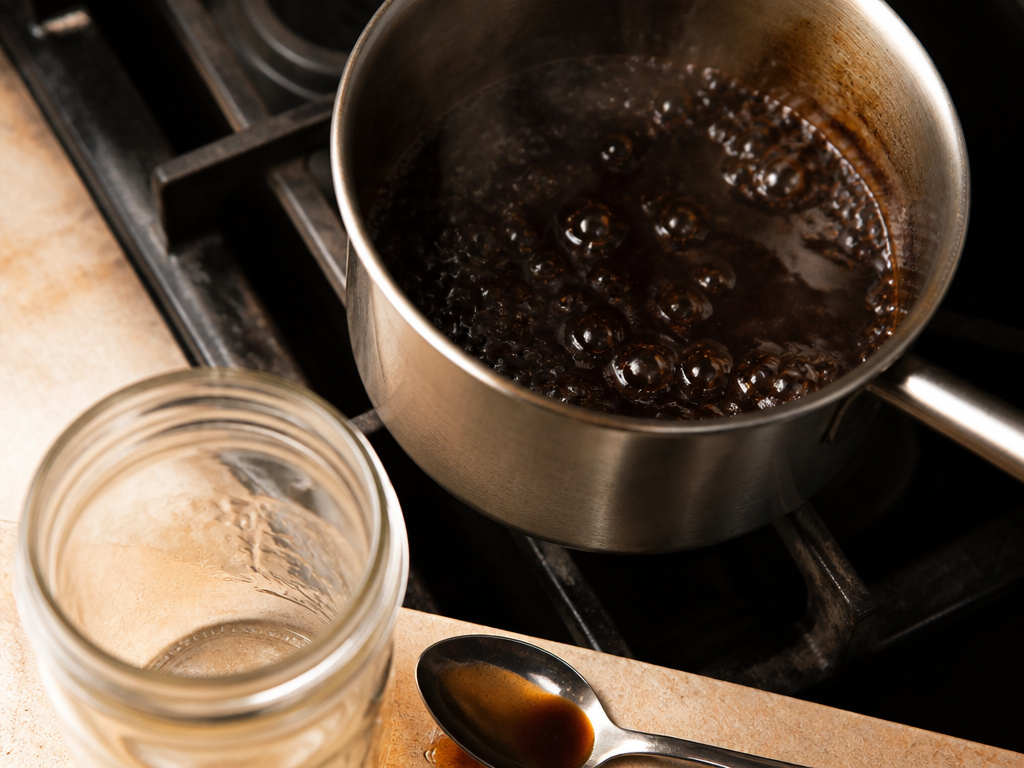
You cannot truly replicate industrial drying without industrial equipment. What you can make is a stable coffee concentrate, a syrup, that dissolves instantly in hot or cold water. It is a different product, but it is versatile and captures fresh coffee flavor better than any store-bought powder.
You will need:
- A drip machine, French press, or AeroPress.
- A small saucepan.
- A clean glass jar with a lid.
- A dark roast coffee (100g). Light roasts lack the soluble solids for a good yield.
- Filtered water (500ml).
The Process:
- Grind and brew extra strong. Grind your coffee to a medium consistency. Use a 1:5 coffee-to-water ratio (e.g., 100g coffee to 500ml water). This creates a brew twice as concentrated as normal.
- Reduce the brew. Pour the brewed coffee into a saucepan. Simmer gently on low heat. Do not boil. You are evaporating water to further concentrate the flavor. Aim to reduce the volume by half. This takes about 20–30 minutes. It will smell intensely like coffee.
- Cool and jar. Let the reduced coffee concentrate cool to room temperature. Pour it into the clean glass jar.
- Store in the fridge. Seal the jar and refrigerate. This concentrate will last 2–3 weeks.
To use, add one to two teaspoons of the syrup to a cup and top with hot water or milk. It works perfectly for iced coffee.
Expert tip: I tried dehydrating this concentrate in a low oven to make true granules. It worked, but the flavor loss was dramatic. The low-temperature simmer already drives off many top notes. Applying more heat to remove the last bit of water strips away almost everything else. The syrup method, while perishable, delivers a far superior flavor.
TL;DR: Skip making granules. Make a strong coffee reduction syrup instead. Store it in the fridge and use it within three weeks for the best flavor.
The Right Way to Prepare a Store-Bought Cup
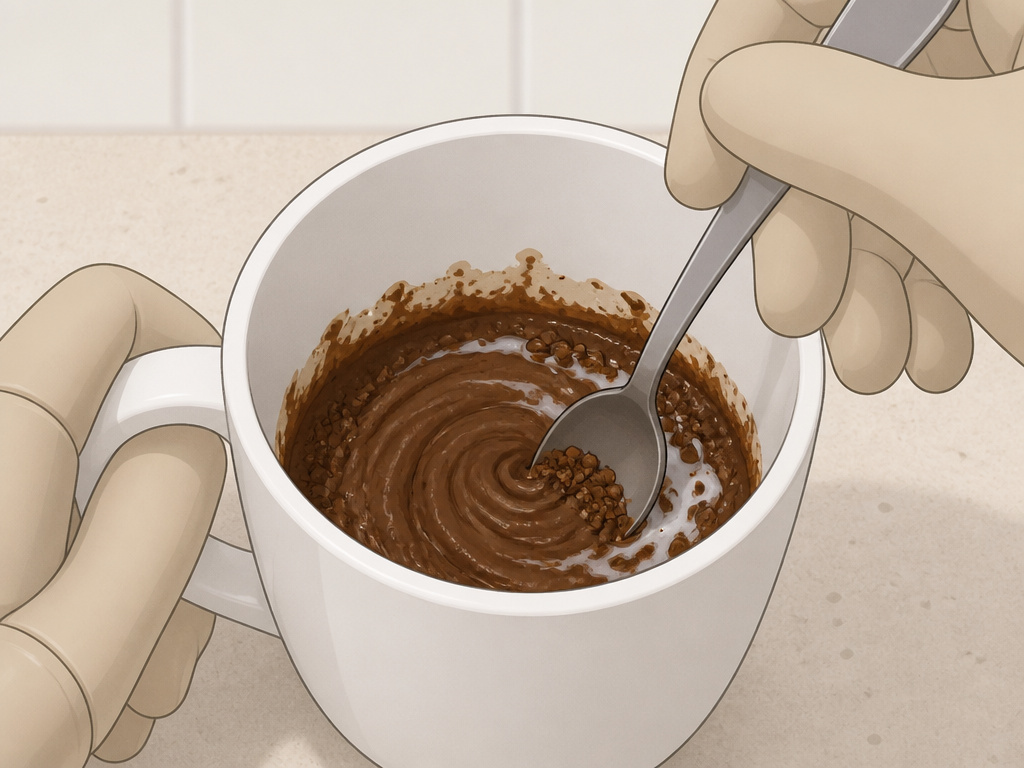
The instructions on the jar are the minimum viable product. For a cup that tastes like coffee, not just caffeine, follow this sequence.
First, ignore the “add hot water” directive. That is the main error. The granules are hygroscopic and fragile. Here is the correct method, adapted from a barista’s approach to working with delicate ingredients:
- Start cold. Put one teaspoon of soluble coffee granules into your mug.
- Add a splash of cold water or milk. Just enough to wet all the granules, about a tablespoon.
- Mix into a smooth paste. Stir vigorously for 10 seconds until no dry clumps remain. This step hydrates the granules gently, protecting the flavor compounds from thermal shock.
- Now add hot water. Pour in your hot water (90–95°C, not boiling) while stirring.
- Adjust to taste. Add more granules for strength, more water for dilution.
This method mimics the industrial “agglomeration” step, where fine particles are deliberately clumped together to improve dissolution. It eliminates the floating clumps and the scorched taste.
If your soluble coffee tastes bitter, add a pinch of salt. The sodium ions block bitterness receptors on your tongue. It is a trick that works for all coffee, not just the instant kind.
For a richer texture, consider a bulletproof-style coffee by blending your prepared cup with a fat like coconut oil or MCT oil. The soluble granules incorporate easily.
Frequently Asked Questions
Can you make real instant coffee at home?
You can make a soluble coffee concentrate or a poorly flavored granule, but you cannot replicate true industrial instant coffee. The spray-drying and freeze-drying equipment required operates at scales and vacuums impossible for a home kitchen. The concentrate method is your best bet for a homemade, instantly-dissolving product.
Why does some instant coffee taste better than others?
The main differentiators are the drying method and bean quality. Freeze-dried coffee typically tastes better than spray-dried. Brands that use a higher percentage of Arabica beans or single-origin coffees will also have a more complex flavor profile, though they are rarer and more expensive.
Is instant coffee stronger than regular coffee?
Gram for gram, soluble coffee contains slightly more caffeine because the extraction process is extremely efficient. However, a typical serving uses less mass than ground coffee. A standard teaspoon of instant coffee has roughly 60–80mg of caffeine, comparable to a weak cup of drip coffee. For a detailed caffeine comparison, the brewing method is the larger variable.
How should I store instant coffee to keep it fresh?
The enemy is moisture and air. Once opened, transfer the granules to an absolutely airtight container. Glass is best. Store it in a cool, dark cupboard, not the fridge or freezer (condensation will clump it). Properly stored, it will remain usable for years, but the aromatic quality will decline noticeably after about 6–12 months.
Can I use instant coffee in baking?
Yes, it is excellent for baking. Its concentrated, dry form distributes flavor evenly through batters and frostings without adding extra liquid. Dissolve it first in a small amount of the recipe’s water or milk to prevent gritty bits. It pairs wonderfully with brown sugar in rubs or glazes.
What’s the difference between instant and soluble coffee?
There is no technical difference. “Instant coffee” is the consumer term. “Soluble coffee” is the industrial and scientific term used in patents and standards like ISO 11292. Both refer to the dehydrated, instantly-dissolvable product.
Before You Go
Soluble coffee is a marvel of food engineering, a decades-long project to bottle convenience. Its taste is a direct reflection of the compromises made between flavor, cost, and shelf stability. Knowing the difference between a spray-dried powder and a freeze-dried crystal lets you choose a better product.
At home, your power is in the preparation. That initial cold-water paste makes a tangible difference. And if you are curious, the path to a homemade version leads not to a powder, but to a potent syrup in your refrigerator.
It will never replace the ritual of a fresh brewed coffee. But understanding its story might just make your next quick cup a little more interesting.
