
How to Make Iced Coffee with Espresso: The Ultimate Guide
To make iced coffee with espresso, pull a standard double shot and immediately pre-chill it by shaking with ice in a separate vessel before pouring it over fresh ice and adding milk. This method locks in flavor and minimizes dilution, which is the core failure of pouring hot espresso directly into a full glass of ice.
Most guides tell you to pull a shot and dump it over ice. That’s the mistake. You get a weak, watery mess before the first sip because the hot espresso melts half the ice on contact. The glass sweats, the drink thins out, and you’re left with a sad, lukewarm imitation of the sharp, cold beverage you wanted.
This method fixes that. We’ll cover the pre-chill technique, the right gear, and how to adapt it for everything from a quick iced Americano to a layered macchiato. You’ll also get the specifics your machine’s manual probably skipped.
Key Takeaways
- Pre-chill hot espresso in a separate metal shaker with a handful of ice for 15 seconds before building your drink. This stops catastrophic dilution.
- Match your grind size and dose to your specific machine. A Breville Barista Express Impress needs a 25-30 second pull for 60ml; a De’Longhi La Specialista Maestro targets 30-60ml in 20-30 seconds.
- Never pour hot espresso directly into a full glass of ice and milk. The thermal shock melts the ice instantly, watering down the coffee before you taste it.
- Use a kitchen scale. Volume measurements for espresso are useless, 18g of one bean fills a basket differently than 18g of another.
- Espresso ice cubes are a trade-off. They prevent dilution but dull the flavor through freezing. Use them only for batch drinks where subtlety isn’t the goal.
The Core Principle: Pre-Chill the Espresso
The entire method hinges on managing heat transfer. Hot espresso poured over ice wants to reach equilibrium. It will, by melting the ice. A double shot at around 90°C hitting a glass of 0°C ice melts roughly 40-50% of that ice mass in the first thirty seconds. That meltwater is why your drink tastes weak.
The pre-chill step rapidly lowers the espresso’s temperature by exchanging heat with a small, sacrificial amount of ice in a shaker. This preserves the majority of your drinking ice for texture, not for cooling duty.
You need two ice reserves: one for cooling, one for serving. The cooling ice gets spent in the shaker. The serving ice stays mostly whole in your glass, keeping the drink cold without drowning it. This is the single adjustment that moves a home iced espresso from mediocre to café-quality.
TL;DR: Shake your hot espresso with a small amount of ice in a separate metal cup for 15 seconds before pouring it over fresh ice in your glass. This stops dilution.
Why Your Machine’s Manual Doesn’t Mention This
Manufacturer guides like the Breville Barista Express Impress manual focus on hot extraction parameters, 25-30 seconds for a double shot, 54mm portafilter dosing. They assume you’re drinking the espresso hot. The Specialty Coffee Association’s standards, building on older ISO frameworks for sensory analysis, also prioritize hot beverage preparation. The “pre-chill” step is a community-developed workaround for a cold-serving problem the official literature often ignores. It’s a classic case of owner practice outpacing manufacturer advice.
Gear You Actually Need (And What You Don’t)
You can overcomplicate this. Don’t. The necessary tools are few, but specific choices matter.
A proper burr grinder is non-negotiable. Blade grinders create inconsistent particles that channel and extract unevenly, making your espresso taste both sour and bitter. That flawed flavor gets magnified when chilled. For espresso, you need the precise control a burr grinder provides to hit the correct espresso grind size.
Your espresso machine itself can be anything from a manual lever to a super-automatic. Just know its specs. If you have a Breville Barista Express Impress, its 25 grind settings and 54mm portafilter need a slightly finer grind than a standard 58mm commercial basket. A De’Longhi La Specialista Maestro with its 8 grind settings behaves differently. Pull out your manual.
The other critical tool is a simple 500ml stainless steel cocktail shaker or a small metal pitcher. Metal transfers heat faster than glass. Shaking in metal cools the espresso more quickly and efficiently.
| Tool | Why It Matters | Cheap Alternative |
|---|---|---|
| Burr Grinder | Consistent particle size for even extraction. | None. This is the one place to not cheap out. |
| Kitchen Scale | Espresso dose by weight, not volume. Accuracy within 0.1g. | A less precise gram scale, but expect variability. |
| Metal Shaker | Rapid heat transfer for pre-chilling. | A small metal mixing bowl and a whisk for stirring. |
| Espresso Machine | Any model that produces 9 bars of pressure. | A Moka pot, but the drink will be a strong coffee, not true espresso. |
Skip the specialty glasses, the expensive straws, and the branded stirring spoons. Put the budget into the grinder and the scale.
Before you start: If you own a Breville Barista Express Impress (model BES876BSS) sold between September 2022 and October 2023, check for a recall. The CPSC issued a recall in October 2023 because the steam wand can detach, posing a burn hazard. Confirm your machine is not part of the recalled batch before using the steam wand for frothing milk.
The Step-by-Step Iced Americano (The Baseline Drink)
This is the foundational recipe. Master this, and lattes, macchiatos, and flavored drinks are just additions away.
Step 1: Grind and Dose
Weigh out 18-20g of fresh coffee beans. Grind them finely. The exact setting depends on your grinder and machine. For a Breville Barista Express Impress, start around grind setting 8-10. The goal is to get 50-60ml of liquid espresso in 25-30 seconds. If the shot runs too fast (under 20 seconds), grind finer. If it drips slowly and yields less than 50ml in over 35 seconds, grind coarser. This tuning is the most important part of the process. Skipping it guarantees a weak or harsh base for your iced drink.
Step 2: Pull the Shot
Lock the portafilter into your machine. Start the extraction. Watch the time and the output. You want a steady, mouse-tail stream of espresso that starts blondeing around the 25-second mark. Catch the espresso in a pre-warmed cup or directly into your metal shaker.
Step 3: Pre-Chill
Immediately pour the hot espresso into your metal shaker. Add a small handful of ice, about 5-6 standard cubes. Seal and shake vigorously for 10-15 seconds. Listen. The sound will change from a sloshing liquid to a quieter, thicker sound as the espresso chills and the ice partially melts. Strain the now-cold espresso into a separate cup, leaving the spent ice behind.
Step 4: Build the Drink
Fill a tall glass to the top with fresh ice. Pour the chilled espresso over the ice. Then, add 120-180ml of cold water. The order matters. Adding water after the espresso preserves the crema and creates a more visually appealing layered effect, though it will mix when you stir. For a stronger drink, reduce the water.
Step 5: Adjust and Serve
Taste. Is it too strong or bitter? A tiny pinch of salt trick can counteract bitterness without adding sweetness. Too weak? Your initial extraction was likely too fast, grind finer next time. Add sweetener or milk if desired. Serve with a straw.
Common mistake: Pulling the shot directly into a glass full of ice and water. The hot espresso “cooks” the ice, creating a layer of instantly melted, warm, diluted coffee at the bottom of the glass. Your first sip will be harsh and watery, and the rest never recovers.
Milk, Sweeteners, and Syrups: Building Flavored Iced Drinks
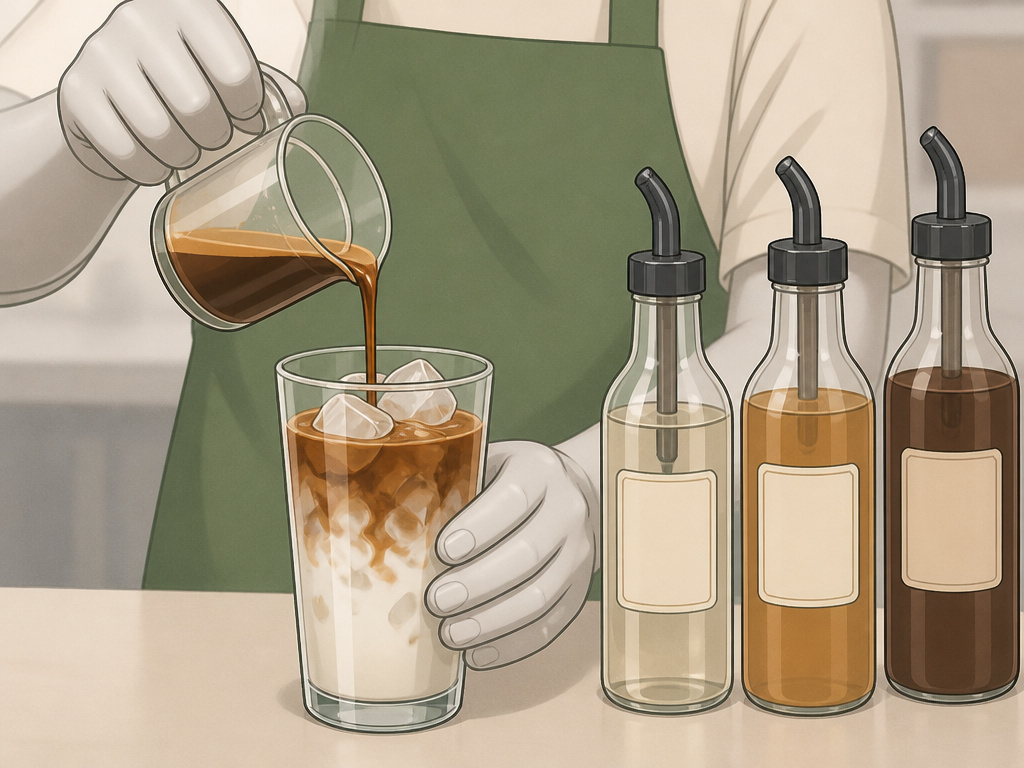
Once you have a solid iced Americano, turning it into a latte or mocha is straightforward. The principle remains: pre-chill the espresso first, then combine with cold ingredients.
For an iced latte, pre-chill your espresso as above. Fill a glass with ice, pour in 180-240ml of cold milk, then top with the chilled espresso. The reverse order, espresso first, creates a more distinct layer. For a richer drink, use a milk with higher fat content. If you’re exploring dairy-free milk options, note that almond and oat milk often separate or become grainy when poured over very acidic, hot espresso. Pre-chilling the espresso mitigates this reaction.
Sweeteners dissolve poorly in cold liquids. Use simple syrup (equal parts sugar and water, heated until dissolved, then cooled) instead of granulated sugar. For caramel notes in coffee, a caramel syrup integrates better than a thick sauce. Add syrups to the glass before the milk and espresso, so they mix more easily.
| Drink Variation | Espresso | Milk/Cream | Sweetener/Syrup | Key Technique |
|---|---|---|---|---|
| Iced Latte | 1 double shot (60ml), pre-chilled | 180ml cold whole milk | Optional 15ml simple syrup | Pour milk over ice, then add espresso for layers. |
| Iced Mocha | 1 double shot, pre-chilled | 150ml cold milk | 20ml chocolate syrup | Mix syrup with espresso in shaker before chilling. |
| Iced Macchiato | 1 double shot, pre-chilled | 30ml foamed cold milk | None | Float a dollop of cold foam over the espresso on ice. |
| Iced Vanilla Bean | 1 double shot, pre-chilled | 180ml cream or half-and-half | 1/2 scraped vanilla bean pod | Infuse the cream with vanilla overnight. |
Want a spiced twist? A dash of cinnamon in coffee can be added to the grounds before tamping for a infused flavor, or simply sprinkled on top of the finished drink. For a keto-friendly version, blending your chilled espresso with a teaspoon of coconut oil coffee creates a rich, frothy texture.
Advanced Techniques and Troubleshooting
Sometimes the standard method hits a snag. Here’s how to diagnose and fix the common issues.
Problem: The drink is always sour.
This is underextraction. Your water is passing through the coffee puck too quickly, grabbing only the bright, acidic compounds. The fix is to grind finer. Increase your dose by half a gram. Make sure you’re tamping with even, firm pressure. A sour shot over ice becomes intensely, unpleasantly tart.
Problem: The drink is bitter and harsh.
This is overextraction. The water is spending too much time in contact with the grounds, pulling out bitter, astringent compounds. Grind coarser. Decrease your dose slightly. Also, check your water temperature. If your machine runs too hot (above 96°C), it can scorch the coffee, creating bitterness that chilling won’t mask.
Problem: The espresso tastes great hot but flat when iced.
Chilling mutes aromatics. It’s normal for some high, floral notes to diminish. To compensate, use a slightly darker roast or a bean with pronounced chocolate or nutty base notes, which carry better when cold. You can also try a slightly stronger ratio, aim for a 1:1.5 brew ratio (18g in, 27g out) for a more concentrated shot that stands up to ice.
Flash Chilling for the Obsessive
The pre-chill shake is effective. For near-zero dilution, some cafes use a “flash chill” method. This involves pouring the espresso directly onto a frozen metal plate or into a chilled metal vessel submerged in an ice bath. It’s overkill for home, but it proves the point: rapid cooling is the goal. Without a blast chiller, your shaker is the best tool.
The Espresso Ice Cube Trade-Off
Freezing leftover espresso into ice cubes seems smart. They melt without diluting. The catch is that freezing damages the volatile aromatic compounds that give espresso its complexity. The thawed cube contributes coffee flavor, but it’s a dull, muted version. Use these cubes only in heavily flavored or milky drinks where you won’t notice the subtleties missing. For a clean iced Americano, they let you down.
Frequently Asked Questions
Can I use a Nespresso machine for iced coffee?
Yes. Machines like the Nespresso Vertuo Next are designed for specific capsule volumes, an “Espresso” capsule yields 40ml. Pull the shot directly into your metal shaker with a few ice cubes, shake to chill, then pour over fresh ice. The result is consistent and requires no grinding or dosing, though the espresso shot strength will differ from a fresh-ground shot.
Is iced coffee with espresso stronger than regular iced coffee?
In terms of caffeine per shot, yes, typically. A double espresso has roughly 80-100mg of caffeine concentrated in 60ml. A similar volume of drip coffee might have 60-80mg. When diluted to the same final volume in a glass, the caffeine levels may equalize, but the espresso-based drink will have a more intense, concentrated flavor profile upfront.
How do I make iced coffee with espresso without a machine?
Moka pot produces a strong, concentrated coffee that can stand in for espresso in a pinch. Brew it normally, then immediately pre-chill the hot coffee using the shake method. The drink will lack the crema and precise body of true espresso, but it works for espresso-based drinks like iced lattes. A French press or AeroPress can also produce a concentrate, though the texture differs.
Does shaking espresso ruin the crema?
Yes, completely. Shaking with ice demolishes the delicate crema. This is a conscious sacrifice. The crema is a textural and aromatic component best enjoyed in a hot espresso. In an iced drink, its texture is lost to the ice and milk anyway, and its aromatics vanish quickly. The trade-off for minimal dilution is worth the loss of the foam.
What’s the best milk for iced lattes?
Whole milk is the standard for its sweetness and texture. For a lighter option, skim milk works but can taste thin. Among plant-based milk frothing options, barista-formula oat milk is the most reliable, it steams and blends well without curdling. If you’re counting calorie content of milk, almond milk is the lowest-calorie choice that still performs decently in cold applications.
Before You Go
Making excellent iced coffee with espresso isn’t about fancy recipes. It’s about physics. Manage the heat, and you manage the dilution. Start with the pre-chill shake method every single time. Dial in your grind size for your specific machine, those manufacturer specs matter. Use a scale.
Remember that the goal is a cold, flavorful drink, not a hot espresso that got wet. Embrace the process. Taste as you go. And keep your shaker in the freezer. That extra bit of cold helps more than you’d think. Now pull a shot, and make a drink that’s actually worth the ice it’s served on.
