
How to Get Coffee Stains Out of a Rug for Good | Proven Tips
To get a coffee stain out of a rug, you need to act fast, blot instead of rub, and match your cleaning solution to the stain’s age and your rug’s fiber type. Cold, fresh coffee on synthetic fibers often lifts with dish soap and water. Hot, old, or sugary coffee on wool may require a hydrogen peroxide oxidizer to break down the melanoidin molecules that weld the pigment to the fibers.
Most people grab the first cleaning spray they see and start scrubbing. That’s the mistake. Scrubbing drives the stain deeper and frays the rug’s fibers, turning a surface spill into a permanent shadow. The real fight starts with temperature and timing.
This guide walks through the standard blot-and-lift method, explains why hot coffee is a different beast, and details the last-resort chemical step that breaks down the stain at a molecular level. You’ll learn what to do in the first sixty seconds and what to try when everything else has failed.
Key Takeaways
- Blot, never rub. Rubbing grinds coffee particles into the rug backing and damages fibers. Use your full body weight on a stack of dry white cloths.
- Hot coffee melts the stain-resistant coating on many synthetic carpets, welding the pigment to the fibers. Cold coffee stains are often superficial.
- Sugar and milk in coffee require a pre-treatment with a mild detergent solution before you tackle the coffee pigment itself.
- Wicking, the stain reappearing as the rug dries, means you didn’t rinse all the soap and coffee out. A wet-dry vacuum is the best fix.
- For permanent pigment, 6% salon-grade hydrogen peroxide is the oxidizer that works. The common 3% medical grade is too weak.
Why Hot Coffee Stains Are Different
Before you start: Hydrogen peroxide can bleach rug dyes, and household ammonia fumes are toxic in enclosed spaces. Always test any solution on a hidden corner of the rug first, like inside a closet seam. Work in a well-ventilated area and wear gloves.
A fresh cup of black coffee spilled on an office carpet is one problem. A steaming latte spilled on a synthetic bedroom rug is another. The difference isn’t just the milk. Heat changes the game at a chemical level.
Most modern synthetic carpets have a factory-applied stain-resistant coating. It’s a thin polymer layer that makes liquids bead up for easy blotting. The Carpet and Rug Institute (CRI) bases its cleaning guidelines on this technology. Pour cold coffee on it, and the coating often does its job. Pour coffee that’s near boiling point on it, and that polymer layer can soften or melt. The coffee, especially its brown melanoidin molecules, bonds directly to the carpet fibers underneath. You’re no longer cleaning a surface spill. You’re trying to separate a fused chemical bond.
This is why the standard “blot and soap” advice fails on hot coffee stains. The YouTube demo that boiled water out of coffee to concentrate it showed exactly this: after multiple rounds of detergent, the stain remained welded in place. The cleaning solution couldn’t reach the bonded pigment.
| Stain Type | Primary Challenge | Why Standard Methods Fail |
|---|---|---|
| Cold, fresh black coffee | Surface liquid absorption | They don’t—blotting and detergent usually work. |
| Hot, fresh black coffee | Melts stain-resistant coating | Soap can’t break the bond between pigment and fiber. |
| Coffee with milk/sugar | Multiple residue types | Sugar caramelizes, milk proteins set; need separate pre-treatment. |
| Old, set-in coffee | Wicking and capillary action | Stains reappear from the backing as the rug dries. |
Wool rugs face a separate, urgent threat. The WoolSafe Organisation highlights that coffee’s natural dyes can cause permanent yellowing on wool if not treated promptly. Their guidelines explicitly warn against strong alkaline or acidic cleaners, which can felt or degrade the wool fibers. For wool, your window for a simple fix is shorter, and your chemical options are narrower.
TL;DR: Heat can melt a rug’s stain guard, bonding the pigment directly to the fibers. Sugar and milk add sticky, separate residues that need their own treatment first.
The 3-Step Blot-and-Lift Method (For Fresh Stains)
This is the baseline procedure from the Carpet and Rug Institute and most professional cleaners. It works for cold spills and moderately warm ones that haven’t had time to set. The clock starts the moment the coffee hits the floor.
Step 1: Blot Like Your Rug Depends On It
Grab a stack of clean, white cloths or paper towels. Colored towels can transfer dye. Press down onto the stain with your full weight. Stand on it if you have to. The goal is to hydraulic as much liquid back out of the fibers as possible. Replace the cloth as soon as it’s saturated. Keep going until the cloth comes back nearly dry. Rubbing here is the cardinal sin. It spreads the stain laterally and grinds particulates into the base of the tufts.
Step 2: Apply a Mild Detergent Solution
Mix one teaspoon of clear, non-bleach dish soap into 25 ounces of warm water in a spray bottle. Clear soap avoids dye transfer. Spray the solution liberally over the stain, you want to soak the fibers, not just mist them. Let it dwell for five minutes. The detergent breaks the surface tension of the remaining coffee, surrounding the pigment and sugar molecules so they can be lifted out.
Lightly agitate the area with your fingers or a soft-bristled brush. Don’t scrub. Just work the solution into the fibers. Then, blot aggressively again with fresh white cloths.
Step 3: Rinse Thoroughly to Prevent Wicking
This is the step everyone wants to skip. Don’t. Fill your spray bottle with clean, warm water. Soak the area again, then extract the water. If you have a wet-dry vacuum, use it here. If not, blot with dry cloths until the cloth comes away clean. If you leave soap or coffee residue in the rug’s backing, it will travel back up the fibers as the rug dries, a process called wicking. The stain will return, sometimes darker than before. I learned this the hard way on a beige hallway runner. The stain vanished after cleaning, only to reappear as a faint brown ghost twelve hours later.
Common mistake: Skipping the rinse step after using detergent, the leftover soap acts as a magnet for dirt, and the unseen coffee residue wicks back to the surface as the carpet dries, leaving a permanent shadow.
For lingering tan discoloration after this process, move to a white vinegar solution. Mix one part white vinegar to two parts water, spray, let sit for 15 minutes, then blot and rinse again. The mild acidity can help break down the remaining pigment. This is the official follow-up step in the IICRC carpet care tip sheet for persistent organic stains.
When Your Coffee Has Extras: Sugar, Milk, and Flavors
Black coffee is a single enemy. A latte, a brown sugar coffee, or a cup with almond milk coffee creamer is a multi-front war. Each additive sets differently and requires its own approach.
Sugar is the sneakier problem. When a sweetened coffee spill dries, the sugar crystallizes. It acts like glue, binding the coffee pigment to the fibers. It also attracts moisture from the air later, creating a sticky patch that collects dirt. The CRI advises treating the sugar residue first. Use the same mild detergent solution, but let it dwell longer, up to ten minutes, to dissolve the crystals before you tackle the coffee stain itself.
Dairy and dairy alternatives like the calories in coffee creamer you might add pose a protein problem. As milk sits, the proteins denature and bind to fibers. They can also sour, leaving an odor. The detergent solution handles proteins well, but speed matters. The longer milk sits, the more it bonds.
Oily additives are a separate challenge. A spill from coconut oil coffee or MCT oil coffee leaves a greasy residue that repels water-based cleaners. For these, you need a degreaser. A drop of clear dish soap directly on the stain before adding the water solution can help emulsify the oil. Rinsing is even more critical here, as soap residue will trap dirt.
The sequence matters: blot the bulk, pre-treat for sugar or milk with detergent, then address the coffee pigment. Doing it out of order means you might dissolve the coffee stain only to find a sticky, milky patch left behind.
The Hydrogen Peroxide Last Resort

When the blot-lift-rinse cycle has run its course and a tan shadow remains, you’re dealing with oxidized pigment bonded to the fiber. This is where chemistry takes over from mechanics. The molecule responsible for coffee’s brown color is a melanoidin. These are large, complex polymers formed during roasting. To remove them, you need to break the chemical bonds, you need an oxidizer.
Hydrogen peroxide is that oxidizer. Not the 3% medical grade from the drugstore. That’s too weak. You need 6% salon grade hydrogen peroxide. The difference isn’t trivial. In the YouTube demonstration, 3% peroxide did almost nothing after hours. The 6% solution visibly lightened the stain in an eight-hour time-lapse.
The process is simple but requires patience and safety precautions.
1. Ventilate the room. The fumes from peroxide, especially when mixed with ammonia, are strong.
2. Test in an inconspicuous area. Peroxide can bleach some rug dyes.
3. Apply the 6% hydrogen peroxide liberally to the stain.
4. Add a few drops of household ammonia to the area to catalyze the reaction. The ammonia doesn’t clean; it speeds up the peroxide.
5. Wait. For at least eight hours. The reaction is slow. You might not see change for the first few hours.
6. Blot the area dry with a clean cloth once the stain has lightened to your satisfaction.
You will likely need to repeat this process two or three times for a severe, cooked-in stain. The demo that used concentrated, boiled-down coffee required three full applications over 24 hours. Peroxide breaks down into oxygen and water, so there’s no need to rinse after the final application. Just blot up the remaining liquid.
I won’t use peroxide on a wool rug without checking the WoolSafe guidelines first. The organization warns against strong chemicals, and peroxide, even at 6%, can degrade wool fibers over time. On synthetics, it’s my go-to last ditch effort.
Common mistake: Using 3% hydrogen peroxide from the medicine cabinet, the concentration is too low to break the melanoidin bonds, and after 24 hours of waiting you’ll see zero change, wasting time and letting the stain set further.
What Not to Do: The Shortcuts That Set Stains
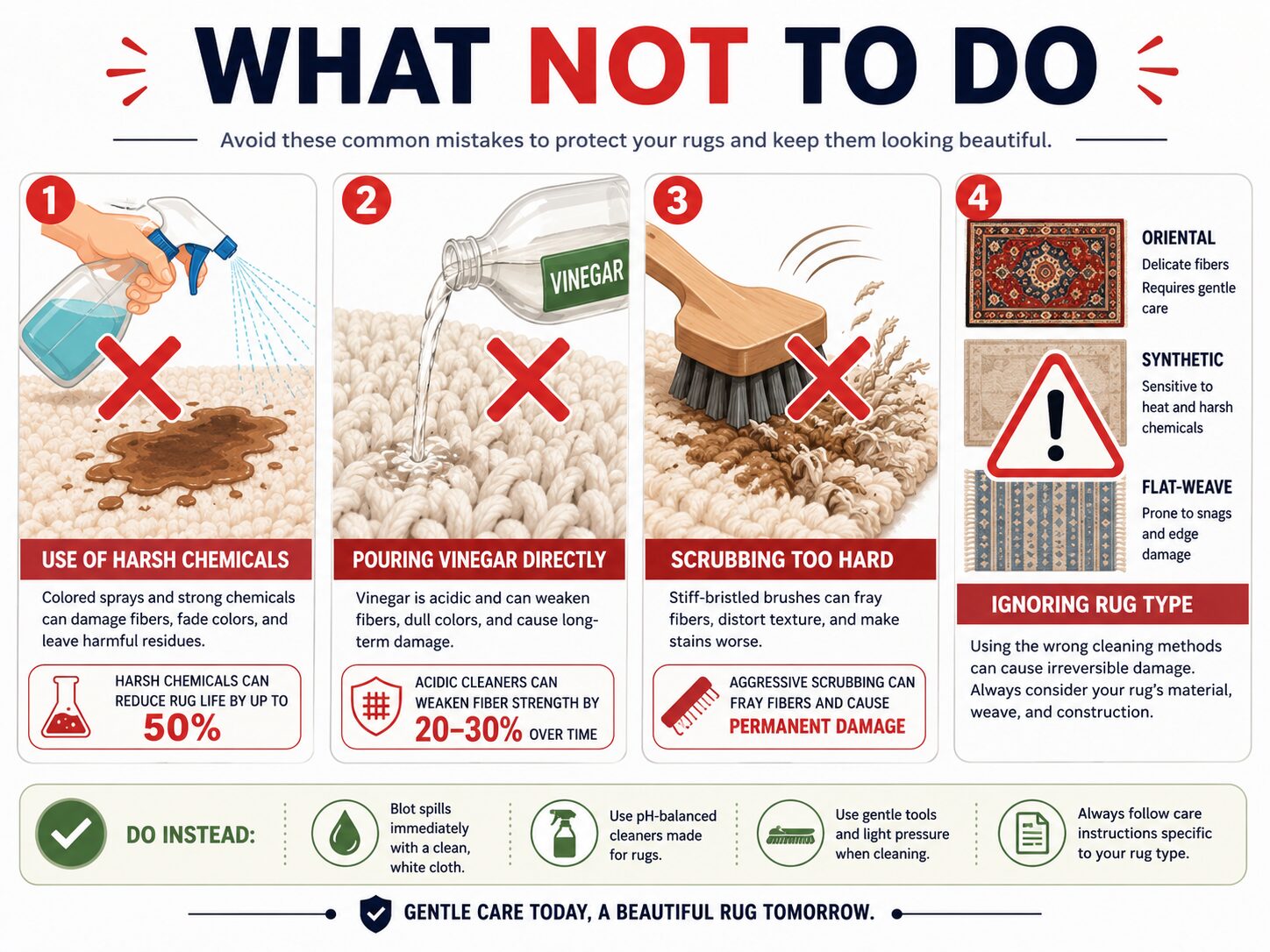
Every rug cleaning mistake has a consequence and a timeline. Here are the big ones.
Don’t use colored or scented cleaning sprays. The dyes and perfumes can transfer to your rug, creating a new, permanent stain right on top of the coffee. You’ll notice the color shift within an hour of the rug drying.
Don’t pour vinegar directly from the bottle. Full-strength vinegar is an acid. On wool, it can damage fibers. On some synthetics, it can break down the backing adhesive. Always dilute it to at least a 1:2 ratio with water.
Don’t use a brush with stiff bristles. Scrubbing with a stiff brush frays the ends of the carpet fibers. This frays the tips, creating a rough, discolored patch that looks worn even after the stain is gone. The damage is immediate and irreversible.
Don’t assume all rugs are the same. An antique Oriental rug, a modern synthetic plush, and a flat-weave wool rug have completely different fiber and dye systems. The cleaning approach for an Oriental rug is a specialist’s job. What works on one can ruin another.
| Mistake | Immediate Consequence | Long-Term Result |
|---|---|---|
| Rubbing the stain | Spreads stain laterally, grinds particles deep | Permanent discoloration at base of fibers |
| Using bleach or ammonia alone | Can bleach dye, doesn’t lift stain | Patchy, permanent light spot |
| Skipping the rinse step | Sticky soap residue left in backing | Wicking stain returns in 12-24 hours |
| Using hot water on protein stains (milk) | Cooks the protein into the fiber | Permanent yellowed, hardened patch |
The urge to fix the problem fast is strong. The discipline to follow the steps slowly is what saves the rug.
Tools and Supplies You Actually Need

You don’t need a professional-grade extractor. You need the right cheap tools used correctly.
- Clean white cloths or paper towels. This is non-negotiable. You need absorbance and you need to see what you’re pulling out of the rug. A full roll is better than a half roll.
- A spray bottle. For applying your cleaning solutions evenly without overwetting.
- Liquid dish soap (clear, non-bleach). The surfactant that breaks the stain’s surface tension. Dawn Ultra Original is a common pro choice.
- White vinegar. For the acidic follow-up on lingering pigment.
- Hydrogen Peroxide, 6% Salon Grade. This is a specific product, not the drugstore kind. It’s sold online and in beauty supply stores.
- Household ammonia (optional). A catalyst for the peroxide reaction. Use with extreme ventilation.
- A wet-dry vacuum (like a Shop-Vac). This is the single biggest upgrade from a basic cleanup to a professional one. It extracts the dirty solution from the rug backing, preventing wicking. A small, inexpensive model is fine.
A soft-bristled brush, like a nail brush or a soft toothbrush, is useful for gentle agitation. A stiff scrub brush is not. Keep your kit simple. The technique matters more than the tool.
Frequently Asked Questions
Does club soda work on coffee stains?
Club soda is weakly acidic and can help lift fresh, surface-level stains due to its carbonation. It’s better than nothing in a pinch at a restaurant. For a home rug, a dedicated detergent solution is far more effective because the surfactants actively surround and lift the stain molecules.
Can I use baking soda and vinegar?
The fizzing reaction looks productive, but it’s mostly theater. Baking soda (a base) and vinegar (an acid) neutralize each other, producing water, carbon dioxide gas, and a sodium acetate salt. The salt remains in your rug. You’re left with a damp, slightly salty rug and a stain that’s largely untouched.
How do I get old, dried coffee stains out?
Old stains have undergone wicking and oxidation. Start with the standard blot-and-lift method to remove any surface residue. If a shadow remains, you’ll likely need the hydrogen peroxide oxidation step. Be prepared for multiple applications over 24-48 hours, as the pigment is deeply set.
Will hydrogen peroxide bleach my rug?
It can. Always perform a spot test in a hidden area, like inside a closet or under a piece of furniture. Apply a small amount of the 6% peroxide, let it sit for an hour, and check for color change or bleaching. If it’s safe, proceed with the stain.
What about espresso or really strong coffee stains?
Stronger espresso stains mean a higher concentration of melanoidin pigments. They follow the same process but often require more repetitions of the detergent step and almost always need the hydrogen peroxide treatment. Act faster, the darker pigment sets more visibly.
Before You Go
Coffee stains are a battle of absorption, chemistry, and patience. Your first move is always blotting, never rubbing. Your first weapon is a simple mix of dish soap and water. When that isn’t enough, you escalate to vinegar. When even vinegar fails, you bring in the oxidizer: 6% hydrogen peroxide.
Remember that heat, sugar, and milk change the fight. They demand pre-treatment and different tactics. And always, always rinse thoroughly after any cleaning solution. The ghost that comes back is almost always a ghost of your own making, a reminder of the residue you left behind.
Your rug can survive a coffee spill. The fix is systematic, not magical. Follow the steps, respect the timelines, and match your method to your mug’s contents.
{
“@context”: “https://schema.org”,
“@type”: “HowTo”,
“name”: “How to Get Coffee Stains Out of a Rug”,
“totalTime”: “PT90M”,
“tool”: [
{
“@type”: “HowToTool”,
“name”: “Clean white cloths or paper towels”
},
{
“@type”: “HowToTool”,
“name”: “Spray bottle”
},
{
“@type”: “HowToTool”,
“name”: “Wet-dry vacuum (optional but recommended)”
},
{
“@type”: “HowToTool”,
“name”: “Soft-bristled brush”
}
],
“supply”: [
{
“@type”: “HowToSupply”,
“name”: “Liquid dish soap (non-bleach, clear)”
},
{
“@type”: “HowToSupply”,
“name”: “White vinegar”
},
{
“@type”: “HowToSupply”,
“name”: “Hydrogen peroxide, 6% salon grade”
},
{
“@type”: “HowToSupply”,
“name”: “Household ammonia”
}
],
“step”: [
{
“@type”: “HowToStep”,
“name”: “Blot the spill immediately”,
“text”: “Press dry, clean white cloths onto the stain with your full weight to absorb as much liquid as possible. Do not rub.”
},
{
“@type”: “HowToStep”,
“name”: “Mix and apply a detergent solution”,
“text”: “Mix 1 teaspoon clear dish soap into 25 ounces of warm water in a spray bottle. Spray liberally onto the stain, let sit for 5 minutes, then blot. Repeat until the stain lightens.”
},
{
“@type”: “HowToStep”,
“name”: “Rinse with clean water”,
“text”: “Spray the area with plain water and use a wet-dry vacuum or blot with a clean cloth to remove all soap residue. Skipping this causes wicking.”
},
{
“@type”: “HowToStep”,
“name”: “Apply a vinegar solution for lingering pigment”,
“text”: “Mix 1 part white vinegar to 2 parts water. Spray, let sit for 15 minutes, blot, then rinse again with water.”
},
{
“@type”: “HowToStep”,
“name”: “Treat stubborn stains with hydrogen peroxide”,
“text”: “For stains that remain, apply 6% salon-grade hydrogen peroxide mixed with a few drops of household ammonia. Let it work for 8+ hours, then blot dry.”
}
]
}
{
“@context”: “https://schema.org”,
“@type”: “FAQPage”,
“mainEntity”: [
{
“@type”: “Question”,
“name”: “Does club soda work on coffee stains?”,
“acceptedAnswer”: {
“@type”: “Answer”,
“text”: “Club soda is weakly acidic and can help lift fresh, surface-level stains due to its carbonation. It’s better than nothing in a pinch at a restaurant. For a home rug, a dedicated detergent solution is far more effective because the surfactants actively surround and lift the stain molecules.”
}
},
{
“@type”: “Question”,
“name”: “Can I use baking soda and vinegar?”,
“acceptedAnswer”: {
“@type”: “Answer”,
“text”: “The fizzing reaction looks productive, but it’s mostly theater. Baking soda (a base) and vinegar (an acid) neutralize each other, producing water, carbon dioxide gas, and a sodium acetate salt. The salt remains in your rug. You’re left with a damp, slightly salty rug and a stain that’s largely untouched.”
}
},
{
“@type”: “Question”,
“name”: “How do I get old, dried coffee stains out?”,
“acceptedAnswer”: {
“@type”: “Answer”,
“text”: “Old stains have undergone wicking and oxidation. Start with the standard blot-and-lift method to remove any surface residue. If a shadow remains, you’ll likely need the hydrogen peroxide oxidation step. Be prepared for multiple applications over 24-48 hours, as the pigment is deeply set.”
}
},
{
“@type”: “Question”,
“name”: “Will hydrogen peroxide bleach my rug?”,
“acceptedAnswer”: {
“@type”: “Answer”,
“text”: “It can. Always perform a spot test in a hidden area, like inside a closet or under a piece of furniture. Apply a small amount of the 6% peroxide, let it sit for an hour, and check for color change or bleaching. If it’s safe, proceed with the stain.”
}
},
{
“@type”: “Question”,
“name”: “What about espresso or really strong coffee stains?”,
“acceptedAnswer”: {
“@type”: “Answer”,
“text”: “Stronger espresso stains mean a higher concentration of melanoidin pigments. They follow the same process but often require more repetitions of the detergent step and almost always need the hydrogen peroxide treatment. Act faster, the darker pigment sets more visibly.”
}
}
]
}
