
How Much Caffeine in a Coffee Bean? A Complete Bean Guide
A single roasted Arabica coffee bean contains about 6 milligrams of caffeine. A Robusta bean holds nearly double that. The real number depends on the bean’s species, its growing conditions, and whether you measure by weight or by volume.
Most people assume a dark, bitter roast means more caffeine. It doesn’t. The bitter taste comes from other compounds developed during roasting, not from extra caffeine. In fact, roasting slightly reduces total caffeine, but the way we measure coffee, by the scoopful, creates a persistent myth.
This guide cuts through the noise with numbers from peer-reviewed studies. We’ll look at the exact caffeine percentages for Arabica and Robusta, explain why a light roast actually gives you more caffeine per scoop, and show you how to estimate the stimulant in your morning cup from the beans in your bag.
Key Takeaways
- Robusta beans contain roughly 70% more caffeine than Arabica beans, averaging 2.5% caffeine by weight versus Arabica’s 1.5%.
- Roasting burns off a tiny fraction of caffeine, but the main effect is on bean density and size. Light roast beans are denser, so a scoop holds more coffee, and thus more caffeine, than a scoop of fluffy dark roast.
- Decaffeinated coffee isn’t caffeine-free. EU standards allow up to 0.1% caffeine by dry weight in decaf beans.
- Brew method changes your caffeine intake more than bean type. A standard 8-ounce cup of drip coffee delivers about 95mg of caffeine, while a single shot of espresso contains 30-50mg.
- Environmental stress increases caffeine. Beans grown at higher altitudes or in less ideal conditions often produce slightly more caffeine as a natural pest defense.
Arabica vs. Robusta: The Caffeine Power Gap
The species of coffee plant determines the caffeine baseline. Coffea arabica and Coffea canephora (Robusta) are not just different tastes; they are different biochemical factories.
Arabica, the smoother, more complex bean that dominates specialty coffee, averages 1.5% caffeine by dry weight. Robusta, the harsher, more bitter bean used in espresso blends and instant coffee, averages 2.5% caffeine by weight or more. A 2019 study in the Journal of Food Science and Technology noted the range for Robusta can stretch from 1.7% to 4.0% depending on the cultivar.
Arabica beans typically contain 1.5% caffeine by dry weight, while Robusta beans contain 2.5% or more. This difference is a genetic trait, not a result of processing.
The why-layer here is plant defense. Caffeine is a natural insecticide. Robusta plants are hardier, grown at lower altitudes with more pests and diseases, so they evolved to produce more of the compound. That extra caffeine translates directly into the cup’s flavor profile and stimulant punch.
TL;DR: For maximum caffeine per bean, choose Robusta. For a balanced cup, stick with Arabica.
How Roasting Plays a Trick on Caffeine
Roasting doesn’t add caffeine. It destroys a small amount. The confusion starts because we don’t brew coffee bean by bean, we brew by scoop or by weight.
During roasting, beans lose moisture and some organic compounds. Caffeine is thermally stable, so very little degrades. However, because the bean loses overall mass, the concentration of caffeine per gram can appear to increase slightly. A 1986 study in Food Chemistry tracked this: caffeine content per 100g of dry matter increased from 1.18% in green Arabica beans to 1.31% in dark roasted beans.
The real-world impact is about density. Light roast beans are smaller and denser. Dark roast beans expand, becoming larger and less dense.
| Roast Level | Bean Density | Caffeine per Scoop | Caffeine per Gram |
|---|---|---|---|
| Light | High | More | Slightly higher |
| Medium | Medium | Medium | Similar to green |
| Dark | Low | Less | Slightly lower |
If you measure coffee with a scoop, you’ll fit more light roast beans into that volume. More beans means more total caffeine. If you measure by weight on a scale, the difference between light and dark roast caffeine content is almost negligible, we’re talking a difference of a few milligrams per cup.
Common mistake: Choosing a dark roast for more caffeine, a scoop of dark roast contains fewer beans and less total caffeine than a scoop of light roast, despite the darker coffee’s stronger, bitter taste.
From Bean to Brew: Where Your Caffeine Actually Comes From
The bean’s native caffeine is just potential energy. Your brewing method determines how much of that potential ends up in your cup.
Espresso uses fine grounds and high pressure for a short time, typically 25-30 seconds. This extracts caffeine efficiently but not completely, around 80-85% of the available caffeine transfers to the shot. A standard 1-ounce espresso shot contains 30-50mg of caffeine.
Drip or pour-over coffee uses coarser grounds and longer contact time with hot water, often 4-5 minutes. This method extracts closer to 90-95% of the caffeine. An 8-ounce cup of brewed coffee averages 95mg of caffeine.
The brewing factors that matter most are grind size, water temperature, and contact time. Finer grinds and hotter water increase extraction. But there’s a limit. Over-extracting doesn’t pull more caffeine; it just pulls more bitter-tasting compounds.
TL;DR: Your brewer extracts most, but not all, of the caffeine. Drip coffee gets more of it than espresso does, which is why a cup of coffee has more caffeine than a shot.
The Variables You Can’t See: Environment and Genetics
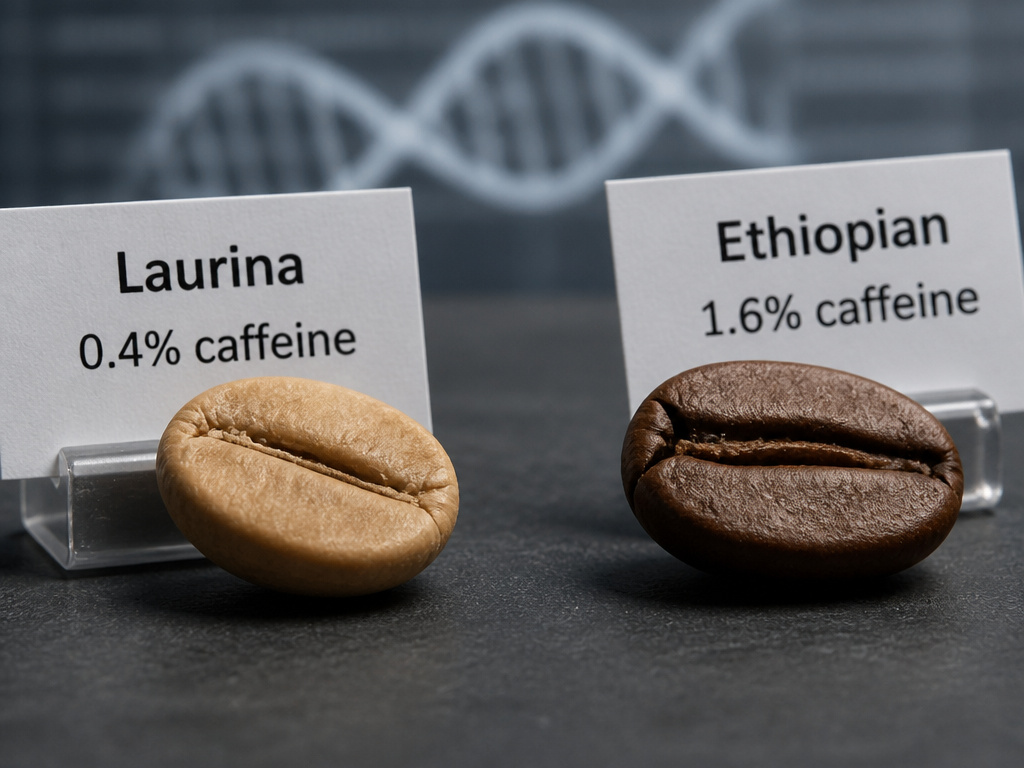
Caffeine content isn’t uniform even within a species. Where and how the coffee is grown changes the chemistry.
Altitude, rainfall, soil nutrition, and sun exposure all stress the coffee plant. Stress triggers a defense response, which can include increased caffeine production. Beans from a high-altitude Ethiopian farm might test at 1.6% caffeine, while a Brazilian Arabica from a lower, shaded plot might come in at 1.2%.
On the genetic side, breeders have developed naturally low-caffeine varieties. The “Laurina” mutation of Arabica, for example, produces beans with only 0.3-0.6% caffeine. It’s a rarity, but it proves the rule: caffeine levels are a heritable trait.
I once cupped a Laurina lot from Colombia side-by-side with a standard Ethiopian Yirgacheffe. The Laurina was shockingly mild, almost tea-like in its clarity, with none of the jittery edge I expected from my usual morning cup. It confirmed that the buzz isn’t just about strength, it’s baked into the bean’s DNA.
These variables mean the 1.5% and 2.5% averages are just that, averages. Your specific bag could be 10-15% higher or lower.
Decaf, Green Beans, and Extreme Caffeine Products
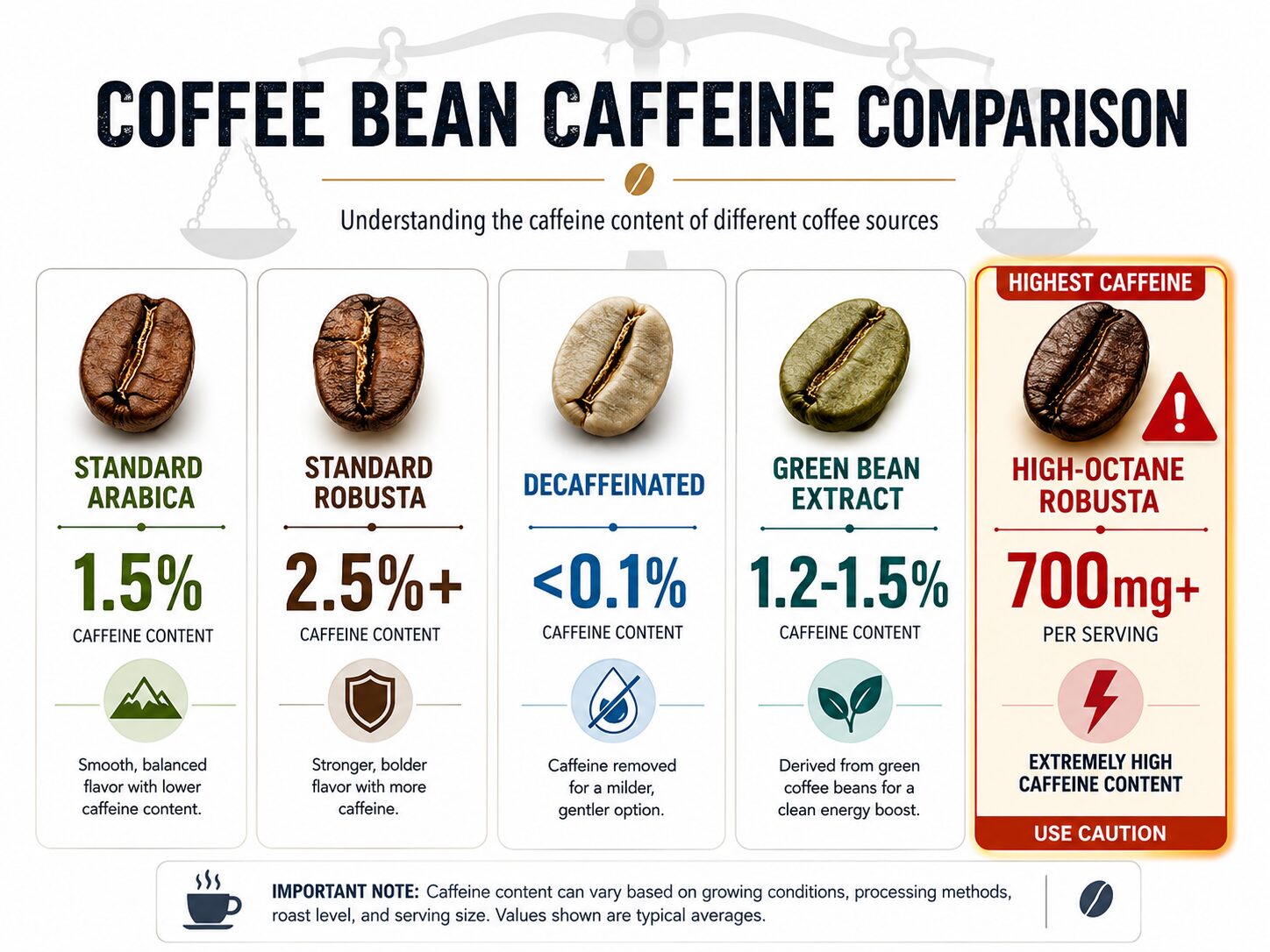
Decaffeinated Coffee
Decaf doesn’t mean zero. The European Union standard sets a maximum of 0.1% caffeine by dry weight for decaffeinated roasted coffee. Swiss Water Process or chemical solvents remove most, but not all, of the caffeine. You’re still getting about 2-5mg per cup.
Green Coffee Beans
For caffeine supplements and extracts, manufacturers often start with green (unroasted) beans. The caffeine percentage here is the pure, pre-roast baseline. This is the number referenced in most scientific studies, like the 2018 Food Science and Biotechnology paper which analyzed caffeine content across different processing methods.
High-Caffeine Commercial Blends
Brands like Death Wish Coffee or Biohazard Coffee use specific high-caffeine Robusta beans and careful blending to push total caffeine per serving above 700mg. They are the exception that proves the rule: you must start with a high-caffeine bean to end with a high-caffeine brew.
| Product Type | Typical Caffeine Source | Key Consideration |
|---|---|---|
| Standard Arabica | Bean (1.5% by weight) | Flavor complexity over stimulant power |
| Standard Robusta | Bean (2.5%+ by weight) | Bitter taste, higher caffeine, cheaper |
| Decaffeinated | Bean (<0.1% by weight post-process) | Not truly caffeine-free |
| Green Bean Extract | Green Bean (1.2-1.5% for Arabica) | Used in supplements, minimal roasting impact |
| “High-Octane” Commercial | Select High-Caffeine Robusta | Can exceed 700mg per serving; monitor intake |
Estimating Caffeine in Your Daily Cup
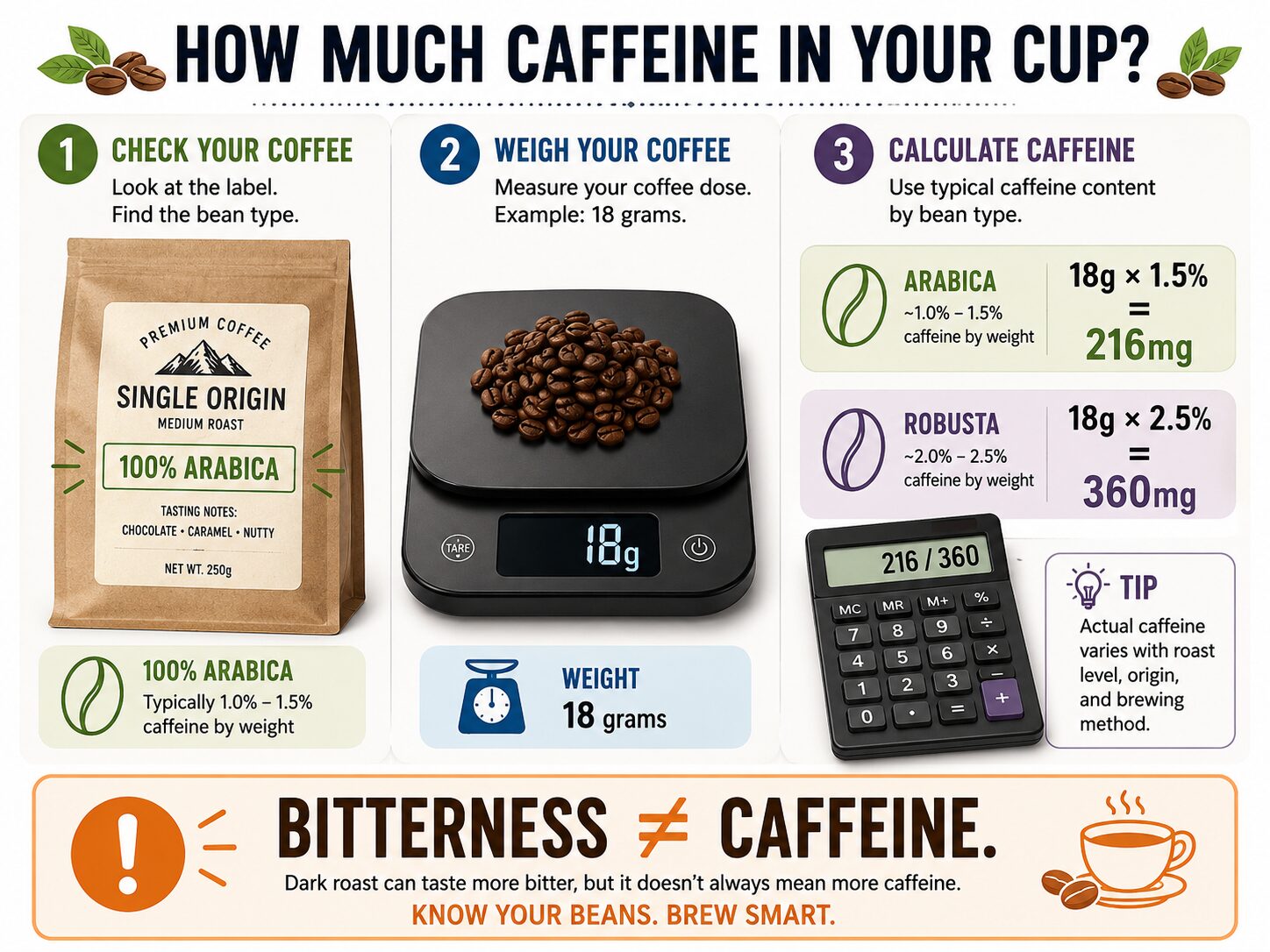
Let’s move from percentages to your actual mug.
- Identify your beans. Check the bag. Is it 100% Arabica, a blend, or 100% Robusta?
- Weigh your dose. A standard double-shot espresso dose is 18g. A drip coffee dose is often 15-20g.
- Do the math.
- For 18g of Arabica beans: 18g × 0.015 (1.5%) = 0.27g of caffeine in the grounds. If your espresso machine extracts 80% of that, you get 0.216g, or 216mg, in the cup.
- For 18g of Robusta beans: 18g × 0.025 (2.5%) = 0.45g of caffeine in the grounds. With 80% extraction, that’s 0.36g, or 360mg.
These numbers line up with the ranges published in the NIH study on chlorogenic acids and caffeine, which cataloged caffeine across dozens of commercial products. Your espresso caffeine content might be lower if you prefer a ristretto, or higher if you use a longer lungo extraction.
The caffeine in a cappuccino is simply the caffeine from the espresso shot, diluted by milk. A latte macchiato follows the same principle. The caffeine in tea is a different calculation entirely, reliant on steeping time and leaf grade.
Common mistake: Assuming all “strong-tasting” coffee is high in caffeine, the bitter notes in dark roast come from roasted compounds, not caffeine. You can have a intensely bitter, low-caffeine cup and a bright, acidic, high-caffeine cup.
Frequently Asked Questions
Does dark roast have more caffeine than light roast?
No. When measured by weight (using a scale), they have nearly identical caffeine. When measured by volume (using a scoop), light roast has more caffeine because the denser beans pack more into the scoop.
Which has more caffeine, Arabica or Robusta?
Robusta has significantly more caffeine, averaging 2.5% caffeine by weight compared to Arabica’s 1.5%. This is a consistent finding in research like the RSC Food & Function caffeine variations study.
How much caffeine is in one coffee bean?
single roasted Arabica bean contains about 6 milligrams of caffeine. A single Robusta bean contains about 10 milligrams. This is an average; individual bean size and density cause variation.
Does decaf coffee have any caffeine?
Yes. Regulations allow decaffeinated coffee to contain up to 0.1% caffeine by dry weight. A typical 8-ounce cup of decaf brewed from such beans contains 2-5mg of caffeine.
How does brewing method affect caffeine content?
Brewing method determines extraction efficiency. Drip coffee typically extracts 90-95% of the available caffeine. Espresso extracts about 80-85%. Cold brew, with its long steep time, can extract nearly all of it, leading to a highly caffeinated concentrate.
Is the caffeine content on coffee bags accurate?
It’s an estimate based on the bean type and roast. The actual caffeine in your cup varies with your dose weight, grind size, water temperature, and brew time. The Monster Energy caffeine content listed on a can is far more precise because it’s a manufactured product.
Before You Go
Forget the roast color as a caffeine indicator. Your bean’s species is the primary driver. If you need a serious jolt, seek out a high-quality Robusta or a blend that includes it. If you’re sensitive to caffeine, stick with 100% Arabica and consider a lighter roast when you measure by the scoop.
Remember that energy drink health impacts often stem from sugar and other additives, not just caffeine. Coffee gives you the stimulant without the extra baggage. Your daily caffeine intake is a simple equation: bean type, dose weight, and extraction method. Master those three, and you’ll know exactly what you’re drinking.
{
“@context”: “https://schema.org”,
“@type”: “HowTo”,
“name”: “How to Calculate Caffeine Content in Your Coffee Bean”,
“totalTime”: “PT5M”,
“tool”: [
{
“@type”: “HowToTool”,
“name”: “Digital kitchen scale”
},
{
“@type”: “HowToTool”,
“name”: “Coffee bean information (species, roast level)”
},
{
“@type”: “HowToTool”,
“name”: “Standard coffee scoop (optional)”
}
],
“step”: [
{
“@type”: “HowToStep”,
“name”: “Identify your bean species”,
“text”: “Check the bag for ‘Arabica’ or ‘Robusta’. Arabica beans average 1.5% caffeine by weight; Robusta averages 2.5% or more.”
},
{
“@type”: “HowToStep”,
“name”: “Weigh your dose”,
“text”: “Weigh your coffee dose in grams. A standard 18g dose for a double shot of espresso contains roughly 270mg of caffeine if it’s Arabica, or 450mg if it’s Robusta.”
},
{
“@type”: “HowToStep”,
“name”: “Adjust for roast level”,
“text”: “Understand that roast level changes bean density, not caffeine. Light roast beans are denser, so a scoop yields more caffeine by volume. A scoop of dark roast yields less caffeine by volume because the beans are larger and less dense.”
},
{
“@type”: “HowToStep”,
“name”: “Calculate for your brew method”,
“text”: “Apply an extraction rate. Drip coffee typically extracts about 90% of the bean’s available caffeine, while espresso extracts closer to 80% due to shorter contact time.”
}
]
}
{
“@context”: “https://schema.org”,
“@type”: “FAQPage”,
“mainEntity”: [
{
“@type”: “Question”,
“name”: “Does dark roast have more caffeine than light roast?”,
“acceptedAnswer”: {
“@type”: “Answer”,
“text”: “No. When measured by weight (using a scale), they have nearly identical caffeine. When measured by volume (using a scoop), light roast has more caffeine because the denser beans pack more into the scoop.”
}
},
{
“@type”: “Question”,
“name”: “Which has more caffeine, Arabica or Robusta?”,
“acceptedAnswer”: {
“@type”: “Answer”,
“text”: “Robusta has significantly more caffeine, averaging 2.5% caffeine by weight compared to Arabica’s 1.5%. This is a consistent finding in research like the RSC Food & Function caffeine variations study.”
}
},
{
“@type”: “Question”,
“name”: “How much caffeine is in one coffee bean?”,
“acceptedAnswer”: {
“@type”: “Answer”,
“text”: “single roasted Arabica bean contains about 6 milligrams of caffeine. A single Robusta bean contains about 10 milligrams. This is an average; individual bean size and density cause variation.”
}
},
{
“@type”: “Question”,
“name”: “Does decaf coffee have any caffeine?”,
“acceptedAnswer”: {
“@type”: “Answer”,
“text”: “Yes. Regulations allow decaffeinated coffee to contain up to 0.1% caffeine by dry weight. A typical 8-ounce cup of decaf brewed from such beans contains 2-5mg of caffeine.”
}
},
{
“@type”: “Question”,
“name”: “How does brewing method affect caffeine content?”,
“acceptedAnswer”: {
“@type”: “Answer”,
“text”: “Brewing method determines extraction efficiency. Drip coffee typically extracts 90-95% of the available caffeine. Espresso extracts about 80-85%. Cold brew, with its long steep time, can extract nearly all of it, leading to a highly caffeinated concentrate.”
}
},
{
“@type”: “Question”,
“name”: “Is the caffeine content on coffee bags accurate?”,
“acceptedAnswer”: {
“@type”: “Answer”,
“text”: “It’s an estimate based on the bean type and roast. The actual caffeine in your cup varies with your dose weight, grind size, water temperature, and brew time. The Monster Energy caffeine content listed on a can is far more precise because it’s a manufactured product.”
}
}
]
}
