
Learn How They Flavor Coffee Beans: Post-Roasting Methods
Flavoring coffee beans is an industrial process where food-grade, oil-soluble flavoring compounds are sprayed onto roasted beans as they tumble in a large drum. The standard method applies 1-2 milliliters of concentrated flavoring oil per pound of cooled beans, letting the porous bean structure absorb the oil over 24 hours before packaging. The key is applying flavor after roasting; heat during roasting would destroy most synthetic flavor molecules.
Most people imagine flavor is baked into the bean during roasting, like a vanilla cake. That assumption is why homemade attempts often fail, they add flavor before the roast, which incinerates the delicate compounds. The real work happens in a cooled, tumbling drum.
This guide walks through the industrial spray method, the niche practice of pre-roast infusion, and how to adapt the principles for your kitchen. You will learn why the post-roast step is non-negotiable, what “food-grade, oil-soluble” really means for safety, and how to avoid the sticky, uneven mess that plagues first-timers.
Key Takeaways
- Flavoring is a post-roast process; applying flavor before roasting vaporizes most compounds.
- Industrial flavorings are food-grade, oil-soluble, and highly concentrated, often just 1-2ml per pound of beans.
- The beans must be completely cool before application; residual heat causes the flavoring to evaporate on contact.
- Home flavoring works with a small spray bottle, a glass jar, and a 24-hour curing period.
- Natural infusions (soaking green beans in vanilla extract or spices) are an experimental alternative with wildly variable results.
Why Flavor is Applied After Roasting
Heat is the enemy of most flavor compounds. During roasting, bean temperatures exceed 400°F (204°C). At that heat, the delicate ester and aldehyde molecules that create flavors like hazelnut or French vanilla simply combust. They turn to vapor and are gone before the bean finishes its first crack.
The porous structure of a roasted coffee bean is what makes flavoring possible. As beans roast, internal moisture escapes, leaving behind a network of microscopic tunnels and chambers. This structure is perfect for absorbing oils. According to the University of Nebraska-Lincoln Extension, flavorings are applied “after they have been roasted and cooled.” The cool, dry bean acts like a sponge for the flavored oil.
Applying flavor to hot beans is the single most common home mistake. You will see the liquid vanish in a puff of scented steam, leaving behind a faint smell and no actual taste in the cup.
TL;DR: Roasting temperatures destroy flavor molecules. The cooled bean’s porous structure absorbs oil-based flavorings, which is why the industry always flavors post-roast.
The Standard Industrial Method
This is how every major flavored coffee brand, from mass-market to specialty, does it. The scale is larger, but the physics are the same you can replicate at home.
First, beans are roasted in batches and transferred to a cooling tray. They must drop to room temperature, usually around 70°F (21°C). A industrial flavoring drum is essentially a large, motorized tumbler. The cooled beans go in, and the flavoring agent is introduced.
| Component | Industrial Specification | Why It Matters |
|---|---|---|
| Flavoring Agent | Food-grade, oil-soluble compounds. | Oil bonds to the bean’s surface and absorbs into pores; water-based flavorings cause mold. |
| Concentration | Highly concentrated; typical usage is 1-2% of bean weight. | A little goes a long way. Over-flavoring creates a greasy, artificial-tasting bean. |
| Application Method | Fine mist spray nozzles inside a rotating drum. | Ensures even coating on every bean. Hand-tossing leads to clumping and uneven flavor. |
| Curing Time | 12-24 hours in sealed containers post-application. | Allows the oil to fully penetrate the bean’s structure. Skipping this causes surface-only flavor. |
The flavoring itself is a trade secret blend, but it is always oil-soluble. Water-based flavors would bead up on the oily bean surface and promote rancidity. The oil acts as a carrier, sticking to the bean and seeping in. After tumbling, the beans are sealed in bags for a curing period. This resting phase is critical, it lets the flavor migrate from the surface into the bean’s core. Grind and brew immediately after spraying, and you will taste oil, not hazelnut.
Common mistake: Assuming “flavored coffee” means flavored grounds. The flavoring oil is applied to the whole bean. Pre-ground flavored coffee loses its signature aroma twice as fast because of the increased surface area.
The entire process hinges on temperature control. I learned this the hard way after roasting a batch of Ethiopian Yirgacheffe and trying to add a homemade orange zest oil while the beans were still warm. The kitchen smelled incredible for ten seconds. The beans tasted like faint, bitter ash.
What Are Coffee Flavorings Made Of?
They are not syrups. Commercial coffee flavorings are synthetic compounds designed to mimic natural flavors, crafted to be stable and potent. A “French Vanilla” flavor might contain vanillin (the primary compound in vanilla beans) alongside other esters to round out the profile. These compounds are suspended in a food-grade solvent, like propylene glycol or triacetin, which evaporates or is absorbed, leaving the flavor molecules behind.
The Springer Nature wet fermentation study highlights how natural fermentation can develop complex fruity and floral notes in green beans. Synthetic flavoring is a shortcut to achieving specific, consistent notes that natural processing can’t guarantee year-round.
- Food-Grade Status: This is a non-negotiable safety standard. It means the flavoring is approved for human consumption and contains no harmful solvents.
- Oil-Solubility: Water and coffee oil do not mix. Oil-soluble flavors bind to the natural oils on the roasted bean, ensuring the flavor survives storage and grinding.
- High Concentration: A typical dosage is 1-2 milliliters of flavoring oil per pound (450 grams) of coffee beans. This is why flavored beans can smell strong in the bag but taste balanced in the cup.
Natural alternatives exist, like vanilla extract or spice-infused oils. These work on the same principle but are less concentrated and can introduce moisture. A vanilla extract soak risks adding water, which leads to mold in the bag within a week. If you go natural, you must use an oil-based extract.
TL;DR: Flavorings are lab-created, oil-soluble, food-safe compounds. Their high potency and oil base allow them to stick to beans and survive storage.
How to Flavor Coffee Beans at Home

You can achieve professional, even results without a steel drum. The goal is to mimic the three pillars of the industrial method: an even coating, an oil-soluble flavor, and a curing period.
You will need:
- 100 grams of freshly roasted, completely cooled coffee beans.
- 1-2 milliliters of food-grade flavoring oil (like those from OliveNation or LorAnn Oils).
- A clean, airtight glass jar (mason jar works).
- A small spray bottle or pipette.
- A digital kitchen scale.
- A baking sheet and parchment paper.
Step 1: Roast and Cool Completely
Start with beans roasted within the last 24 hours for maximum porosity. Let them cool on a baking sheet until they are truly room temperature, no residual warmth at all. This can take an hour.
Step 2: Weigh and Transfer
Weigh your beans. For 100 grams, you will use about 1 ml of flavoring oil. Pour the beans into your clean, dry glass jar.
Step 3: Apply the Flavoring
Add the flavoring oil to the jar. Seal the lid tightly. Now shake. Shake vigorously for a full 60 seconds, then roll the jar to redistribute any pooled liquid. Shake again for 30 seconds. The beans should look slightly glossy but not wet.
Step 4: Cure the Beans
Let the sealed jar sit at room temperature, out of direct sunlight, for 12-24 hours. Shake the jar every few hours. This curing time lets the oil soak past the surface.
Step 5: Dry and Store
After curing, spread the beans back on the parchment-lined sheet for 1-2 hours. This lets any excess surface oil evaporate, preventing a greasy grind. Store the beans in an airtight container. Wait at least 3 days before brewing for the best, most integrated flavor.
I won’t flavor a light roast Ethiopian the same way I flavor a dark roast Sumatran. The lighter, denser bean absorbs oil slower. Give it the full 24-hour cure or the flavor stays on the outside.
The type of bean you start with matters. A dark roast, being more porous, will absorb flavor faster and taste stronger. A dense, light roast like a Kenyan or Ethiopian might need the longer end of the curing window. This is the difference between a hint of hazelnut and a punch in the face.
The Experimental Path: Flavoring Green Beans Before Roasting
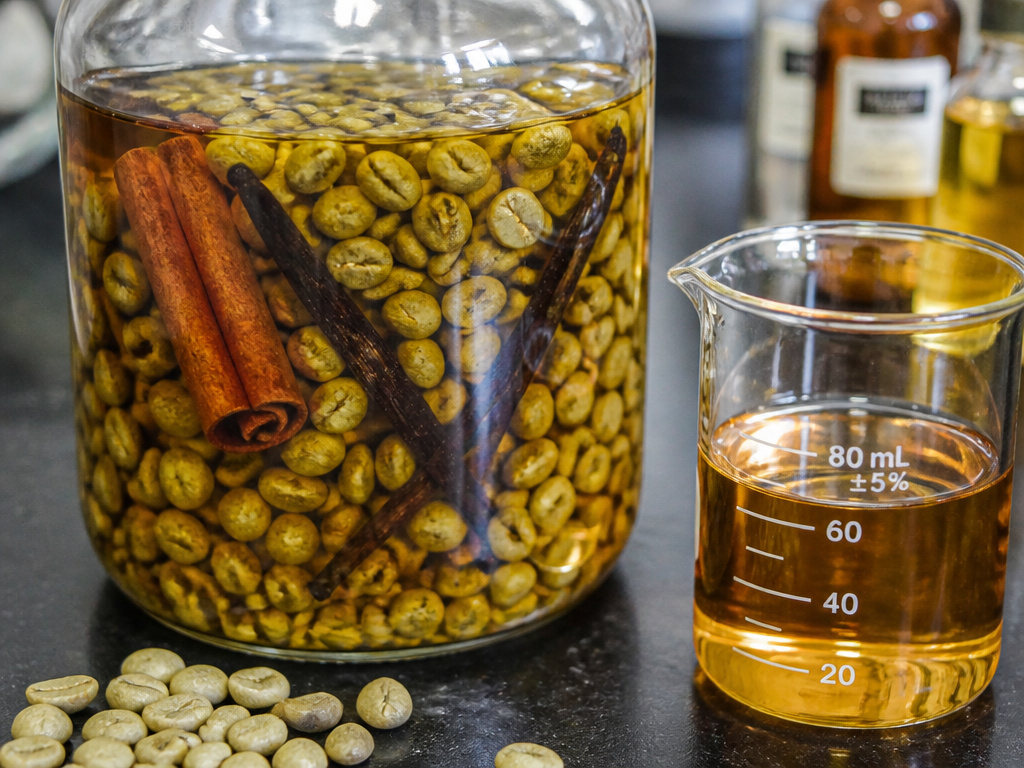
Some specialty roasters experiment with adding flavorings before roasting. The theory is intriguing: as the bean develops during roasting, the flavor compounds might integrate more deeply, creating a more “baked-in” taste rather than a surface coating.
The practice is far from standard. As noted in research, this technique involves “soaking green coffee beans in various flavor additives such as spices, herbs, or even alcohol.” For example, soaking green beans in a cinnamon-infused spirit or a vanilla extract solution.
| Method | Process | Pro | Con & Risk |
|---|---|---|---|
| Post-Roast (Standard) | Spray oil-based flavoring on cooled roasted beans. | Consistent, controlled, no flavor loss. | Flavor can fade faster over time. |
| Pre-Roast (Experimental) | Soak green beans in a flavoring solution, then dry and roast. | Potential for deeper, more integrated flavor. | Highly inconsistent; most flavor compounds burn off during roast. |
The major hurdle is the roast itself. While the bean’s internal chemistry is changing, many added flavorants are volatile. They evaporate or break down long before the roast is finished. You are left with a faint memory of the flavor and often a bean that roasted unevenly because of added moisture. The ScienceDirect fermentation process review details how controlled, natural fermentation can develop flavor precursors in green beans, a far more reliable method than soaking them in external flavorings.
I tried a pre-roast infusion with whole vanilla beans and a high-proof spirit. The green beans smelled incredible after a week of soaking. After roasting, the aroma was gone. The cup had a subtle, smoky vanilla note, but it was not worth the extra week and the risk of mold.
TL;DR: Pre-roast flavoring is an unpredictable niche experiment. For reliable, strong flavor, the post-roast method is the only proven path.
Flavored Coffee vs. Naturally Flavored Beans

This is a crucial distinction that changes what you are actually buying.
Flavored Coffee Beans have had synthetic or natural flavoring oils added after roasting, as described above. The flavor is added.
Naturally Flavored Beans get their distinct taste from their environment and processing method. A Sumatra Mandheling has earthy, spicy notes from the wet-hulling process. A natural-processed Ethiopian tastes like blueberries because the beans dried inside the coffee fruit. This is the bean’s inherent character, not an additive.
When you explore single-origin flavors, you are tasting the results of coffee fermentation scientific review, soil, and roast, not a flavoring drum. This is why a blonde roast bean from Brazil tastes different from a blonde roast from Colombia. The search for these inherent flavors is what drives the specialty coffee movement, far from the world of flavored coffee oils.
Choosing between the two is not about quality, but intent. Flavored beans aim for consistency and a specific, recognizable taste. Natural beans offer a tasting experience of a specific place and time.
Your coffee grinder matters more with naturally flavorful beans. A consistent grind extracts those delicate, inherent notes evenly. For pre-flavored beans, grind consistency is less critical because the dominant flavor is the added oil.
Common Problems and How to Fix Them
Flavoring at home goes wrong in predictable ways. Here is how to spot and solve each issue.
Problem: The beans smell strong but taste like nothing.
Cause: The flavoring was applied to beans that were still warm. The heat caused immediate evaporation.
Fix: Let your roasted beans cool for a full hour. Test by touching a few, they should feel completely cool, not warm.
Problem: The flavor tastes chemical or artificial.
Cause: You used too much flavoring oil. More is not better.
Fix: Stick to the 1% rule (1 ml of flavoring per 100g of beans). Measure with a syringe.
Problem: The beans are sticky or greasy.
Cause: Insufficient drying time after the curing period. Oil pooled on the surface.
Fix: After curing, spread beans in a single layer on parchment paper for 1-2 hours before storing.
Problem: The flavor is uneven, some beans are potent, others bland.
Cause: Inadequate shaking during the coating phase.
Fix: Shake the sealed jar for a full minute, rest, then shake again. The goal is a mechanical, even coating.
Problem: The beans developed mold after a week.
Cause: You used a water-based flavoring like a vanilla extract or a syrup.
Fix: Only use oil-based, food-grade flavorings. Any product with water in the ingredient list will spoil.
If you are looking for subtle flavor enhancement without oils, consider salting coffee grounds to reduce bitterness, or adding cinnamon coffee spices directly to your grounds before brewing. For a different texture and flavor, try a brown sugar coffee syrup or a coconut oil coffee blend.
Frequently Asked Questions
Can you flavor coffee beans with vanilla extract?
You can, but you should not. Pure vanilla extract contains alcohol and water. The alcohol will evaporate, and the remaining water can cause the beans to mold. For a vanilla flavor, use a food-grade vanilla flavoring oil instead.
Does flavored coffee have more calories?
No. The amount of flavoring oil used is minuscule, about 1-2 ml per pound of beans. This adds a negligible number of calories, far less than adding sugar or almond milk to your cup.
Why does flavored coffee smell so strong in the bag?
The sealed bag traps the volatile aroma compounds from the flavoring oils. Once opened, those compounds begin to oxidize and evaporate, which is why flavored coffee loses its potency faster than unflavored beans. Grinding accelerates this process dramatically.
Can I flavor decaf coffee beans?
Yes. The decaffeination process does not affect the bean’s ability to absorb oils. The method is identical. Use decaf beans if you want flavored coffee without the caffeine.
Do flavored beans ruin my grinder?
They can leave residual oils in your grinder, which will go rancid and taint subsequent batches of unflavored coffee. If you grind flavored beans, clean your grinder thoroughly afterward by grinding a handful of plain, cheap beans to absorb the residual oils, then wipe it out.
What’s the difference between flavored beans and adding syrup to my cup?
Flavored beans infuse the flavor into the coffee oils themselves, which carries through into the crema and the entire sip. Syrup just sweetens and flavors the liquid after the fact. The experience from the bean is more integrated, while syrup sits on top.
Before You Go
Flavoring coffee beans is a post-roast, oil-based process built on simple mechanics. The industry uses cooled, tumbling drums and highly concentrated flavorings to achieve a consistent product. At home, you can replicate this with a glass jar, a steady hand, and patience. Remember the three rules: cool beans, oil-based flavorings, and a 24-hour cure. Skip any one, and the result is weak, uneven, or spoiled.
For a truly unique cup, start with high-quality Arabica beans and a precise coffee grinder. Then decide if you want the controlled hit of a flavored oil or the natural complexity of the bean itself. Both have their place. The choice is yours.
