
French Roast vs Dark Roast Coffee | The Caffeine Trap
French roast vs dark roast coffee is defined by roast level, not strength. French roast is the darkest commercial style, roasted past second crack for a smoky, bitter cup. Other dark roasts stop earlier, preserving more bean origin character. The key difference is flavor profile, not caffeine content, which actually decreases with longer roasting.
French roast vs dark roast coffee is a comparison of a specific, very dark style against a broader category. French roast is the darkest common commercial roast, defined by beans that are roasted well into or past the ‘second crack,’ producing a shiny, oily surface and a flavor dominated by roast-derived smokiness and bitterness. Other dark roasts stop earlier, often just at the onset of second crack, retaining more of the bean’s original sugars and acids for a more balanced, bittersweet profile.
Most people think the difference is just strength. They grab the darkest bag on the shelf assuming it packs the biggest punch, both in flavor and caffeine. That assumption is wrong in two specific ways, and it leads to a lot of disappointing, one-note cups.
This guide cuts through the marketing haze. We’ll define each roast level with physical markers, debunk the caffeine myth with roasting chemistry, and tell you exactly which one to pick for your espresso machine versus your pour-over setup.
Key Takeaways
- French roast is a subset of dark roast, not a synonym. It’s roasted longer, often past the ‘second crack,’ leading to an oily bean surface and a flavor where the roast itself overpowers the bean’s origin.
- Darker roasts have less caffeine by weight, not more. The prolonged heat breaks down caffeine molecules. A scoop of dark roast contains fewer caffeine molecules than the same scoop of a light roast.
- Choose French roast for espresso or milk-based drinks where you need a heavy body and low acidity to cut through milk. Opt for a standard dark roast for drip or pour-over if you want more complexity and less char.
- The oily sheen on French roast beans signals advanced roasting. Those oils oxidize quickly, turning rancid. Buy French roast in smaller quantities and use it within two weeks of the roast date.
- Quality matters more at darker levels. A cheap bean roasted dark tastes ashy and flat. A high-quality, dense bean can handle a dark roast and still offer some chocolate or nutty depth beneath the smoke.
The Roasting Spectrum: Where French Roast Fits
Coffee roasting is a progression of heat, time, and chemical change. The common shorthand, light, medium, dark, is useful but vague. The Specialty Coffee Association uses the Agtron Gourmet Scale, a color-measurement system, to bring precision. On this scale, ground coffee readings below 35 generally fall into the dark roast category.
French roast lives at the far end of this dark territory. The key event is the ‘second crack.’ The first crack is a popping sound as moisture escapes and the bean structure expands. The second crack is a faster, sharper snapping sound as the bean’s cellulose structure begins to fracture. A standard dark roast might be stopped at the very onset of second crack. A French roast pushes well into it, sometimes even past it.
Roasters targeting a French roast profile typically aim for an Agtron number between 25 and 30. At this stage, the bean’s internal sugars have caramelized and then begun to carbonize, and oils migrate to the surface, giving the beans a distinctive shiny appearance.
This isn’t a subtle difference you need a lab to detect. Your eyes and fingers can spot it. A French roast bean is noticeably darker, often with a wrinkled surface and that telltale oily slick. A dark roast that isn’t a French roast will be dark brown, not nearly black, and its surface will be dry or only slightly shiny.
TL;DR: French roast is the darkest defined style, pushed past second crack until oils emerge. Other dark roasts stop earlier, keeping the beans drier and the origin flavors more intact.
The Caffeine Content Myth
This is the most persistent error in coffee. The logic seems sound: a darker, stronger-tasting coffee must have more caffeine. Roasting chemistry says the opposite is true.
Caffeine is a stable molecule, but it is not indestructible. Prolonged exposure to high heat causes degradation. A 2009 study published in the Journal of Analytical Toxicology measured caffeine content across roast levels and found a measurable decrease as roast darkness increased. The difference isn’t massive, often in the 5-15% range, but it is consistent and significant.
The “strength” you taste in a dark roast comes from other compounds: melanoidins (which contribute to body and bitterness), and products of pyrolysis (the burning of organic material), which create smoky, charred notes. Your tongue interprets these intense, bitter flavors as “strong,” but the stimulant payload is actually slightly diminished.
There’s a second layer to this. Because dark roast beans are less dense (they’ve expanded more and lost more mass), a scoop-by-scoop measurement means you’re using physically fewer beans compared to a light roast. Fewer beans means less total caffeine. If you measure by weight, this effect is mitigated, but the heat degradation still applies.
| Measurement Method | Light Roast | Dark / French Roast | Why It Matters |
|---|---|---|---|
| By Volume (Scoop) | Higher caffeine | Lower caffeine | Less dense beans per scoop reduces count. |
| By Weight (Grams) | Slightly higher caffeine | Slightly lower caffeine | Heat degradation reduces caffeine per bean. |
| Perceived “Strength” | Bright, acidic, nuanced | Bold, bitter, smoky | Flavor intensity is from roast compounds, not caffeine. |
Common mistake: Choosing a French roast for an extra morning jolt, you’re selecting for bitter flavor compounds, not a higher caffeine concentration. For maximum caffeine, a light roast measured by weight is the better bet.
So, if you’re reaching for that oily French roast to wake up faster, you’re optimizing for the wrong thing. The buzz might feel different because of the heavier body, but the chemical reality is a lighter load.
The Flavor Profiles: Beyond “Bold”

Calling both “bold” is like calling both lemons and limes “sour.” It’s true but useless. The flavor journey from a standard dark roast to a French roast is a shift from balance to dominance.
A well-executed dark roast, like a Full City or Vienna roast, develops flavors through caramelization. Sugars in the bean break down into sweet, nutty, and chocolatey compounds. There’s a pleasant bitterness, like dark chocolate, and the acidity of the origin bean is muted but not erased. You might still taste a hint of fruit or floral note from a good Ethiopian or Colombian bean beneath the roast.
French roast changes the game. The roasting process itself becomes the primary flavor source. The extended heat drives off most of the origin’s volatile acids and aromatics. What remains are the robust, roast-derived flavors: smokiness, a charcoal-like bitterness, and a pronounced heavy body. The tasting notes shift from “dark chocolate and almond” to “smoke, tar, and bittersweet cocoa.”
This has a direct impact on your blend vs single-origin coffee decision. A single-origin coffee roasted to a French roast largely wastes its unique terroir. You’re paying for geographic specificity that the roast destroys. A French roast is better applied to a robust, cost-effective blend designed specifically to provide a heavy, smoky base.
Your brewing method decides which profile works.
For espresso, the low acidity and heavy body of a French roast can be an asset. It creates a thick, syrupy shot that stands up well to milk in lattes and cappuccinos. The intense flavor cuts through the dairy. A standard dark roast can also work beautifully for espresso, often with more complexity and less aggressive bitterness, making it better for straight shots.
For drip or pour-over, I typically avoid French roast. The paper filter can accentuate bitter, ashy notes, and the lack of acidity makes the cup taste flat. A standard dark roast is my pick here. It provides the warmth and body you want from a dark roast but retains enough sweetness and structure to make a balanced, satisfying cup. The difference is stark when you compare brewing methods like an Americano vs drip coffee; a French roast Americano can taste harsh, while a standard dark roast offers more nuance.
How to Choose: A Decision Matrix

Don’t just grab the darkest bag. Ask these three questions before you buy.
1. What are you brewing?
This is the most important filter. Match the roast to your machine.
* Espresso Machine / Moka Pot: Both work. French roast for a blunt, smoky base for milk drinks. Standard dark roast for more complexity in straight shots.
* Drip, Pour-Over, French Press: Standard dark roast. French roast will likely taste ashy and one-dimensional.
* Cold Brew: Standard dark roast. The long steeping time can extract excessive bitterness from a French roast.
2. What do you taste in your cup?
Be honest about your preference. Do you want to taste the coffee bean or the roast?
* Choose French Roast if: You love smoky, campfire-like notes. You drink mostly milk-based espresso drinks. You want a consistent, powerful flavor regardless of the bean’s origin.
* Choose a Standard Dark Roast if: You enjoy bittersweet chocolate, caramel, or nutty notes. You drink your coffee black sometimes. You want some origin character (like the profiles in Arabica vs Colombian coffee) to come through.
3. What does the bag really say?
Ignore the marketing poetry. Look for physical and descriptive clues.
* French Roast Indicators: The name “French Roast” or “Italian Roast.” Beans are very dark, nearly black, with an oily sheen. Tasting notes include “smoky,” “intense,” “heavy body,” “bittersweet.”
* Dark Roast Indicators: Names like “Full City,” “Vienna,” “Dark,” “Espresso.” Beans are dark brown, not black, with a dry or slightly shiny surface. Tasting notes include “dark chocolate,” “caramel,” “nutty,” “smooth.”
Your grinder plays a role here, too. A dark roast is more forgiving of an inconsistent grind, but for the best extraction, a proper burr vs blade grinder is non-negotiable. Blade grinders pulverize beans into dust and boulders, which will over-extract the bitter compounds in a dark roast and make a French roast taste especially acrid.
Buying and Storing for Best Flavor
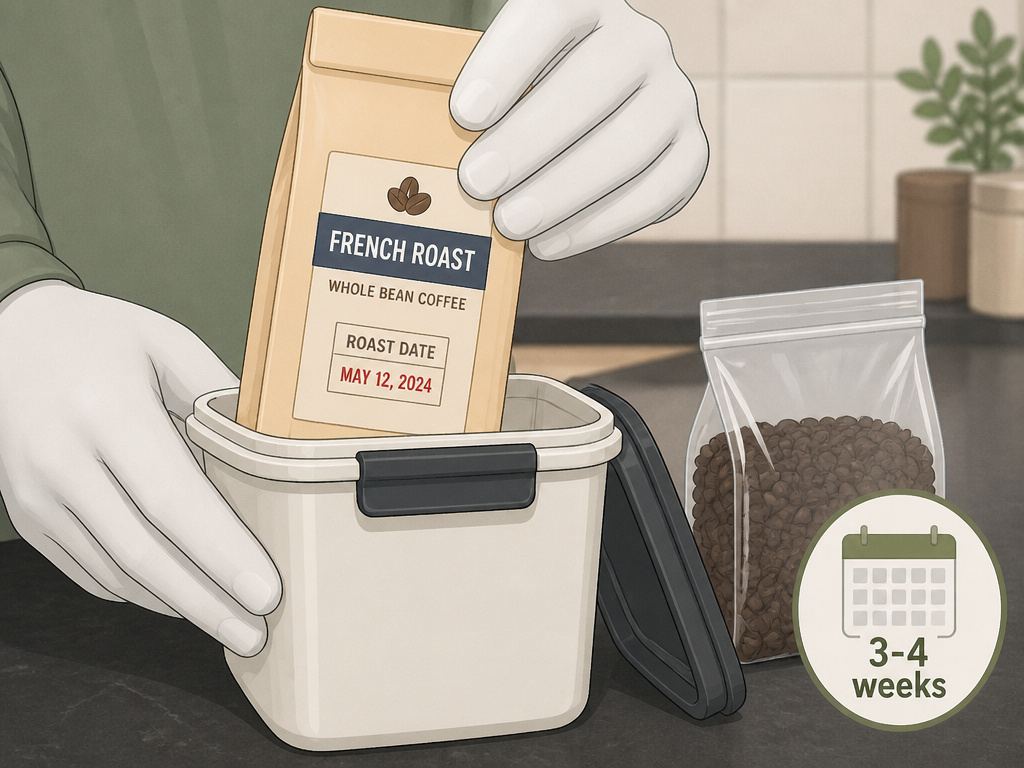
The rules tighten with darker roasts. Those flavorful oils on a French roast bean are also its Achilles’ heel, they oxidize and turn rancid quickly.
Buy Fresh, Buy Small. Never buy a giant bag of French roast. Look for a roast date, not a “best by” date. Purchase only what you’ll use in two weeks. A standard dark roast has a slightly longer shelf life of about three to four weeks before noticeable staling.
Store It Right. An airtight container is mandatory. Keep it in a cool, dark cupboard. Do not refrigerate or freeze your daily coffee, the condensation that forms when you take it out accelerates staling and can introduce off-flavors. The only exception is for long-term storage of unopened bags, which isn’t recommended for dark roasts anyway.
Grind Just Before Brewing. This is critical. Pre-ground coffee loses its volatile aromatics in minutes. For a dark roast, you lose those rich, roasty notes first. For a French roast, you’re left with nothing but flat bitterness. Invest in a good grinder. Your taste buds will thank you.
If you find your dark roast tasting a bit harsh, a pinch of adding salt to coffee can work wonders. It doesn’t make it salty; it neutralizes bitter compounds on your tongue. It’s a classic barista trick for rescuing an over-extracted or very dark shot.
Frequently Asked Questions
Is French roast the strongest coffee?
It has the strongest roast flavor, characterized by smokiness and bitterness. However, it does not have the most caffeine. In terms of stimulant strength, a light roast typically has slightly more caffeine by weight.
Can I use French roast for regular drip coffee?
You can, but I don’t recommend it. The paper filters used in most drip machines tend to highlight the bitter, ashy notes of a French roast, often resulting in a flat and unpleasant cup. It’s much better suited to espresso or immersion methods like a French press if you must.
Why are French roast beans oily?
The oils come from inside the coffee bean. During the extended high heat of a French roast, the bean’s structure breaks down, allowing internal oils to migrate to the surface. This is a sign the beans have been roasted well into or past the second crack.
Does dark roast have less acid?
Yes. The roasting process breaks down chlorogenic acids, which are a primary source of perceived acidity in coffee. Both standard dark roasts and French roasts are significantly lower in acidity than light or blonde roast coffee beans, making them a common choice for people with sensitive stomachs.
What’s the difference between French roast and Italian roast?
Very little. Both are extremely dark roasts at the end of the spectrum. The terms are often used interchangeably by roasters. Some argue Italian roast is pushed slightly further than French, but there is no universal standard. Treat them as functional equivalents.
The Bottom Line
French roast is a tool, not a default. It’s the right tool when you need a heavy, smoky flavor bomb to anchor a latte or provide a consistent, powerful base. A standard dark roast is the more versatile choice, offering a wider range of bittersweet flavors and better compatibility with most brewing methods.
Chasing darkness for its own sake is a dead end. It leads to cups that taste more of the roast than the bean, and it buys you no extra caffeine. Instead, match the roast level to your brewer and your desired flavor experience. Let that guide you past the shiny, oily beans to the bag that will actually make your morning ritual better.
And if you enjoy the caramelized sweetness of a dark roast, try swapping white sugar for brown sugar in coffee, the molasses notes complement the roast flavors beautifully without needing to push the beans further into the fire.
{
“@context”: “https://schema.org”,
“@type”: “HowTo”,
“name”: “How to Choose Between French Roast and Dark Roast Coffee”,
“totalTime”: “PT5M”,
“step”: [
{
“@type”: “HowToStep”,
“name”: “Identify your brewing method”,
“text”: “Choose French roast for espresso or milk drinks where a smoky, heavy body is needed. Pick a standard dark roast for drip or pour over if you want more balance and less char.”
},
{
“@type”: “HowToStep”,
“name”: “Check the bean’s surface”,
“text”: “Look for a visible oily sheen, which indicates a roast at or past second crack, typical of French roast. A matte surface suggests a lighter dark roast.”
},
{
“@type”: “HowToStep”,
“name”: “Read the roaster’s description”,
“text”: “Ignore generic ‘bold’ claims. Look for specific tasting notes like ‘bittersweet chocolate’ or ‘heavy body’ for French roast, or ‘caramel’ and ‘nutty’ for other dark roasts.”
},
{
“@type”: “HowToStep”,
“name”: “Consider the origin”,
“text”: “Use a French roast to mask a lower-quality or blend bean. Choose a high-quality single-origin dark roast if you want to preserve some origin character.”
}
]
}
{
“@context”: “https://schema.org”,
“@type”: “FAQPage”,
“mainEntity”: [
{
“@type”: “Question”,
“name”: “Is French roast the strongest coffee?”,
“acceptedAnswer”: {
“@type”: “Answer”,
“text”: “It has the strongest roast flavor, characterized by smokiness and bitterness. However, it does not have the most caffeine. In terms of stimulant strength, a light roast typically has slightly more caffeine by weight.”
}
},
{
“@type”: “Question”,
“name”: “Can I use French roast for regular drip coffee?”,
“acceptedAnswer”: {
“@type”: “Answer”,
“text”: “You can, but I don’t recommend it. The paper filters used in most drip machines tend to highlight the bitter, ashy notes of a French roast, often resulting in a flat and unpleasant cup. It’s much better suited to espresso or immersion methods like a French press if you must.”
}
},
{
“@type”: “Question”,
“name”: “Why are French roast beans oily?”,
“acceptedAnswer”: {
“@type”: “Answer”,
“text”: “The oils come from inside the coffee bean. During the extended high heat of a French roast, the bean’s structure breaks down, allowing internal oils to migrate to the surface. This is a sign the beans have been roasted well into or past the second crack.”
}
},
{
“@type”: “Question”,
“name”: “Does dark roast have less acid?”,
“acceptedAnswer”: {
“@type”: “Answer”,
“text”: “Yes. The roasting process breaks down chlorogenic acids, which are a primary source of perceived acidity in coffee. Both standard dark roasts and French roasts are significantly lower in acidity than light or blonde roast coffee beans, making them a common choice for people with sensitive stomachs.”
}
},
{
“@type”: “Question”,
“name”: “What’s the difference between French roast and Italian roast?”,
“acceptedAnswer”: {
“@type”: “Answer”,
“text”: “Very little. Both are extremely dark roasts at the end of the spectrum. The terms are often used interchangeably by roasters. Some argue Italian roast is pushed slightly further than French, but there is no universal standard. Treat them as functional equivalents.”
}
}
]
}
