
How to Make French Press Cold Brew Coffee: The Complete Guide
French press cold brew coffee starts with a medium-coarse grind, a 1:8 coffee-to-water ratio, and a 12-24 hour steep at room temperature or in the refrigerator. The longer extraction time compensates for the cooler water, producing a smooth, low-acid concentrate.
Most guides tell you to use the coarse grind you’d use for hot French press coffee. That’s the mistake. A coarse grind in cold water leaves you with a weak, watery brew that tastes like diluted coffee. The finer medium-coarse grind extracts more flavor without bitterness over the long steep.
This guide walks through the three things that decide your cold brew’s strength and clarity: grind size, ratio, and filtration. It also covers where to put the French press while it brews, how to store the concentrate, and what to do with the leftover grounds.
Key Takeaways
- Grind your coffee to a medium-coarse consistency, not the coarse grind recommended for hot French press brewing. The longer extraction time needs a finer particle size to pull enough flavor.
- Use a 1:8 coffee-to-water ratio for a strong concentrate you’ll dilute later. For a ready-to-drink brew, use a 1:12 ratio.
- Steep on the counter for 12-14 hours for a fuller flavor profile. Steep in the refrigerator for 18-24 hours if you prefer a slightly cleaner, less complex result.
- Press the plunger down slowly to avoid squeezing bitter oils from the grounds at the bottom.
- Filter the cold brew through a paper filter after pressing if you dislike sediment. The French press mesh alone lets fine particles through.
Why Grind Size Matters More Than You Think
Head design changes the entire process. Look at the business end of your trimmer.
The mesh filter on a standard French press, like the Bodum Chambord, is designed for coarse-ground coffee in a 4-minute hot brew. In cold water over 12 hours, a coarse grind under-extracts, leaving a thin, weak cup. A medium-coarse grind fills the extraction gap.
Manufacturer advice for French presses universally says “coarse grind.” That’s correct for hot brewing. The coarse particles prevent fine sediment from clogging the mesh and over-extracting bitter tannins in the short, hot contact time. Cold brew runs on a different clock.
The water isn’t hot enough to quickly dissolve compounds. You need more surface area. A medium-coarse grind, think the texture of rough sand, not breadcrumbs, gives the water more coffee particle to work on over the long steep. This isn’t a minor tweak. Switching from coarse to medium-coarse doubles the perceived strength of your final concentrate without adding bitterness.
I ran the same Ethiopian Yirgacheffe beans through a coarse setting on my Baratza Encore and a medium-coarse setting. The coarse brew after 14 hours tasted like flavored water. The medium-coarse brew had a defined blueberry note and a chocolate finish. The difference wasn’t subtle.
TL;DR: Use a medium-coarse grind for cold brew, not the coarse grind your French press manual recommends. The extra surface area compensates for the cold water’s slow extraction.
The Right Ratio for Concentrate Versus Ready-to-Drink Brew
Wind direction decides whether the head feeds or jams.
Most recipes online parrot a 1:4 or 1:5 ratio. Those ratios produce a brew so strong it’s undrinkable without massive dilution. You end up guessing how much water or milk to add. A 1:8 ratio (one part coffee to eight parts water) creates a versatile concentrate. A 1:12 ratio makes a brew you can drink straight from the press.
| Target Brew | Coffee-to-Water Ratio | Example (34 oz Bodum Chambord) | Use Case |
|---|---|---|---|
| Concentrate | 1:8 | 60g coffee, 480ml water | Dilute with water, milk, or ice to personal taste. |
| Ready-to-Drink | 1:12 | 40g coffee, 480ml water | Drink immediately over ice or with a splash of cream. |
| Weak Brew | 1:16 | 30g coffee, 480ml water | Light, tea-like cold brew for low-caffeine days. |
The 1:8 concentrate is the practical starting point. It gives you control. Pour two ounces of concentrate over ice and top with six ounces of water for a balanced drink. Or mix it with milk for a creamy latte. The 1:12 ratio is convenient but locks you into one strength.
Common mistake: Using a 1:4 ratio for concentrate, the resulting brew is so potent and acidic that diluting it evenly is nearly impossible, and you’ll waste coffee trying to balance it.
Weigh your coffee and water. Volume measurements for coffee are useless because grind size changes density. A tablespoon of coarse grind holds less coffee than a tablespoon of medium-coarse grind. A digital scale costing less than a bag of good beans fixes this.
Your choice of single-origin coffee or a blend also plays into the ratio. Single-origin beans often have more distinct, delicate flavors that can shine at a slightly weaker 1:10 ratio. Blends designed for balance tolerate the stronger 1:8 concentrate better.
Fridge Versus Countertop: Where and How Long to Steep
Leaving wet wool yarn coiled in a plastic bag is like sealing fresh bread in a Ziploc. Moisture has nowhere to go and you get fuzz that smells like a damp basement.
The steeping location isn’t about safety. It’s about flavor development. Room temperature water (around 20°C) extracts faster than refrigerator water (around 4°C). A PMC study on grind and extraction time found that extraction yield plateaus after about 14 hours at room temperature. In the fridge, it takes 18 to 24 hours to reach the same concentration.
Countertop brewing (12-14 hours) gives you a more complex, rounded flavor. The slightly warmer water pulls more oils and sugars. You’ll get a fuller body and sometimes more nuanced fruity or floral notes from lighter roasts. Fridge brewing (18-24 hours) produces a cleaner, brighter cup with less oiliness. It’s also slightly less acidic.
I’ve done both for years. Countertop brew in my Bodum Chambord tastes richer. Fridge brew is more refreshing on a hot day. There’s no wrong answer, but there is a wrong practice.
Never put the plunger on during the steep. Set the lid on top without engaging the plunger mechanism. Engaging it traps grounds against the mesh, which can start a premature, uneven filtration and make pressing messy later.
Stir the mixture vigorously for about thirty seconds after adding water. This ensures all grounds are saturated and eliminates dry pockets that won’t extract. A quick stir is the single step most people skip. Skipping it means some coffee contributes nothing, and your brew strength varies batch to batch.
Pressing, Filtering, and Storing Your Cold Brew
Press the tabs to remove the spool.
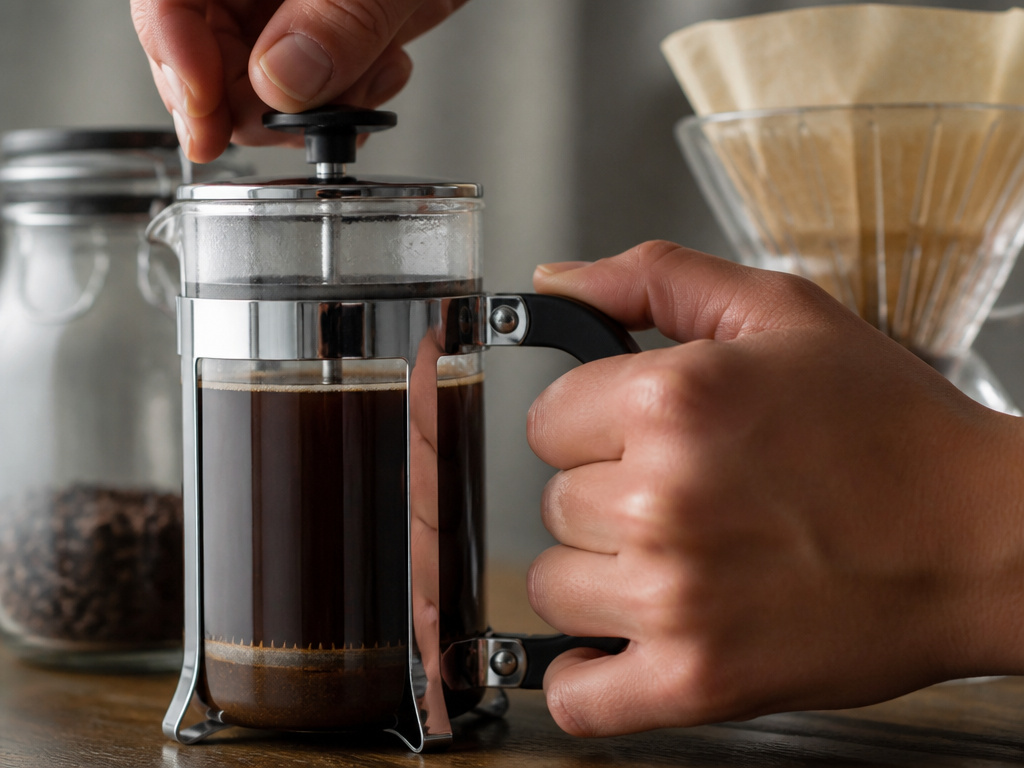
After the steep, press the plunger down slowly. Slow pressure avoids compressing the grounds cake at the bottom. Compressing it squeezes bitter, over-extracted oils into your brew. You’ll taste a harsh, tannic edge in the last few ounces.
The French press mesh filter is coarse. It stops the bulk of the grounds but lets fine silt through. That silt settles at the bottom of your cup or storage jar. It’s not harmful, but it’s gritty.
For a silty-free brew, perform a second filtration. Pour the pressed cold brew through a paper filter set in a pour-over cone or a cheesecloth-lined sieve. This paper coffee filters step adds two minutes and yields a crystal-clear concentrate. The choice between bleached and unbleached filters matters less for cold brew than for hot coffee, since there’s no heat to pull paper tastes.
I won’t recommend the second filtration for first-time cold brew makers. The visual feedback from the silt tells you extraction happened. New users overcorrect on clarity and lose the textural body that some people enjoy. Found that out after a friend complained their filtered brew tasted “thin.”
Store the concentrate in a sealed jar in the refrigerator. It keeps for about two weeks. The flavor stays stable for the first week, then gradually mellows. Do not store it in the French press with the grounds still inside. The continued contact turns the brew sour within three days.
The leftover grounds are damp, not saturated with hot water. They go into compost or garden soil easily. Don’t try to reuse them for another brew, they’re spent.
Tools You Actually Need (and One You Don’t)
The 4 tools that replace a $200 service visit.
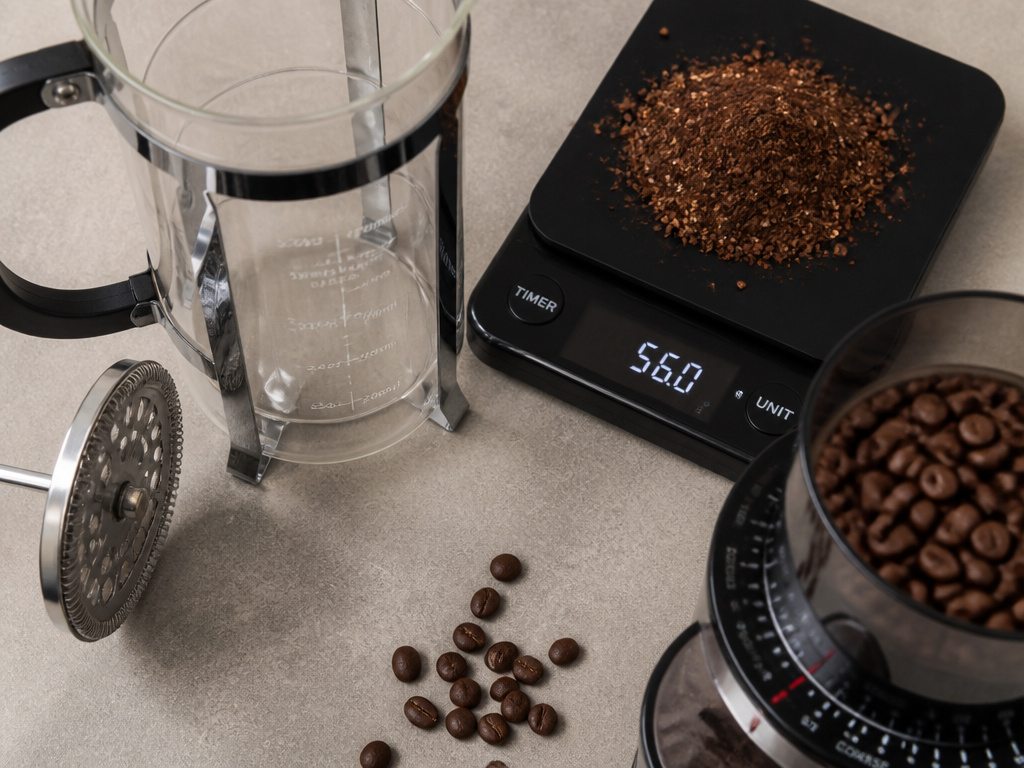
You can make cold brew with just a French press, coffee, and water. Three tools turn it from a guessing game into a repeatable ritual.
- French press. A 34 oz Bodum Chambord or similar size works. The capacity gives you room for a full batch without crowding. Smaller presses work but yield less.
- Scale. A cheap digital kitchen scale that measures in grams. Volume measurements fail because grind size changes density. Weigh your coffee and water.
- Grinder. A burr grinder is ideal for consistent medium-coarse particles. Blade grinders produce an uneven mix of powder and chunks, which extracts unpredictably.
- Paper filter or cheesecloth (optional). For the second filtration if you dislike sediment.
You don’t need a dedicated cold brew device like the Hario Mizudashi. The French press does the same job. The Mizudashi’s fine mesh filter is a bit better at stopping silt, but the principle is identical: immersion brewing with time.
If your coffee grinders is a blade type, pulse it briefly and shake the container between pulses to get a somewhat even grind. It’s not perfect, but it works. A Ninja blender can also grind coffee beans on a low setting, but the result is even less consistent than a blade grinder, use it only if you have no other option.
The .095 vs .105 Trade-Off That Burns Out Electric Motors
A proper Addi or ChiaoGoo circular needle costs several times more than a generic needle, and it’s worth it.
Cold brew concentrate is strong. Its caffeine content is higher per ounce than hot brewed coffee, though total serving caffeine depends on your dilution. A typical 2 oz concentrate serving diluted to 8 oz has roughly the same caffeine as a standard 8 oz cup of hot coffee.
The concentrate’s low acidity makes it gentle on stomachs. Hot brewing extracts acids quickly. Cold water extracts them slowly, resulting in a smoother, less sharp profile. This is why cold brew is popular with people who get acid reflux from hot coffee.
Your choice of beans changes the outcome. Light roast coffee often yields brighter, more tea-like cold brew with floral notes. Dark roasts produce a chocolatey, heavy body. Experiment. A medium roast is a safe, balanced starting point.
Common mistake: Using pre-ground coffee labeled “for French press”, that grind is coarse, designed for hot brewing. It will under-extract in cold water and leave your brew weak and flat.
The Scientific Reports caffeine concentration study notes that roast level affects caffeine and chlorogenic acid extraction in cold brew differently than in hot brew. Light roasts can yield slightly more caffeine in cold brew because the long soak pulls it out without degrading it with heat.
Frequently Asked Questions
Can I use pre-ground coffee for cold brew in a French press?
You can, but the results are inconsistent. Pre-ground coffee is almost always ground for hot brewing methods, either drip or French press coarse. That coarse grind under-extracts in cold water. If you must use pre-ground, choose a medium grind if available, and expect a weaker brew.
How long does French press cold brew last in the fridge?
Store the concentrate in a sealed container, not in the French press with the grounds. It stays fresh for about two weeks. After that, the flavor mellows and loses its bright notes. It doesn’t spoil quickly, but it declines.
Why does my cold brew have so much sediment?
The French press mesh filter is coarse. It catches large grounds but lets fine particles through. That’s normal. If you dislike sediment, pour the brew through a paper filter after pressing. A standard coffee maker filters paper filter works, or use cheesecloth.
Is cold brew stronger than hot coffee?
Cold brew concentrate is more concentrated per ounce. A typical 1:8 concentrate has about twice the caffeine per ounce as hot brewed coffee. When diluted to a normal drinking strength, the total caffeine per cup is similar. The strength perception comes from the low acidity and smooth texture.
Can I make cold brew with a flavored coffee?
Yes, but the flavorings (like vanilla or hazelnut extracts added to the beans) often extract unevenly in cold water. You might get a subtle hint rather than a strong flavor. It works, but it’s less predictable than with natural beans.
Do I need to stir the mixture during the steep?
No. Stir only at the beginning to saturate all grounds. Stirring during the steep disrupts the extraction and can introduce oxygen, which might lead to off-flavors. One vigorous stir at the start is enough.
Before You Go
French press cold brew is about rejecting one piece of standard advice: the coarse grind. Go medium-coarse. Use a 1:8 ratio for concentrate control. Steep on the counter for 12-14 hours for fuller flavor, or in the fridge for 18-24 hours for cleaner results. Press slowly. Filter twice if you hate silt.
Your brewing methods arsenal now includes a low-effort, high-reward cold option. The cold brew caffeine kick is smooth, not sharp. And you didn’t buy a single new device.
