
The Science of Sublimation in Freeze Dried Instant Coffee
Freeze dried instant coffee is a shelf-stable coffee product made by brewing a concentrate, freezing it solid, and then removing the ice through sublimation under a deep vacuum. This low-temperature process preserves more volatile aroma compounds and chlorogenic acids compared to high-heat spray-drying, resulting in a cup that often tastes closer to traditional brewed coffee.
Most people think all instant coffee is the same cheap, bitter powder. They miss the fundamental mechanical difference between a high-heat blast and a slow, cold vacuum pull. That distinction is what separates a cup that tastes like cardboard from one that can genuinely satisfy.
This guide breaks down the patented science, the tangible quality differences, and what those glossy granules in the jar actually deliver.
Key Takeaways
- The defining step is sublimation, where ice turns directly to vapor under vacuum, avoiding the heat damage that plagues spray-drying.
- Freezing rate matters. Slower freezing creates larger ice crystals and a more porous structure for faster rehydration, but can trap fewer aromas.
- Residual moisture is the enemy. Quality freeze-dried coffee must hit a moisture content below 3% to prevent oxidative staling during storage.
- It is not a flavor match for fresh espresso or pour-over. The process still loses the most delicate top notes, but it preserves the core body and acidity better than any other instant method.
- The higher cost comes from a batch process that takes over 24 hours, massive energy use for vacuum pumps and condensers, and lower overall yield per batch.
The Core Science: How Sublimation Works
Forget everything you know about drying. This isn’t about evaporation. Freeze-drying, or lyophilization, is a three-phase physical process that hinges on skipping the liquid phase entirely. You start with a frozen coffee concentrate slab.
First, the vacuum pump pulls the chamber pressure down to a near-perfect vacuum, typically between 0.1 and 10 millimeters of mercury. Atmospheric pressure is 760 mm Hg. You are creating a space almost devoid of air.
In the 1969 General Foods Corporation patent (US3615671A), the process specifies freezing the extract “below the eutectic point of the coffee solids” and subliming the ice under vacuum, sometimes introducing a trace inert gas like nitrogen to improve aroma retention.
At this extreme low pressure, the frozen water molecules in the coffee slab gain enough energy to break their solid bonds and turn directly into vapor. This is sublimation. The ice crystals vanish, leaving behind a honeycomb-like matrix of dry coffee solids and trapped oils. The water vapor then travels to a super-cold condenser coil, where it re-freezes, effectively being removed from the chamber.
TL;DR: Sublimation under deep vacuum removes water as vapor, not liquid, preserving the coffee’s chemical structure from heat damage.
Why the Freezing Speed Changes the Granule
Not all freezing is equal. A 1973 study in the Journal of Food Science tested freezing rates from 0.5°C to 10°C per minute. The speed determines the ice crystal size.
Slow freezing (0.5°C/min) lets larger crystals form. These create big, cavernous pores in the coffee structure. The result is a granule that rehydrates almost instantly in your cup. The trade-off is that those large pores can allow volatile aroma compounds to escape more easily during the drying cycle.
Fast freezing (10°C/min) produces a forest of tiny crystals. The resulting structure is denser and finer. It might take an extra stir to fully dissolve, but it acts like a tighter net, trapping more of the delicate flavor compounds. Manufacturers choose their freezing profile based on the target sensory outcome, speed of prep versus depth of flavor.
| Freezing Rate | Crystal Size | Granule Structure | Primary Trade-off |
|---|---|---|---|
| Slow (0.5°C/min) | Large | Very porous, brittle | Fast rehydration, higher aroma loss risk |
| Fast (10°C/min) | Small | Dense, hard | Slower dissolve, better aroma retention |
Freeze-Dried vs. Spray-Dried: A Sensory Breakdown
Spray-drying is the other dominant method. It is a continuous, high-heat process. Concentrated coffee extract is sprayed as a fine mist into a towering hot-air chamber, often exceeding 200°C. Water flashes off instantly, leaving a fine powder to collect at the bottom. It’s fast, efficient, and cheap.
The heat is the problem. It drives off the most volatile top notes, the fruity, floral aromas, and can degrade chlorogenic acids, which contribute to perceived acidity and complexity. What remains is the robust, often bitter, base note profile.
Freeze-drying avoids that thermal trauma. The low-temperature vacuum preserves a broader spectrum of compounds. The cup will have more pronounced acidity, a fuller body, and detectable origin characteristics, especially in a high-quality single-origin coffee. It won’t beat a freshly ground and brewed cup of a light roast coffee, but it closes the gap significantly.
The cost difference isn’t just marketing. A spray-dryer runs continuously. A freeze-dryer processes batches that can take 24 to 48 hours, consuming massive energy to maintain deep vacuum and run condensers. You pay for time and precision.
What You’re Actually Tasting (And What’s Gone)
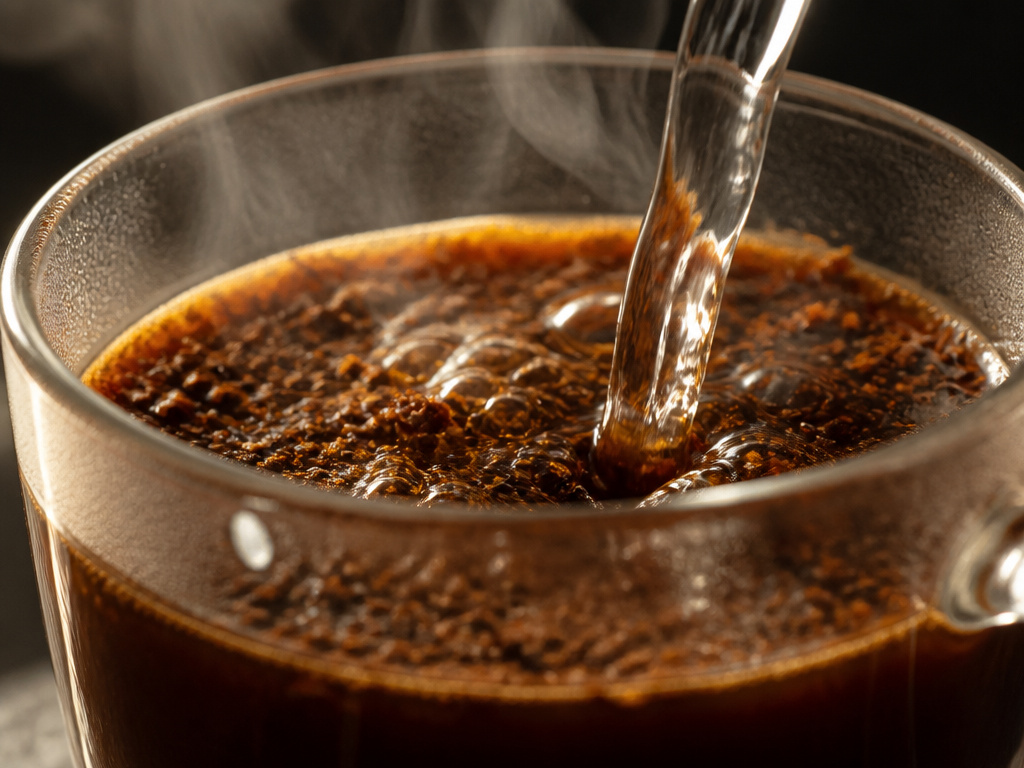 When you dissolve those granules, you’re not getting a full-spectrum reproduction of brewed coffee. The process has casualties. The very first aromas to disappear are the highly volatile compounds like 2-furfurylthiol, which gives coffee its fresh-roasted character. Those are often gone before the concentrate even reaches the freezer.
What the freeze-drying process excels at preserving are the mid-range volatiles and non-volatile compounds. This includes many of the organic acids that create brightness, and a higher percentage of chlorogenic acids compared to spray-drying. A scientific study on coffee drying methods confirmed that drying technique directly impacts the final chlorogenic acid content and sensory profile.
This is why a good freeze-dried coffee can taste surprisingly like a cafe americano, it has a clear, recognizable coffee flavor with body and acidity. The subtleties of a specific farm or processing method will be muted, but the fundamental character of the Arabica beans remains.
Common mistake: Using boiling water. Pouring 100°C water onto freeze-dried granules can still “cook” the delicate compounds it managed to preserve. Aim for water just off the boil, around 90-95°C, to maximize flavor.
The Critical Role of Moisture and Packaging
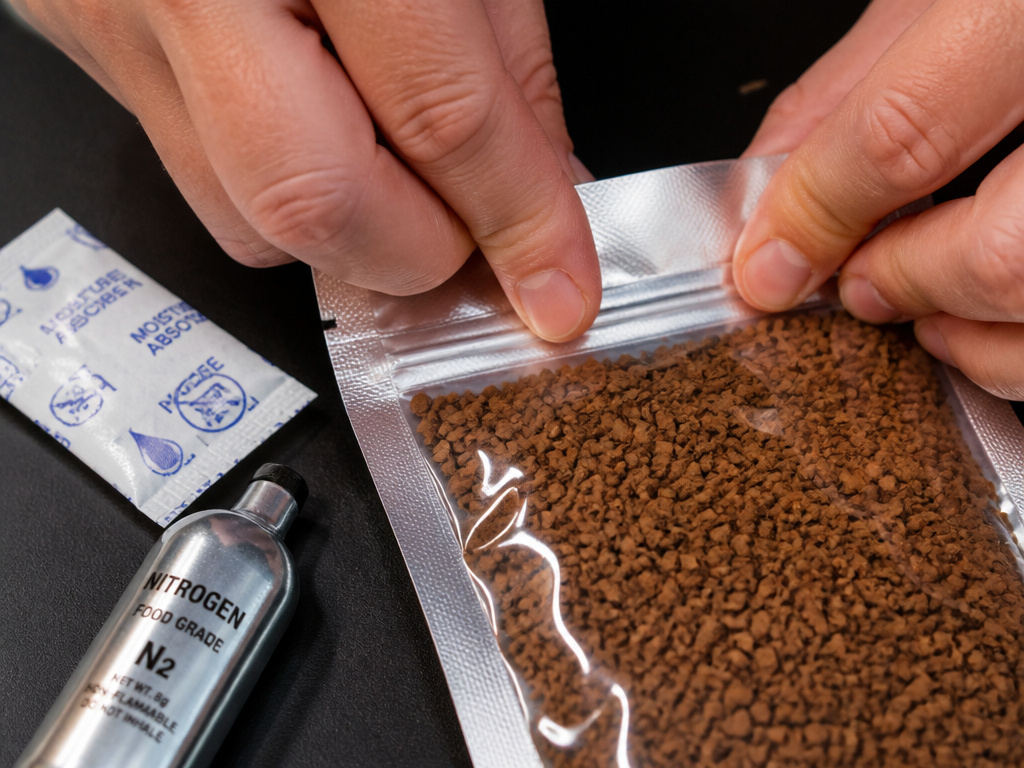 Sublimation is incredibly efficient, but it’s rarely 100% complete. Residual moisture is the silent killer of shelf life. The international ISO instant coffee sampling method exists because measuring this moisture accurately is that important.
The target for freeze-dried coffee is typically below 3% moisture by weight. Go above that threshold, and you have enough water molecules present to act as a catalyst for oxidation. The coffee will go stale, taking on a cardboard or papery flavor, far more quickly, regardless of the superior drying method.
This is why packaging is never an afterthought. The granules are hygroscopic, meaning they actively pull moisture from the air. Jars are flushed with inert nitrogen gas before sealing to displace oxygen. Foil-lined pouches are sealed against moisture and light. Breaking this seal starts the clock.
Store it like medicine. Once opened, keep the jar in a cool, dark cupboard and close it tightly after every use. Do not store it in the fridge or freezer, the constant temperature cycling and high humidity every time you open the door will introduce condensation and ruin the coffee faster.
When Freeze-Dried Makes Sense (And When It Doesn’t)
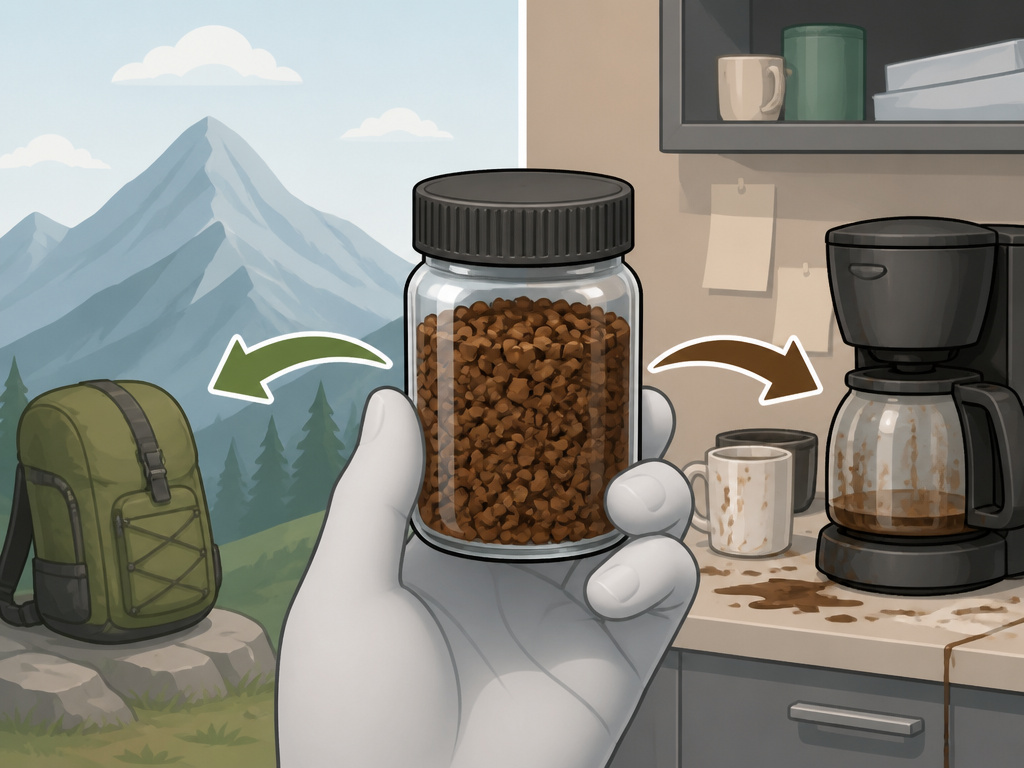 This isn’t a wholesale replacement for your burr grinder and French press. It serves specific use cases where convenience and a decent cup must coexist.
It wins for camping, backpacking, or emergency kits. The granules are lightweight, won’t spoil, and only need hot water. It’s a lifesaver in office kitchens where shared equipment is grim and maintenance is zero. For travelers facing unreliable hotel “coffee makers,” a small jar is insurance.
It struggles in direct comparison to any fresh-brewed method. If your morning ritual is about the process and the peak sensory experience, this will feel like a compromise. It’s also not the right choice if you’re hyper-sensitive to caffeine content nuances, as the processing can slightly alter the extraction and perception of caffeine compared to a standard drip coffee method.
For someone exploring coffee additives like cinnamon or experimenting with fatty coffee additions, freeze-dried provides a consistent, neutral base that won’t introduce the variable of uneven extraction from a bad brew.
| Scenario | Freeze-Dried Recommendation | Reason |
|---|---|---|
| Backpacking / Travel | Strong Yes | Ultralight, no equipment needed, stable. |
| Daily Home Brewing | No | Fresh grinding and brewing will always be superior. |
| Office Kitchen | Conditional Yes | Beats stale pot coffee and shared mess. |
| Taste Testing Origins | No | Mutes the subtle terroir notes you’re trying to detect. |
| Quick Iced Coffee | Strong Yes | Dissolves easily in cold water or milk for fast cold brew. |
Frequently Asked Questions
Does freeze dried instant coffee expire?
Yes, but slowly. Properly sealed and stored, it can last 2-3 years. Once opened, aim to use it within 6-8 weeks for optimal flavor. You’ll notice it loses vibrancy and becomes flat long before it becomes “unsafe.”
Is it stronger than regular instant coffee?
It can taste stronger or more intense because it retains more of the coffee’s natural acids and body. The actual caffeine levels are comparable to other instant coffees and depend primarily on the original coffee blend and serving size.
Why is it so expensive?
The batch-based freeze-drying process is energy-intensive and time-consuming. Maintaining a deep vacuum for 24+ hours and running massive condensers costs significantly more than the continuous high-heat spray of standard instant production.
Can I make it at home?
Technically yes, with a home freeze-dryer, but it’s impractical. You need to start with a highly concentrated coffee base, and the home unit cycle can take over 48 hours for a tiny yield. The coffee blends used are also engineered for this process.
Does it taste like real coffee?
It tastes like a very good version of instant coffee, and a credible approximation of a basic americano. It will not replicate the nuanced clarity of a freshly ground and brewed cup. The gap is smaller than with spray-dried, but a gap remains.
Is it healthier than other instant coffees?
“Healthier” is vague. It may retain slightly higher levels of antioxidants like chlorogenic acids due to the low-heat process. However, the nutritional differences are minor compared to choosing a quality bean and watching your overall caffeine intake.
Before You Go
Freeze-dried instant coffee is an exercise in intelligent compromise. It accepts that some aroma will be lost to physics but uses a gentler, more precise method to salvage everything else. The jagged granules are a physical map of a vacuum-pulled ice crystal.
It will not replace your morning ritual. It exists for the other moments, the rushed mornings, the distant trails, the hotel rooms, where good enough is a minor miracle. Keep a jar in the back of the pantry. When you need it, you’ll understand the engineering in every sip.
