
How to Make Espresso Coffee Without a Machine Using an AeroPress
To make espresso coffee without a machine, you need a method that mimics pressure or uses intense immersion. An AeroPress pressed for 30 seconds creates about 0.5 bar of pressure for a clean, strong concentrate. A Moka Pot uses steam pressure around 1.5 bar for a richer, heavier brew. Neither hits a true espresso machine’s 9 bars, but with the right grind and technique, both can produce a shot good enough for milk drinks.
Most people grab the wrong tool first. They see “espresso” and reach for a French press or a pour-over cone. Those are immersion and percolation brewers. They make great coffee, but they lack the pressure-driven intensity that defines espresso’s mouthfeel and crema. You need a device that either mechanically presses water through grounds or builds steam pressure.
This guide walks through the two devices that get closest: the AeroPress and the Moka Pot. We’ll cover why grind size is the single biggest lever you have, how to avoid the burnt taste that ruins most stovetop espresso, and when to add water to turn a concentrate into a proper drink.
Key Takeaways
- An AeroPress produces a cleaner, more tea-like concentrate using manual pressure (around 0.5 bar), while a Moka Pot uses steam for a heavier, oilier brew (around 1.5 bar).
- Grind size is critical. Use a medium-fine setting, just coarser than true espresso. Too fine in a Moka Pot clogs the filter and scorches the coffee.
- Pre-heat everything. A cold Moka Pot chamber steals heat from the water, leading to a weak, sour extraction. Run hot water through the assembled pot before brewing.
- The official AeroPress method often drips prematurely. The community-developed inverted method prevents this, allowing full immersion and a stronger brew.
- Neither method creates real crema. The layer on a Moka Pot brew is foam from boiling water, not the emulsified oils of a true 9-bar espresso shot.
The Physics of a Fake Shot: Pressure vs. Immersion
True espresso requires about 9 bars of pressure to force hot water through finely-ground coffee, emulsifying oils and suspending solids to create the signature body and crema. No manual method at home hits that mark. The goal shifts to simulating the result: a small, intense, syrupy coffee concentrate.
The two paths are mechanical pressure and steam pressure. Immersion brewers like the French press soak grounds in water, which extracts broadly but lacks intensity. Percolation brewers like a pour-over drip water through a bed, which can be strong but is often too clean. You need a device that squeezes.
Common mistake: Using boiling water in a Moka Pot, the superheated steam scorches the grounds in the filter basket before proper extraction can happen, guaranteeing a bitter, ashy cup every time.
Why Your Grinder Matters More Than Your Brewer
Your coffee’s particle size distribution decides everything. A blade grinder creates a mix of dust and boulders. The dust over-extracts into bitterness immediately, while the boulders under-extract, leaving sourness. A consistent grind from a burr coffee grinder is non-negotiable for concentrated coffee.
For AeroPress and Moka Pot, target a medium-fine grind. It should feel like table salt, not powder. If it gums up the paper filter or clogs the Moka Pot’s metal filter, it’s too fine. That clog is what causes the dreaded burnt taste, the water steam-cooks the packed grounds instead of flowing through them.
TL;DR: A consistent, medium-fine grind from a burr grinder is the single most important factor for a clean, balanced concentrate. Blade grinders cannot produce this.
The 4 Ways to Fake Espresso Pressure at Home
You have a spectrum from pure manual force to passive steam. Your choice depends on the texture you want and how much hands-on work you’re willing to do.
| Method | Pressure Source | Typical Pressure | Best For | Biggest Risk |
|---|---|---|---|---|
| AeroPress (Standard) | Manual plunger | ~0.5 bar | Clean, tea-like concentrate; quick, easy cleanup | Premature dripping weakens the brew |
| AeroPress (Inverted) | Manual plunger | ~0.5 bar | Stronger, full-immersion concentrate; no drip | Messy flip can spill hot grounds |
| Moka Pot | Stovetop steam | 1–1.5 bar | Rich, heavy, oily coffee; traditional texture | Scorching from too-fine grind or high heat |
| Manual Espresso Maker | Lever-operated piston | 6–9 bar (user-dependent) | True espresso body and potential crema | High cost, steep skill curve, arm fatigue |
The AeroPress is a sealed cylinder you push a plunger through. The Moka Pot is a three-chamber stovetop boiler. One is plastic and portable, the other is metal and iconic. Your kitchen habits pick the winner.
The AeroPress plunger diameter is approximately 63.5mm, and its total capacity is around 250ml. This large plunger surface area is why steady, moderate pressure is effective, you’re not forcing water through a tiny portafilter basket.
The AeroPress Inverted Method (The Official Workaround)
The official AeroPress manual shows the standard method: chamber on top of a mug, add coffee, add water, stir, insert plunger, press. Problem? It starts dripping into your cup the second you add water. You lose up to a third of your brew before you even press, diluting the final cup.
The inverted method fixes this. You assemble the AeroPress with the plunger sealed at the bottom of the chamber, then flip the whole thing over onto your mug to press. It’s the community hack that became the pro standard.
Here is the inverted sequence that gives you control:
1. Insert the plunger into the chamber about an inch to create a seal at the bottom.
2. Stand the AeroPress upside down on its plunger end. This is your brewing chamber.
3. Add your ground coffee (17-18g for a strong concentrate).
4. Pour hot water (95°C) up to the #2 circle (about 200ml). Stir for 10 seconds.
5. Screw the filter cap on tightly. Now, place your mug on top of the cap.
6. In one confident motion, flip the entire assembly. AeroPress and mug, so the mug is on the bottom.
7. Press down steadily for 20-30 seconds.
I used the standard method for a year, wondering why my coffee always tasted weak. The first inverted brew was a shock, the same beans produced a syrupy, almost opaque concentrate. The difference was the water sitting with the grounds the entire time, not dripping away.
Skip the flip, and you’re giving away flavor. The trade-off is spill risk. A loose cap or an uneven seal means hot coffee grounds in your lap. Hand-tighten that cap.
TL;DR: The AeroPress inverted method brews a full-immersion concentrate by preventing early dripping, resulting in a much stronger and more flavorful cup than the standard method.
Why Your Moka Pot Coffee Tastes Burnt
The Bialetti Moka Pot is a stovetop icon. You fill the bottom chamber with water, the middle basket with coffee, screw on the top chamber, and apply heat. Steam pressure builds, forcing hot water up through the coffee basket and into the top chamber. It’s simple in theory, brutal in practice.
The most common failure is a bitter, burnt flavor. This comes from two mistakes happening together: too fine a grind and too high a heat.
Bialetti’s official guidance often suggests a medium-fine grind. Many users go finer, thinking “espresso = fine grind.” A too-fine grind packs the basket, restricting water flow. The steam then sits in the overheated lower chamber, superheating before it finally blasts through the clogged coffee, scorching it. You get extraction and burning.
The fix is a slightly coarser grind and pre-heated water.
1. Grind coarser. Aim for a texture between table salt and fine sand. If it looks like espresso powder, it’s too fine.
2. Use hot water in the boiler. Fill the bottom chamber with hot water from your kettle, just below the safety valve. This reduces the time the grounds are exposed to direct heat from the stove.
3. Use medium-low heat. Start on a medium-low flame. You want a steady, gentle percolation, not a violent, sputtering geyser.
4. Listen for the gurgle. As soon as you hear the characteristic gurgling sound and see the top chamber filling with dark coffee, remove it from the heat. Run the base under cold water to stop the extraction.
The espresso extraction research publication from Mapping Ignorance outlines how channeling, uneven water flow, causes both under- and over-extraction in pressurized systems. In a Moka Pot, a too-fine grind creates the ultimate channel: one solid, impenetrable puck. The water finds one weak spot and blasts through, over-extracting a tiny section while leaving the rest under-extracted. The result is simultaneously bitter and sour.
Common mistake: Tamping the coffee in a Moka Pot basket, this creates an even denser puck, guaranteeing channeling and a burnt, uneven extraction. The grounds should sit loosely leveled, not compressed.
Dialing In Your “Shot” Without a Machine
You can’t adjust pressure on these devices, so you manipulate the other variables: grind size, dose, water temperature, and time. This is your dial.
The AeroPress Dial: Grind, Dose, and Time
With an AeroPress, you control everything except pressure. The plunger gives you a fixed, low pressure. Your levers are:
– Grind: Finer = stronger, more body, but risk of over-extraction bitterness. Start medium-fine.
– Dose: More coffee = stronger, but also requires more water for proper saturation. A standard dose is 17-18g.
– Water Temperature: Hotter water extracts faster and more fully. Start at 95°C (203°F). For light roasts, go hotter; for dark roasts, slightly cooler (85-90°C).
– Brew Time: This includes stir time and press time. A longer steep (up to 2 minutes inverted) extracts more. A faster press (20 seconds) yields a brighter cup.
A typical starting recipe: 18g coffee, medium-fine grind, 200ml water at 95°C, stir 10 seconds, steep 1 minute, press for 30 seconds. Taste. If sour, grind finer or steep longer. If bitter, grind coarser or lower the temperature.
The Moka Pot Dial: Heat, Grind, and Water
Your control on a Moka Pot is indirect. You set the conditions, then the device takes over.
– Heat Source: Gas offers more immediate control than electric. A lower, wider flame is better than a high, concentrated one.
– Grind: This is your primary control. Too fine → burnt. Too coarse → weak and sour. The sweet spot is specific to your pot and stove.
– Water Temperature: Always start with hot water in the boiler. Cold water extends the time the grounds cook on the heat.
– Coffee Freshness: Stale coffee lacks the gases needed to create any crema-like foam in the top chamber. Use coffee roasted within the last 2-3 weeks.
The single-origin coffee from a specific farm will behave differently than a dark espresso blend. Lighter, denser beans often need a slightly finer grind in a Moka Pot than oily dark roasts.
From Concentrate to Drink: Milk, Water, and Sweeteners
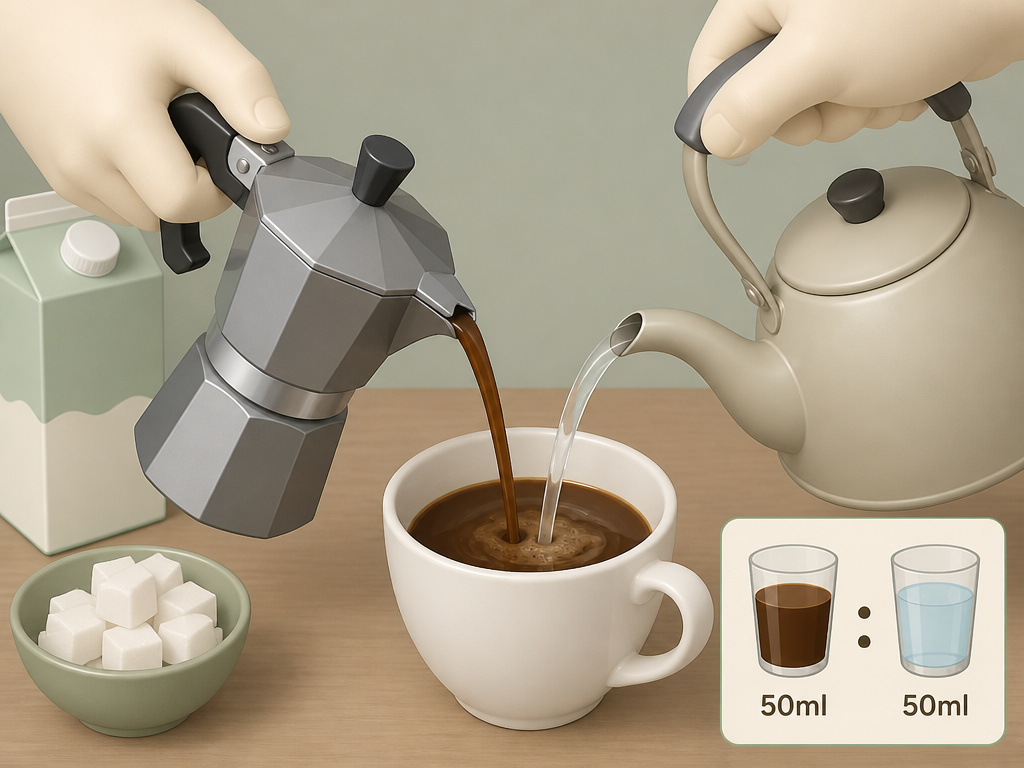
Your AeroPress or Moka Pot output is a strong coffee concentrate, not a traditional shot. You can drink it straight, but it often benefits from dilution or pairing.
The Americano Method (Bypass Brewing)
This is the classic way to turn a strong concentrate into a longer black coffee. Pour your concentrate into a cup, then add hot water to taste. Start with a 1:1 ratio (e.g., 50ml concentrate to 50ml water) and adjust. This mimics the cafe americano made with real espresso.
The AeroPress community calls this “bypass brewing.” You brew a very small, very strong coffee (like 50ml), then bypass the filter by adding hot water directly to the cup. It allows you to use a high coffee-to-water ratio for maximum extraction in the brewer, then dial back the strength to your preference.
Building Milk Drakes
The concentrate has enough body to stand up to milk. For a latte, heat and froth your milk. Pour your coffee concentrate into a cup, then add the frothed milk. The foam will sit on top. Because you lack real crema, the visual separation between espresso and milk foam will be less distinct, but the taste works.
For a vegan coffee addition, oat and almond milk froth reasonably well with a handheld frother. Soy milk can curdle if added to very hot, acidic coffee. Pour the milk in first, then gently pour the coffee over the back of a spoon to create layers.
Taming Bitterness and Adding Sweetness
If your concentrate has a harsh edge, a tiny pinch of salt can neutralize bitterness without making the coffee taste salty. It works by blocking bitter receptors on your tongue. Start with two or three grains of fine salt stirred into a full cup.
For sweetness, white sugar is neutral. Brown sugar sweetener adds molasses and caramel notes that pair well with darker roasts from a Moka Pot. For a cleaner taste, consider liquid sweeteners that dissolve instantly in the hot concentrate.
The Tools and Gear You Actually Need

You can spend a fortune on coffee paraphernalia. For this job, three things are essential, and the rest are nice-to-haves.
- A Burr Grinder. This is non-negotiable. A consistent medium-fine grind is impossible with a blade grinder. A manual hand grinder like a Timemore C2 or an entry-level electric burr grinder is the baseline.
- A Gooseneck Kettle. Control over water flow and temperature is key, especially for the AeroPress. A gooseneck spout lets you pour evenly and gently.
- A Scale. Coffee is better by weight, not volume. A cheap digital kitchen scale that measures to 0.1g will transform your consistency.
- The Brewer Itself. An AeroPress or a Moka Pot. The AeroPress is more versatile and forgiving. The Moka Pot is more traditional and produces a heavier body.
- Filter Papers (for AeroPress). The reusable metal filter lets more oils through for a heavier cup. The standard paper coffee filters produce a cleaner, brighter concentrate. Unbleached filters can impart a slight papery taste if not rinsed with hot water first.
I used a blade grinder for my first six months with a Moka Pot. Every pot was either weak or bitter, never balanced. Switching to a basic burr grinder was like getting a new coffee maker. The difference wasn’t subtle.
The water matters too. Hard water can leave scale in a Moka Pot and mute flavors. If your tap water tastes bad, your coffee will taste bad. Use filtered water.
Frequently Asked Questions
Can you make real espresso without a machine?
No. Real espresso requires 9 bars of pressure to emulsify oils and create crema. The AeroPress produces about 0.5 bar, and a Moka Pot about 1.5 bar. Both make a strong coffee concentrate that can stand in for espresso in drinks, but they lack the body, mouthfeel, and crema of a true shot.
What is the best coffee for Moka Pot?
Use a medium to dark roast ground to a medium-fine consistency, just coarser than espresso. Darker roasts are more forgiving of the Moka Pot’s higher heat and produce the classic, bold flavor associated with stovetop espresso. Light roasts can taste sour and under-developed if the water isn’t hot enough.
Why is my AeroPress coffee weak?
You are likely using the standard method, which allows water to drip through the filter before you press. This pre-infuses the coffee but also dilutes the brew. Switch to the inverted method, use a slightly finer grind, increase your coffee dose to 18g, and ensure your water is at least 90°C.
How do you make an Americano without an espresso machine?
Brew a strong coffee concentrate using your AeroPress or Moka Pot. Pour the concentrate into a cup, then add hot water to your desired strength. A typical ratio is 1 part concentrate to 1-2 parts water. This diluted espresso mimics the drink’s profile.
Does Moka Pot coffee have more caffeine?
Not necessarily. Caffeine content is primarily a function of coffee dose and extraction time. A Moka Pot uses a similar dose to an espresso machine but extracts with longer contact time and lower pressure. The espresso caffeine content per milliliter is higher, but a full Moka Pot yield is a larger volume. Per serving, they can be comparable.
The Bottom Line
Chasing true espresso without the machine is a fool’s errand. Chasing a fantastic, intense coffee concentrate you can build a latte or Americano around is entirely possible. The AeroPress offers control and clarity. The Moka Pot offers tradition and body. Your choice depends on whether you want to fiddle with variables or master a ritual.
Grind size is your main lever. Get that wrong, and no amount of technique will save the cup. A consistent, medium-fine grind from a burr grinder is the entry ticket. From there, it’s managing heat, time, and water. Pre-heat your Moka Pot. Use the inverted method on your AeroPress. Your first attempts might be too strong, too weak, too bitter, or too sour. That’s the process. The twentieth pot I made was drinkable. The fiftieth was good. Now I know the sound my particular stove and pot make right before the good stuff arrives. You will too.
