
Does Dark Roast Coffee Have More Caffeine? Scoop vs Scale
No, dark roast coffee does not have more caffeine. The belief stems from its bolder flavor, but the science shows caffeine content is nearly identical by weight. The real difference appears when you measure by volume, a scoop of dark roast contains less dense beans, so you get slightly less coffee mass and therefore slightly less caffeine.
Most people get this wrong because they associate dark roast’s intense, smoky flavor with a stronger kick. That flavor comes from roasting longer, which caramelizes sugars and breaks down acids. Caffeine, however, is a stable alkaloid. It doesn’t magically multiply in the roaster.
This guide cuts through the myth with data from peer-reviewed studies. We’ll explain why the measurement method creates confusion, how much the difference actually is, and what factors, like bean type and brew method, matter far more for your morning buzz than roast color ever will.
Key Takeaways
- By weight, light and dark roast from the same beans have statistically identical caffeine levels. A 2018 study found 1.37% caffeine in light roast vs. 1.36% in dark roast.
- By volume, dark roast loses. Beans expand during roasting, becoming less dense. A standard scoop of dark roast holds less coffee mass, so it yields less caffeine.
- Brewing method is the dominant variable. A double shot of espresso from dark beans delivers more caffeine than a large cup of light roast drip coffee.
- Bean species is the ultimate trump card. Robusta beans contain nearly double the caffeine of Arabica, regardless of roast level.
- The Agtron scale (industry roast measurement) shows dark roasts (Agtron 30-35) are physically larger and lighter than light roasts (Agtron 70-75).
The Weight vs. Volume Paradox
Head-to-head studies produce seemingly contradictory results because of one variable: how the coffee is measured. This isn’t academic nitpicking, it’s the core reason the myth persists.
When researchers at the University of Zagreb measured caffeine by weight using High-Performance Liquid Chromatography, they found no significant difference: light roast (Colombia Supremo, Agtron 70-75) contained 1.37% caffeine, dark roast (Agtron 30-35) contained 1.36%. The same study found a significant drop when measuring by volume, dark roast had about 17% less caffeine per scoop.
The physical change is straightforward. Green coffee beans are dense. Applying heat causes moisture to steam off and the bean structure to expand. A dark roast bean is literally puffier and more brittle than its light roast counterpart. It’s like comparing a dense ball of clay to a baked, airy pastry made from the same amount of clay.
TL;DR: Weigh your coffee for consistent caffeine. Scoop it for inconsistent results, where dark roast loses.
What the Peer-Reviewed Numbers Say
Two key studies frame the debate. Their different conclusions hinge on the measurement protocol.
| Study (Bean Type) | Measurement Method | Light Roast Caffeine | Dark Roast Caffeine | Key Finding |
|---|---|---|---|---|
| Hecimovic et al. 2018 (Colombian Arabica) | By weight (HPLC) | 1.37% | 1.36% | No significant difference. |
| Hecimovic et al. 2018 (Colombian Arabica) | By volume (per scoop) | 1.37% | 1.14% | Significant drop for dark roast. |
| Kim et al. 2010 (Brazilian Arabica) | By dry bean weight (HPLC) | 10.9 mg/g | 10.1 mg/g | Slight decrease with roast level. |
The Kim study suggests a minor degradation of caffeine molecules under extreme heat. The Hecimovic study, which is more frequently cited in recent peer-reviewed roast level research, shows that effect is negligible compared to the density change. For the home brewer, the practical takeaway is the second row of that table.
Common mistake: Assuming a “heaping scoop” of dark roast equals a “level scoop” of light roast, the dark roast mound is less dense, so you’re still starting with less coffee. That’s why your afternoon cup might not pack the same punch.
If you want predictability, ditch the scoop. A $20 digital scale is the single best investment for caffeine consistency. It also solves the second major variable: your coffee grinder types. A consistent grind from a burr grinder ensures even extraction, so the caffeine in your grounds actually makes it into your cup.
What Actually Determines Your Caffeine Buzz?
Roast level is a minor actor in the caffeine drama. Two other factors have a much larger speaking role: the species of coffee bean and how you brew it.
First, the bean. Coffea arabica and Coffea canephora (Robusta) are different plants. Robusta evolved with nearly double the caffeine content as a natural pest deterrent. It’s harsh and bitter, which is why it’s often used in instant coffee and espresso blends for crema and kick.
- Arabica: 1.2–1.5% caffeine by weight. The specialty coffee standard.
- Robusta: 2.2–2.7% caffeine by weight. The caffeine heavyweight.
A dark roast Robusta will absolutely contain more caffeine than a light roast Arabica beans. Roast can’t change the plant’s genetics. This is the first reason asking “which roast has more caffeine?” is incomplete without knowing the bean type.
Second, the brew. Extraction is everything. You can have caffeine-rich grounds, but if your method doesn’t pull it out, it stays in the puck.
Brewing Method: The Great Caffeine Multiplier
Consider these typical servings: – Espresso (1 oz / 30ml double shot): 60–80 mg caffeine. High concentration, small volume. – Drip Coffee (8 oz / 240ml): 95–165 mg caffeine. Lower concentration, much larger volume. – French Press (8 oz / 240ml): 80–135 mg caffeine. Depends on steep time and grind.
The method dictates the water-to-coffee ratio, water temperature, contact time, and pressure. Espresso uses fine grounds, high pressure, and short time. Drip coffee uses medium grounds, gravity, and longer time. The espresso caffeine content is higher per ounce, but you drink less of it. A full mug of drip coffee will almost always deliver more total caffeine.
This is why the question is flawed. A dark roast espresso might have less caffeine than a light roast drip coffee. The brewing variable swamps the roast variable. If you’re tweaking your routine for energy, look at your brewed coffee methods and serving size before you fret over roast color.
The Professional’s Gauge: Understanding the Agtron Scale
Coffee professionals don’t use “light,” “medium,” or “dark.” They use the Agtron scale, a spectrophotometer reading that quantifies roast degree by measuring how much light the ground coffee reflects. Lower numbers mean darker roasts.
- Light Roast: Agtron 70–85
- Medium Roast: Agtron 50–65
- Dark Roast: Agtron 30–45
The studies cited earlier used this scale. The Hecimovic study’s “dark roast” was Agtron 30-35. Its “light roast” was Agtron 70-75. This standardization is critical, one roaster’s “medium” might be another’s “dark.” The Agtron number tells you the bean’s physical state. At Agtron 30, the bean’s cellular structure is more expanded, its density lower, and its surface oilier than at Agtron 70.
When you buy coffee, the roast name is a marketing label. The taste description is more reliable. Look for terms like “caramel,” “nutty,” or “chocolate” for darker profiles, and “floral,” “fruity,” or “tea-like” for lighter ones. The blonde roast characteristics of a very light roast are entirely different from a French roast.
A Practical Test You Can Do at Home
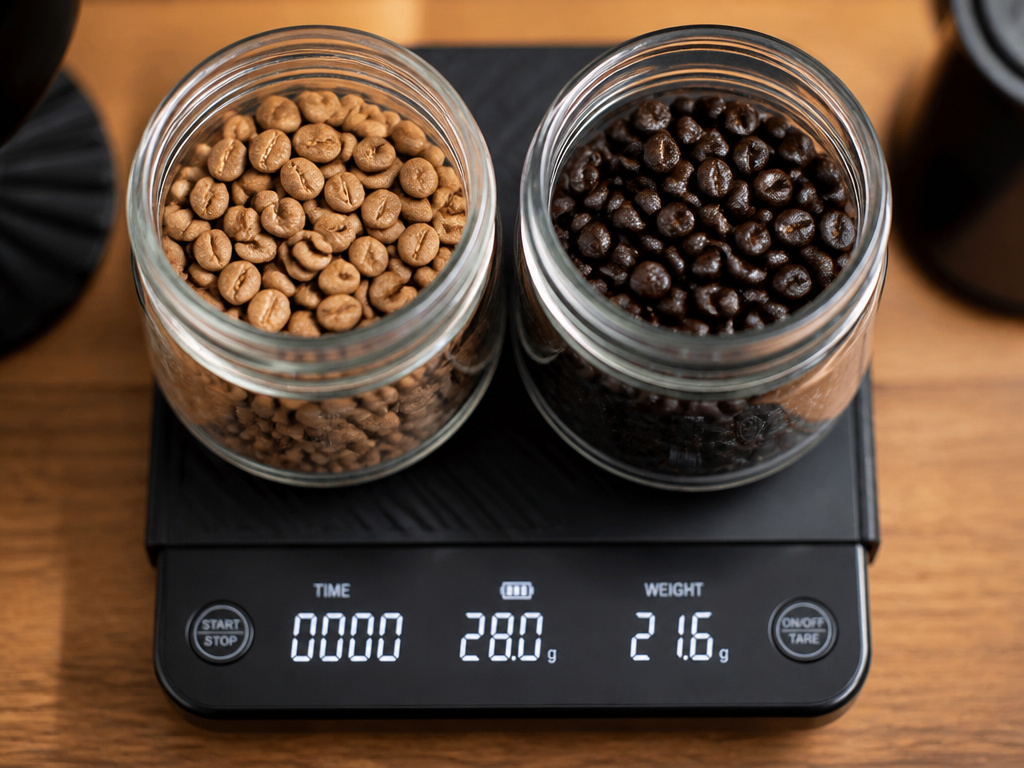
You don’t need a lab to see the density difference. Try this.
- Take two identical containers.
- Fill one with light roast whole beans, fill the other with dark roast whole beans from the same brand and origin. Fill them to the same level.
- Weigh each container.
The dark roast container will weigh less. It has fewer beans because each bean takes up more space. Now imagine that’s your coffee scoop. That’s the entire “volume vs. weight” argument in a five-minute kitchen experiment.
This density impacts grinding, too. A gram of dark roast will produce a slightly larger volume of grounds. If your grinder is set by time (like many entry-level models), a two-second grind of dark roast might yield a fluffier, less-dense dose than the same two-second grind of light roast. Again, the scale is the fix.
Why the Myth of “Stronger” Dark Roast Persists
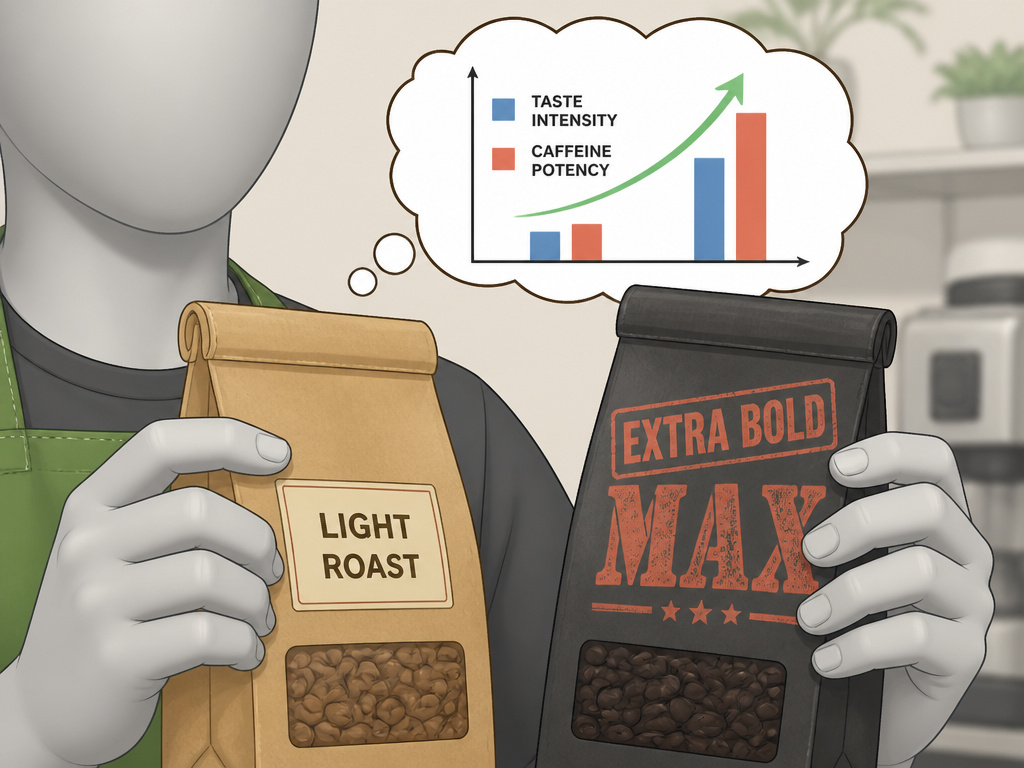
We conflate taste intensity with chemical potency. Dark roast tastes stronger, more bitter, more smoky, less acidic. Our brains interpret that sensory punch as “more caffeine.” It’s a logical, but incorrect, leap.
The roasting process breaks down chlorogenic acids, which are a source of bitterness in light roasts. It also creates bitter-tasting compounds like melanoidins. The result is a flavor profile we perceive as powerful. Meanwhile, caffeine is nearly tasteless. You can’t taste caffeine content.
The marketing doesn’t help. Terms like “bold,” “extra bold,” and “max” are stamped on dark roast bags, implying greater potency. They’re describing taste, not biochemistry. A coffee blend marketed as a “wake-up roast” is often just a darker profile, not a higher-caffeine one.
Frequently Asked Questions
Does Starbucks dark roast have more caffeine?
No. Starbucks uses Arabica beans for its brewed coffees. Their dark roasts (like Sumatra or French Roast) will have marginally less caffeine per scoop than their light roasts (like Blonde Veranda). However, a venti cup of dark roast has more total caffeine than a short cup of light roast because serving size is the biggest driver.
Is dark roast less acidic?
Yes. The longer roasting time breaks down chlorogenic acids. This makes dark roast a common recommendation for people with acid sensitivity. The trade-off is the development of bitter compounds.
Which has more antioxidants, light or dark roast?
Light roast retains slightly more chlorogenic acids, which are antioxidants. However, the roasting process creates new antioxidant compounds, like melanoidins. The total antioxidant profile changes, but one isn’t categorically “healthier” than the other.
Does decaf dark roast have caffeine?
Yes, but a trace amount. By U.S. law, decaf must have 97% of caffeine removed. The remaining 3% is virtually the same whether the bean started as a light or dark roast. The roast level affects flavor, not the decaffeination process efficiency.
How does this compare to tea?
The variability is similar. A black tea caffeine content depends on the tea plant cultivar, steep time, and water temperature, not just whether it’s called “breakfast” or “darjeeling.” The caffeine release rates differ due to tannins, which is why tea’s buzz often feels smoother.
The Bottom Line
Chasing caffeine by roast color is a fool’s errand. The difference is too small and too easily overturned by how you measure your grounds.
For a predictable, powerful caffeine dose, control the big levers. Use a scale to measure by weight. Choose a brewing method with a high coffee-to-water ratio, like a strong cafe americano or a French press with an extended steep. If you really need a jolt, seek out blends that include Robusta beans.
The dark roast myth is a story about perception trumping chemistry. The bold, in-your-face flavor shouts “strength,” while the quiet, stable caffeine molecule barely changes its tune. Understand that, and you can brew for the experience you want, whether it’s a bright, complex single-origin flavor or a smoky, robust cup, without misunderstanding the science in your cup.
