
Decaf Coffee via Swiss Water Method: Flavor-Preserving Process
The Swiss Water method decaffeinates coffee using only water, temperature, and activated carbon. It relies on a proprietary Green Coffee Extract (GCE) to create osmotic pressure that selectively pulls caffeine from hydrated beans, leaving flavor compounds intact. The process guarantees 99.9% caffeine removal and is certified chemical-free.
Most people think “water process” means soaking beans in plain water. That would strip the flavor along with the caffeine, leaving you with a bland, brown husk. The real challenge isn’t removing caffeine, it’s keeping everything else in place.
This guide walks through the factory steps, explains the science of the Green Coffee Extract, and shows why your roaster might treat these beans a little differently.
Key Takeaways
- The core invention is the Green Coffee Extract (GCE), a flavor-saturated, caffeine-free solution that acts as a selective solvent.
- Osmosis drives the process: caffeine moves from the high-concentration bean into the zero-caffeine GCE until equilibrium is reached.
- Decaffeinated beans are 50% water when they enter extraction and must be carefully dried back down to 10.5% moisture.
- The beans rest for 2–3 days post-drying, a step many other methods skip, which stabilizes them for shipping and roasting.
- Roasters often need to adjust their profiles for Swiss Water beans, as the process changes bean density and heat transfer.
How the Swiss Water Process Actually Works
The method is a four-stage sequence: clean, hydrate, extract, dry. Missing one stage compromises the next. The factory in Delta, British Columbia, runs this sequence on a industrial scale, but the principles are the same whether you’re processing ten bags or ten thousand.
The Swiss Water Process uses a proprietary Green Coffee Extract (GCE) made from green coffee beans. This extract contains all the water-soluble flavor components of coffee except caffeine. When fresh, hydrated green coffee is immersed in the GCE, osmotic pressure forces only the caffeine to leave the bean, preserving the flavor structure. The caffeine-saturated GCE is then filtered through activated carbon to remove the caffeine, allowing the GCE to be reused.
First, raw coffee arrives in woven bags. It gets dumped, cleaned of dust and debris, and sorted by screen size. Uniform bean size matters for even hydration later. Then the beans are polished. A machine rubs off the thin, papery silverskin. This isn’t for aesthetics. That silverskin sheds during processing and gums up the works. Removing it early keeps the water filtration systems from clogging.
TL;DR: Beans are cleaned, sized, and polished before they ever touch water. This prep work prevents downstream failures and ensures even caffeine extraction.
The Green Coffee Extract (GCE) is the Whole Game
You cannot have Swiss Water decaf without the GCE. Think of it as a sourdough starter for decaffeination. You build it once, by soaking a batch of green coffee in hot water until the water is saturated with coffee’s soluble solids, and then maintain it forever. The critical step is taking that initial extract and stripping its caffeine using a proprietary activated carbon filtration.
Now you have a solution that looks, smells, and tastes like concentrated green coffee, but with one thing missing. The GCE’s job is to trick the bean. Since the solution outside the bean already contains a full load of sugars, acids, and aromatics, there’s no concentration gradient for those compounds to cross. Only the caffeine, which is absent from the GCE, has a gradient. It moves out.
| Process Component | Function | What Happens If It’s Wrong |
|---|---|---|
| Green Coffee Extract (GCE) | Caffeine-free flavor solution | Old or unbalanced GCE pulls flavor compounds, resulting in hollow-tasting decaf. |
| Activated Carbon Filter | Traps caffeine molecules from GCE | Wrong carbon formulation binds flavor compounds instead of caffeine, ruining the GCE. |
| Hydration Stage | Swells beans to 50% moisture | Under-hydrated beans extract caffeine slowly and unevenly; over-hydrated beans can split. |
| Osmotic Pressure | Drives selective caffeine migration | Incorrect temperature disrupts osmotic efficiency, extending process time by hours. |
The GCE circulates through temperature-controlled stainless steel tanks. As it soaks the beans, caffeine concentration in the GCE rises. Once it reaches a threshold, the solution is pumped away to the carbon filters. The filters use a specific carbon formulation designed to bond with caffeine molecules and nothing else. Other decaf methods use carbon designed to ignore caffeine. That’s the Swiss Water patent play.
The cleaned GCE, now caffeine-free again, cycles back to the tank. This loop continues until the beans test at 99.9% caffeine-free. The spent carbon is regenerated in a furnace, the caffeine is burned off, so the carbon can be reused. They don’t recover the caffeine for sale. That would require chemical solvents, which defeats the chemical-free ethos.
Why This Method Preserves Flavor (And What Can Still Go Wrong)
The promise is flavor integrity. Because the GCE is saturated with coffee’s own compounds, the bean isn’t being stripped. It’s in equilibrium. In theory, the flavor that was in the green bean stays there. Practice is messier.
The quality of the incoming green coffee is the largest variable. The Swiss Water process cannot add flavor. It can only try to preserve what’s there. A green bean with pre-existing defects, water damage, mold, insect bites, will produce a defective decaf bean. The process amplifies flaws; it doesn’t correct them.
Common mistake: Assuming all Swiss Water decaf tastes the same because the process is standardized. The green bean’s origin, variety, and processing method (washed, natural, honey) dictate the final cup profile more than the decaffeination step.
Your brewing method matters too. A bleached paper coffee filter will absorb some of the coffee oils, which can mute the subtle acidity that Swiss Water tries to preserve. An unbleached filter introduces a papery taste that can clash with a delicate decaf. This is one reason many specialty cafes serving Swiss Water decaf use it for espresso. The metal filter in an espresso machine allows more oils through, giving a fuller body that better represents the preserved flavors.
Here’s where people get disappointed. They buy a beautifully preserved single-origin Swiss Water decaf, then run it through a stale blade grinder and a cheap drip machine. The resulting cup is weak and flat. They blame the decaf process. The problem was the grind consistency and the water filtration in their machine. You need equipment that respects the bean.
The Roaster’s Challenge: Why Decaf Beans Behave Differently
Swiss Water doesn’t end when the beans leave Delta. The roaster’s job is harder. Decaffeinated green beans are more fragile. They’ve been soaked, heated, and dried. Their cellular structure is different. They are less dense and more porous.
This changes everything in the roaster. Heat transfers faster. The beans move through the roasting stages quicker. A roaster using their standard profile for a Colombian Huila will over-roast the Swiss Water version of the same bean. The first crack comes early, and the window between first crack and the desired roast level shrinks.
Roasters adapt by lowering the charge temperature and extending the drying phase. They might also reduce airflow early in the roast to prevent scorching the more delicate beans. It’s a recalibration. A good roaster will have a separate profile specifically for Swiss Water decaf. If they don’t, the coffee often tastes baked or ashy, a sign of too much heat too slowly.
The resting period Swiss Water adds is a gift to roasters. Those 2–3 days in the silo let the beans’ moisture content equalize internally. A bean that hasn’t rested can have a wet core and a dry exterior. In the roaster, that core turns to steam and can cause an internal fracture, leading to a baked flavor. The rest period minimizes this.
Swiss Water vs. Chemical Decaffeination Methods
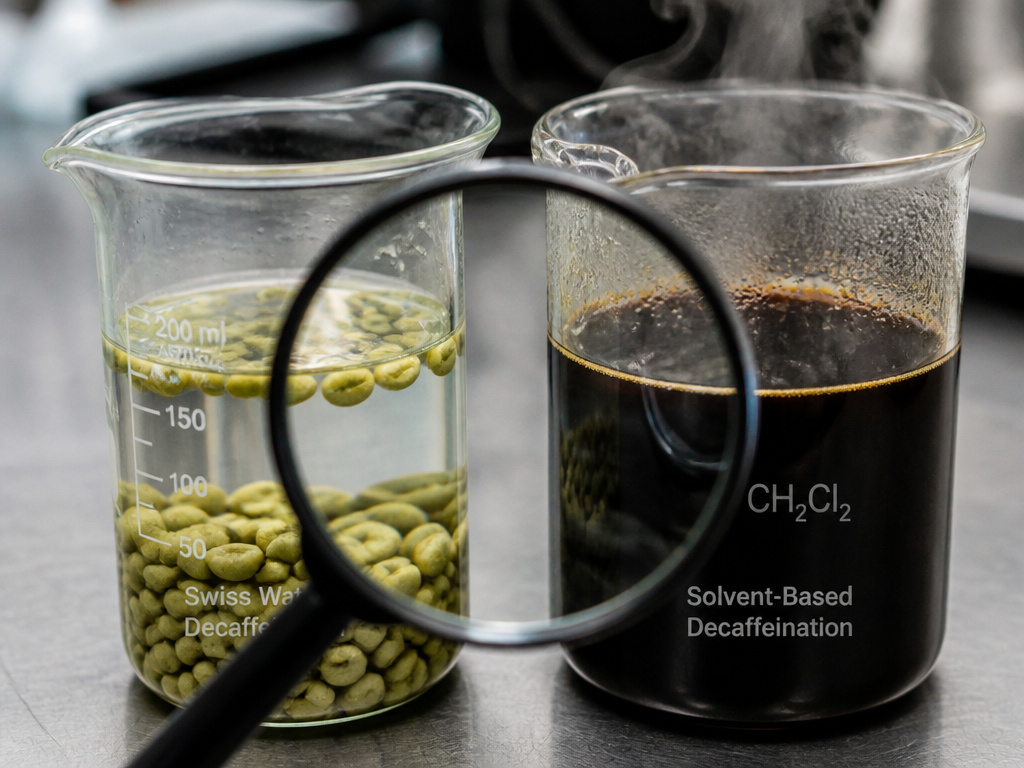
The alternative is solvent-based decaf. The two common chemicals are methylene chloride and ethyl acetate. Ethyl acetate is often marketed as “natural” because it can be derived from fruit, but the industrial decaf version is typically synthetic. These solvents bond with caffeine molecules in the steamed beans and are then washed away.
The trade-off is speed and cost. Solvent methods are faster and can be cheaper to operate at scale. The debate is about residue and flavor. Regulators set strict parts-per-million limits for solvent residues, and proponents argue the limits are safe. The flavor argument is where Swiss Water proponents dig in.
| Decaffeination Method | Process | Flavor Impact | Certifications |
|---|---|---|---|
| Swiss Water Process | Water, GCE, activated carbon | Aims to preserve origin character; can highlight acidity | Organic, Kosher, Non-GMO |
| Methylene Chloride | Chemical solvent applied to steamed beans | Can strip volatile aromatics; often results in a smoother, simpler cup | Limited organic compatibility |
| Ethyl Acetate | Chemical solvent (often synthetic) | Can impart a faint fruity/solvent note; mutes high notes | Can be certified organic depending on source |
| Carbon Dioxide (CO2) | Pressurized CO2 as solvent | Excellent flavor retention; very expensive equipment | Organic compatible |
Solvents are less selective than the GCE osmosis system. While they target caffeine, they can also grab other volatile compounds. This often results in a decaf that is less acidic, less complex, but also less likely to have harsh defects. It’s a smoother, sometimes generic, cup. Swiss Water decaf retains more of the origin’s sharp edges, for better or worse. A bright Ethiopian might stay bright, flaws and all.
The caffeine content outcome is identical. All major methods, including Swiss Water, must meet the 99.9% decaffeinated standard to be legally sold as decaf. The difference is in the other 0.1% of the experience.
Who Should Buy Swiss Water Decaf Coffee?
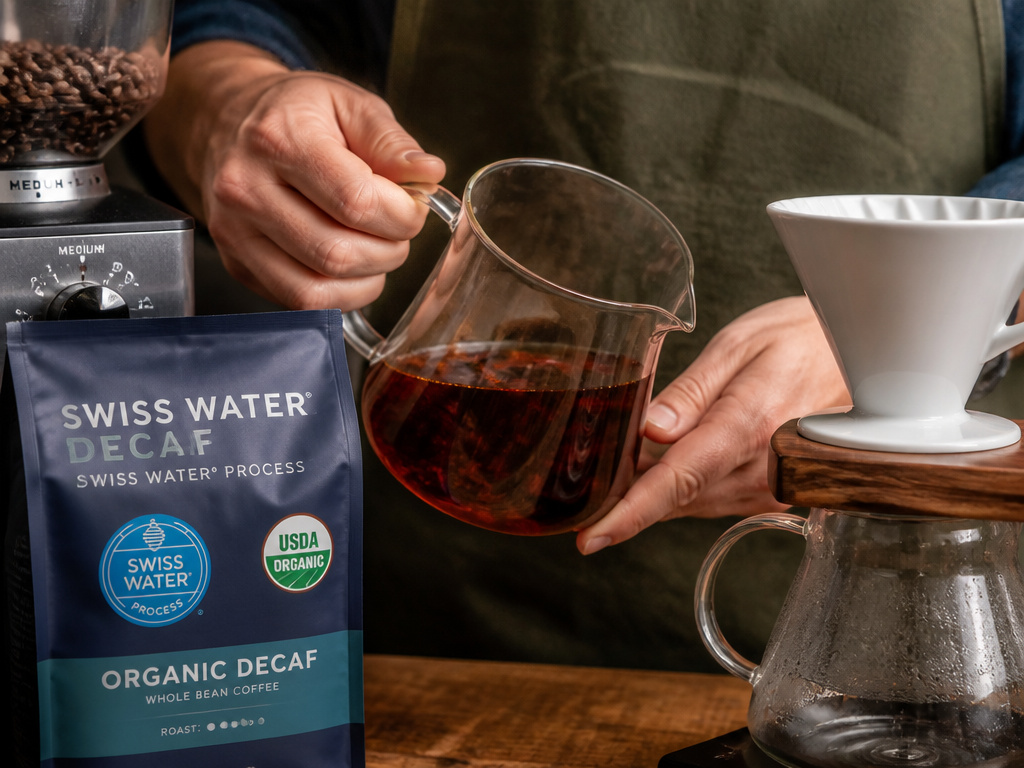
This isn’t just for the chemically averse. It’s for the flavor-chasing home brewer. If you enjoy tracing the terroir of a Yirgacheffe or the berry notes of a natural process, Swiss Water is your best bet to keep those notes recognizable in decaf form.
It’s also the default choice for certified organic coffee. The USDA National Organic Program and the European Union’s organic regulations strictly limit the use of synthetic solvents. The water-based process fits seamlessly into an organic supply chain, which is why you’ll see the Swiss Water logo on so many organic decaf bags.
You’re also a candidate if you’re managing caffeine intake for health reasons but don’t want to sacrifice your coffee ritual. Since the process doesn’t introduce new compounds, it’s a pure subtraction. You get the coffee, minus the stimulant.
I reach for Swiss Water for my evening espresso. Not because I’m dogmatic about chemicals, but because the decaf shots from my local roaster pull with the same crema and body as their regular espresso. The flavor is just quieter. With solvent-based decaf, I often get a thin, one-note shot that makes me wish I’d just made tea.
The downside is price. The process is energy-intensive and slower, and that cost is passed on. You are paying for flavor preservation and a specific set of ideals. If you just want a reliable, inexpensive decaf for a large pot of drip coffee, a well-made ethyl acetate decaf might be a more practical choice. Know what you’re buying.
Frequently Asked Questions
Is Swiss Water decaf 100% caffeine free?
No decaf coffee is 100% caffeine free. The Swiss Water Process, like all certified methods, removes at least 97% of the original caffeine, typically achieving 99.9% removal. A trace amount remains, but it’s negligible for most people.
Does the Swiss Water Process remove antioxidants?
common criticism of other methods is that they leach antioxidants. The Swiss Water company claims their process preserves antioxidants because the GCE is in equilibrium with the bean’s flavor and antioxidant compounds. Independent studies suggest retention is high, but some loss is inevitable with any process that removes caffeine.
Why does my Swiss Water decaf taste sour or flat?
Sourness usually points to under-extraction. Decaf beans are less dense and extract faster. Try grinding finer than you would for regular coffee. Flatness can be from stale beans, a poor roast, or using a paper coffee filter that strips oils. Try a metal filter or a fresher roast.
Can I use Swiss Water decaf for cold brew?
Absolutely. Its preserved acidity can make for a very bright and complex cold brew. Because it’s less bitter, you can use a longer steep time (18-24 hours) to build body without extracting harshness.
Are there other water-based decaf methods?
Yes. The Mountain Water Process in Mexico and the Descamex process are similar proprietary water-based methods. They all use the principle of a flavor-charged water solution to selectively remove caffeine. Swiss Water is simply the most branded and widely available in specialty markets.
Before You Go
The Swiss Water method is a clever engineering solution to a chemical problem. It trades efficiency for purity. The Green Coffee Extract is the masterstroke, a self-replenishing system that tricks coffee beans into giving up only their caffeine.
For the drinker, this means a cup that can still speak of its origin. It also means you need to be a more attentive brewer. Grind finer, maybe lower your water temperature a degree or two, and pay your roaster a premium for their skill. The reward is a real coffee experience, just without the jolt. That’s worth the extra steps.
