
Unlock Flavor: The Role of Cold Water Temperature in Coffee
Brewing coffee with cold water primarily means cold brew steeping or the Japanese iced coffee method. Cold brew uses room-temperature or refrigerated water (4-10°C / 39-50°F) steeping for 12-24 hours, extracting sugars and oils while leaving bitter acids behind. Japanese iced coffee brews hot coffee directly over ice, flash-chilling it for a bright, nuanced cup in minutes.
Most guides tell you to use “cold water” and stop there. They miss the single variable that changes everything: the exact starting temperature of that water. Tap cold, fridge cold, or ice-bath cold each pulls a different flavor profile from the same beans.
This guide breaks down the two main methods, the science behind the smooth taste, and the precise temperatures that separate a good cold coffee from a great one.
Key Takeaways
- Cold brew requires time, not heat. Steeping coarse grounds in cold water (4-10°C) for 12-24 hours produces a low-acid, naturally sweet concentrate by avoiding the extraction of bitter chlorogenic acid compounds.
- Japanese iced coffee is fast and bright. Brewing hot coffee directly over ice halts extraction instantly, preserving the nuanced, acidic notes of light roasts that cold brew mutes.
- Water temperature is a dial, not a switch. “Cold” means 4°C (39°F) for a slower, smoother extract versus 10°C (50°F) for a slightly faster brew with more perceived body.
- The grind must match the method. Cold brew needs a coarse grind to prevent over-extraction and silt; Japanese iced coffee uses a medium-fine grind to compensate for the flash-chilling dilution.
- Never use hot water to speed up cold brew. Adding heat extracts astringent polyphenols and defeats the purpose. If you’re short on time, make Japanese iced coffee instead.
What is the Best Temperature for Cold Water in Coffee?
The Specialty Coffee Association’s water standard recommends 20-25°C (68-77°F) for cold brew preparation. Enthusiast practice refines that further. The best temperature is between 4°C and 10°C (39°F and 50°F).
Water straight from a standard refrigerator sits at about 4°C. This is the default for most cold brew systems like the Toddy T2N. Some home brewers experiment with slightly warmer water, around 10°C, to slightly accelerate extraction without introducing harshness. The difference is real. A batch started at 4°C will taste marginally smoother and sweeter after the same 18-hour steep than one started at 10°C. The warmer water coaxes out a hint more of the oils that carry body and some acidic notes.
Common mistake: Using “tap cold” water in summer, tap water can reach 20°C (68°F) on a hot day. At that temperature, the extraction races. You’ll get a sharper, more bitter concentrate in 12 hours that tastes closer to over-extracted hot brewed coffee than proper cold brew.
The OXO Brew Compact Cold Brew Coffee Maker manual specifies “cold, filtered water.” They don’t give a number because their design assumes fridge temperature. Treat any manufacturer instruction that says “cold water” as shorthand for water between 4°C and 10°C.
TL;DR: Keep your brewing water between 4°C and 10°C (39–50°F). Fridge-cold is perfect; slightly warmer speeds extraction slightly.
The Science of Cold Extraction: Why It Tastes Smoother
Heat is a brutal extractor. It dissolves compounds quickly and indiscriminately. Cold water is selective. It lacks the kinetic energy to quickly pull certain acidic and bitter molecules out of the coffee cell structure.
The key compound left behind is chlorogenic acid. When hot water hits coffee, it hydrolyzes chlorogenic acid into quinic acid and caffeic acid. Quinic acid is a primary source of perceived bitterness and sourness in a cup of espresso shots or drip coffee. Cold water simply cannot break this bond efficiently. A Scientific Reports caffeine concentration study confirmed that cold brew extracts significantly less chlorogenic acid than hot methods, directly correlating with lower perceived acidity.
Meanwhile, sugars, caffeine, and some flavorful oils are more soluble. They diffuse into the water over the long steep. The result is a cup that highlights sweetness and body, with the sharp edges filed off. This is why cold brew is famously easy to drink black. It’s also why it pairs so well with milk or cream, the smooth base doesn’t curdle dairy the way a high-acid hot coffee can.
The process is diffusion, not dissolution. That’s why time is non-negotiable. You cannot rush diffusion by stirring more. You can only wait for the concentration gradient to do its work.
Cold Brew vs. Japanese Iced Coffee: A Side-by-Side
These are two distinct drinks with two different goals. Choosing one isn’t about preference; it’s about what kind of coffee experience you want right now.
| Aspect | Cold Brew | Japanese Iced Coffee |
|---|---|---|
| Core Process | Steeping in cold water (4-10°C) for 12-24 hours. | Brewing hot coffee directly onto ice. |
| Flavor Profile | Low acidity, high sweetness, heavy body, chocolate/nut notes. | Bright acidity, floral/fruit notes, lighter body, crisp finish. |
| Best Bean Roast | Medium to dark roast. | Light to medium roast. |
| Total Time | 12-24 hours (mostly hands-off). | 5 minutes (active brewing). |
| Caffeine Yield | Slightly higher per serving (concentrate). | Similar to its equivalent hot black tea. |
Cold brew mutes acidity to highlight sweetness. Japanese iced coffee uses acidity as a feature. The ice flash-chills the hot brew the moment it drips through, locking in the volatile aromatic compounds that usually evaporate as steam. This gives you the nuanced top notes of a light roast, the jasmine, the berry, the citrus, that are completely absent in cold brew.
If you find cold brew sometimes tastes flat or one-dimensional, you’re likely using a light roast. Try the Japanese method. Your tea versus coffee preference might hint at your choice here: if you enjoy the bright, aromatic lift of a good green tea, you’ll probably prefer Japanese iced coffee.
I used a light Ethiopian Yirgacheffe for both methods back-to-back. The cold brew was smooth and sweet but tasted like “generic coffee.” The Japanese iced coffee exploded with blueberry and lemon. That’s when I stopped treating them as interchangeable.
TL;DR: Want sweet, smooth, and strong? Make cold brew. Want bright, nuanced, and fast? Make Japanese iced coffee.
How to Make Cold Brew Coffee (The Right Way)
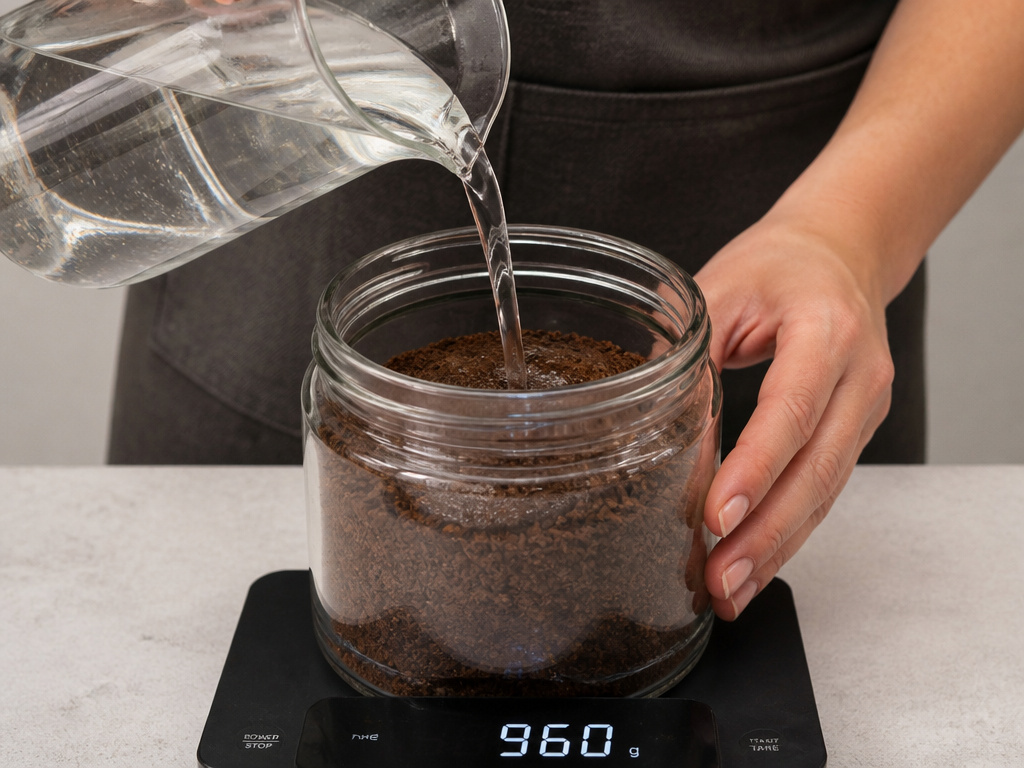
This is a simple waiting game. The only way to fail is to rush it or use the wrong grind.
The Tools You Actually Need
- A large container: A 1.5-liter glass jar is ideal. Avoid metal or plastic that can retain odors.
- Coffee grinder: A burr grinder is non-negotiable for a consistent coarse grind. Blade grinders create fine dust that will silt up your brew.
- Digital scale: Volume measurements for coffee are useless. Weigh everything.
- Filtering system: A fine-mesh nut milk bag, a dedicated cold brew filter, or a simple cheesecloth and sieve combo.
- Cold, filtered water: As discussed. Fill a pitcher and let it sit in the fridge for a few hours before you start.
The Step-by-Step Steep
- Grind 120 grams of coffee to a coarse setting. The particles should look like rough breadcrumbs or coarse sea salt. Grinding too fine is the most common error, it over-extracts, causing bitterness, and makes filtering a muddy nightmare.
- Add grounds to your clean jar. Pour in 960 grams (ml) of cold, filtered water. This is a 1:8 ratio, which makes a concentrate. Stir gently with a long spoon until all grounds are wet. A dry clump of coffee in the middle is a pocket of wasted flavor.
- Cover and steep. You have two options. Room temperature (around 20°C) for 12-16 hours, or in the refrigerator for 18-24 hours. Fridge brewing is slower and yields a slightly cleaner, crisper flavor. Room-temperature brewing is faster and can produce a fuller body. Don’t peek. Every time you open the lid, you lose volatile aromatics.
- Filter with patience. Place your filtering device over another clean jar or pitcher. Slowly pour the steeped mixture through. Let gravity do the work. Squeezing the filter bag or pressing on the grounds will force bitter silt into your concentrate. This step can take 10-15 minutes. Wait.
- Store and serve. Your concentrate is now in the clean jar. Seal it and store it in the refrigerator for up to two weeks. To serve, dilute with water, milk, or a milk alternative at a ratio between 1:1 and 1:2. Taste and adjust.
Before you start: Ensure all equipment is impeccably clean. Any residual soap or old coffee oils will sour your batch. Sanitize your jar and utensils with hot water and vinegar, then rinse thoroughly. Coffee is a food product; treat it like one.
How to Make Japanese Iced Coffee in 5 Minutes
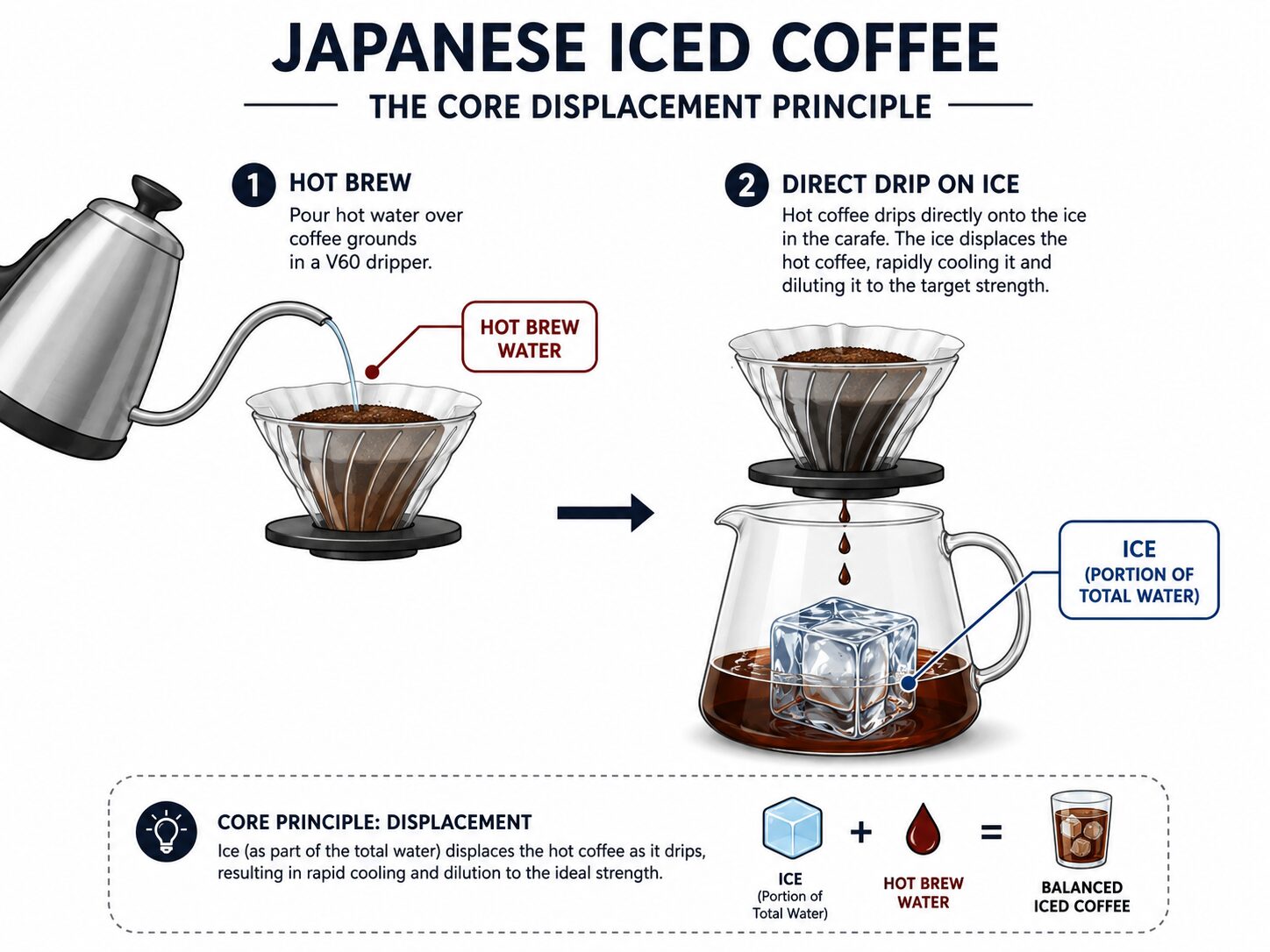
This method is for when you want a brilliant, chilled coffee now. It’s a pour-over with a twist.
The core principle is displacement. You brew with the total amount of water you want, but a portion of that water is frozen as ice in the serving carafe. As the hot coffee drips onto the ice, it melts, instantly chilling the coffee and diluting it to the perfect strength. No waiting, no watering down later.
Your setup: A pour-over dripper (Hario V60, Kalita Wave, or Chemex), a paper filter, a carafe or serving vessel, a gooseneck kettle, a scale, and 30 grams of coffee.
- Prepare the ice. Weigh 250 grams of ice directly into the carafe you will serve from. This is not optional. The weight of the ice is part of your total water recipe.
- Grind and heat. Grind your 30 grams of coffee to a medium-fine consistency, finer than for cold brew, but coarser than for espresso. Heat 275 grams of water to just off the boil (96°C / 205°F).
- Set up the dripper. Place the paper filter in your dripper, set it over the carafe containing the ice, and rinse the filter with a little hot water to remove the paper taste. Discard this rinse water.
- Add coffee and bloom. Add the 30 grams of ground coffee to the filter. Start your timer. Pour 60 grams of hot water evenly over the grounds, ensuring they are all saturated. Let it bloom for 45 seconds. This degasses the coffee, preventing a hollow flavor.
- Brew directly onto the ice. After the bloom, slowly pour the remaining 215 grams of hot water in a slow, steady spiral, keeping the water level consistent. Aim to finish pouring by the 1:30 mark, and let the coffee finish dripping through by 3:00 minutes total.
- Swirl and serve. Once dripping stops, gently swirl the carafe to mix the melted ice and coffee thoroughly. The result is a perfectly chilled, perfectly diluted cup of coffee that retains all the clarity of a hot pour-over. Pour into a glass and drink immediately.
The result is shockingly good. It preserves the lively acidity in coffee that defines great light roasts, without a hint of the bitterness that plagues regular iced coffee made from cooled-down hot brew.
Advanced Techniques and Troubleshooting
Once you’ve mastered the basics, a few tweaks can refine your results further.
The “Hot Bloom” Cold Brew Experiment
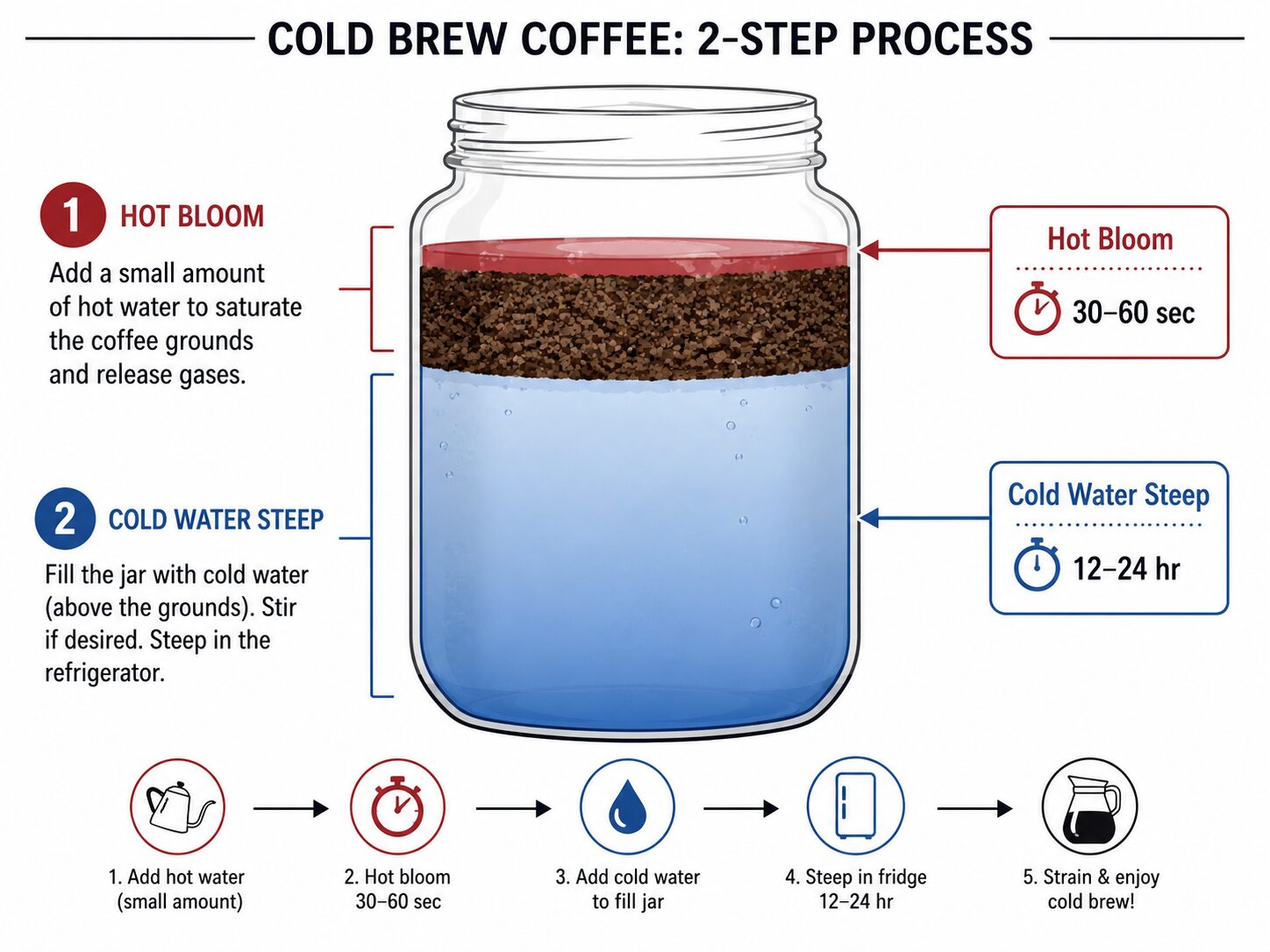
This is an edge case that breaks the pure cold rule. Some brewers add a “hot bloom” to their cold brew: before adding the bulk of the cold water, they pour a small amount (50-100ml) of hot water (90-96°C) over the grounds, wait 30-60 seconds, then add the cold water and proceed with the long steep.
The theory is that the hot water quickly opens up the coffee cell structure and releases CO2, allowing for better contact with the cold water and a marginally faster, more efficient extraction. It can add a subtle complexity, a hint of the brighter notes usually lost. It also introduces a risk. If you use too much hot water or let it sit too long, you’ll start extracting those bitter compounds you’re trying to avoid. Try it as a weekend experiment, not your daily driver.
Why Is My Cold Brew Weak or Bitter?
- Weak: Your ratio is off, your grind is too coarse, or your steep time was too short. Confirm your 1:8 ratio by weight. If it’s still weak, steep longer (up to 24 hours in the fridge) or use a slightly finer grind next time.
- Bitter/Astringent: Your grind is too fine, your water was too warm, or you pressed on the grounds during filtering. A PMC cold brew optimization study shows grind size has a more dramatic impact on bitterness in cold brew than steep time. Go coarser. Always.
Can I Use This Method for Tea?
The principles are similar but not identical. Cold-brewing tea, especially green tea antioxidants, can produce a very smooth, sweet cup with less tannic bitterness. However, the lower temperature may not extract all the beneficial compounds like EGCG as effectively as hot water. For a direct caffeine comparison, cold brew coffee will typically have a higher yield than cold brew tea.
Frequently Asked Questions
Can I make cold brew with hot water to save time?
No. Adding hot water fundamentally changes the extraction chemistry. You will pull chlorogenic acids and polyphenols that create bitterness and astringency. The result will taste like stale, over-extracted coffee, not smooth cold brew. If you’re in a hurry, make Japanese iced coffee instead.
How long does cold brew concentrate last in the fridge?
Properly filtered and stored in a sealed glass container, cold brew concentrate maintains good flavor for 10-14 days. After two weeks, it will start to taste flat and develop subtle off-flavors. For the best taste, try to use it within a week.
Does cold brew have more caffeine than hot coffee?
It can, but not always. Because it’s often brewed as a concentrate and you control the dilution, a serving of diluted cold brew can have more caffeine than a standard cup of drip coffee. However, ounce for ounce of liquid, a hot black tea has less caffeine than either. The NIH cold brew characterization research shows caffeine extraction in cold brew is high and efficient due to the long contact time.
Why does my cold brew taste sour?
Sourness in cold brew is unusual, as the method suppresses acids. If you detect a sharp, vinegar-like sour note, it’s likely contamination. Your equipment wasn’t clean, or water got trapped in your filter or grinder and developed mold or bacteria. Always clean and dry every part of your setup immediately after use.
Is filtered water necessary?
Highly recommended. Tap water contains minerals and chlorine that can impart off-flavors during the long steeping time. These flavors are subtle in a hot brew but become pronounced in cold brew. Using filtered water ensures a clean, pure coffee taste. It’s one of the easiest ways to improve your results.
Before You Go
Using cold water for coffee isn’t a single trick. It’s access to two different flavor universes. Cold brew gives you sweet, sturdy simplicity. Japanese iced coffee delivers bright, aromatic complexity. Your choice depends on the bean in your cabinet and the mood you’re in.
Remember the numbers. Keep your cold brew water between 4°C and 10°C. Steep for at least 12 hours. Use a coarse grind. For the Japanese method, match your ice weight to your recipe and brew hot right over it. This isn’t just following steps. It’s understanding why each step matters, the science of solubility, the physics of heat transfer, the patience of diffusion.
Your next cup is a decision. Choose the method, control the temperature, and taste the difference that precision makes. And maybe consider your dental care routine after enjoying those smoother, less acidic cups.
