
Can I Drink Coffee Before an MRI with Contrast? Guidelines
Yes, you can drink coffee before an MRI with contrast unless your doctor or the specific imaging instructions tell you not to. The American College of Radiology, the Radiological Society of North America, and institutions like Mayo Clinic and UCSF Health state there are no routine dietary restrictions for gadolinium-based contrast agents. Your usual medications and diet, including caffeine, are permitted.
People get this wrong because they assume all medical procedures require fasting, or they conflate MRI rules with those for CT scans or surgeries. The anxiety about “ruining” the scan by moving is real, but the restriction isn’t universal.
This guide covers the official medical stance, the one specific MRI sequence that changes the rules, how caffeine physically affects scan quality, and what you must confirm with your doctor before your appointment.
Key Takeaways
- The American College of Radiology’s 2023 manual explicitly states no routine dietary restrictions for MRI with gadolinium contrast.
- The only general exception is for MRCP (Magnetic Resonance Cholangiopancreatography) scans, which often require fasting.
- Your ordering physician’s instructions override all general guidelines, always check yours first.
- Caffeine increases heart rate and can induce restlessness, which may cause motion artifacts and blur your images.
- If you are cleared to drink coffee, do so at least 30 minutes before the scan to avoid mid-scan bathroom urgency.
The Official Medical Answer
The definitive answer comes from the primary source: the American College of Radiology (ACR) Manual on Contrast Media. Its 2023 edition, in Chapter 2, states plainly: “There are no specific dietary restrictions (e.g., fasting) routinely required prior to the administration of GBCAs for MRI examinations.” The manual adds that patients may continue their usual medications and diet, including caffeine, unless otherwise instructed by the ordering physician or for specific MRI sequences like MRCP.
Technical Snippet: The ACR Manual on Contrast Media (2023) specifies that gadolinium-based contrast agents (GBCAs) do not require routine fasting. Patient preparation is dictated by the specific MRI sequence (e.g., MRCP for biliary imaging) or individual patient factors, not by the contrast agent itself.
This is the professional standard. Patient-facing resources from the Radiological Society of North America (RSNA) and Mayo Clinic echo it, advising you to eat and drink normally unless told otherwise. The UCSF Health MRI preparation guide similarly notes that for most MRI exams, you can follow your regular routine.
The “unless otherwise instructed” clause is critical. Your doctor or the imaging center’s pre-appointment sheet is the final authority. If it says “no coffee,” then no coffee. If it says nothing about coffee, the default is that you can have it.
TL;DR: Official medical guidelines say coffee is fine before an MRI with contrast. Your doctor’s specific instructions are the only thing that can change that.
Why Caffeine Could Ruin Your Scan
Even with the official green light, there’s a practical reason to consider skipping your cup. Caffeine is a stimulant. It increases your heart rate and can make you feel restless or anxious.
Inside the MRI machine, you must lie perfectly still for 20 to 45 minutes. Any movement, even a slight shift from a caffeine-induced jitter or a deep sigh, creates “motion artifacts.” These blur the images, sometimes making them unusable. A blurred scan might need to be repeated, costing you more time and potentially another dose of contrast.
Common mistake: Drinking a large coffee right before walking into the imaging center, the caffeine hits its peak stimulant effect during the scan, and the full bladder from the liquid volume creates an urgent need to move.
The YouTube anecdote in the research notes, where a scan was blurred and repeated because of pre-MRI coffee, is a real-world example of this mechanism. It’s not a rule, but a consequence.
If you know caffeine makes you jittery or if you’re already anxious about the scan, skipping coffee that morning is a prudent choice. For others, a modest cup 30-plus minutes before the appointment, when the initial stimulant peak has passed, might be fine. This is a personal risk calculation, not a medical prohibition.
TL;DR: Caffeine can cause movement that blurs MRI images. If you’re jittery or anxious, skipping coffee is smart, even if it’s technically allowed.
When Your Doctor Says No

The “ordering physician’s instructions” are the wild card. General guidelines exist, but your specific situation can override them.
| Reason for Restriction | Likely Instructions | What Happens If You Ignore It |
|---|---|---|
| Specific MRI Sequence | No food or drink for 4–8 hours before | The scan may fail to visualize the target organs (like the bile ducts) because digestive activity creates interfering signals. |
| Patient Health Condition | No caffeine due to heart arrhythmia or severe anxiety | Caffeine could exacerbate the condition during the scan, requiring intervention or stopping the procedure. |
| Medication Interaction | Adjust timing of coffee relative to a specific medication | The contrast agent or your medication’s efficacy could be altered, affecting diagnostic accuracy. |
| Institutional Protocol | Follow the imaging center’s unique prep sheet | The center may refuse to perform the scan, citing protocol violation. |
Your doctor might restrict coffee for reasons unrelated to the contrast agent itself. A history of palpitations or arrhythmias means caffeine could spike your heart rate during the scan, which might be dangerous or simply degrade the image quality of cardiac-focused sequences. Severe anxiety is another; adding a stimulant to an already stressful situation is counterproductive.
Some medications interact with caffeine or affect hydration levels, which could influence how the contrast agent circulates or is excreted. Your doctor knows your full profile.
Expert Tip: I’ve had scans where the prep sheet was generic and said “no restrictions,” but my cardiologist called the imaging center directly to add “no caffeine” to my orders because of a recent episode of tachycardia. The front desk didn’t know until I arrived. Always confirm with the ordering doctor, not just the scheduling clerk.
Always contact the doctor who ordered the MRI, the “ordering physician”, for final confirmation. The imaging center’s front desk usually follows a generic script; your doctor holds the specific context.
The One MRI Sequence That Changes Everything
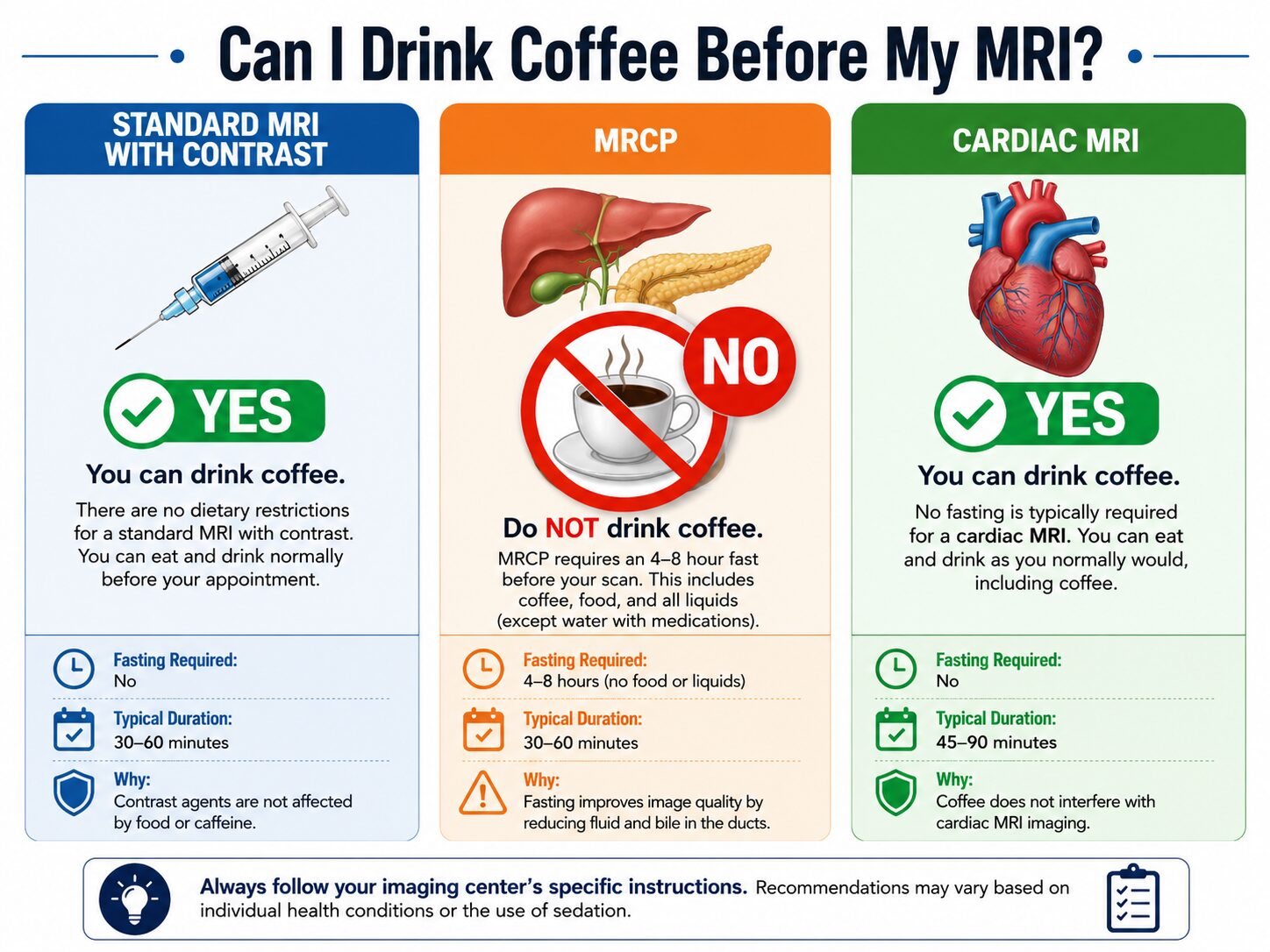
While most MRI scans with contrast follow the no-restriction rule, one common sequence explicitly breaks it: MRCP (Magnetic Resonance Cholangiopancreatography). This scan looks at your bile ducts and pancreas.
For an MRCP, you are typically asked to fast for 4 to 8 hours beforehand. The reason is physical, not pharmacological. Food and drink in your stomach and intestines create fluid motion and gas patterns that can obscure the delicate biliary structures. A clear, quiet abdomen is necessary for the images to be diagnostic.
Coffee, even black coffee, stimulates gastric activity and bile secretion. Having it before an MRCP could literally hide the problem the scan is meant to find.
| MRI Type | Typical Prep Regarding Coffee | Why |
|---|---|---|
| Standard MRI with Gadolinium Contrast | No restriction (unless doctor says otherwise) | Gadolinium contrast agents are not affected by diet. |
| MRCP (with or without contrast) | Fasting required (includes no coffee) | Digestive activity and fluid motion obscure the bile ducts and pancreas. |
| Cardiac MRI (stress test) | Often no caffeine for 12+ hours prior | Caffeine interferes with the pharmacological stress agent and affects heart rate imaging. |
If your appointment is for an MRCP, your instructions will almost certainly say “no food or drink,” and that includes coffee. This is a standard, known exception that every radiologist understands.
TL;DR: MRCP scans require fasting, which means no coffee. Check your appointment paperwork for the sequence type.
Gadolinium Contrast Agents and Diet

Gadolinium-based contrast agents (GBCAs), like MULTIHANCE (gadobenate dimeglumine), are fundamentally different from the iodine-based contrasts used in CT scans. Iodine contrasts can sometimes cause nausea or vomiting, which is why some CT protocols recommend a light diet or fasting. Gadolinium agents, as documented in the FDA-approved gadolinium contrast agent labeling, have a very low incidence of gastrointestinal side effects.
The contrast itself doesn’t interact with coffee or food in your stomach. It’s injected intravenously and circulates in your bloodstream, highlighting blood vessels and tissues. What you eat or drink doesn’t alter its efficacy or safety profile in a standard MRI.
This is why the ACR manual makes no dietary recommendations. The restriction, when it exists, is always about something else: the specific body part being imaged (like the abdomen for MRCP), your personal health condition, or an institutional policy.
Specific Warning: Never assume the rules for a CT scan with contrast apply to an MRI with contrast. Iodine and gadolinium are different chemicals with different side-effect profiles and preparation requirements.
If you’re also managing other health conditions influenced by caffeine, like hypertension or heart arrhythmias, the decision involves more than just the MRI. Your coffee and heart arrhythmias risk profile should be part of the conversation with your doctor.
Practical Preparation Steps
If you decide to drink coffee before your MRI, or if your doctor clears you to do so, follow a practical plan to minimize any risk of ruining the scan.
- Confirm with the source. Call the ordering physician’s office or the radiology department nurse line. Don’t rely on the generic instructions sheet alone. Ask: “Are there any patient-specific reasons I should avoid coffee before my MRI with contrast?” Get a verbal yes or no.
- Time your consumption. Drink your coffee at least 30 minutes before your appointment. This allows the initial caffeine stimulant peak to pass before you’re in the machine and gives your body time to process the liquid, reducing the chance of a urgent bathroom need during the scan.
- Moderate your intake. Stick to your normal amount. Don’t drink an extra-large “for courage” cup. If you normally have one 8-ounce coffee, have one 8-ounce coffee. A sudden double dose is more likely to cause jitters.
- Skip additives that might upset your stomach. Heavy cream, sugary syrups, or artificial sweeteners can cause gastrointestinal discomfort for some people. Discomfort leads to movement. Stick to black coffee or a simple splash of milk.
- Plan for the aftermath. The contrast agent will be filtered out by your kidneys. Drinking a normal amount of water after the scan is recommended to help flush it out. Your post-scan coffee habit is unaffected.
Having a clear, practical plan turns a vague “can I?” into a confident “how should I?” It removes the last-minute anxiety that itself can ruin a scan.
What About Other Caffeine Sources?
Coffee is the common question, but caffeine comes from many sources. The same principles apply.
- Energy Drinks: These often contain much higher concentrations of caffeine and other stimulants like taurine. A Monster Energy caffeine serving can be equivalent to two strong coffees. The stimulant effect is more pronounced and unpredictable. I would skip these entirely before an MRI.
- Tea: The caffeine in tea is often released more slowly due to other compounds. A black tea caffeine content is lower per cup than coffee. It might be a milder alternative if you crave a warm beverage but are worried about coffee jitters.
- Decaf Coffee: Truly decaffeinated coffee contains minimal stimulant. It’s generally safe from a movement perspective, but remember that MRCP fasting rules likely still prohibit it because it’s a liquid that stimulates gastric activity.
- Soft Drinks & Chocolate: These contain smaller amounts. The sugar in soft drinks can be a bigger issue, causing energy spikes and crashes. I’d avoid them for the same reason as heavy coffee additives.
The rule is about the physiological effect of caffeine (and sometimes other ingredients), not the source. If your doctor says “no caffeine,” that includes all these sources.
Frequently Asked Questions
What if my instructions say nothing about coffee?
If your preparation sheet from the imaging center does not mention dietary restrictions, the default position from major medical authorities like the ACR is that you may follow your usual diet, including coffee. However, a final confirmation call to your ordering physician is the safest step.
Can I drink coffee before an MRI without contrast?
Yes, the same guidelines apply. The restriction is not about the contrast; it’s about the MRI sequence (like MRCP) or your personal health. An MRI without contrast follows the same preparation rules regarding diet and caffeine.
Why do some websites say to avoid coffee?
Some patient information websites generalize rules from other procedures (like CT scans) or emphasize the motion artifact risk without clarifying that it’s a practical caution, not a medical prohibition. Others might be reflecting stricter institutional policies that are not the universal standard.
How long before the MRI should I stop drinking coffee if I need to?
If your doctor instructs you to avoid caffeine, you should stop consuming it at least 12 hours before the appointment to ensure its effects have fully dissipated. For a fasting requirement like an MRCP, no food or drink (including coffee) for the specified period, typically 4–8 hours.
Does decaf coffee count?
For MRI sequences that require fasting (like MRCP), any liquid in your stomach can interfere, so decaf coffee would typically be prohibited. For standard MRI with contrast where the only concern is caffeine stimulation, decaf is generally acceptable as it contains minimal stimulant.
Before You Go
The official answer is clear: you can drink coffee before an MRI with contrast unless your doctor or the specific scan instructions tell you not to. The American College of Radiology’s manual is the definitive source.
The practical answer is nuanced. Caffeine can cause movement that ruins image quality. If you’re prone to jitters or anxiety, skipping it is wise. If you have a cardiac history, your doctor may say no regardless of the official guidelines.
Always check your specific instructions and confirm with the ordering physician. For MRCP scans, fasting is required, no coffee. For everything else, the rule is your doctor’s rule, not a universal ban.
Your scan is a significant diagnostic tool. A little preparation and a clear understanding of the caffeine release rates from your chosen beverage ensure you get the clearest images without unnecessary repeats.
